SMS Marketing List: How to Build, Grow, and Manage It
84% of U.S. consumers have opted in to receive SMS messages from businesses, according to a 2026 analysis of SMS marketing statistics. That changes the question for Shopify operators. The challenge isn't how to collect more phone numbers. It's how to build an SMS marketing list that people explicitly authorize, carriers can reliably deliver to, and customers still want to hear from.
A large list can look impressive in a dashboard while producing weak reach, rising opt-outs, and poor revenue per send. A smaller list of recent buyers, clearly consented subscribers, and engaged contacts gives you a stronger commercial asset. Treat every signup as a relationship with obligations, not as a row in a database.
Table of Contents
- Why the SMS Marketing List Matters More Than You Think
- Choosing the Opt-In Surfaces That Actually Convert
- Writing Consent Language That Keeps You Compliant
- Segmenting Your List So Promotional and Transactional Texts Stay Separate
- Cleaning Your List Without Losing Real Revenue
- Three Automation Plays That Turn the List Into Sales
- Growth Experiments and KPIs Worth Tracking
Why the SMS Marketing List Matters More Than You Think
SMS is often described as an engagement channel because customers tend to notice a text quickly. The more important distinction for ecommerce operators is permission quality. A subscriber has given your store access to a personal channel, and that access can disappear when your messages feel irrelevant, arrive too often, or don't match the consent they provided.
The list also affects deliverability. Invalid numbers, unclear opt-ins, inactive subscribers, and promotional messages sent to people who expected only order updates can create operational problems. The SMS marketing benchmarks from Omnisend recommend using delivery rate, calculated as delivered messages divided by total messages sent, as a core health measure. Their guidance commonly places a healthy opt-in list at at least 95% delivery, with strong programs around 98% to 99%, while rates below 90% to 95% warrant investigation.
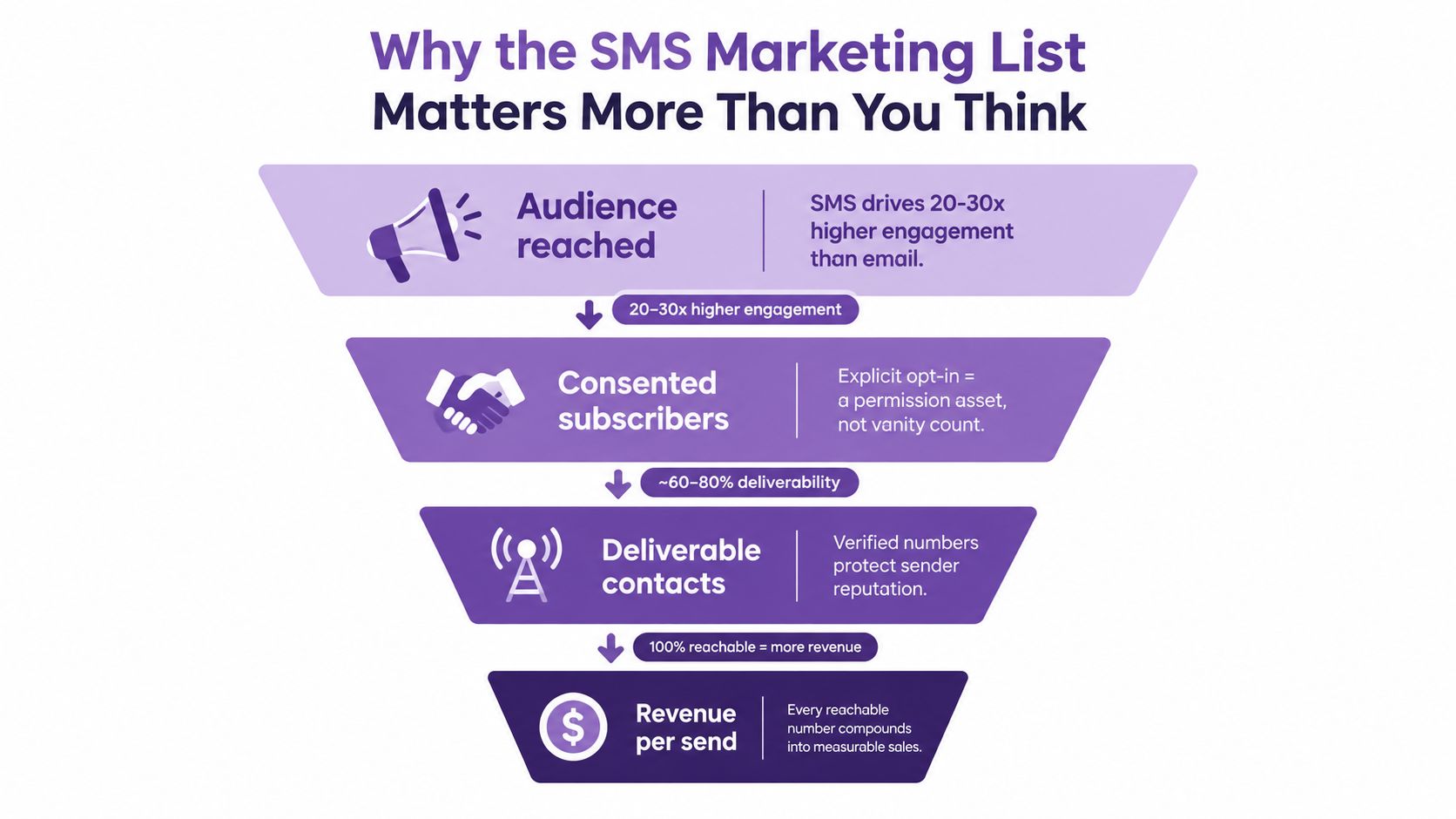
Build the list as a controlled pipeline:
- Capture consent on a surface you control.
- Confirm that the phone number is tied to SMS permission.
- Segment by lifecycle, purchase behavior, and engagement.
- Automate useful messages around customer intent.
- Suppress invalid, inactive, or withdrawn contacts.
That approach also complements broader revenue-focused email list strategies from Netco Design LLC. Email and SMS can share customer data, but they shouldn't share permission assumptions.
Practical rule: If you can't explain exactly when, where, and why a customer opted into SMS, don't treat that contact as marketable.
The U.S. SMS marketing market is estimated at $12.6 billion in 2026, with a 20.3% CAGR cited in the same industry analysis. That growth reflects consumer acceptance and sustained investment, but it doesn't make every contact equally valuable. Choose quality unless a specific experiment proves that an additional source creates qualified, deliverable customers.
Choosing the Opt-In Surfaces That Actually Convert
Shopify stores usually control several capture points, but they don't produce the same kind of subscriber. The best surface depends on whether you value volume, purchase intent, or the strength of the consent record.
| Surface | Consent Quality | Typical Conversion | Best For |
|---|---|---|---|
| Checkout phone field | High when promotional consent is separate and explicit | Varies by checkout flow | Capturing high-intent shoppers |
| Exit-intent popup | Variable, depending on disclosure and offer | Varies by traffic and offer | Reaching visitors before they leave |
| Post-purchase thank-you page | Strong, because the customer has completed an order | Varies by customer and offer | Building a buyer-based list |
| Account creation | Moderate to high when SMS permission is separate | Varies by account motivation | Long-term customer relationship building |
| Click-to-text ads | Strong when the keyword and program disclosure are clear | Varies by campaign intent | Acquiring subscribers from targeted traffic |
The checkout is usually the cleanest baseline. A phone field alone isn't permission for promotions, so place an unchecked SMS consent option beside it, identify the brand, and link to the required terms and privacy information. A customer who provides a number for delivery updates hasn't automatically joined your promotional program.
Post-purchase capture deserves special attention. The customer has just experienced your checkout and may have a clear reason to receive replenishment reminders, product education, or support. Ask for promotional consent after the order is confirmed, rather than hiding it inside unrelated order communications.
Exit-intent popups can add reach, but their quality depends heavily on the incentive and the disclosure. A discount-only offer may attract people who want the coupon and nothing else. Imported lists, rented contacts, and giveaways aimed at maximizing entries create an even worse trade-off because consent may be missing, unclear, or unrelated to the store's actual purpose.
Use a layered setup: checkout for dependable intent, post-purchase for qualified buyers, and a popup only when the disclosure is unambiguous. The SMS opt-in best practices guide provides another useful reference for checking the details of each surface before launch.
Writing Consent Language That Keeps You Compliant
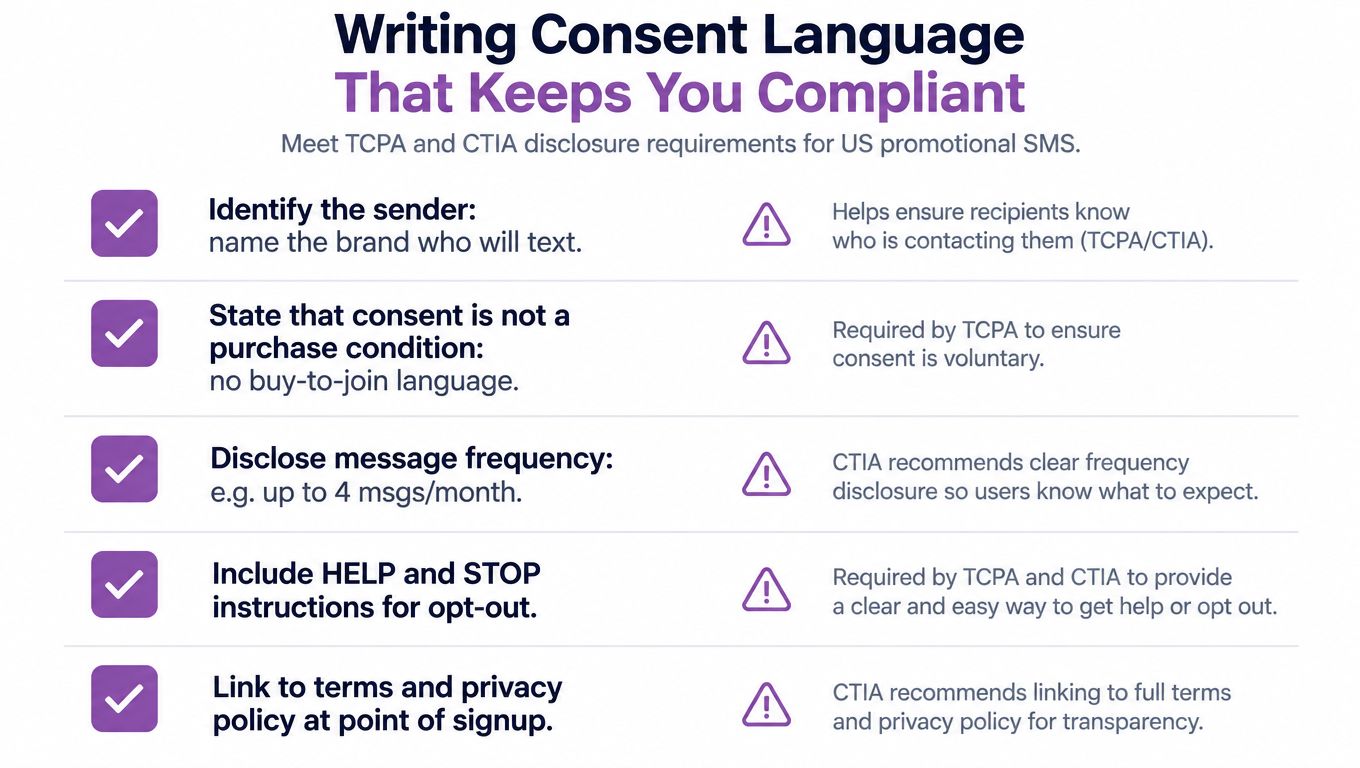
Promotional SMS consent must stand on its own. In the U.S., promotional texts require prior express written consent, and the signup language should identify the sender, explain that message and data rates may apply, state the expected frequency, link to the privacy policy and terms, and provide STOP and HELP instructions. Consent also shouldn't be presented as a condition of purchase.
A practical disclosure might read:
By checking this box, you agree to receive recurring marketing text messages from [Brand Name] at the number provided, including promotions and cart reminders. Consent isn't a condition of purchase. Message and data rates may apply. Message frequency varies. View our [Terms] and [Privacy Policy]. Reply STOP to opt out or HELP for help.
Adapt the wording to your actual program. Don't claim a fixed frequency if your flows and campaigns don't follow it. For U.S. promotional programs, a confirmation message should restate the enrollment details and contain no marketing content, as described in this SMS compliance guidance.
A double opt-in flow
A clean flow starts with a customer submitting the form, receiving a confirmation request, and replying with the required keyword. Your platform then records the confirmation, timestamp, source, and disclosed program details before sending the welcome message.
For example:
- Customer submits the form after seeing the disclosure.
- The platform sends a confirmation request asking the customer to reply YES.
- The customer replies YES.
- The platform sends a non-promotional confirmation with brand identification and STOP and HELP instructions.
- The welcome offer arrives only after the confirmation step, if the customer consented to promotional content.
A guide to defining express consent can help your team review the exact point at which a phone number becomes marketable.
Surface-level checks
- Checkout: Keep the promotional checkbox separate from the phone field, unchecked by default, and visible beside the disclosure.
- Popup: Show the brand, purpose, frequency, rate notice, terms, privacy policy, and opt-out instructions before submission.
- Post-purchase: Don't treat order confirmation consent as promotional consent. Ask separately after the transaction.
The EU and UK add another layer. Your program needs an appropriate lawful basis, granular consent for the relevant purpose, and a practical way for subscribers to withdraw consent at any time. Consent also belongs to the specific organization and purpose, not to a reseller or a related brand. CTIA principles likewise state that consent must be obtained directly, cannot be bought or rented, and can't be reused for an unrelated purpose, as explained in this CTIA messaging principles reference.
Segmenting Your List So Promotional and Transactional Texts Stay Separate
Segmentation isn't a collection of decorative tags. It's the operating architecture that determines which customer receives which message, through which flow, and at what frequency.
Start with three layers. The first is lifecycle, such as new subscriber, first-time buyer, repeat buyer, lapsed customer, and VIP. The second is transaction type, such as browse-only visitor, one-time buyer, subscription customer, and wholesale account. The third is engagement, such as recent clickers, openers who haven't clicked, and dormant subscribers.
| Segment Layer | Example Segments | Shopify Sync Source | Primary Use |
|---|---|---|---|
| Lifecycle | New subscriber, first purchase, repeat, lapsed, VIP | Order count, customer tags, last-purchase date | Welcome, retention, and win-back flows |
| Transaction type | Browser, one-time buyer, subscription, wholesale | Product data, order type, customer tags | Message relevance and offer control |
| Engagement | Recent clicker, opener only, dormant | Click events, campaign activity, last engagement | Frequency caps and suppression |
| Consent status | Promotional opt-in, transactional-only, opted out | Consent field, event history, suppression status | Compliance and audience eligibility |
The most important split is between transactional and promotional messages. Shipping confirmations, delivery updates, and order support serve an operational purpose. Promotional campaigns sell something. Combining them into a single undifferentiated audience can make customers who signed up for useful updates feel over-marketed.
Use separate permissions and, where practical, separate audience logic for each message type. A customer may want delivery information but not weekly offers. A subscription customer may need replenishment reminders at a different cadence from a one-time buyer. A wholesale account may require an entirely different service workflow.
Sync the architecture from Shopify using customer tags, order counts, product categories, and last-purchase dates. Then apply a frequency cap across campaigns. Without a global cap, a subscriber in a VIP, repeat-buyer, and product-interest segment can receive several messages on the same day.
The customer data segmentation guide offers a useful framework for turning these fields into usable audience rules. The goal isn't to create every possible segment. It's to prevent irrelevant messages and make each send defensible.
Cleaning Your List Without Losing Real Revenue
List size is a weak growth metric if reachability and permission are deteriorating. The SMS list-cleaning benchmark guidance illustrates the trade-off: 10,000 numbers with 60% reachability yield 6,000 reachable contacts, while 4,000 numbers at 95% reachability yield 3,800. The larger audience can deliver more reach, yet the smaller one is easier to target, audit, and protect from stale-contact problems.
Treat the list as a permission and deliverability asset before treating it as a sales channel. Keep active marketable contacts separate from subscribers who need re-engagement and people who should no longer receive promotional messages. Deleting dormant customers immediately can remove purchase history and obscure why revenue changed.
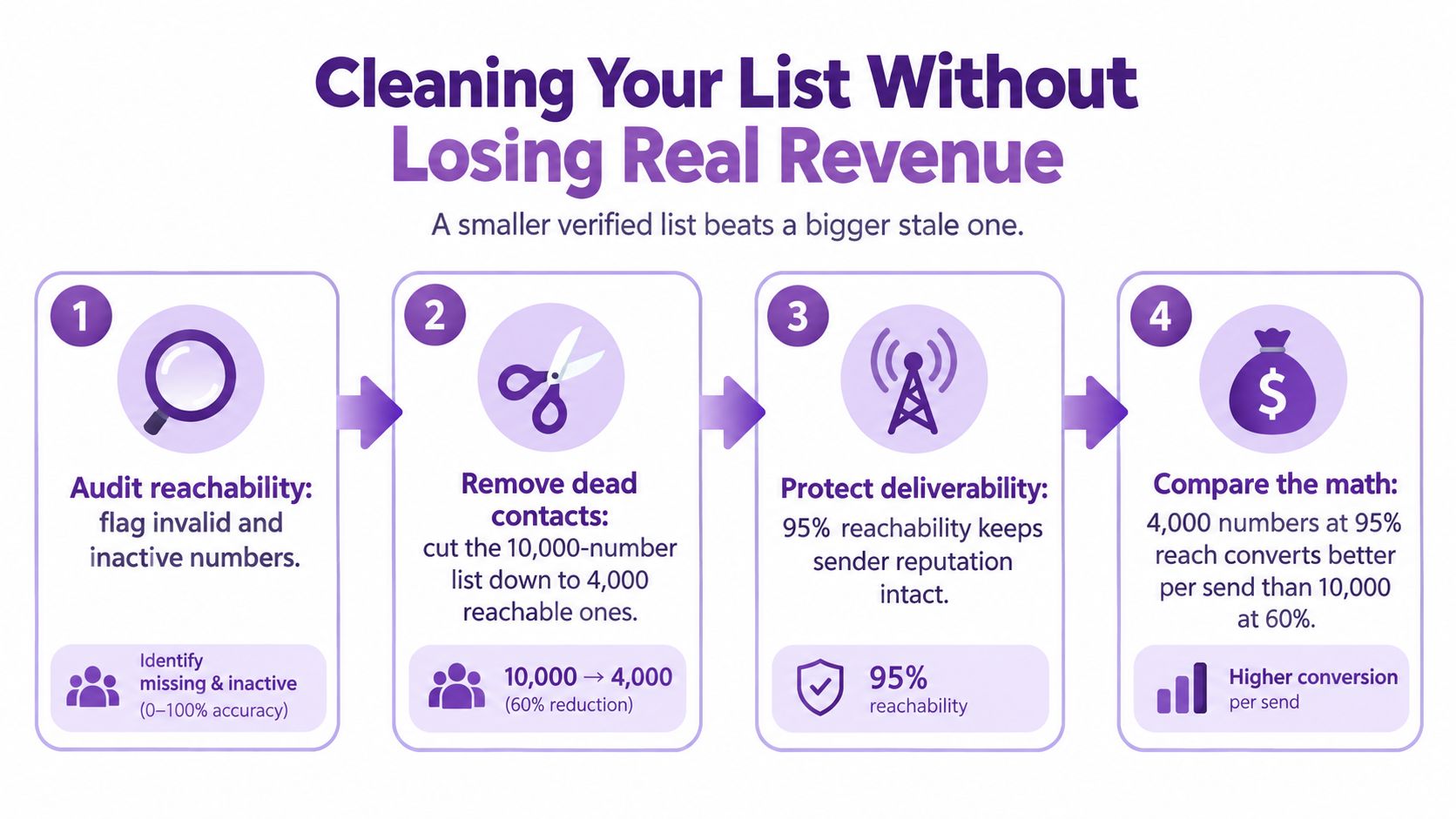
Run a recurring hygiene process:
- Audit reachability: Check carrier responses, delivery failures, invalid numbers, and recent engagement.
- Re-engage carefully: Send dormant subscribers a short win-back message with a clear reason to remain subscribed.
- Suppress inactive contacts: After the re-engagement window, move people with no opens or clicks over 90 days into a suppression audience.
- Preserve history: Retain suppressed records for revenue attribution and consent history instead of deleting them permanently.
Review delivery rate and opt-out rate after each cleanup. The guidance identifies an opt-out rate around 1% to 2% as a warning sign for fatigue or weak targeting. Add revenue per reachable contact to the report. A healthy cleanup leaves fewer marketable contacts, but stronger economics and a cleaner permission base.
A suppressed contact isn't lost data. It's a contact you've stopped pressuring while preserving the record needed for analysis and future consent management.
Three Automation Plays That Turn the List Into Sales
Automation works when the trigger reflects a real customer moment. The most useful flows don't send the same promotion to everyone. They respond to an abandoned purchase, a delivery event, or a meaningful period of inactivity.
Cart recovery
Trigger the first message 30 minutes after abandonment, provided the shopper has given valid promotional SMS consent. Keep it focused: identify the product, show a single product image where supported, and include a 10% code valid for 24 hours only if that incentive fits your margin and strategy.
Example:
Still thinking about [Product Name]? Your cart is saved. Use code SAVE10 for 10% off for the next 24 hours: [link]. Reply STOP to opt out.
If the cart remains open, send a softer reminder at 24 hours. Don't keep extending the discount or add multiple messages just because the customer hasn't converted. Independent 2026 benchmark summaries report abandoned-cart SMS recovery conversion rates around 15% to 20%, click-through rates around 19% to 30%, and open rates around 98%, with messages often opened within about 90 seconds, as reported in this abandoned-cart SMS benchmark. Track cart recovery rate, not clicks alone.
Shipping and delivery updates
Shipping messages are transactional. Send order confirmation, shipment, out-for-delivery, and delivered updates without adding a promotional offer to every status notification. These messages help customers trust the number and find support when something goes wrong.
Example:
[Brand Name] update: your order #[number] has shipped. Track it here: [link]. Reply HELP for support.
Measure repeat purchase rate among customers who receive the full post-purchase experience. Keep promotional eligibility separate from the operational flow.
The 60-day win-back
For past purchasers, send a personal recall on day 60, based on the product or category they bought. If there's no engagement, send a final incentive on day 75, then suppress the contact on day 90 unless they re-engage or purchase.
Missing your [Product Name]? We thought you might need a refill soon. See what's available: [link].
The second message can offer a relevant incentive, not a generic sitewide discount. Track reactivation rate and exclude anyone who has already purchased, opted out, or entered another active lifecycle flow.
For teams comparing SMS with broader acquisition and retention channels, a resource on B2B SaaS SEO agency selection can provide useful context on how owned-channel work fits into a wider growth system.
Growth Experiments and KPIs Worth Tracking
List growth experiments fail when operators change the popup, offer, disclosure, audience, and campaign timing at once. You can't tell which variable created the result, and a high signup rate can conceal weak consent or poor downstream revenue.
Use a 30-day testing plan with one primary surface variable per week. Keep the audience definition, disclosure standard, incentive, and measurement window stable unless the experiment is specifically about one of those elements.
| Week | Variable Tested | Opt-in Rate | Cost / Subscriber | Revenue / Subscriber (60d) | Verdict |
|---|---|---|---|---|---|
| 1 | Homepage popup versus no popup | Record result | Record result | Track cohort | Continue, revise, or stop |
| 2 | Checkout consent placement | Record result | Record result | Track cohort | Continue, revise, or stop |
| 3 | Post-purchase offer placement | Record result | Record result | Track cohort | Continue, revise, or stop |
| 4 | Welcome incentive or message sequence | Record result | Record result | Track cohort | Continue, revise, or stop |
Allocate traffic consistently and decide the minimum evidence required before declaring a winner. For teams that need a refresher on statistical analysis for marketers, the central lesson is simple: don't call a test based on an early spike that may disappear as the cohort matures.
Separate list growth from revenue
Your dashboard should contain two distinct groups of metrics.
List growth metrics include:
- Opt-in rate: The share of eligible visitors or customers who provide valid consent.
- Cost per subscriber: Acquisition spend divided by new consented subscribers.
- List size: The count of active promotional contacts, not every phone number stored in the database.
- Consent source mix: The surfaces and campaigns producing subscribers.
Revenue and quality metrics include:
- Revenue per reachable contact: Campaign revenue divided by contacts who could receive the message.
- Revenue per subscriber: Revenue attributed to the subscriber cohort over a 60-day view.
- Average order value contribution: Whether SMS-acquired or SMS-influenced customers buy at a commercially useful order value.
- Unsubscribe rate: Whether the new acquisition source creates fatigue.
- Click-through rate: Whether subscribers act on the message.
- Delivery rate: Whether the audience remains reachable.
Opt-in rate alone can mislead you. A compelling giveaway may increase signups while attracting people who never purchase, ignore future messages, or opt out after receiving the incentive. A checkout consent test may produce fewer subscribers but a stronger buyer cohort. Measure both the immediate signup and the later customer behavior.
Stop tests that damage list quality
End an experiment early if the signup mechanism obscures consent, imports contacts without direct permission, creates a noticeable rise in opt-outs, or produces repeated delivery failures. Also pause a campaign when subscribers receive messages outside the purpose they agreed to, or when frequency caps fail across overlapping segments.
Use this audit sheet during quarterly reviews:
- Consent language: Confirm the sender, purpose, frequency, rate notice, terms, privacy policy, STOP, and HELP instructions are visible at signup.
- Checkbox state: Verify promotional consent isn't checked by default.
- Double opt-in: Confirm the confirmation event and timestamp are recorded.
- Source tracking: Confirm each subscriber has a capture source.
- Permission separation: Store promotional and transactional eligibility separately.
- Lifecycle logic: Check that new, repeat, lapsed, and VIP audiences use current Shopify data.
- Frequency controls: Confirm one subscriber can't enter overlapping sends without a global cap.
- Automation mapping: Review cart, shipping, delivery, and win-back triggers.
- Invalid contacts: Suppress failed and undeliverable numbers without deleting history.
- Dormant contacts: Run re-engagement before suppressing inactive subscribers.
- KPI review: Compare delivery, opt-outs, clicks, reachable contacts, and 60-day revenue.
- Consent withdrawal: Test STOP handling and suppression across every campaign audience.
For U.S. programs, process opt-out requests within 10 business days, accept them through any reasonable method, and avoid promotional texting before 8 a.m. or after 9 p.m. in the recipient's time zone, following the TCPA and CTIA compliance overview. These controls aren't administrative details. They determine whether the list remains usable.
YipSMS Inc. offers Shopify-focused list capture, CSV and customer-list management, segmentation, automated cart and checkout abandonment flows, shipping and delivery notifications, scheduled campaigns, and real-time analytics. If you want to connect those workflows to a permission-first SMS marketing list, visit YipSMS Inc. and review the setup against your consent, segmentation, and hygiene requirements.
Build fewer disposable contacts and more durable customer relationships. Audit your capture surfaces, separate transactional from promotional permission, and schedule the first quarterly cleanup before adding another acquisition incentive.
How this article was made: the YIPSMS team drafts some articles with AI writing tools, then checks pricing, compliance and product details against how YIPSMS actually works before publishing. Spotted something wrong? Tell us through your YIPSMS account.