Your 2026 Black Friday SMS Campaign Playbook
You've built the offer, checked inventory, and scheduled the email campaign. Then Black Friday arrives, your customers' phones light up with competing promotions, and the easy answer seems obvious: send more texts to more people.
That approach creates noise, margin pressure, and unnecessary unsubscribe risk. A profitable Black Friday SMS campaign uses the channel's immediacy without treating every subscriber like the same customer. The work happens in the details, audience selection, message relevance, timing, automation, and measurement.
Table of Contents
- Why Your Black Friday SMS Strategy Needs a Rethink
- Laying the Groundwork for a Profitable Campaign
- Crafting SMS Copy That Actually Converts
- The Art of Timing Your Black Friday Sends
- Automating Your Campaign and Staying Compliant
- Measuring Success and Planning for Cyber Monday
Why Your Black Friday SMS Strategy Needs a Rethink
Your Black Friday offer is ready, but your SMS list contains VIPs, recent buyers, inactive subscribers, and shoppers who never purchase the promoted category. Sending the same promotion to everyone wastes attention and can erode margin.
SMS deserves a central place in your holiday plan. Reach alone is not a strategy. During the 2023 Cyber Ten shopping period, merchants sent 41.2% more SMS messages than the previous year, while Black Friday generated 26.3% of all SMS sales across the period, making it the single most important SMS revenue day in that analysis. (Omnisend's 2023 BFCM SMS analysis)
The opportunity is clear, and so is the trade-off. More sends can produce more immediate clicks, but irrelevant messages increase sending costs and unsubscribe risk. They also put the same offer in front of customers with very different purchase intent.
SMS earns attention quickly, which suits launches, flash offers, inventory warnings, and final reminders. Industry roundups cite an average SMS open rate of around 98%, compared with roughly 20% to 30.7% for email, and report that about 90% of SMS messages are read within 3 minutes. (AudienceTap's SMS marketing statistics) Those figures explain the channel's value during compressed shopping windows. They do not guarantee a sale.
Practical rule: Treat SMS as a high-attention channel, not permission to interrupt every subscriber repeatedly.
Start with one question: who needs this message right now? A VIP customer may respond to early access. A recent purchaser may need complementary products instead of another broad discount. A lapsed customer may need a stronger return incentive, while an engaged browser may only need a reminder about the product viewed.
Use each channel for a distinct job. Email can handle fuller product education. SMS can deliver urgency. Other channels should add utility rather than repeat the same promotion.
Shoppers are becoming less receptive to broad multichannel blasts. Recent data reports that 67% want promotional messages across more than one channel in 2026, down from 78% in 2024, while preference for plain text fell from 16% to 11% as richer and interactive formats gained appeal. (Sinch's Black Friday statistics and trends) These findings support a more selective plan. Segment by behavior, match the offer to intent, and schedule only messages with a clear commercial purpose.
If your store needs help assessing list growth, segmentation, scheduling, or execution, you can review Crescade's SMS solutions during vendor comparison. The platform matters less than the discipline: send fewer irrelevant messages, protect compliance, and make each send earn its place.
Laying the Groundwork for a Profitable Campaign
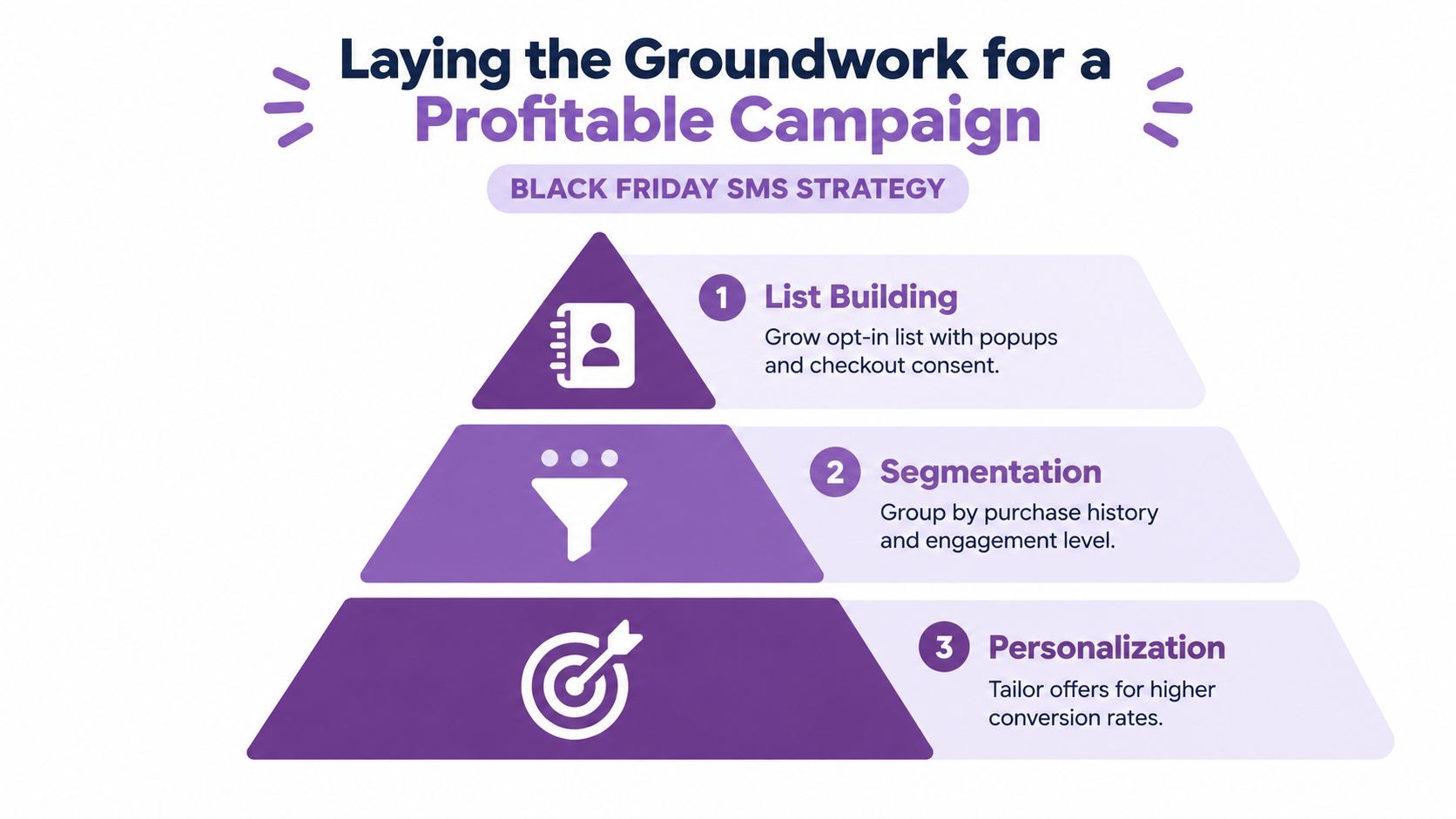
A strong campaign begins before the sale. Your list and segmentation determine whether Black Friday SMS feels like a useful alert or another unwanted promotion.
Build a high-intent subscriber list
Give shoppers a reason to opt in that connects directly to the event. Early access works because it offers a benefit beyond the public discount. Add an SMS signup unit to your Shopify popup, product pages, checkout experience, and post-purchase touchpoints. State what subscribers will receive, how often you'll message them, and how they can opt out.
Use a specific promise instead of vague copy:
- Early access: “Join the text list for first access to our Black Friday collection.”
- Private offer: “Text subscribers get the sale before everyone else.”
- Product alert: “Get a text when your saved item enters the Black Friday promotion.”
A documented recommendation for Black Friday planning is to collect opt-ins with an early-access incentive, then send VIP subscribers the promotion 24–48 hours before the general public. (Sinch's Black Friday SMS marketing guidance) That sequence gives subscribers a concrete reason to join and gives you a high-intent audience for the first offer.
Review your consent language and signup mechanics with SMS opt-in best practices before traffic rises. A larger list only helps when subscribers understand what they agreed to receive.
Segment by behavior, not just status
Create segments that reflect commercial intent. The label “subscriber” tells you almost nothing about what a person wants next.
VIPs should receive the earliest access, limited inventory alerts, and recognition of their loyalty. Don't lead with the same generic message sent to everyone.
Recent purchasers need complementary products, replenishment cues, or a clear explanation of what's new. Sending them a blanket reminder to buy the product they just purchased wastes attention.
High-AOV customers can receive curated bundles, premium launches, or spend-based value offers. The message should protect the relationship and avoid making the customer feel reduced to a discount code.
Lapsed customers need a reactivation angle. Use a product category they previously bought, a customer-only incentive, or a direct invitation to return. Avoid pretending they're active if they haven't engaged recently.
Engaged non-buyers are often ideal for reminders. Segment people who clicked, browsed, or added an item without completing checkout, then match the message to that behavior.
Before scheduling, verify each segment's eligibility, product relevance, consent status, and suppression rules. The campaign should know who not to message as carefully as it knows who to target.
Crafting SMS Copy That Actually Converts
A Black Friday SMS should give the recipient one clear reason to act. Choose one objective, such as early access, cart recovery, a product announcement, or a closing reminder. Packing every benefit, category, and deadline into one text makes the offer harder to understand and weakens the call to action.
Build the message around identity, offer, urgency, action. Tell recipients why they are receiving it, state the benefit, give a real reason to act now, and provide one obvious next step.
Copy and adapt these examples:
VIP early access
“VIP access is live. Shop our Black Friday offers before the public launch: [link]. Reply STOP to opt out.”
Category-specific launch
“Black Friday starts now for skincare. Your saved essentials are included while stock lasts: [link].”
Abandoned cart reminder
“Still thinking about your cart? Your Black Friday pricing is available now: [link]. Reply STOP to opt out.”
Low-stock alert
“Your selected [product] is moving quickly. Shop the Black Friday offer while it's available: [link].”
Final-hours message
“Final hours. Black Friday pricing ends tonight on [category]. Shop before the offer closes: [link].”
Each example uses specific context instead of a vague “sale ends soon” warning. Replace urgency with a genuine deadline, confirmed availability, or a clear audience benefit. Manufactured scarcity damages trust, especially when every message claims that stock is nearly gone.
Preference for plain text has declined, while interest in richer and interactive formats has grown. Use MMS when a product image, gift guide, bundle, or limited-edition design helps someone choose. Keep plain SMS for rapid alerts where the offer and action need no visual explanation.
Before launch, check your copy for spam trigger words. Treat the result as a screening step, not a final decision. Aggressive wording can make a legitimate promotion look unreliable.
Operational details affect conversion. Name the brand, use one primary link, confirm that the destination works well on mobile, and test the discount code. Place important exclusions near the call to action, especially restrictions involving products, locations, or shipping methods.
Review each message against its segment before scheduling. A profitable campaign does not send the same copy to every subscriber. The offer, proof, and urgency should match the recipient's likely intent.
The following video provides another practical reference for shaping concise SMS messages and campaign ideas.
The Art of Timing Your Black Friday Sends
Timing determines whether your message arrives as a useful shopping prompt or an interruption. Omnisend's Black Friday research identifies 8–9 AM as the strongest window, with Friday at 9 AM as the top slot in its dataset. That slot produced a 0.238% conversion rate across 4.57 million sends, while Friday generated $0.17 in revenue per SMS. (Omnisend's Black Friday SMS timing data)
Use that benchmark as a starting point, not a universal rule. Your customers may shop later, live in different time zones, or respond to product-specific timing. Schedule by recipient timezone, review historical engagement, and test the send window before the largest launch.
A practical sequence keeps the campaign visible without turning it into a barrage. One industry guide recommends 3–5 well-timed messages per campaign cycle, usually covering teaser, launch, reminder, last chance, and follow-up. (Ecosire's mobile commerce SMS guidance)
A workable Cyber Week sequence
Before Black Friday: Use a teaser for subscribers who have opted into event alerts. Don't reveal every detail if curiosity is part of your strategy, but explain the value of staying subscribed.
VIP access: Send the strongest early-access segment its offer first. Keep general subscribers suppressed until their launch window.
Black Friday morning: Send the main offer in the recommended morning window. Match products and copy to each segment rather than changing only the first name.
Later on Black Friday: Send a reminder only to eligible subscribers who haven't purchased or clicked. Exclude purchasers and anyone who has already received the maximum planned frequency.
Before the offer closes: Use a last-chance message for non-buyers who engaged with the promotion. A real closing time gives the text a clear reason to exist.
After purchase: Send a useful confirmation, delivery update, or product guidance. Don't immediately follow a completed purchase with another promotional blast.
| Day/Time | Audience Segment | Message Purpose |
|---|---|---|
| Black Friday eve, morning | SMS subscribers who haven't seen the offer | Teaser and expectation setting |
| Black Friday, 9 AM local time | VIPs and high-intent subscribers | Launch early access or primary offer |
| Black Friday, later in the day | Clickers and non-buyers | Targeted reminder |
| Black Friday, final hours | Engaged non-buyers | Last chance |
| Cyber Monday morning | Remaining eligible segments | New offer or category-specific follow-up |
Avoid copying a calendar without checking fatigue. A subscriber who received VIP access, clicked through, and purchased doesn't need the reminder. A subscriber who ignored the teaser may not deserve the same launch cadence as someone who viewed the promoted product repeatedly.
For more planning guidance around send windows and recipient behavior, use this reference on the best time to send text messages. The right schedule balances the benchmark, your customer data, local time, inventory, and the actual expiration of the offer.
Automating Your Campaign and Staying Compliant
Automation should remove repetitive work, not remove judgment. Build flows around customer actions, then add Black Friday rules that control eligibility, timing, discount logic, and suppression.
Start with the flows that protect revenue and customer experience:
- Welcome flow: Confirm the new subscriber's signup and explain the promised early access or offer.
- Browse reminder: Follow up with shoppers who viewed a promoted item but didn't add it to cart.
- Cart recovery: Remind customers about an abandoned cart, then stop the flow after purchase or when inventory changes.
- Checkout recovery: Use a direct completion prompt for customers who started checkout.
- Post-purchase flow: Confirm the order, share delivery information, and later suggest relevant complements.
Black Friday changes the conditions around these automations. A cart message should use the current promotion, not an expired evergreen code. A low-stock item should be removed from a flow if it sells out. A customer who purchased after receiving a campaign should be suppressed from follow-up reminders.
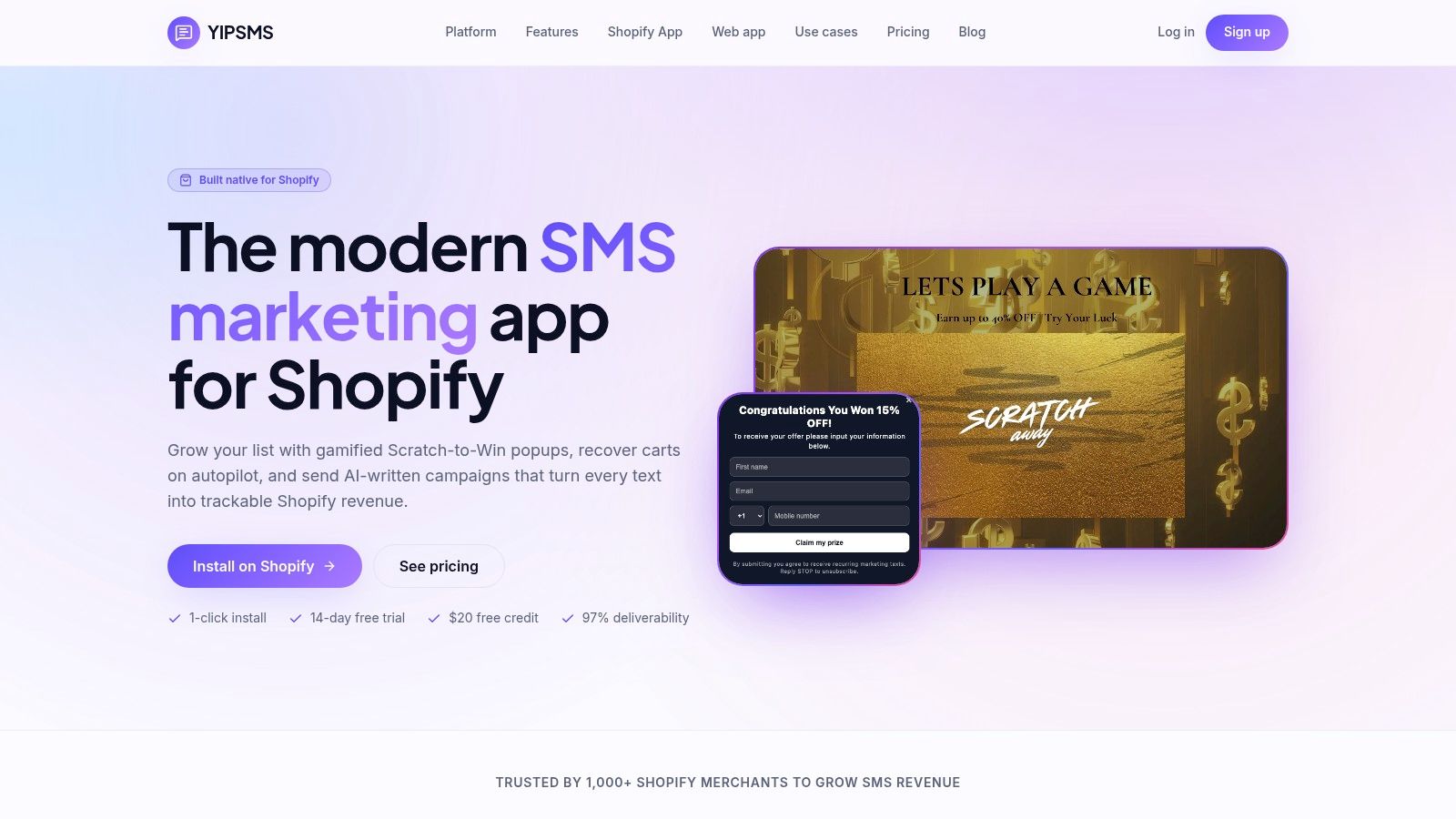
Tools such as SMS marketing automation can help coordinate triggers, scheduled campaigns, cart recovery, and transactional updates. YipSMS Inc. is one Shopify app option that supports popup-based subscriber collection, SMS and MMS campaigns, scheduled sends, automation flows, delivery notifications, and real-time campaign analytics. Evaluate it alongside your existing Shopify, checkout, customer data, and consent workflow.
Consent is part of campaign performance
Holiday urgency doesn't change the rules. High-volume promotional messaging creates privacy and consent risks under TCPA and CAN-SPAM-style requirements. Independent guidance reports that 43% of shoppers cite privacy as their top AI concern, which makes clear consent and easy opt-out handling part of customer trust, not just legal hygiene. (Response Labs' BFCM privacy guidance)
Before scheduling, check that:
- Consent is documented: Store the source, timestamp, and wording associated with each promotional opt-in.
- Promotional and transactional messages are separated: An order confirmation isn't permission to add a sales pitch.
- Opt-out language is clear: Honor STOP requests promptly and consistently.
- Frequency is controlled: Set campaign caps and suppress people who already converted.
- Vendors are reviewed: Confirm how your platform handles consent records, opt-outs, and automated sends.
- Testing is complete: Send internal tests and verify links, discount rules, timezone handling, and fallback content.
Automation makes scale possible. Governance keeps that scale from becoming a liability. The safest campaign is one where every trigger has an owner, every segment has a purpose, and every subscriber can understand why they received the message.
Measuring Success and Planning for Cyber Monday
Open rate gets attention because SMS is often read quickly, but it doesn't tell you whether the campaign made money. Track the full path from delivery to click to purchase, then compare results by segment, offer, and message stage.
Average SMS click rate is reported at around 6%, while top-performing brands can reach 15%. Black Friday also represented 23.2% of all November SMS orders in the cited analysis, which makes the day important enough to justify close monitoring and fast decisions. (Omnisend's 2022 BFCM SMS analysis)
Read the numbers by decision
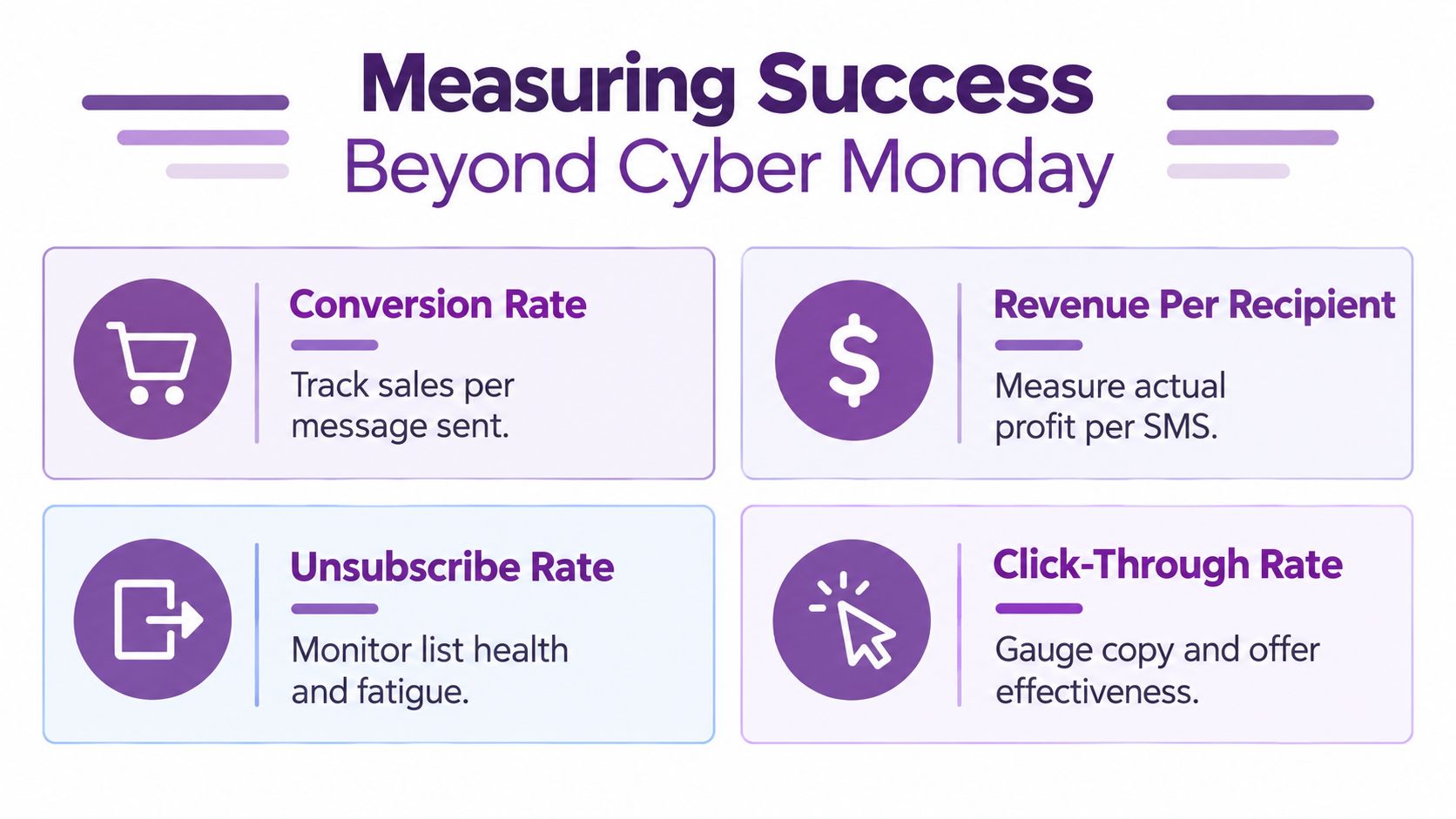
Click-through rate shows whether the copy, offer, and landing page promise were strong enough to earn a visit. A low click rate points to weak relevance, unclear value, poor CTA placement, or the wrong segment.
Conversion rate shows whether clicks turned into orders. If clicks are healthy but purchases lag, inspect the landing page, product availability, checkout friction, shipping terms, and discount application.
Revenue per recipient connects campaign performance to audience economics. Compare it by segment instead of celebrating total revenue alone. A smaller VIP send may produce more useful revenue than a broad campaign with higher costs and more unsubscribes.
Unsubscribe rate protects list health. A spike after a message often signals excessive frequency, weak targeting, unclear expectations, or an offer that didn't justify the interruption.
Look at Black Friday results while the sale is still active. Identify the segment with the strongest conversion, the product category with the highest revenue per recipient, and the message that generated clicks without purchases. Then use those findings to shape Cyber Monday.
For example, if VIPs converted from early access but lapsed customers clicked and stalled, keep the successful VIP structure and change the lapsed audience's landing page or incentive. If a category-specific message beat the sitewide blast, narrow Cyber Monday's creative. If the last-chance message generated clicks but little revenue, fix the checkout or inventory problem before sending another reminder.
The useful question isn't “How many people saw the text?” It's “Which eligible customer received the right offer at the right moment and completed a profitable order?”
Cyber Monday shouldn't be a duplicate of Black Friday. Use the evidence you've gathered to change the audience, product emphasis, or message angle. Keep purchasers and fatigued subscribers out of the next promotional push, and preserve the trust that makes your SMS list valuable after the holiday period.
YipSMS Inc. helps Shopify merchants collect SMS subscribers with popup tools, send scheduled SMS and MMS campaigns, and automate cart, checkout, product-view, shipping, and delivery messages. Visit YipSMS Inc. to evaluate a practical setup for building a segmented Black Friday SMS program and measuring its results through Cyber Monday.
How this article was made: the YIPSMS team drafts some articles with AI writing tools, then checks pricing, compliance and product details against how YIPSMS actually works before publishing. Spotted something wrong? Tell us through your YIPSMS account.