Ecommerce Cart Abandonment: Recovery Strategies That Work
A 70.19% average cart abandonment rate means most ecommerce carts don't become orders, but the right response isn't an automatic discount. The recoverable portion comes from separating low-intent browsers from high-intent shoppers blocked by checkout friction, then fixing the experience before sending targeted SMS.
For Shopify merchants, ecommerce cart abandonment is both a revenue problem and a diagnostic signal. A visitor who adds a product, starts checkout, and encounters a payment error needs a different message from someone comparing options or saving items for later. Treating both shoppers identically wastes margin, increases message fatigue, and can hide technical defects that no promotion will solve.
Table of Contents
- The True Cost of Empty Carts
- Why Shoppers Leave Before Paying
- Optimizing the Checkout Experience
- The Power of SMS Cart Recovery
- Building Effective Abandonment Flows
- Measuring Success and Scaling Up
The True Cost of Empty Carts
Baymard's global benchmark places average abandonment at 70.19%, based on 13 years of tracking and research that includes moderated usability testing, eye-tracking, checkout benchmarking, and quantitative studies involving thousands of participants. The benchmark matters because it establishes a difficult but useful baseline: a large share of shoppers will leave before payment, even when the product and acquisition strategy are sound. (Baymard's checkout usability benchmark)
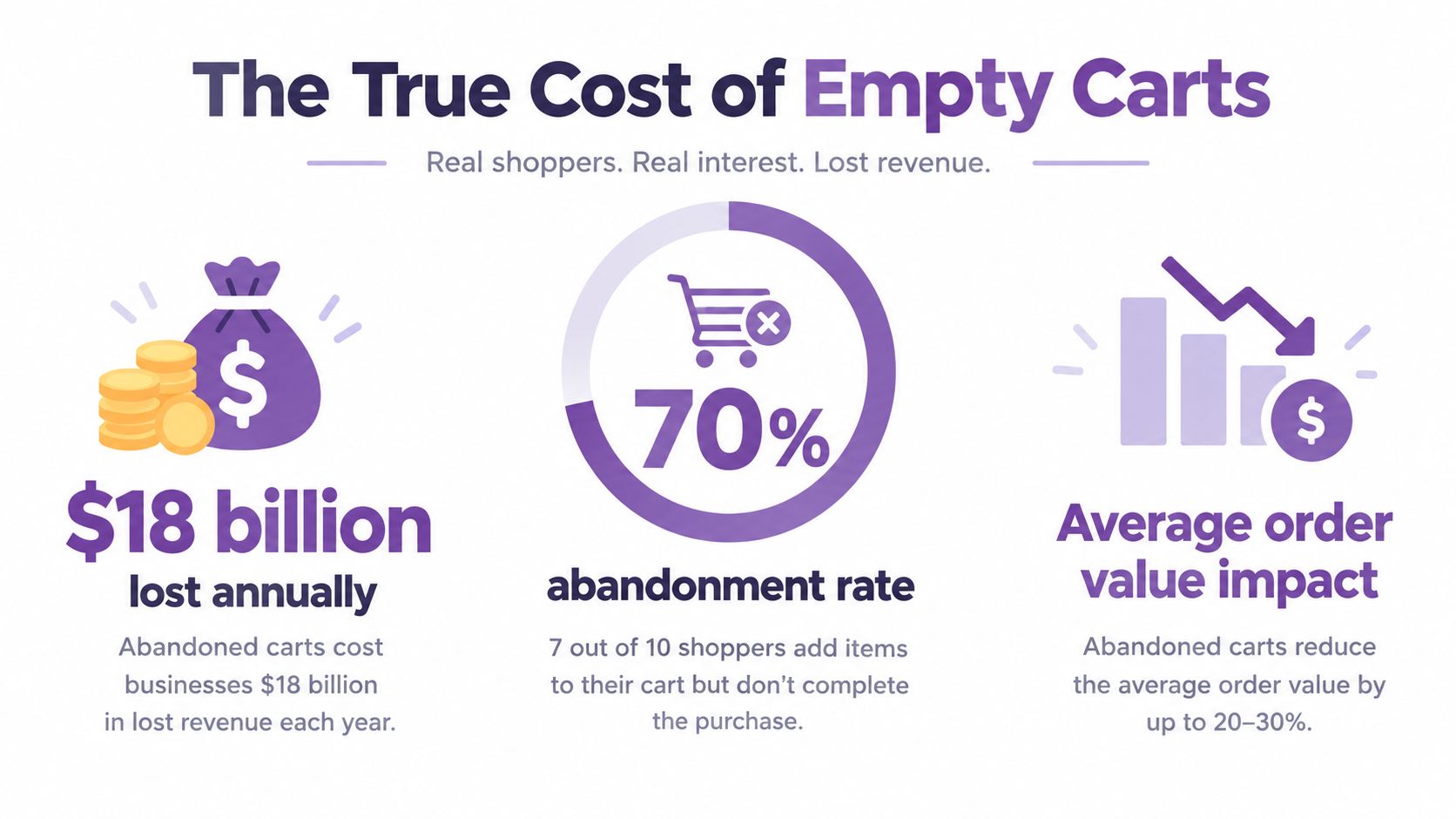
The headline rate shouldn't become a vanity benchmark. Your own checkout data tells you more than a global average because it reveals where shoppers leave, which devices struggle, and whether the problem concentrates around shipping, payment, account creation, or form validation. A high rate at the cart page points to a different problem from a sharp drop after payment selection.
Start with the size of the leak
Calculate abandonment consistently using the same definition of a cart or checkout session. Then segment the result by:
- Checkout stage: Separate product views, add-to-cart events, checkout initiation, payment failure, and completed orders.
- Device: Compare mobile and desktop behavior, including load time and field-level errors.
- Customer status: Distinguish first-time visitors, returning customers, and existing subscribers.
- Product economics: Review margin, stock status, cart value, and discount-code behavior.
- Acquisition source: Compare paid traffic, organic visits, email, SMS, and social referrals.
This classification changes the commercial question. Instead of asking how to recover every abandoned cart, ask which carts represent recoverable intent and which reflect normal browsing behavior. A message sent to every cart can create recovered orders, but it can also give away margin to customers who would have returned without an incentive.
Practical rule: Measure recovered profit and customer behavior, not just recovered order count.
The largest opportunity often sits between prevention and promotion. If shoppers leave because the checkout is confusing, reminders may bring some of them back to the same broken experience. Fixing the path to payment protects every future order, while an SMS incentive only addresses the people you successfully reach and persuade.
That's why ecommerce cart abandonment should sit with both the growth and technical teams. Marketing owns the recovery sequence, but developers, designers, and operations teams influence the shipping display, payment reliability, return information, and mobile form experience that determine whether recovery is necessary in the first place.
Why Shoppers Leave Before Paying
Not every abandoned cart represents a failed sale. Baymard reports that 42% of U.S. online shoppers said they abandoned because they were merely browsing or weren't ready to buy, while 17% cited a checkout that was too long or complicated. (Baymard's research on checkout abandonment)
That distinction should change your automation. A browser may need a saved cart, product education, a price-drop notification, or more time. A shopper who reaches payment and encounters an error needs a fast route back to a working checkout. Offering both groups the same discount treats hesitation and failure as if they were identical.
Read intent from behavior
Behavioral depth provides a practical proxy for purchase intent. No single signal is perfect, but several signals together can create useful branches:
- Product view only: Keep the shopper in browse or education journeys rather than cart recovery.
- Add to cart without checkout: Show the saved products and answer common buying questions, especially if the shopper returns repeatedly.
- Checkout initiation: Prioritize cart restoration, delivery clarity, and help with the next step.
- Payment failure: Send service-oriented assistance, not an immediate discount.
- Repeat session or returning customer: Consider faster recovery because the shopper already knows the brand.
- Heavy discount-code activity: Test price sensitivity separately from technical friction.
Baymard's reported reasons show why the message needs to match the likely objection. 17% cited checkout complexity, 17% cited website errors or crashes, 13% cited an unsatisfactory returns policy, 12% couldn't see or calculate total cost upfront, and 9% lacked enough payment methods. (Baymard's cart abandonment reasons)
A shopper who encountered an error should receive a preserved cart link and a support path. Someone who paused near the returns information may need reassurance about the policy. A customer who reached payment without selecting a method may respond better to a reminder about available wallets or cards.
Discounts belong later in the decision tree. They can help a price-sensitive shopper, but they can also train customers to delay checkout until a coupon arrives. First test whether the actual blocker is missing information, a broken field, unclear delivery timing, or a payment failure. Recovery should solve the objection whenever possible, not pay the customer to tolerate it.
Optimizing the Checkout Experience
SMS can't compensate for a checkout that loses customer input, hides the final cost, or fails on mobile. Baymard reports an average of 11.3 checkout form fields, and 22% of users have abandoned because checkout was too complex. It also found that 72% of sites fail to optimize credit-card expiration date entry, a small interaction that can delay completion at the moment purchase intent is highest. (Baymard's checkout and form research)
Use a friction audit before launching recovery
Work through the checkout as a new customer on the devices your customers use. Don't rely on a desktop browser test when much of your traffic arrives through a phone.
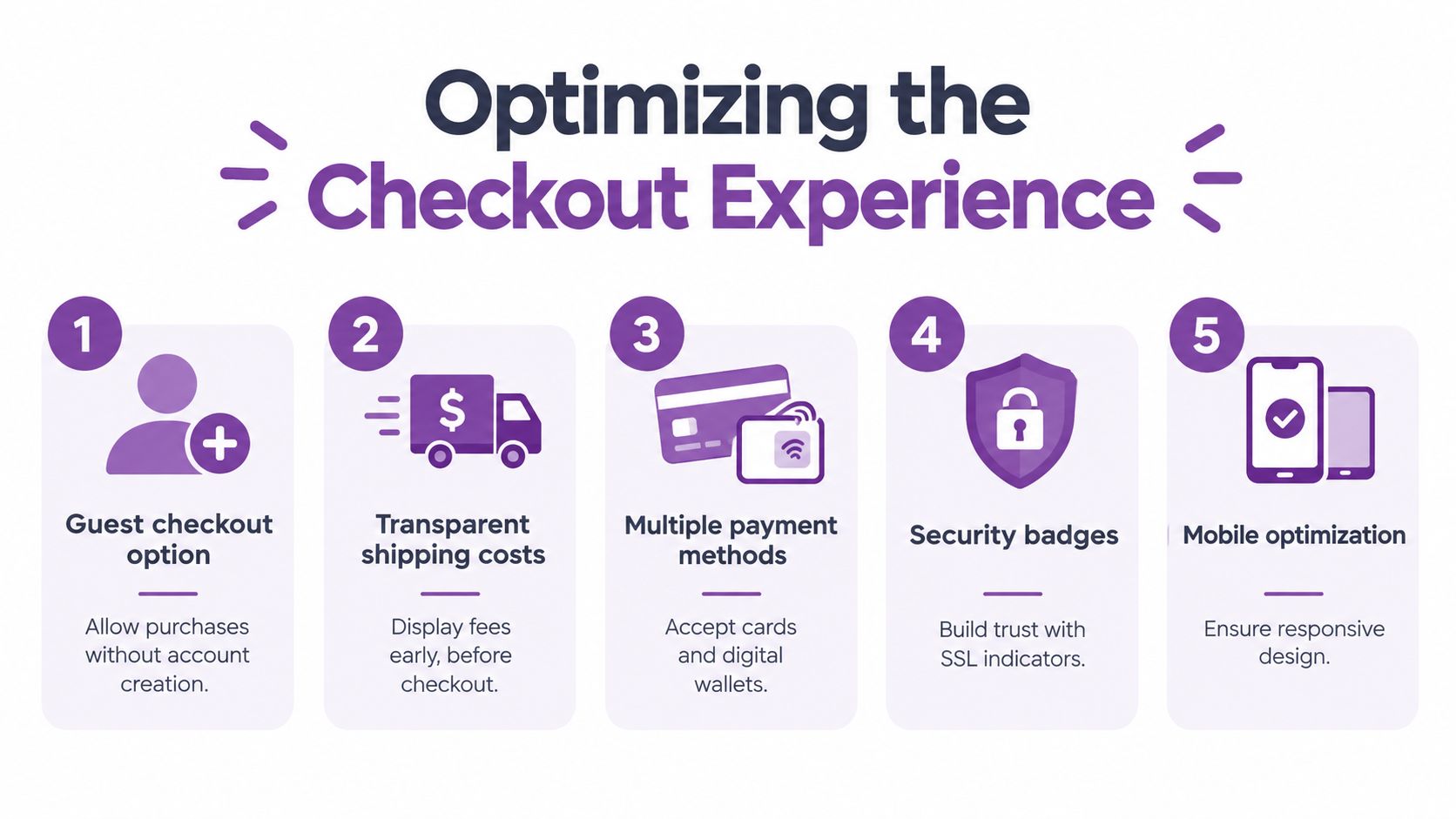
- Guest checkout: Let shoppers buy without creating an account. Invite account creation after the order rather than making it a prerequisite.
- Early cost visibility: Show shipping, taxes, and delivery estimates before payment whenever possible. Surprises at the final step create hesitation that a reminder can't reliably remove.
- Form reduction: Remove fields you don't need for fulfilment, billing, fraud prevention, or compliance. Use autofill and clear inline validation.
- Payment flexibility: Support the cards and digital wallets that fit your audience. Log failed attempts by method instead of recording only a generic payment error.
- Mobile entry: Check keyboard behavior, field focus, expiration-date selection, error recovery, and whether the cart survives an accidental reload.
- Trust and policy access: Keep returns, refunds, contact details, and security signals close enough to the checkout that shoppers don't need to hunt for reassurance.
Instrument each step. Record checkout progression, field-level validation errors, payment-method selection, latency, and device type. Then compare completion by failure mode, not only by overall conversion rate.
For merchants working across social commerce, the checkout lesson applies before the customer ever reaches Shopify. A practical resource on TikTok Shop conversion strategies can help connect product discovery, offer clarity, and the buying path before recovery automation becomes necessary.
You can also use this guide to improving conversion rates to organize broader funnel tests around the same principle: remove measurable friction before adding more follow-up messages.
A recovered cart should return the shopper to the preserved cart or relevant checkout step, not send them back to a generic homepage.
Trigger recovery only after meaningful inactivity. Suppress the flow immediately after purchase, and investigate device-specific errors before adding incentives. This sequence protects margin because the merchant fixes a broken path instead of compensating customers for a defect.
The Power of SMS Cart Recovery
SMS earns its place in cart recovery because some shoppers will respond faster to a text than to an email. Klaviyo's ecommerce guidance, based on research conducted with Recharge, says 18% of customers prefer abandoned-cart notifications by SMS (Klaviyo's ecommerce SMS guidance). That does not make SMS the default fix for every abandoned cart. It works best for high-intent shoppers who hit a blocker, not low-intent browsers who were never close to buying.
Email still handles richer explanation better. You have space for product imagery, shipping context, return policy detail, and social proof. SMS is better for speed, recognition, and getting someone back to the exact cart or checkout step with as little friction as possible. That trade-off matters because text messages feel more intrusive when the message is generic, mistimed, or sent without clear consent.
Match the channel to the objection
The useful split is not email versus SMS. It is browser versus blocker.
A shopper who added a product, never started checkout, and left after casual browsing usually needs a reason to care again. A shopper who reached checkout, viewed shipping, hit a payment error, or stalled after entering details often needs clarity or a technical path back in. Those are different recovery jobs, and they should not get the same text.
| Shopper signal | Message purpose | Appropriate destination |
|---|---|---|
| Cart created, no checkout | Restore interest | Preserved cart |
| Checkout started, no payment | Remove uncertainty | Relevant checkout step |
| Payment failure | Provide help | Payment retry or support |
| Returns page viewed | Reassure | Returns policy and cart |
| Total cost viewed, then exit | Clarify value | Cart with delivery details |
In practice, the first SMS should answer the most likely objection without reaching for a discount. “Your cart is saved” suits a shopper who may only need a reminder. “Having trouble completing payment?” fits a high-intent blocker much better. “Need help with delivery details?” can recover an order that stalled on shipping confusion without training customers to wait for a coupon.
The second message is where many brands give margin away too early. A tested incentive can work, but only after the cart remains abandoned and the behavior suggests price sensitivity rather than checkout friction. Margin, product type, and prior promotion use should shape that decision. If the core issue is a failed payment step or a broken checkout path, a discount solves the wrong problem.
Klaviyo recommends an initial abandoned-cart message within a few hours and another about 48 hours later. Its implementation guidance also points to a first reminder around 2 to 4 hours after checkout begins, uses a 4-hour delay in its prebuilt flow, and notes that delays shorter than 1 hour and 15 minutes may not leave enough time for synchronization to complete reliably. Use that as a starting point, then adjust around your buying cycle, consent model, and checkout behavior. For practical setup ideas, this abandoned cart recovery guide is a useful companion.
The flow should stop as soon as the order completes. It should also pause or change if inventory, pricing, shipping availability, or product status changes. Sending a shopper back to an unavailable cart burns trust fast.
Here's a practical walkthrough of the channel design and recovery logic:
Use email when the shopper needs explanation. Use SMS when the shopper needs a prompt or a fast route back to checkout. Use support messaging when the signal points to confusion or failure. The highest-performing channel is the one that matches the reason the shopper stopped.
Building Effective Abandonment Flows
A useful flow begins with the event definition, not the copy. Decide whether “abandonment” means a cart was created, checkout began, payment failed, or the shopper went inactive after a defined point. If those events collapse into one trigger, every downstream message becomes less relevant.
Preserve the cart state and pass the customer back to the exact products or checkout step. Suppress the journey when an order is completed, and exclude shoppers who have opted out or whose consent doesn't cover the intended message. These controls matter more than clever wording because they prevent the automation from contacting the wrong person at the wrong time.
A practical 48-hour sequence
At roughly 2 to 4 hours, send assistance first. The first SMS should be short, recognizable, and useful. For a standard cart, the copy might read:
“Your cart is saved at [Store]. Need another look? Return here: [cart link]. Reply for help.”
For a payment-failure branch, change the purpose rather than inserting a coupon:
“We couldn't complete your payment at [Store]. Your items are still saved: [checkout link]. Need help? Reply to this message.”
The link should open the preserved cart or checkout, not the homepage. If your platform can identify the last failed step, send the customer to the most relevant location while retaining the items and entered information where appropriate.
At a later point, send reassurance or urgency. A second message between 20 and 48 hours can address an unresolved objection. For example:
“Still deciding on your [product]? Your cart is waiting here: [cart link]. See delivery and returns before you check out.”
Use an incentive only for a segment that has a reason to receive it. Keep the offer tied to a business rule, such as margin, product category, or prior price sensitivity, and test whether the incremental order is profitable after the discount and SMS cost.
At the end of the window, stop by default. A third reminder isn't automatically better. If the shopper hasn't engaged, repeated messages may increase unsubscribes without changing intent. Move low-intent users into a slower nurture path, such as product education or a saved-cart reminder, rather than escalating the pressure.
Build branches around evidence
Use event properties to create separate paths:
- Checkout error branch: Link to payment recovery or invite a reply for support.
- Cost uncertainty branch: Surface delivery, tax, and returns information.
- Payment-method branch: Mention available cards or wallets only when they're supported.
- Repeat visitor branch: Restore the cart quickly and avoid unnecessary introductory copy.
- Exploratory branch: Use saved-cart or product-content messaging instead of a limited-time offer.
Presidio's guide to Shopify cart recovery is useful when mapping platform events, recovery timing, and practical implementation decisions. The same discipline applies to broader marketing automation workflows, where each trigger should have a clear audience, suppression rule, destination, and success metric.
Don't build the sequence around the assumption that every customer wants a coupon. Build it around what the customer did. A shopper who viewed returns information needs confidence, a shopper who hit a payment error needs service, and a shopper who only saved a product may need time. Intent-based automation keeps the experience helpful while preserving the option to use incentives where they earn their place.
Measuring Success and Scaling Up
Recovered orders are only one outcome. A stronger dashboard separates delivery, clicks, completed purchases, revenue per delivered SMS, recovery rate, margin impact, and unsubscribe rate by abandonment branch. That view shows whether a message solves a real problem or merely captures customers who would have returned anyway.
Start with a baseline for each event path:
- Checkout progression: Where do shoppers leave before and after your checkout changes?
- Technical failures: Which devices, fields, and payment methods generate errors?
- Message engagement: Do recipients click the preserved cart link?
- Commercial outcome: Does the resulting purchase remain profitable after incentives?
- Customer response: Are opt-outs, support replies, and repeat purchases changing?
Run holdout tests where your consent and platform setup allow them. Compare a helpful reminder against a discount-led message, and compare a single message against a two-step sequence. Keep the audience definition stable so you're measuring the treatment rather than a different mix of shoppers.
The supplied YipSMS performance claim reports 5x to 7x returns and engagement lifts over 30% for users of integrated SMS automation, but those figures should be treated as reported outcomes, not a universal forecast. Your store's margin, consented audience, product cycle, and checkout quality will determine whether automation creates incremental profit.
YipSMS Inc. can support Shopify merchants with cart and checkout abandonment flows, timed reminders, cart-return links, consent checks, purchase suppression, bulk campaigns, and real-time analytics. The practical role of a platform like this is to connect behavioral events to relevant messages, while your team remains responsible for fixing checkout defects and deciding where incentives make economic sense.
If your Shopify store is losing customers between cart creation and payment, start by auditing checkout errors, cost visibility, payment methods, and mobile form behavior before adding discounts. Then use YipSMS Inc. to build consent-aware SMS flows that restore carts, suppress converted shoppers, and measure recovery by intent segment.