SMS Marketing ROI: A Practical Guide for eCommerce
SMS marketing can return $21 to $71 in revenue for every $1 spent, according to recent industry benchmark summaries. That range is compelling, but it can also mislead a Shopify operator if it blends abandoned-cart automation, transactional updates, post-purchase messages, and promotional broadcasts into one dashboard number. Recent SMS marketing benchmarks put the channel among the strongest digital options, while the performance gap usually appears between a behavior-triggered message and a generic blast.
A store can therefore “prove” that SMS works while still wasting money on the wrong campaigns. The useful question isn't just what SMS marketing ROI looks like. It's which flow earns its keep, which campaign burns list value, and whether attributed revenue represents incremental profit.
Table of Contents
- The SMS ROI Number That Made Us Look Twice
- What SMS Marketing ROI Actually Means for a Store
- How to Calculate SMS ROI With a Real Example
- SMS ROI Benchmarks by Use Case
- Measuring Incremental Lift and Payback Period
- Tactics That Move SMS ROI for Shopify Brands
- A 30-Day Plan to Improve Your SMS ROI
- SMS ROI Questions Shopify Owners Ask Most
The SMS ROI Number That Made Us Look Twice
The headline range is $21 to $71 in revenue per $1 spent. A Shopify owner can see that figure, connect an SMS app, and expect every campaign to perform like a high-intent cart reminder. That expectation is where the trouble starts.
A blended dashboard might combine a customer who abandoned checkout, a customer who received a shipping notification, and a subscriber who saw a weekend promotion. Those recipients have different intent, different costs, and different reasons to click. If an abandoned-cart flow generates most of the attributed revenue while a broadcast produces most of the unsubscribes, the blended average hides the operational decision that matters.
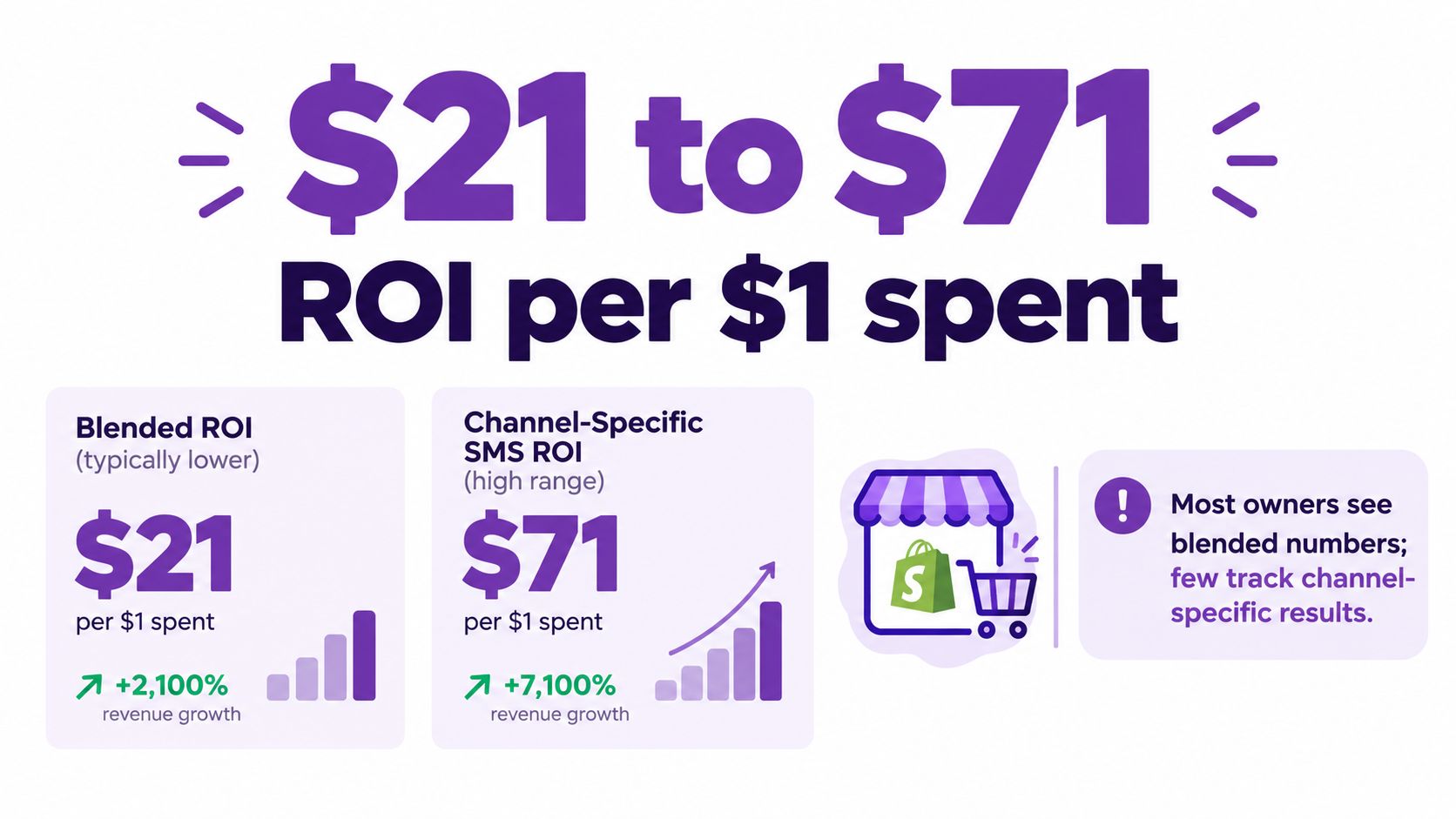
The average isn't the strategy
I've seen merchants treat a strong blended number as permission to increase send volume. That reverses the logic. High SMS marketing ROI usually comes from relevance, timing, and automation, not from sending more messages to every opted-in customer.
Recent benchmark reporting places SMS response rates around 45%, compared with roughly 6% to 10% for email, which helps explain why a relevant text can convert quickly. The same source material also places business-text visibility near 87% within 15 minutes, giving SMS a natural advantage when a customer is already close to purchase. SMS marketing statistics and benchmark context can help merchants compare these channel-level signals, but those signals still aren't profit.
The operator-level test is simple:
- Flow revenue: Which trigger produced the sale?
- Cost per recipient: What did delivery, platform access, and discounts cost?
- List impact: Did the message create an opt-out or preserve trust?
- Incremental value: Would the customer have purchased without the text?
By the end of this analysis, a Shopify merchant should be able to separate blended ROI from flow-by-flow performance, prioritize cart and checkout automation, test broadcasts cautiously, and read the dashboard without confusing attributed revenue for guaranteed profit.
Practical rule: Treat every flow as its own mini business case. A strong channel average can't rescue a campaign that repeatedly damages list quality.
What SMS Marketing ROI Actually Means for a Store
SMS marketing ROI answers a narrow commercial question: how much return does the store generate for each dollar invested in SMS? The word “invested” needs a broad definition. It can include message delivery, platform fees, subscriber acquisition, creative work, discounts, and the operational time required to build and maintain flows.
Revenue alone isn't ROI. A message may produce an order and still lose money after the discount, product margin, delivery cost, and messaging expense are included. A large subscriber list isn't ROI either. List size matters only when subscribers remain engaged, consented, and profitable to reach.
Gross return versus true return
Many Shopify dashboards effectively show a gross revenue ratio:
Gross return per dollar = SMS-attributed revenue ÷ SMS cost
That view is useful for comparing campaigns, but it excludes the cost of goods and the margin given away through an offer. A more honest operating view is:
True ROI = SMS-attributed profit ÷ total SMS investment
The difference can be substantial for stores that use aggressive discounts. A percentage-off offer may increase conversions while reducing contribution margin. Free shipping can behave differently from a product gift. The right choice depends on the economics of the order, not on click volume alone.
Define the cost boundary before launch
Use the same cost boundary for every campaign type. Include:
- Delivery costs: Per-message charges and any carrier-related fees.
- Platform costs: The portion of the SMS software subscription assigned to the program.
- Acquisition costs: Incentives and signup costs used to collect phone numbers.
- Offer costs: Discounts, gifts, shipping subsidies, and other conversion incentives.
- Production costs: Copy, design, testing, and campaign management when those costs are material.
A shipping notification shouldn't be judged like a promotional blast. Its commercial value may come from reducing support demand, strengthening the post-purchase experience, or creating a later purchase opportunity. Keep transactional and promotional reporting separate so one category doesn't inflate the other.
Once the store defines these boundaries, the formula becomes less mysterious. The difficult part isn't arithmetic. It's deciding which purchase deserves credit and whether the credited revenue would have appeared without SMS.
How to Calculate SMS ROI With a Real Example
Start with the basic formula:
SMS ROI = ((SMS-attributed revenue − SMS cost) ÷ SMS cost) × 100
For a Shopify cart-recovery program, total the revenue assigned to the flow, then subtract message delivery, platform allocation, subscriber acquisition, and offer costs. Divide the result by the same total cost. If the store wants a simpler revenue multiple, divide attributed revenue by cost and label it clearly as revenue per dollar, not profit ROI.
A useful worksheet has four fields:
- Recipients: How many consented shoppers entered the flow?
- Orders: How many completed a purchase after receiving the message?
- Revenue: What order value did the store attribute to those recipients?
- Total cost: What did the program cost after delivery, platform, acquisition, and incentives?
A merchant can use the SMS marketing ROI calculation guide to standardize that worksheet across campaigns. The important discipline is to keep the calculation consistent. Changing the cost boundary from one report to the next makes an apparent improvement impossible to trust.
Attribution changes the result
The same order can receive different credit depending on the attribution model.
First-click attribution gives credit to the first marketing touchpoint that introduced the shopper to the store. SMS may receive little credit if email, search, or paid social started the journey.
Last-click attribution gives credit to the final tracked touchpoint before purchase. This is common in platform dashboards because it is easy to implement and easy to explain. It can overstate SMS when the shopper was already ready to buy, and it can understate earlier messages that created the intent.
Assisted or multi-touch attribution distributes credit across the relevant interactions. It better reflects a journey in which email explains the product, paid social creates awareness, and SMS closes a time-sensitive decision. It also requires cleaner tracking and a clear rule for how credit is divided.
Klaviyo, Postscript, and Attentive dashboards may default to a last-click view or another platform-specific rule. Don't treat that default as a universal truth. Export the same program into a second reporting view when the investment decision is important.
| Attribution Model | Assigned Revenue | Reported ROI | What It Hides |
|---|---|---|---|
| First click | Revenue from orders where SMS introduced the shopper | Often conservative for recovery flows | Later SMS influence and purchase urgency |
| Last click | Revenue from orders where SMS was the final tracked touch | Often strongest for cart and checkout flows | Earlier email, ad, and browsing influence |
| Assisted or multi-touch | A portion of revenue shared across relevant channels | Usually more balanced | The precise incremental effect of each touch |
The goal isn't to find the most flattering model. It's to use one model consistently, disclose it beside the result, and validate it with holdouts when the store needs a causal answer.
SMS ROI Benchmarks by Use Case
A store shouldn't compare a shipping update with a cart reminder just because both use SMS. They solve different customer problems. The strongest commercial results generally come from automated, segmented flows, while broad broadcasts depend on offer relevance and audience fatigue.
Recent ecommerce analysis reports $0.74 in revenue per automated SMS send versus $0.15 for one-off messages, a difference that supports separating triggered flows from campaigns in every dashboard. Ecommerce SMS ROI analysis also connects the gap to timing, segmentation, and lifecycle intent rather than raw send volume.
| Use Case | Avg ROI | Revenue / Send | Conversion Rate | Opt-Out Risk | Best For |
|---|---|---|---|---|---|
| Cart recovery | High when the shopper has shown purchase intent | Often strong in automated flows | Recovery campaigns are reported around 15% to 20% in some industry coverage | Moderate if messages continue after purchase | Recovering an active buying decision |
| Browse abandonment | Variable and dependent on product relevance | Best when the viewed item remains available | Track by viewed product and subsequent order | Moderate | Returning shoppers to a product they considered |
| Abandoned checkout sequence | High when friction is the problem | Stronger than a generic promotion when timing is immediate | Track separately from cart recovery | Moderate | Removing payment, shipping, or checkout hesitation |
| Welcome flow | Variable | Depends on the incentive and first-session intent | Compare first-order conversion with incentive cost | Can rise when the offer feels excessive | Turning a new opt-in into a first purchase |
| Post-purchase review request | Indirect commercial return | Usually measured through retention and review activity | Evaluate repeat purchase separately | Low when timed around a useful request | Collecting feedback and supporting retention |
| Shipping and delivery updates | Not a promotional ROI benchmark | Direct revenue may be limited | Measure support impact and later engagement | Low when expected and useful | Reducing uncertainty after purchase |
| Broadcast or promotional blast | Highly variable and often lower than triggered flows | Can be efficient for a well-matched offer | Track against audience segment, not total list | Highest when frequency and relevance are poor | Inventory moments, launches, and timely promotions |
Abandoned-cart coverage reports open rates near 98%, recovery click-through rates around 19% to 30%, and conversion rates around 15% to 20%. Those figures describe a high-intent use case, not a promise for every SMS campaign. Ecommerce cart-abandonment benchmarks also emphasizes the rapid consumption behavior that makes recovery messages commercially useful.
The spread exists because triggers capture friction close to a decision. A broadcast asks the customer to create or revive intent at the moment it arrives. That makes the broadcast more exposed to fatigue, weak offer fit, inventory issues, and attribution noise.
A blended ROI number is a reporting output. Flow-level revenue per send is an operating signal.
Measure each use case with delivery rate, click-through rate, conversion rate, revenue per recipient, contribution margin, and unsubscribe rate. Ecommerce SMS measurement guidance identifies delivery, clicks, conversions, and unsubscribes as core indicators, and advises keeping opt-out rates below 2% as a sign of healthy list quality.
Measuring Incremental Lift and Payback Period
Attributed revenue is the amount a platform connects to a message. Incremental lift is the revenue that would not have occurred without that message. Shopify merchants need both figures, because attributed revenue can make a weak flow look profitable.
A holdout test gives each flow a cleaner read. Keep a consented audience eligible for the same cart-recovery flow, randomly send it to one group, and suppress it for the other group during a defined period. Compare purchase rates, contribution profit, and opt-outs. The gap estimates the flow's incremental effect.
Eligibility must stay consistent. Do not compare recent cart abandoners with older subscribers, or high-value customers with first-time browsers. Keep the offer, send timing, product availability, and measurement window aligned. A smaller, properly matched holdout is more useful than a larger comparison built from different customer groups.
Why attribution behaves differently by flow
Last-click attribution can overstate welcome-flow lift because a new subscriber may already be shopping when they opt in. It can also overstate post-purchase revenue when the customer was likely to reorder without a reminder.
Shipping updates create a different measurement problem. They may increase trust, reduce support demand, or influence a later purchase without generating a promotional click. Last-click reporting can miss that operational value, while still failing to prove incremental revenue.
A blended ROI number is a reporting output. Flow-level revenue per send is an operating signal.
Industry benchmark summaries report that the payback period for SMS marketing improved from 11 months in 2021 to 8 months in 2026, a 3-month acceleration in the reported recovery period. G2's SMS marketing benchmark summary supports using payback as a planning measure rather than treating one campaign's revenue as the entire investment return.
Use this operating formula:
Monthly SMS profit = (gross SMS revenue × gross margin) − (platform fee + per-message cost)
Track cumulative profit against setup and list-growth costs with a flow-level dashboard. SMS campaign analytics and reporting guidance explains how to structure that measurement. A flow can produce positive revenue per send while the broader program remains below payback because acquisition, creative, integration, and testing costs are still being recovered. Keep list-growth spend separate, since it generally takes longer to recover than the cost of messaging an existing subscriber.
Tactics That Move SMS ROI for Shopify Brands
The practical changes are not mysterious. They improve one of four levers: intent, relevance, cost control, or measurement.
1. Build consent around value
A popup that asks for a phone number without explaining the benefit creates weak consent and a fragile list. Use a clear value exchange, an explicit checkbox where required, and a promise that matches the messages the store will send. An exclusive product alert, cart assistance, or delivery update is more credible than a vague promise of “deals.”
Keep the opt-out instruction clear in every promotional message. Ecommerce SMS implementation guidance from Mailchimp recommends concise copy, appropriate local sending times, high-intent use cases, and visible opt-out instructions.
2. Segment by behavior before adding volume
Separate browsers, cart abandoners, recent customers, repeat buyers, and high-value customers. A shopper who viewed a product shouldn't receive the same message as someone who abandoned a fully configured checkout.
Use purchase history and predicted value as additional filters, but don't pretend a prediction is certainty. Start with a simple segment rule, measure revenue per recipient and opt-outs, then refine it. A smaller audience with a clear reason to receive the message is usually a better test than the entire list.
3. Test the offer against the friction
Cart recovery copy should address the reason the customer stalled. Test a discount against free shipping, or test a practical product reminder against an incentive. Keep the test focused on one meaningful variable so the result is interpretable.
The winning offer isn't necessarily the one with the highest conversion rate. Compare contribution profit, average order value, redemption behavior, and opt-outs. A discount can buy orders while eroding the profit available to fund future acquisition.
4. Let timing follow intent
Prioritize abandoned-cart reminders, checkout assistance, back-in-stock alerts, delivery updates, and post-purchase follow-ups. These moments have a clear customer reason behind them and are easier to defend than repeated generic promotions.
Business-text benchmark summaries report that 82% of consumers reply to a business text within 15 minutes, while nearly 70% expect a response within an hour. Use that immediacy for a relevant action, not for pressure. A customer who needs a stock alert or cart reminder benefits from speed. A customer who has received several unrelated offers may experience the same speed as interruption.
5. Watch opt-outs as an early warning
Revenue is a lagging measure. Unsubscribes can reveal fatigue before the monthly report shows a decline. If opt-outs rise, inspect frequency, audience overlap, offer relevance, and send timing before increasing the discount.
For broader lifecycle planning, marketing automation tips from Alpha Omega Digital offer useful context on connecting triggers, segmentation, and follow-up logic. Apply that thinking to SMS, but keep promotional and transactional communication distinct.
A workable dashboard should show delivery, failures, clicks, conversions, revenue, cost, contribution profit, and unsubscribe rate by flow. Don't optimize click-through rate in isolation. The message that earns the most clicks may still lose to a quieter message that produces profitable orders.
A 30-Day Plan to Improve Your SMS ROI
A short sprint works best when the store ships one improvement before adding another layer of complexity.
Week 1
Audit consent sources, message costs, attribution settings, and flow eligibility. Remove invalid or clearly inactive contacts where your compliance and platform rules allow it. Repair abandoned-cart and browse-abandonment logic first, including suppression after purchase.
Week 2
Add the post-purchase foundation. Separate shipping and delivery updates from promotional reporting, then create a useful review or replenishment follow-up where the product and buying cycle support it. Track retention behavior instead of forcing every message into direct revenue attribution.
Week 3
Turn on behavioral segmentation and run a controlled offer test. Separate first-time shoppers from repeat customers, and compare contribution profit rather than choosing a winner from clicks alone. Review opt-outs alongside revenue per recipient.
Week 4
Test one carefully chosen broadcast tied to inventory, a product launch, or a clear customer benefit. Keep the audience narrow enough to understand the result, then compare the broadcast with automated flows using the same cost and attribution definitions.
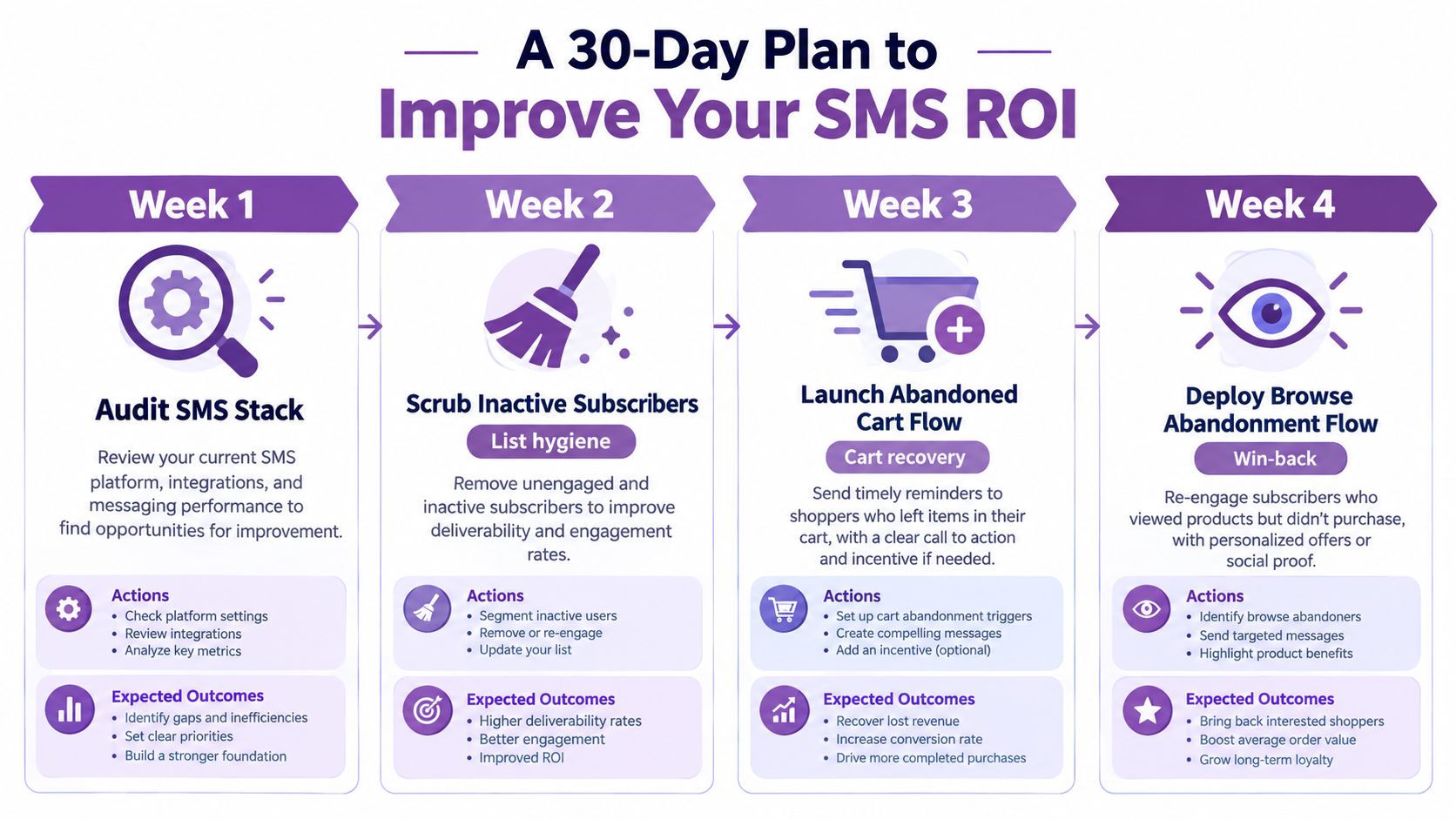
Use a rollout gate based on payback, contribution profit, and list health. Don't scale a flow merely because its attributed revenue looks attractive. The store should know whether the flow creates incremental value and whether customers remain willing to hear from the brand.
A platform such as YipSMS Inc. combines Shopify SMS flows with reporting for delivery, clicks, conversions, spend, and revenue attribution, which can support this flow-by-flow review when the store needs one operating dashboard.
SMS ROI Questions Shopify Owners Ask Most
What does a quality SMS subscriber cost?
There isn't a verified universal acquisition cost that applies to every Shopify store. Measure subscriber acquisition by source, incentive cost, first purchase, repeat purchase, and unsubscribe behavior. A cheaper signup isn't better if the subscriber never engages or immediately opts out.
What attribution window should a store use?
Use a window that matches the buying behavior and keep it consistent across tests. Cart recovery generally needs a short, clearly defined window. Post-purchase recommendations may require a longer view because the message supports future behavior. Validate the setting with holdouts rather than selecting the window that reports the most revenue.
Does SMS beat email on ROI?
SMS often produces faster response and stronger revenue per send, while email supports broader nurturing and richer explanation. Recent benchmark summaries place SMS response around 45% and email around 6% to 10%, but the channels serve different jobs. Use email for depth and SMS for urgent, high-intent moments instead of forcing a winner-takes-all comparison.
When does SMS underperform?
Generic broadcasts, poor segmentation, excessive frequency, weak consent, and irrelevant offers are common failure points. A store should pause or redesign a campaign when revenue per recipient falls while opt-outs rise, even if the blended account number still looks healthy.
Review your Shopify SMS program by flow, not by one flattering average. YipSMS Inc. provides cart and checkout abandonment automation, viewed-product follow-ups, delivery notifications, campaigns, and revenue-focused analytics for stores that want to make that review operational. Start by auditing your current flows and use the data to decide where SMS deserves more budget.
How this article was made: the YIPSMS team drafts some articles with AI writing tools, then checks pricing, compliance and product details against how YIPSMS actually works before publishing. Spotted something wrong? Tell us through your YIPSMS account.