Cart Abandonment Stats: 2026 Benchmarks and SMS Fixes
Most cart abandonment advice starts with the wrong conclusion: a 70% abandonment rate doesn't mean 70% of shoppers were ready to buy and then changed their minds. It mixes casual browsing, price comparison, deferred decisions, technical failures, and genuine checkout friction into one alarming number. If you send the same discount to every abandoned cart, you'll often pay to persuade people who never had purchase intent.
The useful question isn't “How do I recover every abandoned cart?” It's “Which shoppers showed enough intent to deserve a recovery message, and what stopped them?” The answer sits in your checkout data, device patterns, consent records, and the difference between an abandoned cart and an abandoned checkout.
Table of Contents
- Global Cart Abandonment Rate Benchmarks
- Pinpointing the True Causes of Checkout Friction
- Decoding the Mobile Versus Desktop Paradox
- Building High-Converting SMS Recovery Flows
- Expanding SMS Beyond the Abandoned Cart
- Measuring the True ROI of Your SMS Campaigns
- Your 30-Day Cart Recovery Implementation Plan
Global Cart Abandonment Rate Benchmarks
A 70.19% cart abandonment rate grabs attention, but operators who treat it as recoverable revenue usually waste margin. The benchmark is useful because it shows how often carts fail to become orders across ecommerce, as shown in Baymard's checkout usability research. It does not mean seven out of ten shoppers were ready to buy and slipped away at the last second.
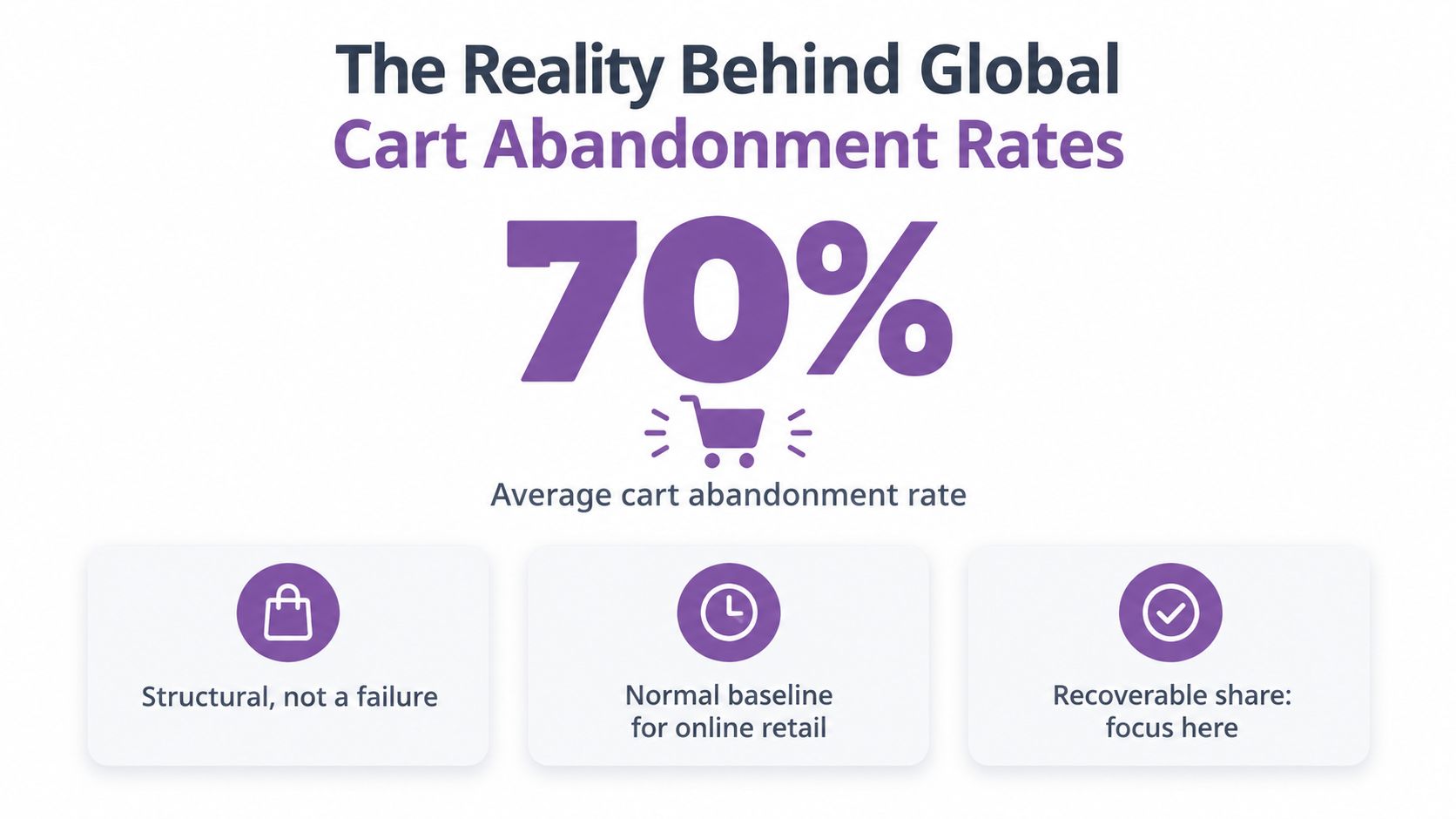
The chart looks dramatic. The behavior behind it is more mixed. Some shoppers are comparing prices, checking shipping policies, saving items for later, or getting approval before they buy. Baymard also found that 42% of U.S. online shoppers had abandoned a cart in the previous three months because they were browsing or were not ready to purchase. That kind of exit sits in the same headline rate as a failed payment or a confusing checkout, even though the recovery play should be completely different.
Use the benchmark as a warning light. Do not use it as your revenue forecast.
For Shopify brands, intent matters more than cart volume. A shopper who reached checkout, entered contact details, came back more than once, and reviewed delivery information is far closer to buying than someone who added a product and vanished. Shopify says a checkout is considered abandoned after a shopper has entered an email address and failed to complete the purchase for more than 10 minutes, according to Shopify's abandoned cart recovery guidance. That is a better recovery pool for SMS than raw cart creation because the signal is stronger and the message can be more specific.
Build an intent model before sending SMS
If you want SMS to recover profit instead of just inflate assisted revenue, segment the audience first:
- Checkout intent: Put shoppers who started checkout or shared contact details at the top of the queue.
- Engagement depth: Score repeat visits, product views, and time spent reviewing the cart.
- Friction evidence: Separate payment issues, delivery uncertainty, and technical errors from silent exits.
- Commercial value: Check margin and likely discount sensitivity before offering an incentive.
- Recent purchase behavior: Returning customers often need a reminder. First-time buyers often need trust.
A lot of recovery programs break here. They treat every abandoned cart as if it deserves the same sequence, timing, and offer. It does not. A shopper who left after seeing shipping costs needs clarity. A shopper who hit a payment decline needs another payment path or support. A casual browser may not deserve an SMS at all.
Start with your baseline using a cart abandonment rate calculation guide, then break performance down by checkout stage, device, geography, acquisition source, and time since abandonment. That view is more useful than one blended headline number. Stores with plenty of browsing traffic can post a high abandonment rate and still be healthy. Stores with a lower rate can still leak serious revenue if high-intent buyers fail late in checkout.
The practical rule is simple. Recover intent, not activity. Send reminders to shoppers who showed buying signals, send support-oriented messages when friction is visible, and protect margin by saving discounts for cases where they are likely to change the outcome.
Pinpointing the True Causes of Checkout Friction
Recovery messages can't repair a checkout that surprises shoppers with costs or asks them to complete unnecessary work. In U.S. 2025 survey data, extra costs, including shipping, taxes, and fees, were the leading reason for checkout abandonment, cited by 39% of respondents, according to Statista's analysis of U.S. checkout abandonment reasons.
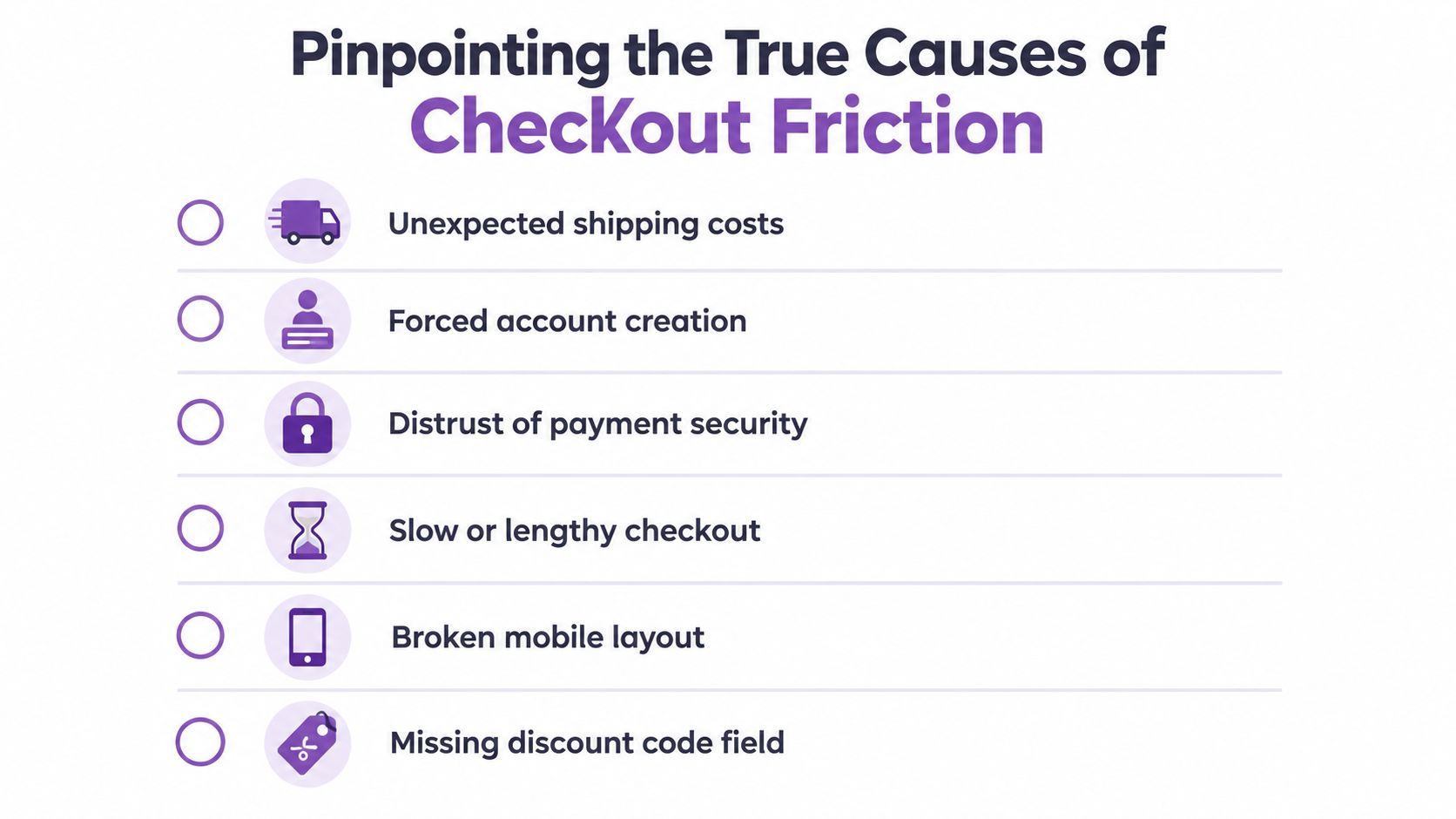
That finding points to a sequencing mistake many merchants make. They launch an abandoned-cart SMS flow before checking whether the shopper saw the actual total. A reminder that links back to an unexpectedly expensive checkout may bring the customer back only to confirm the decision to leave.
Map each reason to one fix
The same U.S. survey identified delivery that was too slow at 21%, mandatory account creation at 19%, and a checkout process that was too long or complicated at 18%, as detailed in the Statista checkout findings.
| Friction signal | Onsite response | SMS response |
|---|---|---|
| Unexpected shipping, tax, or fee | Show estimated total before payment | State the known shipping cost or link to the updated checkout |
| Slow delivery expectation | Publish realistic delivery dates | Remind the shopper of the actual delivery window |
| Forced account creation | Enable guest checkout | Link directly to checkout without asking for a new login |
| Long or complicated form | Remove unnecessary fields and test autofill | Use a deep link that preserves the completed checkout state |
| Payment distrust | Display clear security, returns, and support information | Offer help rather than leading with a discount |
| Missing payment option | Add trusted methods relevant to your audience | Mention the available alternative only when it addresses the failure |
The form deserves a separate audit. Baymard reports that many ecommerce checkouts could reduce their default number of form elements by 20% to 60%, according to its checkout benchmark research. Don't make shoppers re-enter information your store already has, and don't force account creation before the order is complete.
Use session recordings and Shopify checkout events to find the actual exit point. Check whether shoppers leave after shipping appears, after a discount-code interaction, during address entry, or when the payment processor loads. Then fix the largest confirmed leak before judging your recovery campaign.
The video below provides a practical visual reference for diagnosing checkout friction:
A clean checkout doesn't eliminate browsing or comparison shopping. It does stop your store from manufacturing avoidable abandonment. Only after these fixes should SMS become the next layer.
Decoding the Mobile Versus Desktop Paradox
Mobile abandonment is often treated as proof that a phone-sized screen is the problem. Aggregated industry reporting places mobile abandonment near 85.65%, compared with roughly 73.07% on desktop, according to Digital Minds BPO's ecommerce statistics overview. The gap deserves attention, but it doesn't identify the cause.
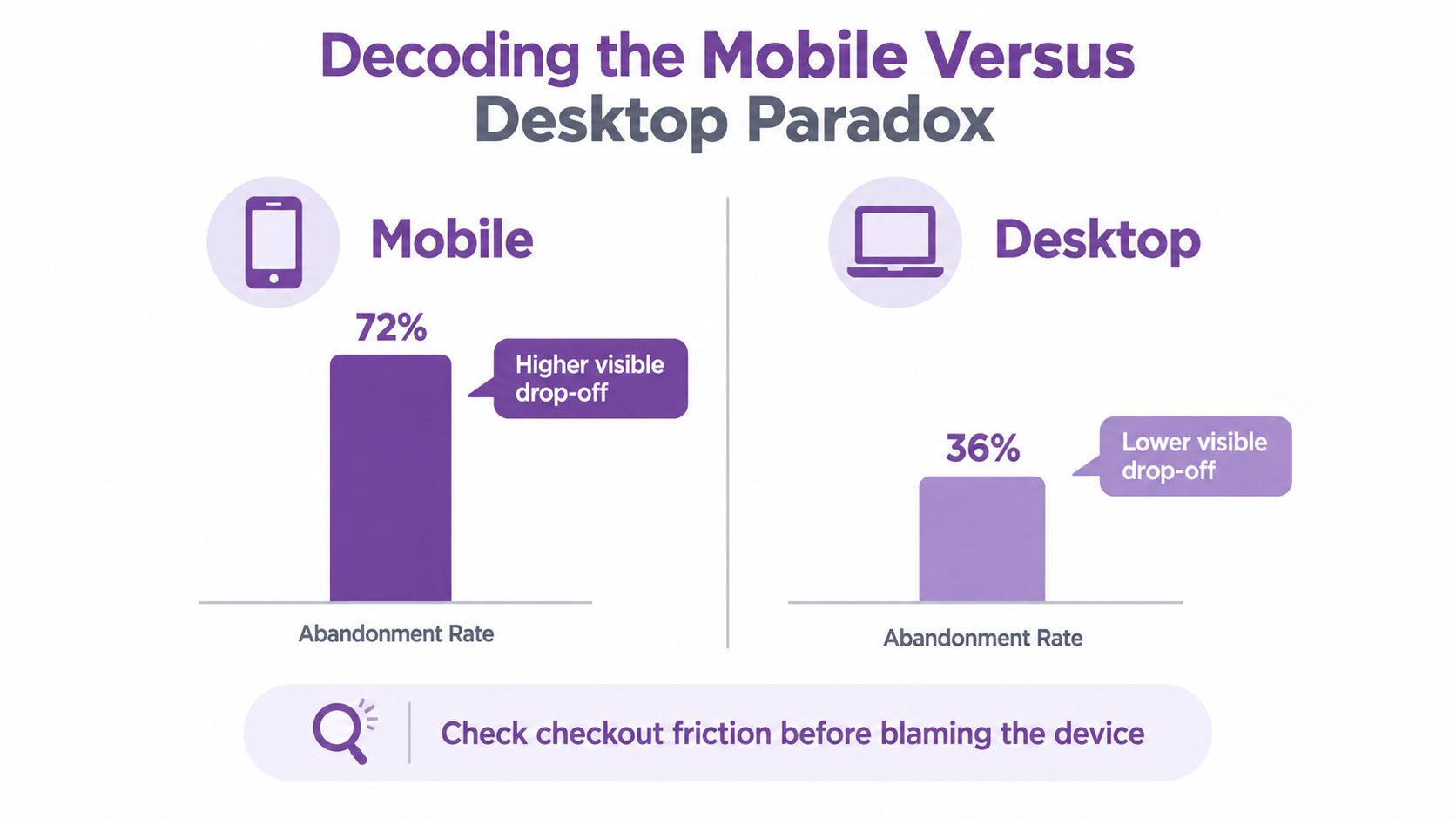
Mobile users may be browsing during a commute and completing the purchase later on a laptop. Desktop users may arrive through branded search or email with stronger intent. Unless you control for traffic source, product type, payment method, customer status, and cross-device behavior, the device comparison is descriptive rather than causal.
Compare behavior, not just abandonment
Baymard identifies several friction points that can affect mobile users disproportionately. 18% of shoppers cited a checkout that was too long or complex, 10% lacked a preferred payment option, and 14% abandoned because they couldn't see the total order cost upfront, according to Baymard's checkout research.
Audit mobile and desktop side by side:
- Checkout starts: Are mobile visitors reaching checkout at a similar rate after adding products?
- Payment failures: Do declines or processor errors cluster on one device?
- Page errors: Look for broken buttons, address-field problems, and layout shifts.
- Time to purchase: A longer mobile journey can indicate research behavior or usability friction.
- Returning-customer share: Existing customers may complete later through a recognized account or another device.
- Completed cross-device orders: Match consented users where your analytics and privacy practices allow it.
The recovery response should follow the diagnosis. If the mobile checkout is technically sound and shoppers return later on desktop, send a reminder with a preserved cart and a direct checkout link. If mobile users fail at a payment step, send help or an alternative payment route. A mobile-only discount is a poor substitute for a broken address field.
Device reporting tells you where shoppers leave. It doesn't tell you why.
Use deep links that reopen the relevant cart or checkout state, and test them on real phones rather than only in a desktop emulator. Keep the message short enough to scan, but make the destination specific. A generic homepage link forces the shopper to reconstruct the journey you were trying to recover.
Building High-Converting SMS Recovery Flows
SMS works best after you've removed the obvious onsite causes and identified shoppers with credible intent. Klaviyo's ecommerce research with Recharge found that 18% of customers prefer receiving abandoned-cart notifications by SMS, according to Klaviyo's ecommerce SMS research. That preference supports SMS as a channel, not as a reason to text every visitor.
Start with lawful consent
For U.S. promotional texts, compliance guidance summarizing TCPA and telemarketing requirements says merchants need prior express consent for covered marketing texts, must honor opt-outs immediately, and should obtain written consent before the first message, as explained in SMS compliance guidance on automated marketing texts.
Your popup should use an unchecked consent mechanism with clear disclosure. Identify the sending company, explain that marketing messages will be sent, state approximate frequency, clarify that consent isn't required to purchase, store the consent record, and provide a straightforward stop instruction such as replying STOP. Suppress messages after purchase or opt-out, and separate promotional recovery from transactional shipping notifications.
Design the flow around the obstacle
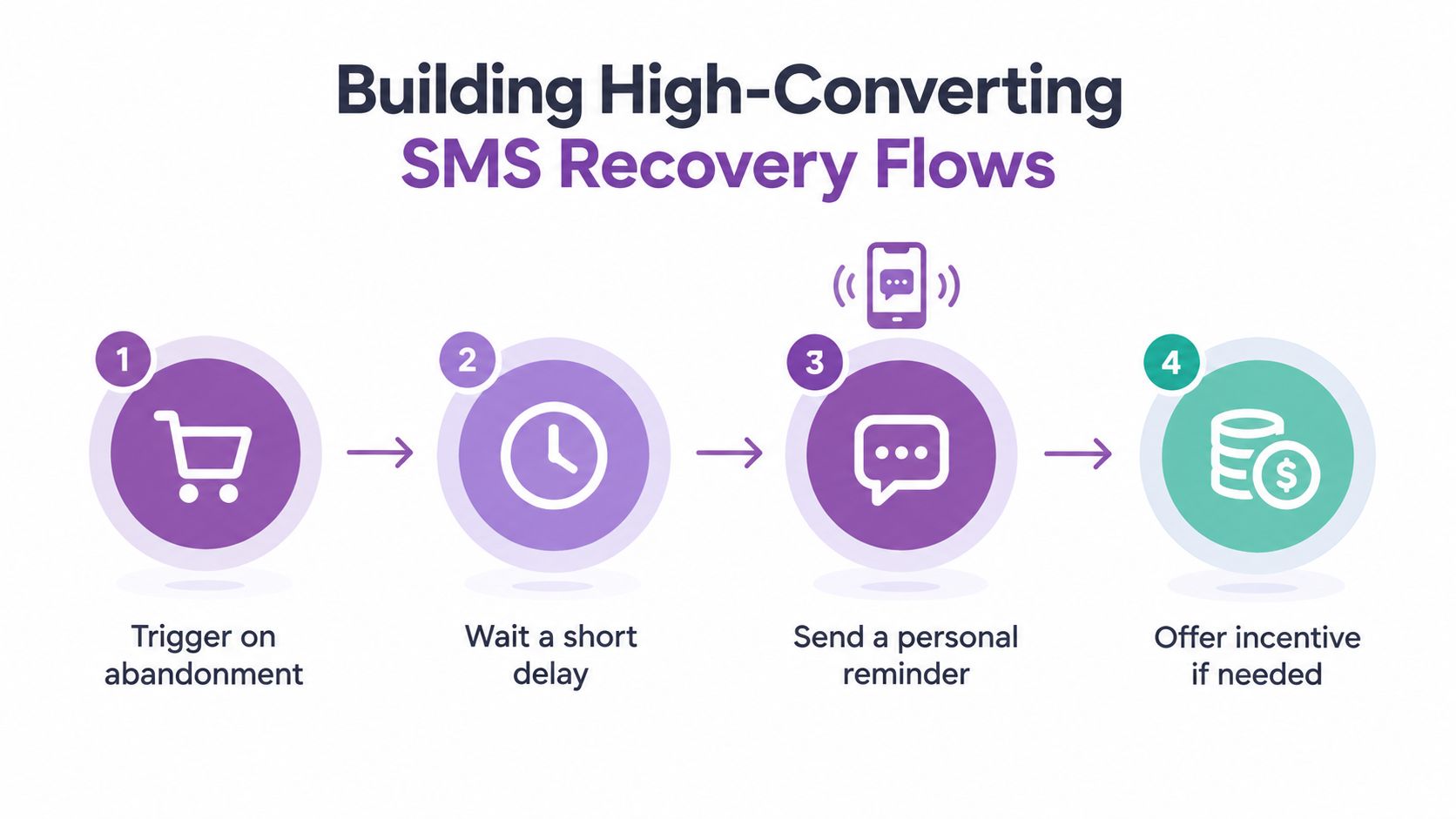
A practical sequence looks like this:
- Trigger on a meaningful event. Prefer an abandoned checkout, a supplied phone number with valid consent, or a known high-intent session. Exclude completed orders and recent support cases.
- Wait long enough to avoid interrupting the purchase. The delay should reflect your product's decision cycle and customer expectations, not an arbitrary urgency rule.
- Send a concise reminder. Include the item, the store identity, and a deep link back to the preserved cart or checkout.
- Escalate only when evidence supports it. Use reassurance for uncertainty, service help for technical friction, and a discount only when margin permits.
A first message should sound useful, not desperate. “Your checkout is saved. Review delivery details here” is more credible than a vague countdown. If the customer abandoned after a payment error, “Need another payment option?” creates a service path. If shipping was the obstacle, show the known cost or delivery estimate rather than hiding it behind a coupon.
Merchants that manage several stores often compare platforms, workflows, and agency support before automating. A practical guide to evaluating automation agencies can help clarify which work belongs in-house and which requires outside implementation.
For message ideas and varied recovery angles, see these abandoned-cart SMS examples. Whatever tool you use, build exclusions first. Don't send a recovery text after an order is placed, after a customer opts out, or while an unresolved support conversation is active.
Expanding SMS Beyond the Abandoned Cart
A recovery subscriber isn't only a discount opportunity. They may become a customer who wants delivery updates, product education, restock alerts, or a relevant recommendation. Treating SMS as a narrow rescue channel creates a list that hears from you only when you want another sale.
Post-purchase communication is often the most useful place to build trust. Shipping confirmations, delivery updates, and clear support instructions give customers information they already expect. Promotional messages should remain distinct, because a delivery notification and a product offer serve different purposes and may fall under different consent and operational rules.
Use behavior to choose the next message
A useful lifecycle can connect the original intent to the next action:
- A shopper who abandoned a product can receive a product-education message when uncertainty appears to be the barrier.
- A completed buyer can receive setup guidance, care instructions, or a complementary recommendation based on the purchased item.
- A customer who viewed a product repeatedly can receive a reminder without assuming a discount is necessary.
- A buyer who receives a delivery update can later enter a replenishment or review flow when the product category supports it.
The key is restraint. Don't turn every event into a broadcast. Set frequency controls, suppress irrelevant campaigns, and keep the promised value of the subscription visible.
A merchant using Shopify can combine checkout events, order data, viewed products, and support status to create these branches. YipSMS Inc. is one option for this type of workflow, with Shopify automations for cart and checkout abandonment, viewed-product follow-ups, shipping and delivery notifications, personalized recommendations, and analytics for delivery, failures, clicks, conversions, and revenue attribution.
The strongest retention programs make SMS feel like a customer-service utility with well-timed commercial moments. That positioning protects the list from discount fatigue and gives customers a reason to stay subscribed after the abandoned cart is no longer relevant.
Measuring the True ROI of Your SMS Campaigns
Cart recovery ROI gets distorted when every abandoned cart is treated as recoverable revenue. It is not. Some shoppers were comparing options, some were price checking, and some were ready to buy but hit friction. SMS pays off when it targets that last group, because high click volume from low-intent browsers can still erode margin through discounts, message costs, and support time.
Klaviyo recommends tracking delivery, click-through, and recovered-checkout rates. The useful denominator is delivered, consented recipients, not every shopper who left a cart. That keeps the analysis tied to people you could reach and who had enough intent to share a phone number.
A practical scorecard should cover both response and economics:
- Delivery rate: how many consented messages reached a handset
- Click-through rate: how many recipients returned to the checkout path
- Recovered checkout rate: how many recipients completed the order
- Revenue per recipient: attributed revenue divided by delivered recipients
- Profit after discounts: revenue minus discounts, message costs, refunds, and relevant variable costs
- Opt-out rate: a warning sign for weak targeting or too much frequency
- Incremental value: comparison against a holdout or another credible baseline when your setup allows it
Weak reporting usually breaks at this point. Attributed revenue flatters almost every recovery flow. A shopper may have come back anyway. A discount may get credit for a conversion that would have happened at full price. The signal vs self-congratulation framework is useful here because it forces a harder question: did the message change the outcome, or just claim it?
I prefer testing one meaningful variable at a time. Compare a service-led reminder against a product-led reminder. Compare a saved checkout link against a cart link. Keep audience rules stable so you can tell whether the change improved performance or just shifted who entered the flow.
Then segment the results by intent. First-time buyers, returning customers, high-AOV carts, and low-consideration products should not be judged the same way. Some cohorts can support an incentive. Others should get a reminder only, because the discount destroys profit without lifting conversion enough to matter.
The winning flow protects margin, keeps opt-outs under control, and recovers buyers who were close to purchasing. This SMS marketing ROI guide is a useful reference for structuring that calculation around revenue, cost, and attribution instead of vanity metrics.
Your 30-Day Cart Recovery Implementation Plan
A month is enough to build a disciplined foundation without launching every possible automation at once.
Week one, audit the checkout. Record abandonment by stage, device, payment outcome, and delivery selection. Fix visible total-cost issues, enable guest checkout, remove unnecessary fields, and test the complete path on real mobile devices.
Week two, capture consent correctly. Install an unchecked SMS consent mechanism with clear disclosures, store the consent record, and create suppression rules for purchases, opt-outs, and active support cases. Start with one high-intent audience rather than importing every available phone number.
Week three, launch the core flow. Send a concise reminder with the saved checkout link. Match the hook to the likely obstacle, and hold back discounts until your data shows that an incentive is necessary and profitable.
Week four, review economics. Compare delivered-recipient revenue, recovered checkouts, profit after discounts, clicks, failures, and opt-outs. Adjust timing and segmentation, then add one post-purchase notification or product follow-up once the recovery flow behaves reliably.
Don't judge the program by the global abandonment headline. Judge it by whether your store prevents avoidable friction, reaches consented high-intent shoppers, and turns recovery into profitable customer relationships.
YipSMS Inc. helps Shopify merchants collect SMS consent, automate cart and checkout recovery, send delivery and personalized follow-up messages, and measure clicks, conversions, and attributed revenue in one workflow. Visit YipSMS Inc. to explore a practical way to build and measure your cart recovery program.