Text Sign Up Free: Build a Compliant SMS List for Shopify
You've added a discount popup to your Shopify store, collected a few phone numbers, and watched the first campaign generate clicks. Then the less visible questions arrive. Did shoppers consent to marketing texts? Can the same form run legally in the United States, the UK, and the European Union? What happens when someone opts out of a cart-recovery flow but remains active in another automation?
A text sign up free offer can grow a valuable customer channel, but “free” only describes the incentive or software entry point. Message charges, compliance work, carrier filtering, discounts, and poor targeting can all create costs later. The strongest SMS programs treat list growth as a permission system, not as a phone-number collection exercise.
Table of Contents
- Why a Free Text Sign Up Is Your Best Growth Lever
- Setting Up Your Shopify SMS Popup Without Friction
- Navigating SMS Compliance and Consent Laws
- Crafting the Perfect Welcome Series
- Common Text Sign Up Mistakes and How to Avoid Them
- Choosing the Right SMS Marketing Tool for Your Store
Why a Free Text Sign Up Is Your Best Growth Lever
SMS can put a relevant offer directly in a shopper's hand, which gives a free text sign-up campaign unusually strong attention potential. That advantage only matters when the list contains people who knowingly agreed to receive messages from your brand. A large list with unclear consent is harder to message, harder to defend, and less valuable than a smaller list with a clear source and commercial intent.
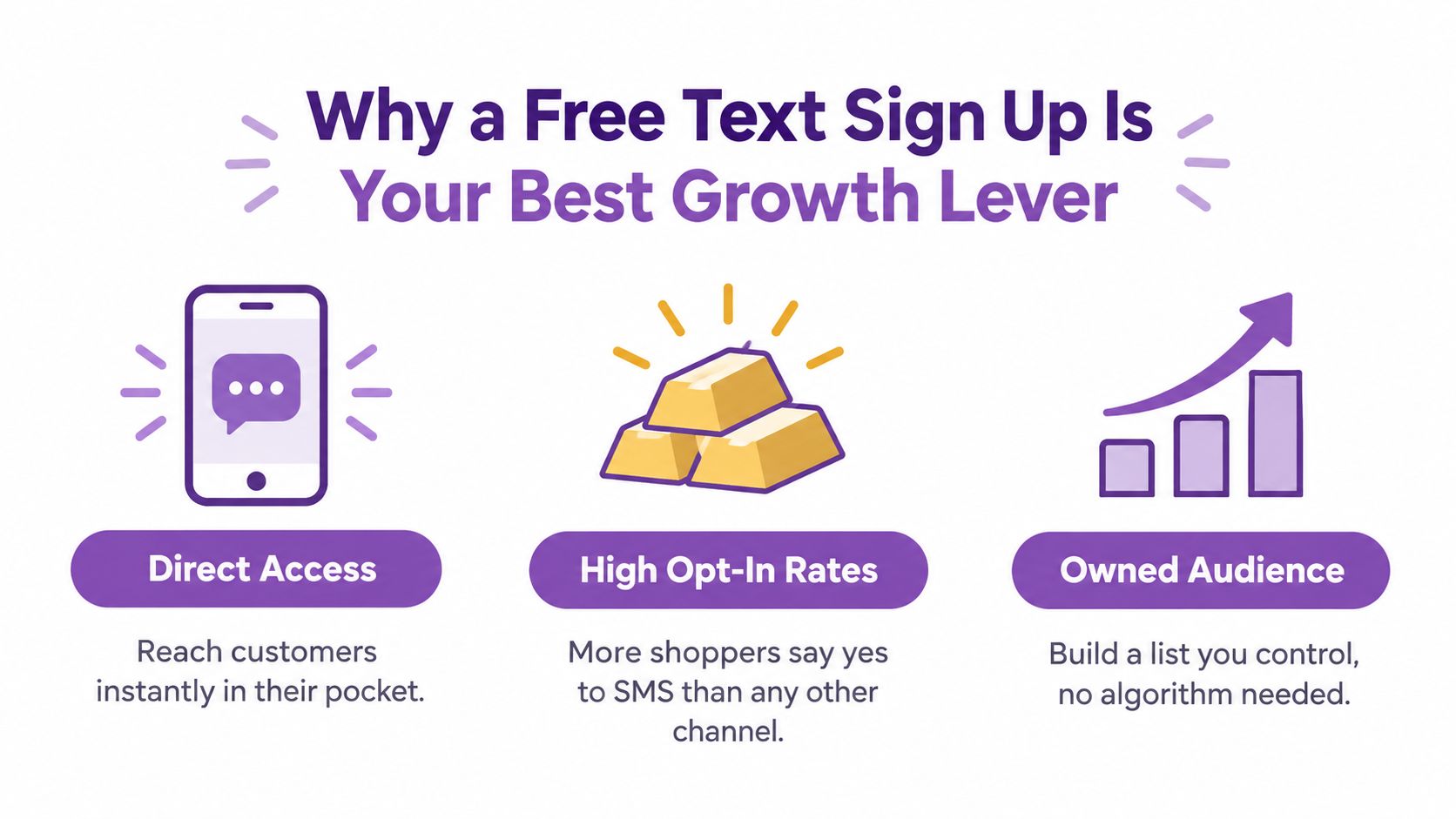
A 2025 survey reported that 84% of consumers had opted in to receive SMS messages from at least one business, representing a 35% increase compared with the level reported several years earlier. The same data reports an average 97% read rate within 15 minutes and says 63% of SMS subscribers had purchased from a text message during the previous three months. Those figures come from SimpleTexting's 2025 SMS marketing statistics, but they shouldn't be read as a guarantee for every store. Attention creates an opportunity. Relevance and consent determine whether you keep it.
The value exchange has to be obvious
A discount is a common reason to subscribe, but it isn't the only one. Early access, product alerts, delivery updates, useful customer service, and cart reminders can all make a phone number exchange feel worthwhile. The offer should tell shoppers what they'll receive and who will send it before they submit the form.
Email and SMS can work together, but they shouldn't be treated as interchangeable permissions. Email gives you room for product education and longer promotions. SMS is better suited to short, timely messages that a customer can understand immediately. A shopper who wants email updates hasn't necessarily agreed to promotional texts.
Practical rule: Build an audience you can prove was invited, informed, and given a simple way to leave.
Treat list growth as an owned operating asset
A popup is only the visible part of the system. Behind it, you need consent records, suppression handling, welcome automation, campaign segmentation, and reporting that distinguishes delivered messages from clicks and orders. That makes the channel more durable than relying solely on social reach or changing platform algorithms.
For merchants creating social creative around an offer, short product visuals can help explain the value exchange before a shopper sees the popup. A practical resource on best free image-to-video workflows for social ads can help turn static campaign assets into clearer promotional content without changing the underlying consent process.
The best free text sign-up flow is therefore not the one that collects the most numbers. It's the one that acquires people who understand the benefit, expect the messages, and are likely to buy from the store.
Setting Up Your Shopify SMS Popup Without Friction
Start with the smallest useful form. Ask for the mobile number, make the SMS permission separate from email permission, and explain the offer beside the submit button. Don't bury the important terms in a privacy policy that shoppers won't read while deciding whether to subscribe.
A practical popup setup looks like this:
- Choose a low-interruption trigger. Exit intent or a short engagement delay is usually more respectful than showing the form immediately on page load. On mobile, use a trigger that doesn't cover the entire product experience.
- State the benefit clearly. “Get an exclusive first-order offer by text” is more useful than “Join our VIP club” because it explains the exchange.
- Keep consent visible. Use an unchecked SMS checkbox, separate from email. Identify the brand, describe the message purpose or expected frequency, mention potential message and data rates, and explain that the shopper can reply STOP to opt out.
- Capture only what you need. Extra fields create friction before the shopper understands the value. You can collect preferences later through a welcome flow.
- Send subscribers into a controlled welcome journey. Don't treat the submit event as permission to send an immediate sequence of unrelated promotions.
If you're researching how shoppers provide a phone number for sign up, use that information to improve your form language and validation, not to bypass consent. A real customer relationship begins when the shopper knowingly gives your brand permission to message them.
Test friction without weakening disclosure
A one-field mobile-first form may attract more completions than a multi-step form, but a shorter form doesn't justify removing the consent explanation. Test a one-field version against a two-step version while keeping the SMS checkbox independent and the promise identical. Trigger the incentive after the visitor has engaged with the store or shown exit intent, rather than interrupting every landing-page visit.
Measure the quality of each variant, not just the number of submissions. Useful comparisons include signup rate, confirmed-consent rate, click-through rate, placed-order rate, revenue per recipient, and unsubscribe rate. The Shopify SMS marketing benchmark data places typical campaign click rates around 8.9% to 14.5%, placed-order rates around 1.0% to 2.0%, revenue per recipient around $0.66 to $2.41, and unsubscribe rates around 0.6% to 1.4% for a good performance range. The same source reports 3.81% click-to-conversion for automated messages versus 0.97% for campaigns, so a welcome or cart flow deserves separate reporting.
Use a tool that can store the source of the signup, pass the subscriber into automation, and suppress the number across every relevant flow. For a detailed implementation reference, Shopify merchants can also review how to create a text message sign-up flow.
The popup is successful only when the next steps work. Confirm the subscription where appropriate, deliver the promised benefit, and prevent an opted-out customer from being re-added by a later checkout or cart event.
Navigating SMS Compliance and Consent Laws
A phone number collected during checkout isn't automatically marketing permission. The same applies to a number used for delivery updates, customer support, or account security. Keep transactional and promotional permissions separate so your store can show exactly what the customer agreed to receive.
A detailed consent record should preserve:
- The permission wording. Store the exact text shown at the time of signup, not only a generic label such as “SMS opt-in.”
- The source and context. Record the form version, source URL, timestamp, phone number, and user agent.
- The sender identity. The customer should know which brand will send the texts.
- The message purpose. Explain whether the messages contain promotions, product updates, cart reminders, or another category.
- The suppression event. After an opt-out, suppress the number across campaigns and automations, and retain the suppression record.
A practical market matrix
| Market | Consent focus | Store implementation |
|---|---|---|
| United States | U.S. SMS marketing is shaped by TCPA, FCC rules, and industry messaging guidance. The FCC's one-to-one consent rule adopted in 2023 was vacated in January 2025, which adds uncertainty for merchants relying on older guidance. | Use explicit marketing language, a separate unchecked SMS consent control, clear STOP instructions, and synchronized suppression records. Review the TCPA compliance checklist for SMS marketing before launch. |
| European Union | GDPR generally requires consent to be freely given, specific, informed, and unambiguous. | Keep SMS consent separate from email and general terms. Explain the sender, purpose, and withdrawal method, and preserve the evidence of consent. |
| United Kingdom | PECR generally requires specific consent before marketing texts are sent. Permission for email, phone calls, or a generic “electronic mail” category doesn't automatically authorize marketing texts. | Use a separate, unticked SMS checkbox naming the brand and text-message purpose, as outlined in the ICO's PECR guidance. |
| Canada and Australia | These markets operate under separate frameworks, so a U.S. or EU form shouldn't be assumed to cover them. | Localize disclosure, opt-out handling, retention, and sending practices by destination. |
The CTIA Messaging Principles recommend express written consent for U.S. marketing messages and say online forms can qualify when the opt-in clearly identifies the message type and how permission can be revoked. CTIA guidance also recommends recognizing natural-language opt-outs such as “stop,” “end,” “unsubscribe,” “cancel,” “quit,” and phrases such as “please opt me out.” Store owners can review the CTIA Messaging Principles and Best Practices and its guidance on natural-language opt-outs.
Compliance isn't finished when the checkbox is published. Test the opt-out route in welcome messages, abandoned-cart flows, scheduled broadcasts, and post-purchase notifications. A customer who replies STOP shouldn't receive a promotional text because another automation uses a separate audience.
Crafting the Perfect Welcome Series
The first message should deliver exactly what the popup promised. If the shopper signed up for an offer, send the offer or explain how to use it. If the promise was early access or product alerts, don't replace it with a generic brand announcement.

SMS rewards relevance because subscribers usually expect a short, useful interaction. Research cited in Attentive's texting statistics reports an average 97% read rate within 15 minutes, while 63% of subscribers reported purchasing from a brand text during the previous three months. The same source reports that 75% of consumers preferred SMS for promotional content over other marketing methods. High visibility makes a weak message more noticeable too, so don't use the channel as a dumping ground for every promotion.
Build the sequence around intent
A useful welcome journey can progress from the promised benefit to a reason to trust the store, then to a relevant product prompt:
- First contact: Confirm the subscription, deliver the promised incentive, identify the brand, and include the opt-out instruction.
- Value message: Explain what subscribers will receive, such as restock alerts, early access, or targeted offers. Keep the content connected to the signup promise.
- Product guidance: Recommend a product category or answer a common buying question. Link to a focused destination rather than the homepage when possible.
- Conversion prompt: Present a clear next action only when it fits the subscriber's behavior and stated interest.
This doesn't mean every subscriber should receive the same content. A person who joined from a running-shoe product page has given you a useful signal. A person who joined from a broad homepage offer has given you less specific intent, so the first follow-up should remain broader.
Protect the relationship after the welcome
Frequency is where many stores lose good subscribers. The industry data reports that 53% of consumers cited receiving too many messages as their leading reason for unsubscribing, so set a deliberate sending policy before launching. Suppress purchasers from acquisition-focused messages, stop cart reminders after an order, and avoid sending a broadcast while a subscriber is already receiving a time-sensitive automation.
Use message-level reporting to judge the series. A click is useful, but it isn't the final outcome. Review delivered messages, clicks, placed orders, revenue per recipient, discount cost, and unsubscribe behavior together. A message that produces clicks but trains customers to wait for unnecessary discounts may look strong in isolation while weakening contribution margin.
Common Text Sign Up Mistakes and How to Avoid Them
The most damaging mistakes usually happen before the first campaign. A store asks for email and phone permission in one vague sentence, collects a phone number for shipping, or hides the SMS terms beneath a crowded submit area. The resulting list may look healthy in the dashboard while the business lacks reliable proof of promotional consent.
Errors that reduce trust
- Bundling email and SMS consent: A shopper may want order emails but not marketing texts. Give each channel its own unchecked control and explanation.
- Using the checkout phone field as permission: A fulfillment number is not automatically a promotional opt-in. Capture marketing consent as a separate event.
- Requesting unnecessary details: Name, birthday, gender, and product preferences can wait unless the value exchange explains why you need them.
- Overpromising the incentive: If the discount excludes sale items or expires under specific conditions, disclose that before submission.
- Skipping confirmation: Where legally and operationally appropriate, use a confirmation or double-opt-in step so the record reflects an intentional subscription.
- Ignoring free-text opt-outs: Your platform should process natural-language requests, not only one keyword.
- Measuring the wrong success signal: List size alone says nothing about valid consent, delivery, profitability, or incremental orders.
Deliverability deserves its own dashboard. A 2025 benchmark covering 246 million campaign sends and 20 million automation sends across 27,000 brands reported 96.6% campaign deliverability versus 92.8% for automations in Omnisend's SMS marketing benchmarks. Campaign and automation performance shouldn't be blended because a scheduled broadcast and an abandoned-cart message travel through different operational contexts.
Abandoned-cart SMS can be useful, but it must remain consent-gated. Klaviyo's ecommerce SMS guidance cites average online cart abandonment at about 70% and says 18% of customers preferred abandoned-cart notifications by SMS. Those are broad reference figures, not a forecast for your store. Use them to justify a test, then measure recovered revenue per recipient, conversion, unsubscribe behavior, and incremental sales against a holdout group.
“Free” also has a boundary. Even if the signup software has no initial fee, you may still pay for messages, discounts, regional delivery, compliance review, and wasted sends. Calculate contribution margin after those costs before increasing automation frequency.
Choosing the Right SMS Marketing Tool for Your Store
Choose the tool around operational control, not the popup alone. A visually polished form won't protect the store if the platform can't record consent language, recognize opt-outs, suppress subscribers across flows, or distinguish a delivered text from an order.
For a small store, a simple Shopify-native app with a popup builder and basic automation may be enough. A growing brand should prioritize segmentation, confirmation workflows, cart and checkout triggers, analytics, and exportable consent records. A team managing several stores may need stronger user permissions, reusable templates, regional controls, and reporting that separates campaigns from automations.
| What to compare | What to verify before choosing |
|---|---|
| Popup setup | Can you control timing, mobile layout, fields, and consent wording? |
| Consent management | Does the system preserve source, timestamp, wording, and suppression status? |
| Automation | Can it stop a cart flow after purchase or opt-out? |
| Reporting | Can you see delivered messages, clicks, orders, revenue per recipient, and unsubscribes separately? |
| Pricing | Are message charges, regional rates, discounts, and trial limits clear? |
| Shopify workflow | Does the app connect signup events to products, carts, orders, and customer status? |
YipSMS Inc. offers a Shopify-focused option with one-click setup, a 14-day free trial, rates starting at $0.015 per SMS, a drag-and-drop popup designer, and prebuilt cart and checkout abandonment flows, as described on its Shopify SMS app page. Those features address the initial setup problem, but merchants should still verify how consent records, opt-outs, regional sending, and message costs work for their own markets.
The right tool won't compensate for an unclear offer or excessive frequency. Start with one consent-led popup, one welcome flow, and one measurable automation. Add broader campaigns only after the store can explain where each subscriber came from and what financial result the channel produces.
YipSMS Inc. provides Shopify merchants with a free-trial entry point, popup tools, consent-oriented signup workflows, and automation for cart and checkout recovery. Visit YipSMS Inc. to evaluate whether its SMS setup and pay-as-you-go approach fit your compliant text sign-up strategy.
How this article was made: the YIPSMS team drafts some articles with AI writing tools, then checks pricing, compliance and product details against how YIPSMS actually works before publishing. Spotted something wrong? Tell us through your YIPSMS account.