Abandoned Cart Campaign Timing and SMS Guide
In 2024, the Dynamic Yield data reported by eMarketer put the global average cart abandonment rate at 73.9% during the 12 months ending July 2024. That's not a checkout bug you fix once. That's the normal shape of ecommerce demand, where most shoppers who add an item leave before paying. An effective abandoned cart campaign doesn't try to chase all of them with more texts and bigger coupons. It sends one consented SMS at a tested delay, matches the message to why the shopper left, moves later nudges to email, and proves the order wouldn't have happened anyway. Anything more aggressive usually trades margin and trust for orders you can't prove you caused.
Table of Contents
- When to Send an Abandoned Cart Campaign
- How to Build the Flow from Consent to Send
- Messages That Match Why They Left
- Measure Recovery and Fix What Lags
- Launch One Compliant Flow This Week
When to Send an Abandoned Cart Campaign
Mobile is where your recoverable carts are sitting. In 2024, data cited by PayPal put mobile sessions at an 85.65% average cart abandonment rate, compared with 80.74% for tablets and 73.07% for desktops. If your recovery plan starts with a desktop friendly email and treats SMS as a louder reminder later, the order is backwards. The first touch belongs on the phone. It does not belong in the first few minutes.
Why Minute 30 Is the Wrong Default
A text at minute 30 feels responsive. It can also interrupt a shopper who is still comparing sizes, checking a bank app, or planning to come back on their own. The randomized study summarized by BLKDG involved more than 40,500 customers and found reminders sent 30 minutes to one hour after abandonment could reduce purchases relative to sending no reminder, while reminders delivered one to three days later produced a positive incremental effect. SMS field tests have shown the same double edged pattern: send too early and you either pay for an order the shopper was going to place anyway, or you sour one you could still have won.
That doesn't mean waiting three days for your one U.S. cart text. U.S. promotional cart reminders work inside a narrower window: express consent, double opt in, one SMS per abandonment event, delivery within 48 hours. It means speed isn't the lever most operators think it is. I would test a delayed window against your current send time and against a small no message holdout before moving the text anywhere closer to the abandonment.
A fast text proves your automation works. A delayed text that beats a holdout proves your campaign works.
The Default Schedule to Lock In
Use this schedule as your starting flow, then test one timing change at a time. The single SMS names the exact item, links to the live cart, and carries no coupon. Email does the slower work of explaining price, delivery, and returns, so the text never has to argue.
Default abandoned cart send schedule
| Touch | Timing | Channel | Message job |
|---|---|---|---|
| First reminder | 2 to 12 hours after abandon | One consented SMS | Name the item and link the live cart, no coupon |
| Price and delivery note | About 24 hours | Shipping, tax, returns, and guest checkout | |
| Browser follow up | 1 to 3 days | Email only | Useful product detail, no second U.S. cart SMS |
| Hard stop | 48 hours for the SMS | Automation rule | Expire the text and suppress on purchase or STOP |
Here's how to read each row in practice:
- 2 to 12 hours, SMS: You've given the shopper room to finish on their own, and you're still close enough that the product name means something. Keep the text to the item, the saved cart, and the link.
- About 24 hours, email: You answer the shipping, tax, return, and guest checkout questions that don't fit cleanly in one text screen.
- 1 to 3 days, email only: Browsers who weren't ready get a fit note, a review, or a care detail. They don't get urgency they didn't earn and you can't support.
- 48 hours, hard stop: The text expires. A purchase, a sold out variant, or a STOP reply kills the flow immediately, not at the next campaign review.
If you sell on Shopify and want the checkout side tightened alongside the send timing, Grumspot's strategies for recovering Shopify sales are a useful companion for reducing abandonment before recovery has to do all the work. Pick one row from the table, make it live exactly as written, and don't add a second SMS because the first week feels quiet. Quiet is data if your holdout is running.
How to Build the Flow from Consent to Send
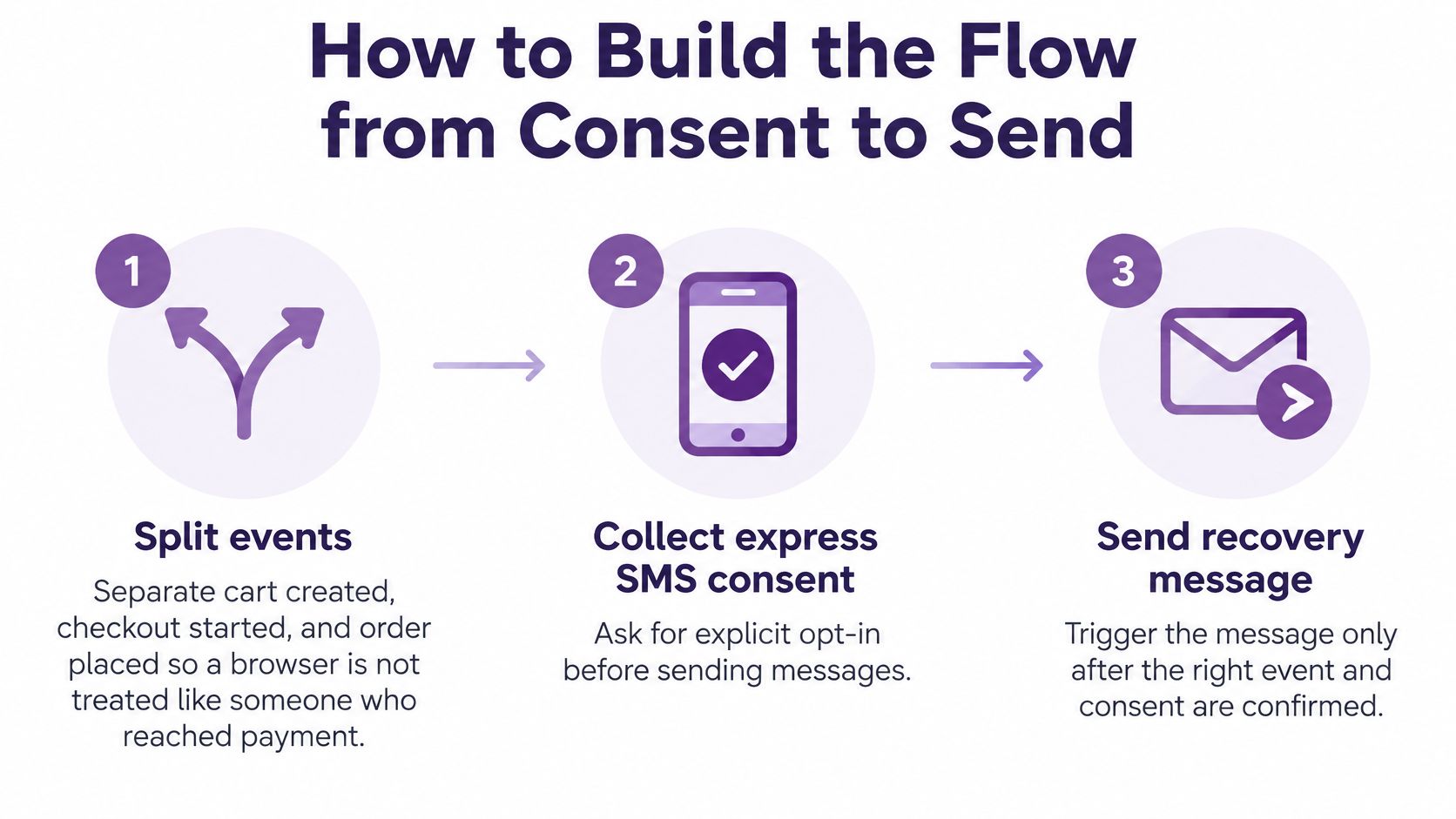
Build the flow in the order below. Each step prevents a specific failure, usually a text sent to the wrong person, about the wrong cart, at a price that no longer exists.
The flow below shows the core logic from event split to consented send.
The Seven Build Steps
- Split the events first. Separate cart created, checkout started, and order placed so a browser isn't treated like someone who reached payment. This split is what lets you send a plain reminder to high intent shoppers and education to browsers instead of blasting both groups with the same offer.
- Collect express SMS consent. Your opt in must clearly cover cart reminder texts, and you need to store the timestamp and source. A phone number typed into a shipping form is contact information for delivery. It is not permission to market. The Klaviyo help guidance for U.S. cart abandonment SMS states the recipient must have expressly agreed to receive cart reminders, double opt in must be enabled, only one SMS may be sent per recipient for the abandonment event, and the message must be delivered within 48 hours of the trigger.
- Save the cart exactly as left. Preserve variant, quantity, price, currency, and the checkout URL under one stable cart or checkout identifier. If the text can't return the shopper to that exact cart, don't send it. A generic homepage link after a specific product reminder wastes the tap.
- Set the delay, cap, and expiry. Delay the SMS into the 2 to 12 hour band, cap it at one message per abandonment, and expire it at 48 hours. A checkout started shopper can use the same clock as a cart created shopper, but they still get only one cart reminder SMS.
- Suppress before you send. Exclude anyone who already bought, unsubscribed, lacks valid consent, or whose item is out of stock. Skip people already in a post purchase thread. Suppression isn't housekeeping at the end. It's the control that keeps a recovery flow from texting a customer who paid ten minutes ago.
- Make the message self identifying. Include your brand name, required disclosures, and an opt out instruction such as STOP. Use a trackable short link that returns to the same saved cart. If you're checking your consent records and disclosures before launch, work through this TCPA compliance checklist for SMS programs and fix gaps while the flow is still in draft.
- Hold out a random slice. Route a random portion of eligible abandoners to receive nothing. Without that group, you'll credit the text for orders from shoppers who were always coming back, and every later decision about discounts will rest on inflated revenue.
A Worked Example on Shopify Timing
Say a shopper creates a cart at hour 0 and starts checkout without ordering. By hour 2 there's still no order, so the same clock keeps running. At hour 3, one consented SMS names the item, shows the live price pulled at send time, and links to the saved cart.
At hour 24, an email covers the full price, delivery window, returns, and guest checkout path. On day 2, a browser focused email adds one useful product detail. At hour 48, the SMS opportunity expires for good.
For example, if you hold out 10% of eligible abandoners at random in this setup, that group receives nothing so you can measure lift instead of guessing at it. Before you enable anything, send a test to your own number. Tap the link on your phone and confirm the variant, quantity, price, and currency still match the cart you left. If any field is stale, fix the data sync before you touch the copy.
Messages That Match Why They Left
A generic reminder assumes the shopper forgot. Most didn't. They saw a price, a delivery estimate, an account wall, or a form they didn't want to finish, and they made a decision. Your message has to answer that decision, not just announce that the cart still exists.
Baymard research summarized in the Mediovsky cart abandonment benchmark reports that 42% of U.S. online shoppers abandoned a cart because they were merely browsing or not yet ready to buy, while unexpected additional costs such as shipping, taxes, and fees were cited by 40%. It also reports 20% said delivery was too slow, 19% did not trust the site with their card information, 18% objected to being required to create an account, and 17% found checkout too long or complicated.
What the recovery message should do by abandon reason
| Reason | Share | Text should | Avoid |
|---|---|---|---|
| Just browsing or not ready | 42% | Later email with one useful detail | An immediate coupon |
| Extra costs too high | 40% | Landed cost and delivery window | Hiding fees behind the link |
| Delivery too slow | 20% | An honest ship window | Fake same day urgency |
| Did not trust the site with card details | 19% | A return to the familiar checkout | Asking for card details by SMS |
| Forced to create an account | 18% | A guest checkout path | Another login wall |
| Checkout too long or complicated | 17% | A deep link to the same cart | A new long landing page |
Two Texts That Do Different Jobs
For a high intent shopper who reached checkout, one line is enough:
Your order is ready, almost. The linen shirt, medium, oat, is still in your cart and checkout is saved: [link]. Reply STOP to end.
That text works because it reduces effort. It names the exact item and variant, confirms nothing was lost, and gives one reason to tap that isn't a vague call to shop now. Add the shopper's first name only when your consent form captured it. A wrong name is worse than no name.
For cost shock, don't open with a coupon. Say what the shopper needs to evaluate the purchase:
Brand name: Your cart is saved. Your full total, including shipping and tax, is shown at checkout before you pay, and standard delivery runs in the window listed there: [link]. Guest checkout is available. Reply STOP to end, HELP for help.
You're not hiding the fees behind the link and hoping momentum carries the sale. You're telling the shopper where the complete total sits and removing the account obstacle in the same message. If you need starting language for compliant, scannable copy, adapt these sample text messages for ecommerce flows to your exact cart fields rather than copying a discount led template.
Personalization and the Discount Rule
Personalize with four things you can verify at send time: the shopper's first name when captured, the exact item and variant, the live price, and the saved cart link. Keep every SMS to one screen and one link. Your opt in wording should also name cart reminder texts specifically, state message frequency, and include STOP and HELP instructions, so the shopper recognizes the message they agreed to receive.
A browser who wasn't ready shouldn't get squeezed into the SMS slot with a percentage off. That shopper waits for email and gets a review, a fit note, or a restock fact. Offer a one time code only after a no discount version has run long enough to establish a baseline, and only for the price sensitive segment. I would not train every abandoner to wait for a text with money in it.
Measure Recovery and Fix What Lags
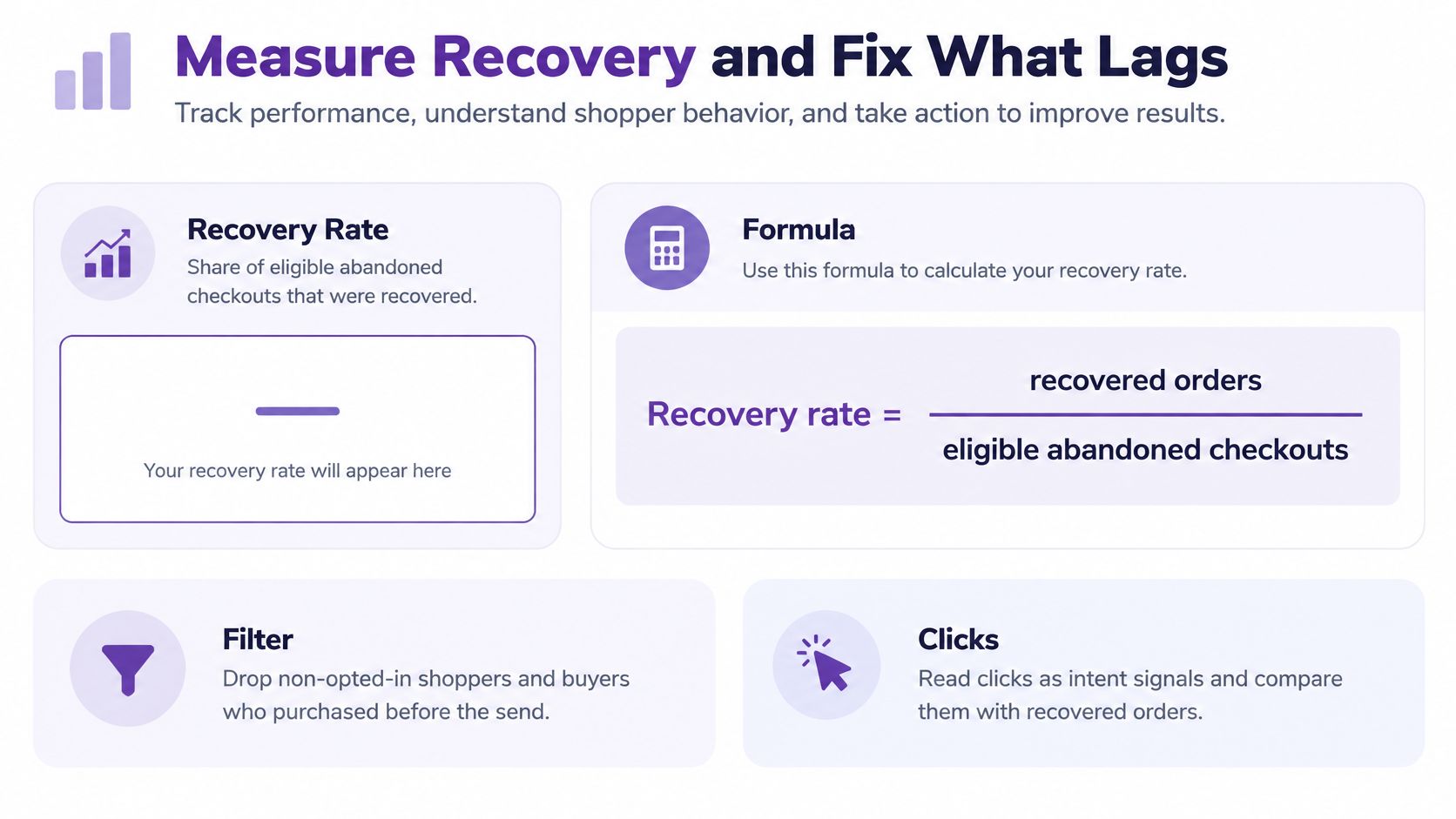
Start with one definition and refuse to let anyone change it later. Recovery rate = recovered orders divided by eligible abandoned checkouts. Eligible means the shopper abandoned, had valid consent for the channel you're measuring, and hadn't already purchased before the send. Drop non opted in shoppers and pre send buyers from the denominator. If you leave them in, you'll understate performance for the audience you could legally reach and argue about the wrong problem for weeks.
The dashboard below frames that formula and the filters that keep it honest.
Clicks Are Diagnostics, Not Revenue
Click rate tells you whether the message earned a tap. It doesn't tell you whether the cart, price, payment step, or trust signals survived that tap. The Klaviyo abandoned cart benchmark report lists average abandoned cart click rates of 6% for email and 10.3% for text messaging. Treat those figures as engagement benchmarks, not conversion guarantees. The same source framework points you toward click to order rate, recovered revenue per recipient, contribution margin after discounts and messaging fees, and incremental orders versus a randomized holdout.
A strong click rate with weak orders is a failed campaign wearing a good costume. It usually means shoppers returned and hit the same wall again. That wall might be a repriced cart, a sold out variant, a payment error, a forced account, or a landing page that made them rebuild the order. Rewriting the hook won't fix any of those. Trace the stable cart identifier through the click and into checkout, then look at where sessions die after the tap.
Revenue per recipient gives you a second check on whether automation deserves priority over another broadcast. The Klaviyo SMS benchmarks by industry compare average email campaign revenue of $0.11 per recipient with $3.65 for abandoned cart flows in benchmark data covering more than 3 billion ecommerce texts, roughly 33 times more in that comparison. Use that spread to justify building the triggered flow well. Don't use it as your forecast. Your number depends on consent coverage, cart value, margin, and how much revenue survives the holdout test.
Cart recovery metrics worth tracking
| Metric | How to read it | Benchmark |
|---|---|---|
| SMS click rate | Clicks divided by delivered cart texts | 10.3% |
| Email click rate | Clicks divided by delivered cart emails | 6% |
| Recovery rate | Recovered orders divided by eligible abandoned checkouts | Your own baseline |
| Flow revenue per recipient | Attributed revenue divided by recipients | About $3.65 |
| One off campaign revenue per recipient | Revenue divided by recipients | About $0.11 in the email comparison |
| Incremental orders | Orders in the send group minus the holdout | Must beat the no message group |
Segment Before You Rewrite Anything
Aggregate results hide the fix. Break recovery rate, click to order rate, unsubscribe rate, and contribution margin by device, country, new versus returning customer, product category, and traffic source. Each cut points to a different owner and a different repair.
- Mobile clicks, mobile stalls: Don't rewrite the text first. Complete the checkout on a phone with your thumb, zoom enabled, and no autofill. If fields jump, labels disappear, or the payment button sits below a wall of optional inputs, you've found the problem.
- New shoppers stall, returning shoppers convert: Look at trust and account friction. Returning customers already believe you'll ship the product and process a return. New shoppers need the familiar checkout, clear returns, and no surprise account requirement.
- One category underperforms: Check variant accuracy, stock status, delivery promises, and price changes for that category before you blame subject lines or send time. A stale price in one product feed can poison an otherwise sound flow.
- One country underperforms: Check currency, landed cost display, delivery windows, and localized consent language. A cart recovered in the wrong currency isn't a copy problem.
The video below is useful as a walkthrough companion while you audit your own funnel stages against these segments.
Fix Checkout Before You Add Incentives
The ceiling on your recovery messaging is set by the checkout you're sending people back to. Baymard's 2025 checkout usability research puts average cart abandonment at 70.19% and reports that 65% of sites have mediocre or worse checkout usability, while only 2% are rated good. If your checkout sits in that mediocre majority, a second coupon is a weak lever. You're paying shoppers to tolerate friction you could remove once.
Practical rule: Do not raise the offer until you can watch a stranger complete your checkout on a phone without help.
Work the fixes in this order. Show total landed cost early enough that the cart link doesn't deliver a second surprise. Keep guest checkout visible. Cut form elements that don't affect payment, delivery, fraud checks, or legal requirements. Preserve the exact variant and quantity through the return link, and suppress the message the moment inventory fails. None of that is glamorous. All of it raises the value of every click you already earn.
Accessibility belongs in the same audit, not in a separate compliance folder. Test the cart and the return link with keyboard navigation, a screen reader, browser zoom, visible error messages, and mobile assistive technology. Check that labels are programmatically tied to fields, contrast survives on a bright phone screen, and product images don't carry essential information without text. If a shopper abandoned because they couldn't operate the checkout, a well timed text sends them back to the same barrier with more urgency attached.
Test One Lever and Price the Result
Test send time inside the legal window first, then incentive versus no incentive, then creative. Change one lever at a time and keep the holdout running through each test. If you change timing and add a code in the same week, you'll learn that revenue moved and nothing about why.
Calculate contribution margin after the discount, product cost, shipping subsidy, and message fee, then divide by eligible abandoners. Kill any code that loses money after those costs, even if attributed revenue looks impressive in the platform dashboard. For a cleaner view across flows and broadcasts, use SMS campaign analytics that connect clicks to orders and reconcile against completed checkouts, not delivered messages.
Cap frequency so several open carts from one shopper become one thread, not a stack of reminders. Never text an expired cart, never show a price you can't honor, and don't squeeze extra sends into the final hours of a sale to rescue a daily target. Those habits produce unsubscribes and complaints that cost you reach on the next launch. A smaller, consented audience that trusts your texts will outperform a larger list trained to ignore them. If clicks hold, orders lag, and the holdout keeps converting on its own, your next dollar belongs in checkout repair. Spend it there before you spend it on a bigger discount.
Launch One Compliant Flow This Week
Don't launch a program. Launch one flow that passes three gates, run it for a week against a holdout, and let the result tell you what to build next.
The Three Go Live Gates
Gate one, consent is on file. Express SMS consent covers cart reminders, double opt in is enabled for the U.S. flow, and the message carries your brand name with STOP language. If you can't produce the consent record for a recipient, that recipient isn't in the flow. There's no partial credit for having collected a phone number for shipping updates.
Gate two, the clock is locked. The single cart text fires between 2 and 12 hours after abandonment and expires at 48 hours. Purchase, cancellation, sold out inventory, and unsubscribe all suppress the send immediately. Test this on your own phone with a real cart before a customer tests it for you.
Gate three, later nudges move to email. The price, delivery, and returns explanation goes out by email at about 24 hours. The browser follow up stays in email on day 2 or 3. If a step can't justify itself without becoming a second U.S. cart text, cut that step.
Fix the Exit, Then Check the Template
Before you raise any offer, fix the top checkout exit for your store. For most Shopify merchants that's surprise shipping revealed too late or a forced account sitting between the shopper and payment. Show the delivery cost and the guest path earlier, then rerun the same no coupon text. You'll learn whether the barrier was price presentation or genuine price sensitivity, and those two problems deserve very different budgets.
If you run Shopify, YipSMS is the route to set this up without building the plumbing yourself. Installation takes one click on Shopify, and a first Scratch to Win popup and abandoned cart automation can be launched in under 10 minutes. Complete the sender registration it requires, then set the send count, the delay inside your legal window, and the suppression rules yourself. The platform sends what you build. It does not decide the structure for you.
That last point matters most with the prebuilt templates. Our abandoned cart automation sends follow ups at 2h, 24h and 48h, which means you must cut that template to one SMS for U.S. promotional cart reminders and move the later nudges to email. Don't enable a three text ladder and assume the legal constraint has been sorted for you. Every campaign automatically adds opt out language, and we handle STOP and HELP responses, but verifying the send structure is still your job.
After a week, compare recovered orders in the send group with orders in the holdout. Look at contribution margin after message fees and any discount cost, then check unsubscribes by segment. If the lift is real and the margin holds, test a tighter offer for the price sensitive segment only. If the lift isn't real, don't send more. Go back to the checkout step where shoppers are dying and fix that.
You don't need a louder abandoned cart campaign. You need one consented text, sent after the shopper has had room to decide, that returns them to a checkout worth finishing.
Ready to build that single, compliant cart text without stitching together separate tools? YipSMS Inc. gives Shopify stores one click setup, prebuilt cart and checkout abandonment automations, and real time analytics to compare recovered revenue against your costs. You configure the send count, timing, and suppression rules to match the flow you designed. Visit us today, launch your first flow this week, and measure the lift against a holdout before you spend a dollar on discounts.
How this article was made: the YIPSMS team drafts some articles with AI writing tools, then checks pricing, compliance and product details against how YIPSMS actually works before publishing. Spotted something wrong? Tell us through your YIPSMS account.