Abandoned Cart Timing That Recovers More Sales
Roughly seven in ten shopping carts never become completed orders, with Baymard Institute's 14-year checkout research placing the global average abandonment rate at approximately 70.19%. That rate has stayed close to 70% despite mobile shopping, digital wallets, one-click payments, and better checkout technology. Baymard's checkout-usability research makes the commercial opportunity clear, but the clock alone won't recover every order.
The useful question isn't merely, “What's the best time to send an abandoned-cart message?” It's, “What stopped this shopper, and how quickly can I address it without creating more friction?” Effective abandoned cart timing matches the message type to the shopper's intent, product category, device, and unresolved concern.
Table of Contents
- Why Timing Decides Your Cart Recovery Results
- The Optimal Send Windows for Email and SMS
- Building Your Shopify Abandonment Flow
- Timing by Segment and Product Type
- A/B Testing Your Timing the Right Way
- SMS Compliance and Frequency Guardrails
- Your Timing Playbook to Launch This Week
Why Timing Decides Your Cart Recovery Results
An abandoned cart signals interest, not purchase readiness. Baymard found that 42% of U.S. online shoppers had abandoned a cart in the previous three months because they were “just browsing” or not ready to buy. That finding makes one point clear: recovery needs both speed and restraint.
Some shoppers compare prices. Others check delivery terms, read reviews, wait for payday, or need more confidence before committing. A reminder while the product is still fresh can bring them back. A message that assumes they forgot may ignore the actual objection.
Timing is therefore an intent-capture problem. The shopper has selected products and created a recoverable event, but the next message must match the reason for the delay. Reminder messages preserve momentum. Problem-resolution messages address delivery, returns, payment, trust, or price concerns.
The first minutes carry context
Soon after checkout exit, the shopper still remembers the product, offer, and page they were viewing. A short reminder can restore the cart without making them search again. It should feel useful, not forceful.
Use the first touch to remove effort or uncertainty. A product image and “complete your purchase” link will not resolve unclear delivery information. A preserved checkout link paired with clear delivery or returns details has a better chance of addressing that hesitation.
Practical rule: Start with the smallest helpful intervention. Protect your margin until testing shows that price caused the abandonment.
The first message should remain a reminder when intent appears high and no clear obstacle is known. If the shopper reached a payment field, encountered a shipping surprise, or viewed returns information, the next touch should solve that friction instead of repeating the same prompt.
One average hides several kinds of abandonment
A first-time visitor considering a low-value impulse product behaves differently from a returning customer weighing an expensive purchase. A mobile shopper who reaches payment may need reassurance that checkout works on their device. A repeat customer may only need the cart restored.
Broad recovery guidance can provide a starting point, but it should not become a permanent rule. Separate high-intent delay, checkout friction, and price resistance in your flow. Each group calls for a different message and, often, a different delay.
For a broader abandoned cart recovery framework, map the message to the friction first. Send soon enough to retain context, then give the shopper a concrete reason to continue. Testing can identify useful patterns, but it cannot prove that one send time will work for every product, audience, or channel.
The Optimal Send Windows for Email and SMS
The first recovery message should arrive after the cart qualifies as abandoned, while the purchase is still fresh in the shopper's mind. Shopify generally treats a checkout as abandoned after an identified shopper enters an email address and leaves the order incomplete for more than 10 minutes. Shopify's checkout guidance supports waiting approximately 10–15 minutes before triggering a sequence. That delay gives an active shopper time to finish payment.
Use this as a starting schedule:
- First email: Send a reminder without a discount after the abandonment threshold. For an impulse product, that may be within the first hour. The message should restore the cart and avoid creating price resistance where none exists.
- Second email: Test a follow-up around 20–48 hours later. Address a likely problem, such as delivery timing, returns, product benefits, or trust.
- SMS follow-up: Send one text later in the sequence only to shoppers who explicitly consented, still qualify for recovery, and have not purchased.
- Final email: Consider a final message around 48–72 hours when consent, inventory, and frequency limits allow. Then suppress the cart sequence instead of applying pressure indefinitely.
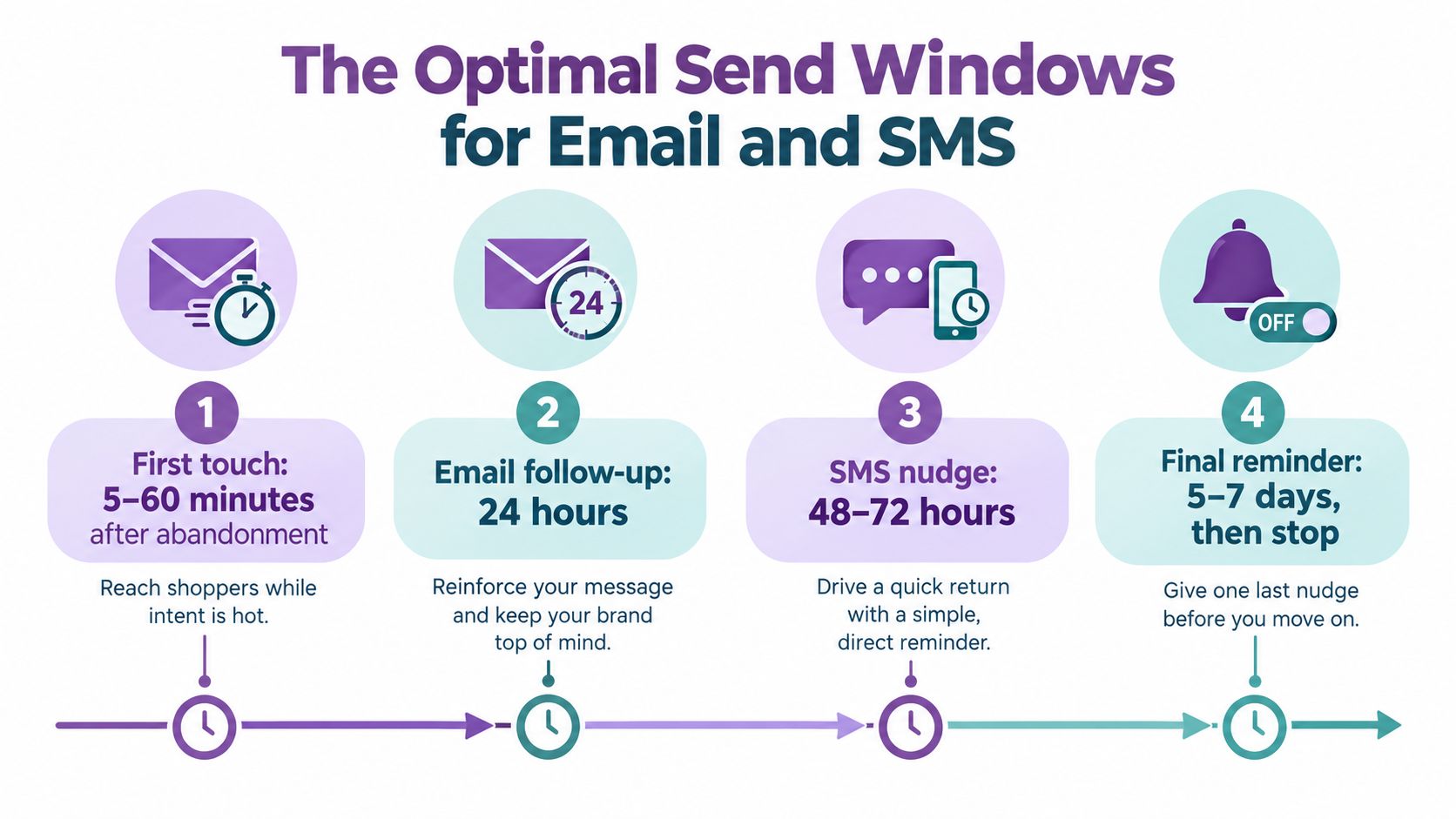
Published timing guidance offers 2–4 hours after checkout begins for the first abandoned-checkout message, followed by a second email 20–48 hours later. Another framework suggests 30–60 minutes for low-value impulse purchases, 1–4 hours for typical direct-to-consumer products, and 4–24 hours for high-consideration purchases. Klaviyo's timing guidance provides test ranges, not a universal rule.
The friction should determine the message. A reminder fits high-intent delay when no obstacle is visible. If the shopper encountered a shipping surprise, reached a payment field, or examined returns information, the next touch should resolve that concern. Repeating “complete your purchase” at the wrong moment adds no value.
Email supports product details, cart contents, delivery information, return policies, and several touches. SMS needs a narrower job: restore the cart, answer one likely concern, and make the next action clear.
Why email usually comes before SMS
Email gives shoppers room to assess the order and lets you test whether a reminder is enough before using a higher-attention channel. SMS works better later, after the shopper has opted in and your automation confirms that no purchase occurred.
Do not send a text solely because an email was unopened. The cause may be deliverability, inbox behavior, or a weak subject line rather than a need for another contact.
Compare your schedule with CleanMyList email timing research, then measure placed orders from your own flow. The best time to send text messages can provide another reference, but consent, product type, friction, and incremental orders should set the final schedule.
Building Your Shopify Abandonment Flow
A reliable Shopify recovery flow starts with the checkout event, not a ready-made message. Collect the shopper's email or phone number through an appropriate consented process. Record the cart contents, product details, cart value, checkout stage, device context where available, and exact abandonment timestamp.
Shopify generally treats a checkout as abandoned after an identified shopper has entered an email address and left the order incomplete for more than 10 minutes. Set the first action for approximately 10–15 minutes after abandonment. That pause gives an active shopper time to complete payment and reduces reminders sent during a temporary delay. Shopify's checkout recommendations provide the operational basis for that delay.
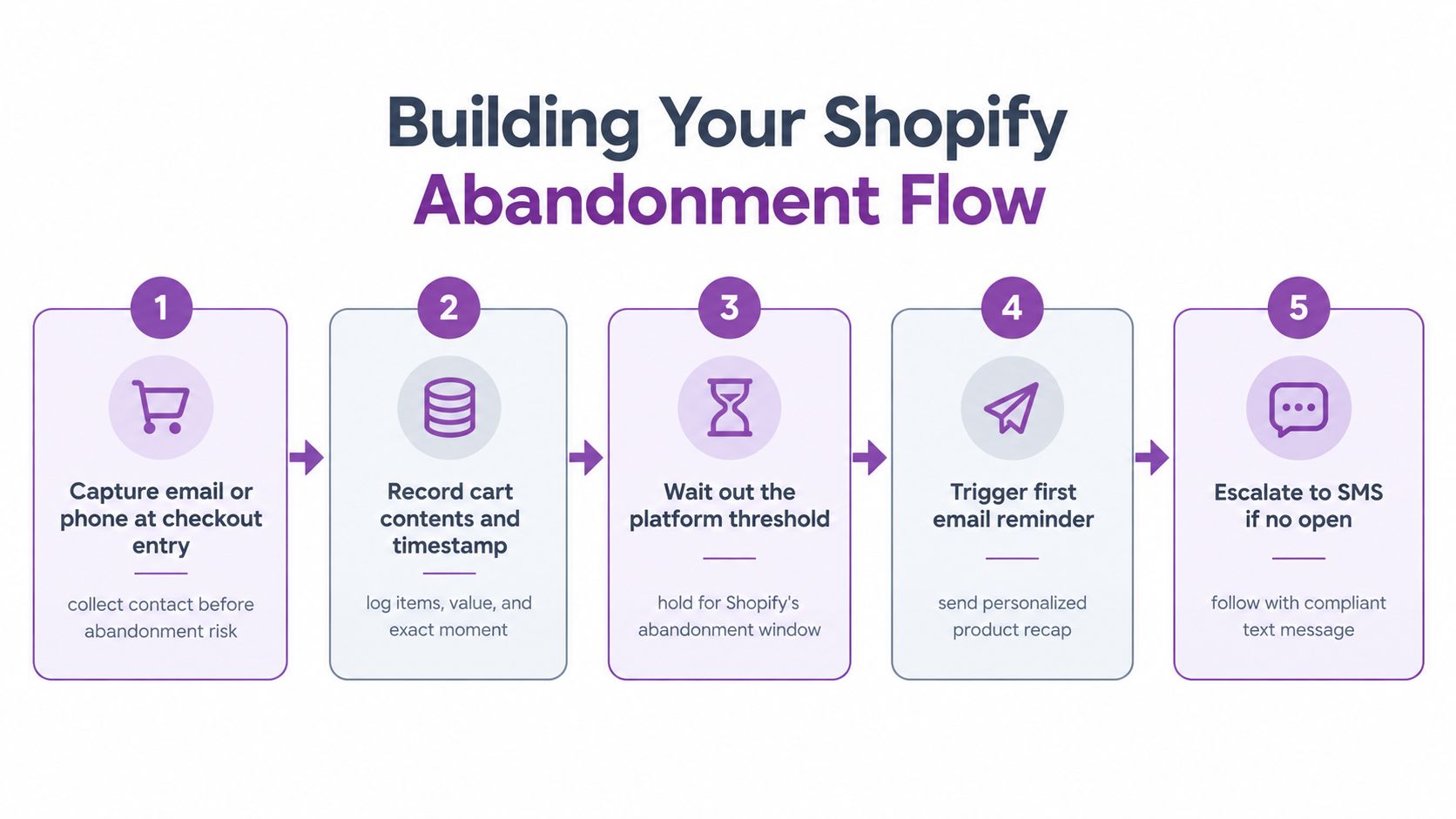
Build the trigger and suppression logic
The first email should show the shopper's actual products and link directly to the preserved cart or checkout. Sending them to a homepage or asking them to rebuild the order adds unnecessary work. Keep this touch as a reminder when the session shows high intent but no clear obstacle.
Use a different branch when the checkout reveals friction. If the shopper reached shipping details, payment, returns information, or another point that suggests a concern, make the next message answer that concern. A reminder asks the shopper to return. A problem-resolution message gives them a reason to continue.
Create purchase suppression at the same time. As soon as Shopify records a completed order, remove the customer from every pending abandoned-cart email and SMS path. This protects the customer experience and prevents a message telling someone to finish an order they have already paid for.
Apply one frequency policy across channels. Separate email and SMS automations can otherwise send overlapping reminders. Use a shared event identifier or profile condition so each channel can see whether the cart remains active, whether a purchase occurred, and whether another message has already been sent.
Make the mobile path earn its place
Every message should open the preserved cart in a mobile browser, without sending the shopper back through the storefront. Test the link while logged out, across different mobile browsers, and while the product remains available. Confirm that variants, quantities, shipping details, and payment options survive the return path.
Before launch, verify these items:
- Event capture: Email or phone collection occurs before abandonment and records the correct timestamp.
- Cart restoration: The link returns to the exact cart or checkout, not a generic product page.
- Cost clarity: Shipping, taxes, fees, and delivery expectations appear before payment.
- Consent separation: SMS consent is stored separately from general email consent.
- Purchase suppression: A completed order immediately exits every recovery branch.
- Frequency control: Email and SMS automations cannot send overlapping reminders.
- Mobile usability: The restored checkout works in mobile browsers.
- Inventory behavior: The message changes or stops if an item becomes unavailable.
YipSMS Inc. offers Shopify cart and checkout abandonment automations with configurable timing, preserved-cart links, and follow-up messaging controls. Configure any tool around your consent records, suppression rules, and margin targets.
Use this video as a visual reference while reviewing the flow structure:
Timing by Segment and Product Type
A low-value impulse purchase doesn't need the same delay as a considered purchase with delivery, sizing, or trust questions. Product category should influence the first touch, while customer status and device should shape the content.
The more important distinction is between a reminder message and a problem-resolution message. A reminder works when the shopper was distracted or needed more time. A problem-resolution message works when the shopper saw an unexpected cost, couldn't complete a field, questioned delivery, or didn't trust the checkout.
In 2025 U.S. survey data, extra costs such as shipping, taxes, and fees were cited by 39% of respondents, slow delivery by 21%, forced account creation by 19%, and checkout complexity by 18%. The Statista survey data shows why a generic “finish your order” reminder often misses the point.
Recommended First-Touch Timing by Segment
| Segment | First-Touch Delay | Best Channel | Message Type |
|---|---|---|---|
| Low-value impulse product | 30–60 minutes | Email, then SMS if consented | Product reminder with a direct cart link |
| Typical direct-to-consumer product | 1–4 hours | Email first | Product benefits, delivery, and returns |
| High-consideration product | 4–24 hours | Trust, reviews, specifications, and support | |
| First-time customer | After the checkout threshold | Reassurance, clear policies, and payment help | |
| Known customer | Within the tested category window | Email or consented SMS | Familiarity, replenishment context, and preserved cart |
| Mobile checkout exit | Soon after the threshold | Mobile-optimized email or SMS | Delivery clarity, payment options, and checkout assistance |
| Price-sensitive shopper | Later in the sequence | Email, then consented SMS where permitted | Incentive only after informational recovery fails |
These are starting ranges, not promises. The right answer depends on your own product economics and friction signals. A returning customer abandoning a replenishment product may respond to a simple restoration link, while a first-time buyer needs evidence that the brand will deliver what it promises.
Match the message to the friction
If shipping or taxes created the hesitation, show the total cost and delivery expectations rather than hiding behind urgency. If forced account creation caused the exit, point the shopper toward guest checkout if your store supports it. If the shopper encountered a long form, make sure the restored path doesn't restart the same obstacle.
A trust concern calls for returns information, secure payment reassurance, customer support access, or relevant product evidence. A discount should come later and only to a segment where price sensitivity is plausible. Early blanket discounts protect short-term conversion at the expense of margin and can teach shoppers to abandon intentionally.
Segmenting by product type, device, cart value, first-time versus known customer, and traffic source gives you a clearer operating picture. Use customer data segmentation for Shopify marketing to structure those branches, but keep the first version manageable. A few meaningful splits beat a complex flow with unreliable data.
A/B Testing Your Timing the Right Way
Open rates and clicks tell you whether a message attracted attention. They don't tell you whether the timing created an incremental order. A shopper may click, return through another channel, and purchase without being credited correctly. Another shopper may open every message and never intend to buy.
A defensible test compares at least three schedules, with equal audience allocation:
- Immediate reminder: The first eligible contact soon after the abandonment threshold.
- Same-day reminder: A later contact within the same day.
- Delayed multi-touch sequence: A first reminder followed by later messages.
Predeclare the success metric before launching. Incremental orders per 1,000 abandoned carts is a practical option because it connects the schedule to completed purchases rather than attention metrics. The available timing-test guidance associates first contact within 60 minutes with materially higher recovery than waiting 24 hours, but that benchmark is a hypothesis, not a controlled universal standard.
Keep a holdout group
A randomized holdout group receives no recovery message during the test window. Compare each schedule with that group, not just with the previous automation. Without a holdout, you can't separate message-driven orders from purchases that would have happened anyway.
Track the complete path:
- Delivery: Did the message reach an eligible recipient?
- Click-through: Did the shopper engage with the message?
- Checkout re-entry: Did the shopper return to the preserved checkout?
- Placed order: Did the shopper complete the purchase?
- Revenue per recipient: What value did each recipient generate?
- Unsubscribe and complaint rate: Did the schedule damage permission or trust?
- Margin after discounts: Did recovered revenue remain profitable?
Don't exclude non-deliverable recipients from the original denominator after seeing the results. Don't stop a test because one early message produced a few orders. And don't credit the final touch automatically when several contacts contributed to the decision.
Test friction resolution against promotion
A useful experiment changes more than the delay. At the same send window, compare an informational message with a promotional one. The informational version might explain shipping, returns, payment, or product details. The promotional version might present a discount only after the first reminder fails.
Run that comparison by product category instead of treating the store as one audience. High-consideration products may need reassurance, while impulse products may respond to a fast restoration link. Evaluate conversion alongside average order value, gross margin, and opt-outs so a higher order count doesn't hide a weaker business result.
SMS Compliance and Frequency Guardrails
For U.S. SMS cart-abandonment programs, consent and message limits are operating requirements. Recipients must explicitly agree to receive cart-abandonment reminders, SMS collection should use double opt-in, the flow should send no more than one SMS per recipient, and the message must be delivered within 48 hours of the triggering event. Klaviyo's compliance guidance also calls for cart-abandonment disclosures in the mobile terms of service and privacy policy.
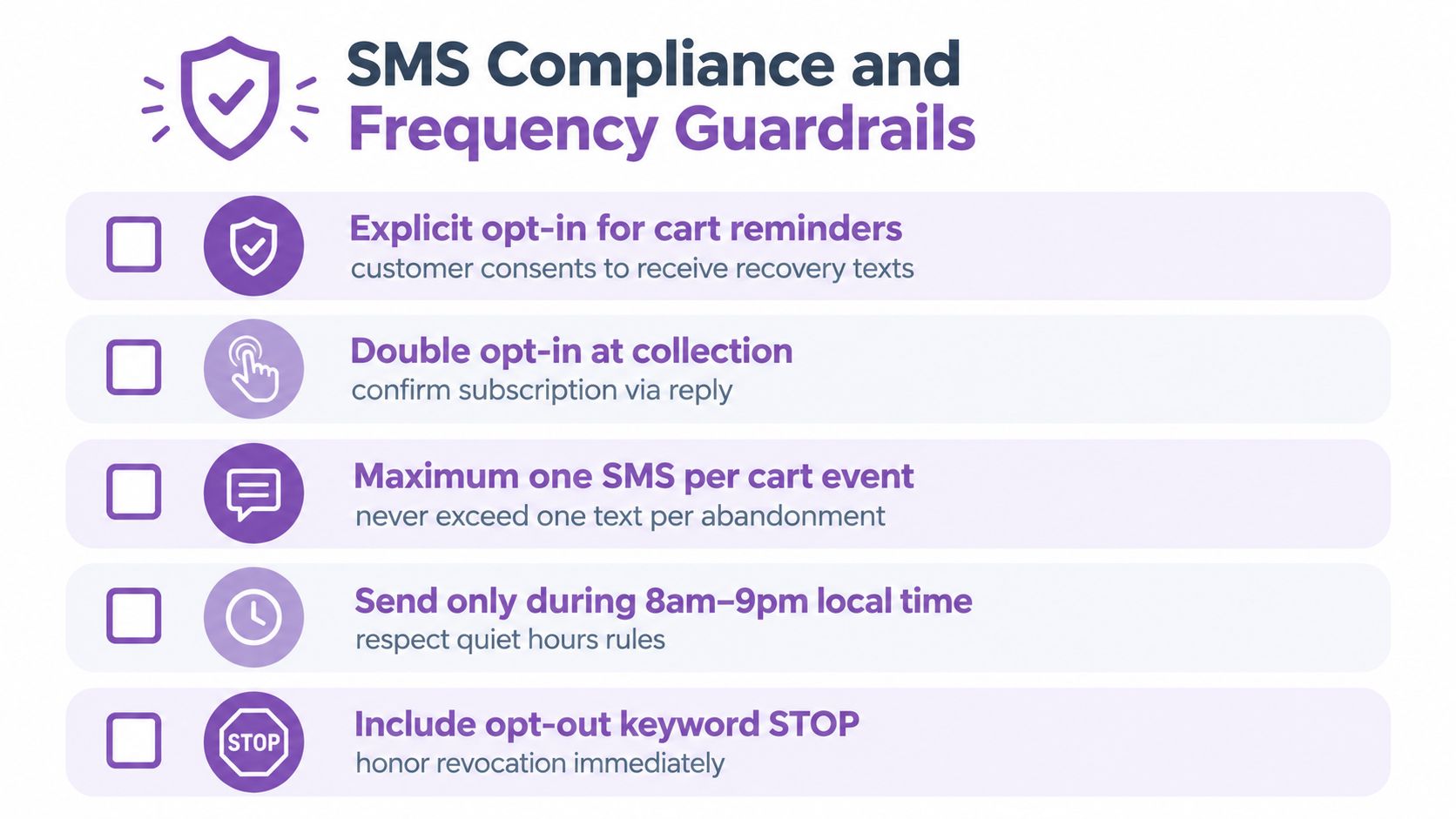
Translate each requirement into a Shopify control:
- Separate consent: Don't treat email permission as SMS permission.
- Store the event: Record when, where, and how the shopper agreed to receive texts.
- Use double opt-in: Confirm the subscription before entering the shopper into SMS recovery.
- Set one-message logic: Allow one SMS per abandonment event, not one SMS per automation branch.
- Apply the cutoff: Stop the flow at the 48-hour boundary.
- Suppress on purchase: Remove the shopper immediately after checkout completion.
- Honor revocation: Stop future messages when the recipient withdraws permission.
The compliance image includes operational safeguards such as local sending windows and opt-out handling. Your final setup should also reflect the requirements that apply to your business, recipients, carrier, and jurisdiction. When rules are uncertain, get advice from qualified counsel instead of relying on a template.
Your Timing Playbook to Launch This Week
Start with a simple Shopify sequence. Wait through the abandonment threshold, send an early non-discount email with a preserved-cart link, follow up around 24 hours, then send one consented SMS later in the allowed window if the shopper hasn't purchased. A final email around 48–72 hours can make sense where consent, inventory, and frequency limits permit.
Customize that baseline by product category and shopper context. Use faster reminders for impulse purchases, more time and reassurance for high-consideration items, and problem-resolution copy when shipping, delivery, trust, account creation, or checkout complexity likely caused the exit. Reserve discounts for later or for clearly price-sensitive segments.
Run one clean test first. Compare immediate, same-day, and delayed multi-touch schedules with equal allocation, a holdout group, and incremental placed orders as the primary measure. Keep the message constant while testing timing, then test informational versus promotional content once you know the schedule is sound.
Finally, audit the checkout itself. Baymard's research reports an average of 11.3 checkout form fields, and says 22% of users have abandoned because checkout was too complex. The Baymard checkout collection also reports that 14% of users abandon when a phone number is required, while 39% of ecommerce sites fail to explain why the phone field is needed. Recovery messages can help, but they can't permanently repair a checkout that creates the abandonment in the first place.
YipSMS Inc. provides Shopify cart and checkout abandonment automations, configurable email and SMS timing, consent-aware subscriber flows, and real-time campaign analytics for stores that want a practical recovery system. Visit YipSMS Inc. to set up a focused abandoned-cart flow and test timing against your own orders, margins, and customer behavior.