Abandoned Cart vs Abandoned Checkout: A Practical Guide
The most popular advice on abandoned cart vs abandoned checkout gets the priority wrong. Most Shopify merchants start with an abandoned-cart SMS flow because “cart abandonment” is the familiar phrase. I'd start with abandoned checkout instead. It's the stage Shopify can identify more reliably, the shopper has shown stronger buying intent, and the recovery message has a clearer path back to payment.
Baymard's global cart-abandonment average was 70.19% on April 29, 2025, meaning roughly 7 in 10 carts didn't become completed purchases. The benchmark has stayed close to that level for more than a decade, which makes abandonment a structural ecommerce problem, not a temporary campaign issue. Baymard's checkout usability research provides the useful baseline, but the operational question is more specific: which abandoned shoppers can you identify, contact, and measure without wasting sends?
For Shopify brands using SMS marketing, the answer is checkout first. Build cart recovery afterward, once your checkout flow is producing clean data and your reporting can separate the two behaviors.
Table of Contents
- Why This Distinction Actually Matters for Your Store
- What Each Term Means and Where It Happens
- Side by Side How the Two Funnel Stages Differ
- Benchmarks and Why Recovery Numbers Vary
- SMS Flow Design for Each Abandonment Type
- Which Flow to Build First and Why
- Setting Up Your First Recovery Automation
Why This Distinction Actually Matters for Your Store
“Abandoned cart” and “abandoned checkout” are often used as if they mean the same thing. They don't. They describe different moments, different levels of intent, and different recovery options.
A shopper who adds a product and leaves before checkout has created an abandoned cart. That shopper may be anonymous. Shopify might not have an email address or phone number, so SMS recovery may not be possible. A shopper who reaches checkout, provides contact information, and leaves before payment has created an abandoned checkout. That record is much more useful because Shopify can associate the event with a person.
Shopify's documentation says an abandoned checkout is counted only after the shopper has provided email information and the checkout remains incomplete for more than 10 minutes. Shopify also notes that items in the cart at abandonment aren't saved in the same way. These rules make the distinction important for attribution, recoverability, and automation. See Shopify's abandoned checkout documentation for the platform definition.
The decision comes down to data
Use this sequence before you build any automation:
- Name the event. Did the shopper add an item, or did they start checkout?
- Check identity. Do you have a permitted email address or phone number?
- Match the message to intent. A cart reminder should reduce uncertainty. A checkout reminder should remove the final obstacle.
- Measure the correct denominator. Don't combine cart sessions and checkout sessions into one abandonment rate.
Practical rule: If Shopify can't reliably identify the shopper and confirm SMS permission, it can't reliably run a compliant recovery text.
This is why a merchant can spend money on an SMS platform yet see limited reach from a cart flow. The automation may be technically active, but most anonymous cart visitors never qualify for a message. Checkout recovery starts with a smaller but more actionable audience.
What Each Term Means and Where It Happens
An abandoned cart occurs when a shopper adds at least one product to the cart and leaves before starting checkout. The event sits in the middle of the purchase journey. The shopper has expressed interest, but hasn't confirmed shipping details, payment intent, or contact information.
In Shopify, cart behavior is often inferred from storefront activity, browser state, and the cart object. The visitor might be identifiable if they're logged into a customer account, recognized through Shop, or already provided contact details. Otherwise, the cart belongs to an anonymous session. You can still improve that experience with better product pages, transparent shipping information, and faster checkout, but you may not be able to send a direct SMS reminder.
An abandoned checkout happens later. The shopper has started checkout, entered contact information, and stopped before payment creates a confirmed order. Shopify records these events under Orders > Abandoned checkouts when its identification conditions are met. That gives you a stronger behavioral signal and a clearer recovery destination.
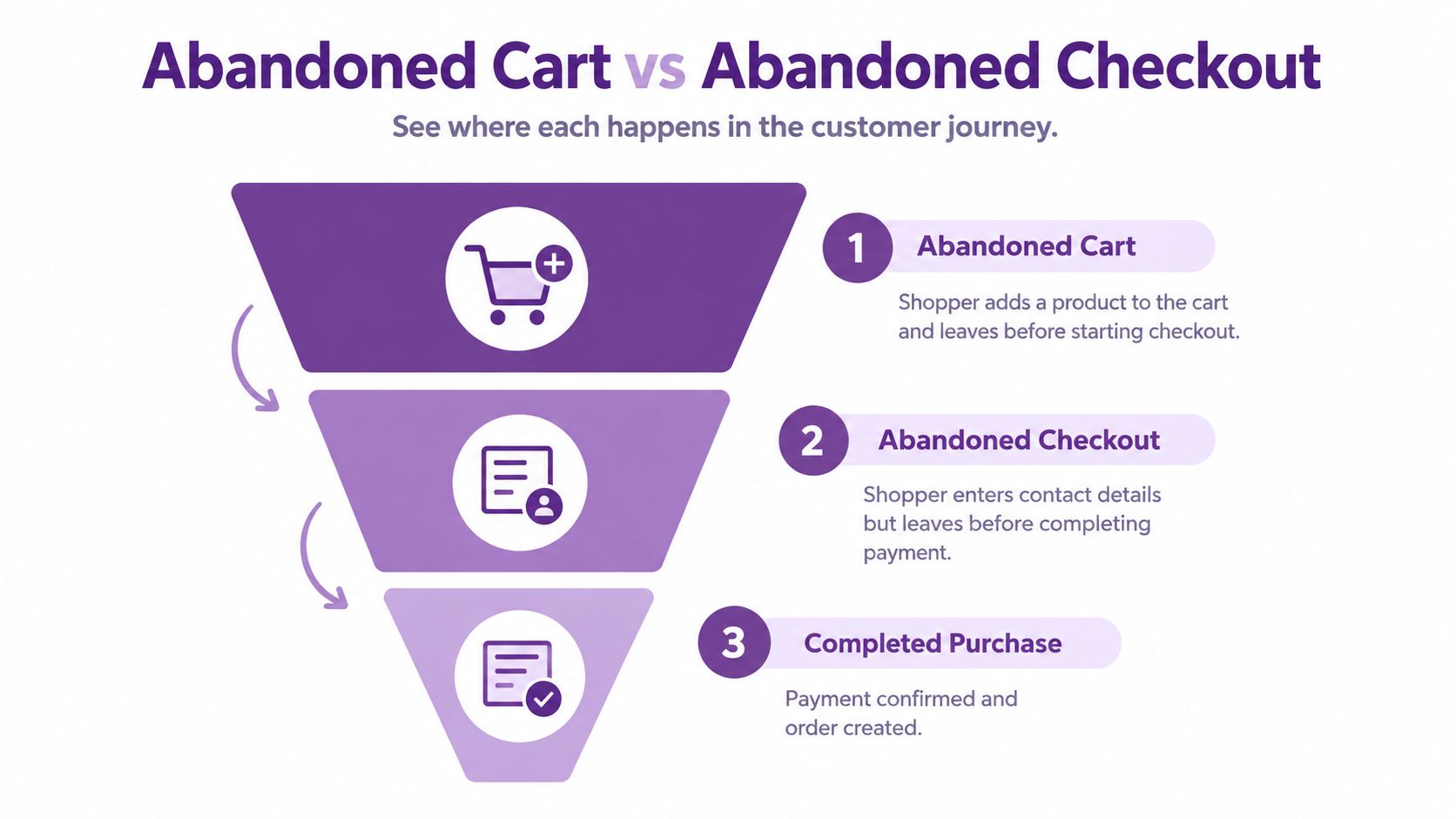
The funnel position changes the message
Cart abandonment is a mid-funnel signal. The shopper might still be comparing products, checking the price, waiting for payday, or investigating shipping. The right recovery message usually reminds them what they selected and answers a question that prevented progress.
Checkout abandonment is a bottom-funnel signal. The shopper has moved beyond browsing and product selection. They may have encountered shipping costs, a missing payment option, a delivery concern, or a form problem. Your message should make returning simple and reassure them about the exact friction point.
The identification rules are the true separator. A cart is a softer signal reconstructed from storefront activity. A checkout is a harder event recorded by Shopify's checkout infrastructure. That difference affects segmentation, compliance, attribution, and the number of shoppers you can genuinely reach.
Don't label every incomplete purchase as “cart abandonment” in your dashboard. Track the event that happened, then build the recovery logic around the available data.
Side by Side How the Two Funnel Stages Differ
The difference becomes obvious when you compare the two events across the decisions that affect SMS performance.
| Dimension | Abandoned Cart | Abandoned Checkout |
|---|---|---|
| Funnel stage | Product selection before checkout | Checkout before payment completion |
| Shopper intent | Interested, but potentially still exploring | Stronger purchase intent with checkout activity |
| Data captured | Often anonymous, with limited contact data | Contact information provided during checkout |
| SMS eligibility | Partial, dependent on prior identification and consent | More actionable when phone details and consent are available |
| Main friction signals | Product fit, price, shipping clarity, uncertainty | Shipping, payment, form entry, trust, or technical friction |
| Recovery destination | Cart or product context | Saved checkout or direct payment path |
| Reporting value | Broad signal that can include anonymous sessions | Narrower, more attributable event |
The formulas also differ. Cart abandonment is commonly calculated as:
(sessions with add-to-cart minus sessions with checkout initiated) divided by sessions with add-to-cart
Checkout abandonment is commonly calculated as:
(sessions with checkout initiated minus sessions with order confirmed) divided by sessions with checkout initiated
Those denominators answer different questions. A high cart-abandonment rate says many shoppers didn't progress from selection to checkout. A high checkout-abandonment rate says shoppers reached the final stage but failed to complete payment. Treating both as one metric hides where the store needs work.
Match the remedy to the stage
For carts, review product-page clarity, variant selection, shipping visibility, returns information, and the quality of your cart experience. A practical guide to reduce Shopify cart abandonment can help you audit those earlier-stage issues.
For checkouts, inspect payment methods, delivery expectations, error states, form length, and trust signals. A checkout reminder can recover a shopper, but it shouldn't become a substitute for fixing a broken payment experience.
The key operational distinction is simple: cart recovery addresses hesitation before commitment, while checkout recovery addresses friction after commitment has started.
Benchmarks and Why Recovery Numbers Vary
Abandonment benchmarks vary because merchants measure different stages, audiences, devices, and traffic sources. A store that reports “a 70% abandonment rate” without naming the stage isn't giving you enough information to diagnose anything.
Baymard reported a 70.19% global average cart-abandonment rate in 2025, based on a long-running aggregation of independent studies. Baymard's cart-abandonment statistics collection also shows why historical context matters. The number has remained stubbornly close to 70% over many years, so merchants should treat abandonment as an ongoing funnel condition.
Checkout abandonment is typically higher than cart abandonment because it examines shoppers who already entered checkout but still failed to pay. Industry sources cite a 75.19% global checkout-abandonment rate in 2026, compared with Baymard's cart benchmark of 70.19%. That comparison doesn't mean every store should expect either number. It shows that the final conversion stage remains a serious friction point even after intent is clear. Stripe's explanation of checkout-abandonment measurement is useful for keeping the formulas and denominators separate.
| Metric | Abandoned Cart | Abandoned Checkout |
|---|---|---|
| What it measures | Added products but didn't begin checkout | Began checkout but didn't complete payment |
| Typical benchmark reference | 70.19% globally, Baymard, 2025 | 75.19% globally, industry benchmark cited for 2026 |
| Primary diagnostic use | Product, pricing, merchandising, and early-funnel friction | Shipping, payment, trust, and form friction |
| SMS measurement quality | Limited by anonymous sessions | Stronger when contact and consent are captured |
| Best starting intervention | Improve clarity, speed, and identification | Recover the identified shopper and remove checkout friction |
The largest abandonment drivers are also actionable. Baymard data cited by Shopify reports that 40% of U.S. shoppers abandon because of extra costs, 20% because delivery is slow, 19% because they don't trust the site with their card details, and 18% because the store requires account creation. Shopify's abandoned-cart recovery guidance connects those friction points to practical recovery work.
Don't compare unlike stores
Traffic source changes intent. Paid social often produces more exploratory sessions, while branded search and returning customers may arrive closer to purchase. Mobile shoppers face different form and payment friction than desktop shoppers, and shipping costs can become more damaging when the store hides them until late in checkout.
For small Shopify stores, checkout metrics are often more useful for SMS decisions because the audience is identified and the event is easier to attribute. Use your own month-over-month trend for optimization, then use external benchmarks as context rather than as a target. For broader SaaS conversion improvement tactics, focus on the specific page and event where shoppers leave, not a blended abandonment number.
Measure response behavior separately from funnel loss. YipSMS response rates can help you evaluate whether recipients engage with the message, but the commercial outcome still comes from completed orders and recovered revenue.
SMS Flow Design for Each Abandonment Type
Build the checkout flow first, then design the cart flow around the shoppers you can identify. The two automations shouldn't share the same trigger, timing, or copy.
Checkout recovery flow
Use a checkout-abandonment trigger when the shopper has started checkout, provided contact details, and hasn't completed an order. Send the first text quickly, while the product, price, and purchase context are still fresh. Industry guidance recommends sending a first abandoned-cart text within 30 to 60 minutes, with a follow-up 4 to 24 hours later when there's no response. Checkout-specific guidance also places the first message 2 to 4 hours after checkout starts in some email-based flows. Omnisend's abandonment SMS guidance outlines these timing approaches.
Use the first message as service, not pressure:
“Your checkout is saved at [Store Name]. Finish your order here: [recovery link]. Reply HELP with questions. STOP to opt out.”
The second message can address a likely objection without automatically discounting:
“Still deciding on [Product Name]? Review shipping and returns, then complete checkout: [link]. STOP to opt out.”
Keep one direct recovery link in each message. Send shoppers back to the saved checkout, not the homepage, where they'd have to rebuild the purchase.
Cart recovery flow
Cart SMS has a smaller reachable audience because many cart visitors are anonymous. Trigger it only when the shopper has already opted in through a valid channel or Shopify has a permitted phone number connected to the session.
A slower sequence makes more sense:
- First touch: Remind the shopper that the selected items remain available.
- Second touch: Answer a practical concern, such as delivery, sizing, returns, or product compatibility.
- Final touch: Use a controlled incentive only when your margin and customer strategy support it.
Keep the first message plain:
“You left [Product Name] in your cart at [Store Name]. Continue when ready: [link]. STOP to opt out.”
SMS permission rules matter more than clever copy. U.S. guidance for cart-abandonment SMS calls for explicit consent, double opt-in, no more than 1 SMS per recipient in a cart-abandonment flow, delivery within 48 hours of the trigger, and opt-out instructions in every message. Klaviyo's abandoned-cart SMS compliance guidance covers those mechanics.
Respect quiet hours in the recipient's time zone. Suppress both flows after purchase, and prevent a shopper from receiving cart and checkout messages for the same session.
For a broader implementation guide, see abandoned cart recovery with SMS.
Which Flow to Build First and Why
Build abandoned checkout SMS first. That's the flow with the cleanest combination of intent, identity, and attribution.
Shopify's abandoned-checkout record is created after the shopper has provided contact information and left the checkout incomplete under Shopify's tracking rules. A cart visitor may never provide an email address or phone number, so a cart flow can only reach a subset of cart abandoners. The checkout flow therefore gives you a more dependable audience for testing message timing, recovery links, opt-outs, and recovered revenue.
Cart recovery still matters. It captures earlier buying intent and can support product education, cross-sell logic, and storefront identification tactics. It just shouldn't be your first SMS project if you want clean reporting and fast feedback.
Sequence the work:
- Launch checkout recovery with one service-led message and one follow-up.
- Verify suppression after purchase and confirm every link restores the right checkout.
- Measure completed orders and recovered revenue separately from clicks.
- Add cart SMS only for identified, consented shoppers.
- Keep the triggers mutually exclusive.
The profitable starting point isn't the largest abandonment audience. It's the audience you can identify, permission, and measure.
Retargeting can support the anonymous portion of the funnel, but don't confuse paid reminders with SMS recovery. Resources on how to scale profitably with retargeting are useful for shoppers you can't legally or reliably message by text.
Setting Up Your First Recovery Automation
Start with checkout abandonment in a Shopify-compatible SMS platform such as YipSMS Inc., which provides separate cart and checkout automations, direct recovery links, campaign tools, and analytics. The tool matters less than the trigger discipline. A badly configured automation will send the wrong message efficiently.
Use this setup checklist
- Install the app and grant permissions. Connect the Shopify store, then approve the customer and checkout data permissions required for the automation.
- Confirm checkout consent. Make the SMS opt-in visible at checkout. Don't bury permission in a footer link or assume that entering a phone number equals marketing consent.
- Create the trigger. Choose Checkout Abandoned, then apply a short delay. A first message within 30 to 60 minutes is supported by industry guidance, while some checkout flows use a later 2 to 4 hour window. Choose one timing rule and test it consistently.
- Write two concise messages. Include the store name, a product reference, one tap-to-recover link, and opt-out language. Keep each SMS under 160 characters where practical.
- Set quiet hours. Use the recipient's local time zone and suppress anyone who has purchased, opted out, or already received another recovery message.
- Respect consent requirements. Apply TCPA and GDPR requirements to your audience and market. Make STOP and UNSUBSCRIBE handling automatic.
- Test the handoff. Create a real test checkout, abandon it, follow the link, and confirm that the cart, product, and checkout state are correct.
- Review Shopify Plus edge cases. If your store uses Checkout Extensibility or a post-purchase page, configure the appropriate webhook fallback so the event remains available to your automation.
The direct link is essential. Sending a shopper to a generic cart or homepage adds work and weakens the recovery path. Test on mobile, because the SMS recipient will usually open the link from a phone.
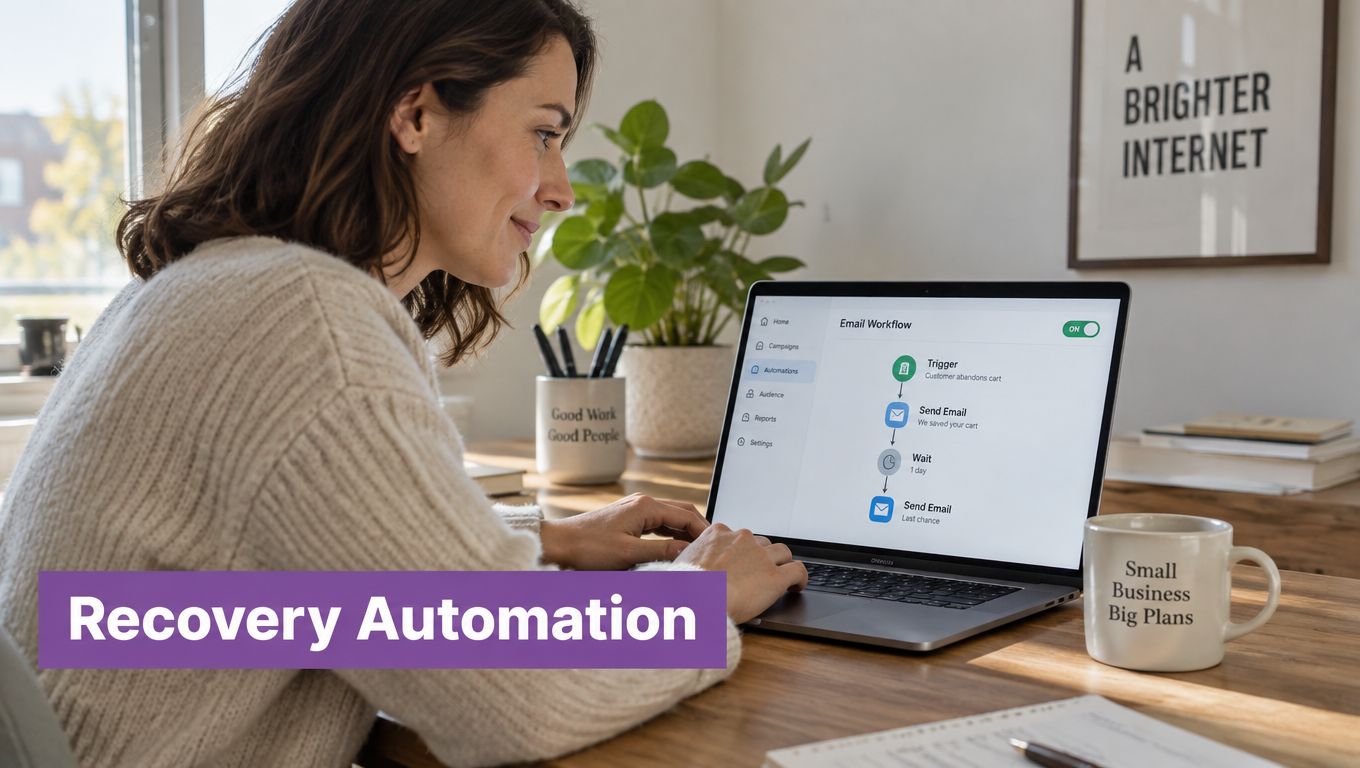
Use the YipSMS setup wizard to work through the connection and automation configuration, then test the complete customer journey before activating sends. Review recovered orders, opt-outs, delivery failures, and revenue by flow. Don't judge the program on clicks alone.
YipSMS Inc. offers Shopify-focused SMS automations for abandoned checkout and cart recovery, with direct recovery links, campaign tools, consent controls, and analytics to help you manage the funnel by stage. Visit YipSMS Inc. to connect your store and build the checkout recovery flow before adding cart-stage messaging.
How this article was made: the YIPSMS team drafts some articles with AI writing tools, then checks pricing, compliance and product details against how YIPSMS actually works before publishing. Spotted something wrong? Tell us through your YIPSMS account.