Omnichannel vs Multichannel Marketing for eCommerce
A Shopify store can have a strong email program, active paid social campaigns, and an SMS list that grows every week, yet still deliver a disjointed customer experience. A shopper abandons a cart and receives a text, then gets a generic promotional email, sees a retargeting ad for an item already purchased, and eventually opts out because every channel appears to operate without context.
That situation sits at the heart of omnichannel vs multichannel marketing. The choice isn't about collecting the largest number of channels. It's about deciding whether your team can connect customer identity, consent, product activity, inventory, offers, and measurement well enough to make those channels work together. Multichannel can be the sensible operating model for a focused store. Omnichannel can create more valuable customer journeys, but only when the underlying systems and workflows are ready.
Table of Contents
- The Store Owner Standing in Two Queues
- Definitions That Actually Decide Your Stack
- Side by Side Across the Criteria That Matter
- What Integration Actually Changes in Revenue
- Where SMS Fits in Each Model
- The Measurement Problem Nobody Warns You About
- Choosing Multichannel or Omnichannel for Your Store
- A 90 Day Build Plan and the KPIs to Watch
The Store Owner Standing in Two Queues
A Shopify merchant starts Monday by checking three dashboards. Klaviyo shows an email campaign promoting a new product. The paid social platform is retargeting visitors who viewed that product. The SMS tool is preparing an abandoned-cart reminder with a discount.
None of the campaigns is wrong. The problem appears when the same customer moves through them. She browses on her phone, adds an item to her cart, leaves, and receives an SMS reminder. Before she returns, an email promotes a different product to her as if no cart exists. Later, she completes the order through a social ad, but the original cart sequence still sends because the SMS audience never received the purchase event.
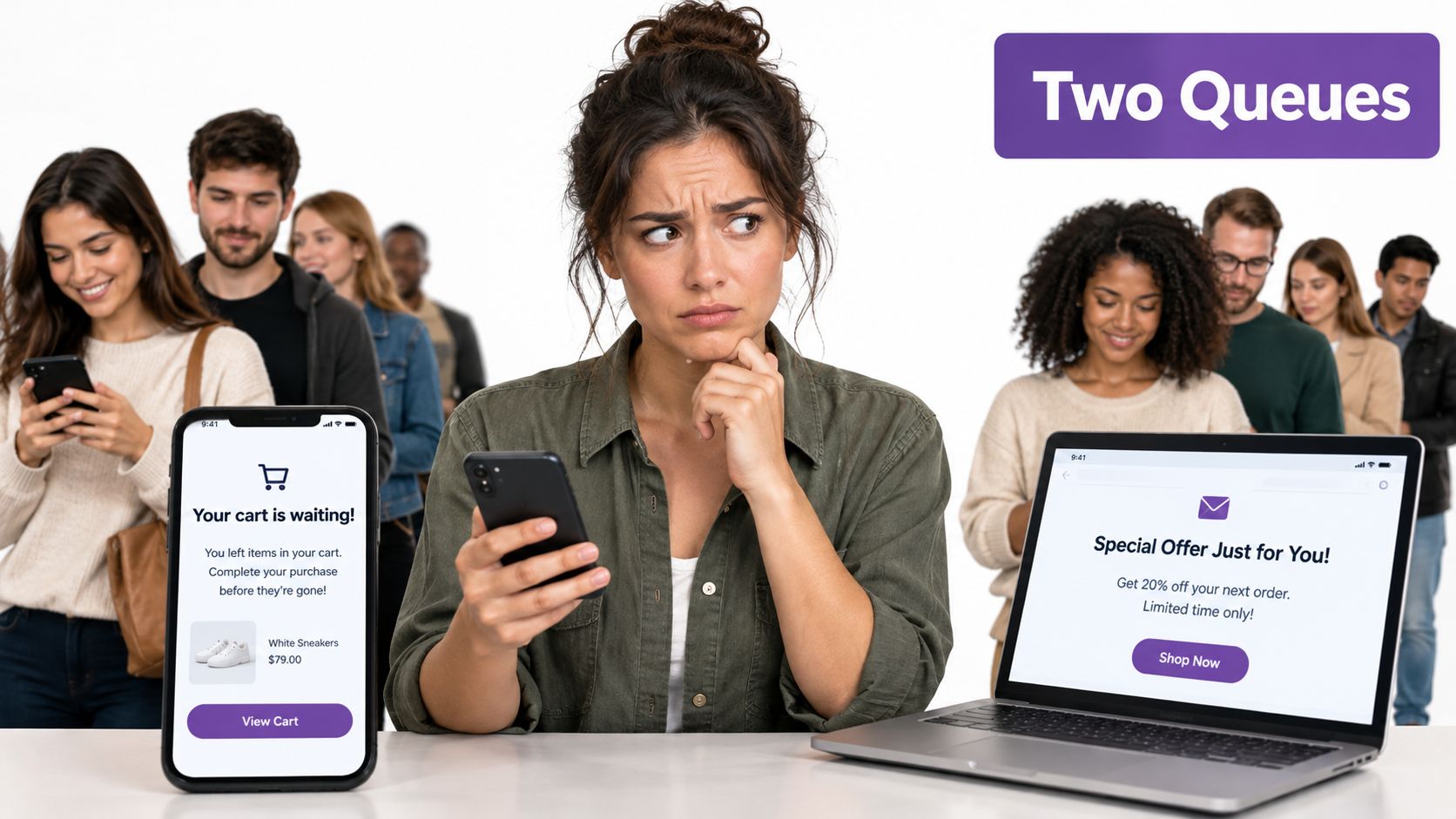
The merchant sees separate metrics, too. Email reports clicks. SMS reports deliveries and opt-outs. Paid media reports attributed conversions. Each dashboard looks useful, but nobody can confidently answer a more important question: what did the customer experience, and which interaction caused the purchase?
This setup creates familiar operational pressure:
- Conflicting offers: A shopper sees different prices or incentives across email, SMS, ads, and the storefront.
- Repeated messages: A purchase doesn't reliably remove the buyer from every active campaign.
- Weak retention: A first order is treated as the end of one channel campaign instead of the start of a coordinated relationship.
- Subscriber fatigue: Customers receive more reminders because each channel owner optimizes independently.
- Rising acquisition pressure: When repeat purchase journeys underperform, the store must keep paying to replace customers who might otherwise have returned.
That merchant may call the setup omnichannel because the brand appears in several places. Operationally, though, the customer is standing in separate queues. The practical question isn't which label sounds more advanced. It's which model fixes the broken handoffs without creating a system the team can't maintain.
Definitions That Actually Decide Your Stack
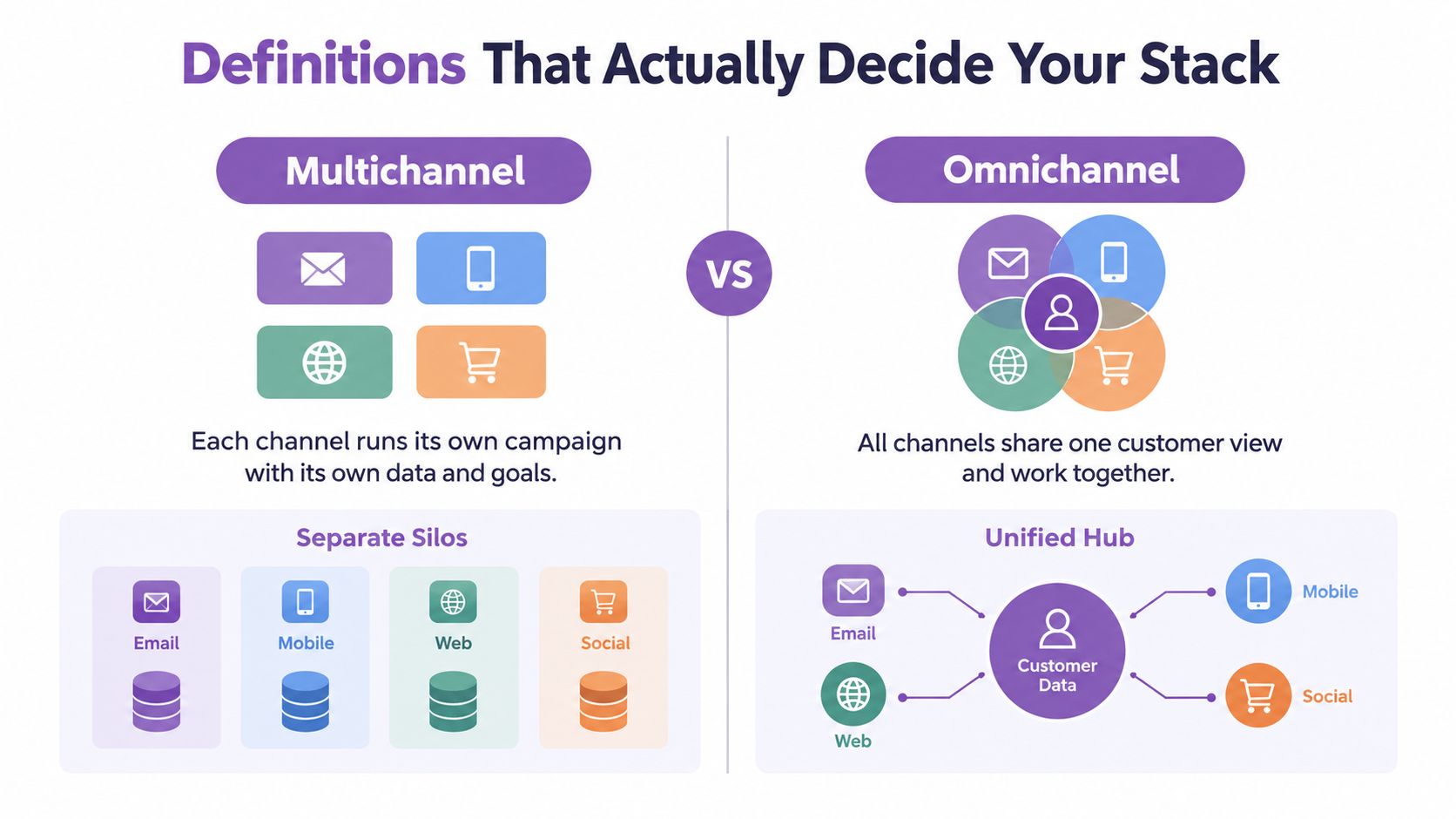
Multichannel marketing means using several customer-facing channels, such as a Shopify storefront, email, SMS, paid social, marketplaces, or physical retail. Each channel can have its own audience, campaign calendar, product information, promotion, and KPI. A multichannel store may be present everywhere customers spend time, but the channels don't necessarily share a live view of the customer's actions.
Omnichannel marketing connects those touchpoints into one coordinated journey. A customer can discover a product through social media, browse on mobile, receive a relevant message, check availability, purchase on desktop, and receive delivery updates without the brand losing the context of the interaction. McKinsey notes that more than half of B2C customers use three to five channels during a purchase or service interaction, which makes presence across channels different from coordination across them. Its research also found that omnichannel customers shop 1.7 times more frequently than single-channel shoppers (McKinsey's explanation of omnichannel marketing).
The dividing line is simple: multichannel gives each channel a place in the plan, while omnichannel gives every channel access to the same customer journey.
Inside Shopify, the distinction appears in the architecture. In a multichannel arrangement, the email platform, SMS app, ad accounts, support desk, and storefront may each maintain separate segments and event histories. A customer who purchased today may remain eligible for tomorrow's SMS campaign because the purchase event hasn't reached that campaign's suppression list.
An omnichannel arrangement passes shared events between systems. A purchase can stop cart recovery, update the customer's lifecycle stage, change paid-media eligibility, and trigger post-purchase communication. The customer ID, consent status, product event, order, and fulfillment state become usable across the journey.
A useful guide to omni channel strategy for lead gen can help teams think beyond channel presence and toward coordinated audience movement. For a Shopify operator, that means starting with the events and decisions that must be shared, not just adding another sending platform.
Side by Side Across the Criteria That Matter
The most useful comparison isn't a list of fashionable features. It's a test of how each model handles the same customer action. Consider a shopper who abandons a cart, returns through an email, completes checkout on a laptop, and later needs a delivery update.
| Criterion | Multichannel | Omnichannel |
|---|---|---|
| Data flow | Channels keep separate events, audiences, and product records | Shared events connect storefront, email, SMS, ads, service, and fulfillment |
| Customer identity | A subscriber may appear as separate profiles across systems | One customer identity links devices, consent, browsing, orders, and interactions |
| Measurement | Teams report channel metrics and last-click revenue | Teams analyze stitched journeys, deduplicated conversions, incrementality, and lifetime value |
| Compliance and consent | Each channel may maintain its own opt-in and suppression logic | Consent, opt-out, market, and channel permissions travel with the customer record |
| Operational cost | Lower integration burden, but more manual reconciliation and duplicated work | Higher implementation burden, with more automated coordination after the foundation is stable |
| Customer experience | Offers, timing, and service context can vary by channel | Messages and service actions reflect the customer's latest behavior across touchpoints |
Data flow and identity
In a multichannel setup, the cart event may reach email while SMS receives only the subscriber's original sign-up status. Retargeting ads may continue after the order because the ad audience refreshes on a different schedule. Omnichannel architecture uses shared behavioral events and a common identity layer to make those decisions together.
The distinction matters most when customers switch devices or channels. A mobile browse should inform a desktop follow-up, not create a second, unrelated prospect profile.
Measurement and consent
Multichannel reporting can answer, “Which channel received the last click?” It struggles to answer, “Would this customer have purchased without the message?” Omnichannel measurement requires conversion deduplication, journey stitching, and tests that separate assisted activity from incremental revenue.
Consent follows the same pattern. A customer who agrees to email isn't automatically eligible for promotional SMS. A coordinated system stores permissions by channel and market, then suppresses the right messages without removing valid communication elsewhere.
Cost and experience
Multichannel is often cheaper to launch because the team can connect only the channels that matter immediately. It also supports channel-specific experimentation. The hidden cost is manual work, duplicated audiences, inconsistent reporting, and the chance that one team's successful campaign undermines another team's customer experience.
Omnichannel costs more in data design, integration, governance, and training. It earns its keep when the business has enough cross-channel activity that coordinated suppression, relevance, fulfillment updates, and retention journeys affect revenue rather than merely making the dashboard look tidy.
What Integration Actually Changes in Revenue
Integration changes revenue when the store's systems agree on identity, inventory, price, and eligibility. If they do not, the customer still gets messages, but the business loses the commercial lift it expected.
Analysts in a widely cited retail study of 46,000 shoppers found that customers using multiple integrated channels spent 4% more per store visit and 10% more online than single-channel shoppers. For a Shopify merchant, that usually points to two different moves. One is reducing friction between discovery and checkout. The other is keeping product context alive as the shopper moves from email, SMS, and storefront into the buy path (research on omnichannel customer value).
A separate synthesis in the same research context reports 13% higher average order value and 90% higher customer retention for integrated approaches versus single-channel ones. On a store level, that usually means better cross-sell logic, better post-purchase timing, and fewer disconnected campaigns that treat every visit like a new customer.
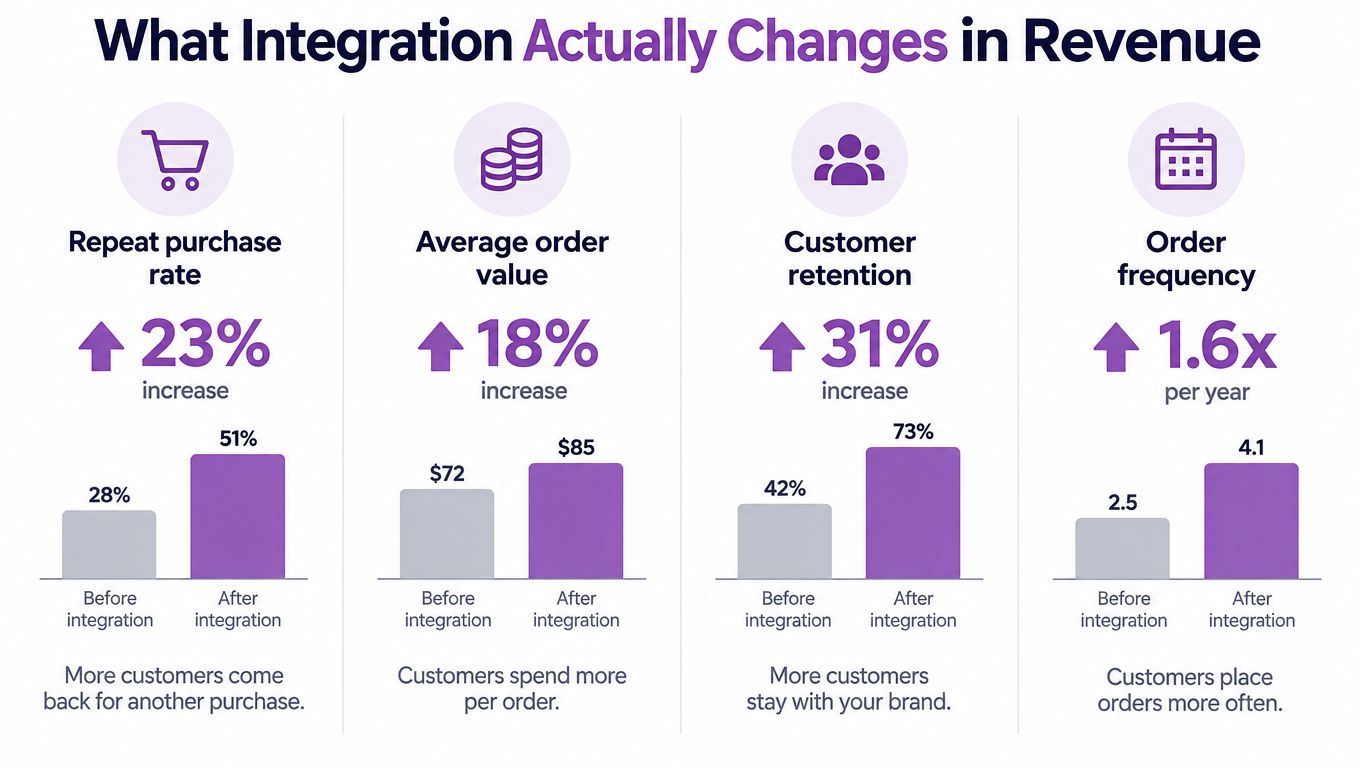
The same research context also reports that omnichannel customers shop more frequently than single-channel shoppers. The practical takeaway is simple. Send the next useful interaction where the customer already is, instead of forcing every buyer through every channel.
The return depends on plumbing
The upside disappears fast when systems disagree about price, stock, identity, or eligibility. A shopper who sees a promotion for an unavailable product does not feel coordinated treatment. A customer who receives three post-purchase messages because an order event failed to suppress campaigns gets the opposite.
McKinsey's apparel omnichannel research, based on more than 3,000 U.S. shoppers, found that six in ten people used at least one digital channel in an apparel-shopping journey, while omnichannel shoppers accounted for one in three shopping journeys. Those shoppers purchased 70% more often than offline-only shoppers and reported spending more than $2,000 annually on apparel (McKinsey's apparel omnichannel research). For store operators, that supports a clear operating rule. Physical and digital channels should reinforce each other, not compete for ownership of the customer.
The technical side matters just as much. Teams should review ecommerce API integration best practices around event reliability, data ownership, and failure handling, because weak event flow turns “integrated” into little more than a dashboard label. For SMS planning, a practical bulk SMS marketing guide helps separate simple broadcast use cases from lifecycle flows that need tighter coordination.
A later McKinsey retailer survey found that only 6% of respondents described omnichannel readiness as excellent and fully implemented, while 36% were still testing proof-of-concept initiatives. 78% said they lacked a single brand experience across channels. That gap matters more than the buzzword itself. Integration can raise revenue, but only after the organization can keep data, timing, and customer decisions aligned.
Where SMS Fits in Each Model
SMS behaves differently depending on the system around it. In a multichannel store, SMS is usually a broadcast channel. The team schedules a campaign for a segment, measures delivery, clicks, conversions, and opt-outs, then compares the result with email or paid social after the fact.
That approach can work for a clear announcement, a product launch, or a time-sensitive promotion. It becomes risky when SMS doesn't know what email, the storefront, or the order system already did. A cart reminder may reach a customer who has purchased, while a promotional text may ignore the product the shopper viewed minutes earlier.
SMS is the last-mile channel because mobile messages can reach a customer quickly. That immediacy makes coordination more important, not less.
In an omnichannel setup, SMS is a behavior-triggered touchpoint. The system uses the customer's latest action to decide whether text is appropriate, what the message should say, and whether another channel has already handled the moment.
Four flows worth building
- Abandoned cart: Multichannel SMS sends a scheduled reminder to an eligible segment. Omnichannel SMS checks whether the customer bought, whether email already recovered the cart, and whether a direct checkout link is the most useful next step.
- Viewed product: Multichannel sends a product campaign based on a broad audience. Omnichannel follows the exact viewed item, uses email for richer education, and reserves SMS for a concise, high-intent prompt.
- Shipping and delivery: Multichannel treats fulfillment messaging as a separate notification stream. Omnichannel uses the order state to suppress promotional messages when the customer needs a delivery update or support.
- Replenishment: Multichannel sends a calendar-based reminder to a product segment. Omnichannel uses purchase history, customer status, consent, and previous engagement to decide whether a replenishment message is timely.
Omnisend's 2025 ecommerce report found that automated SMS generated 18% of orders while accounting for only 9% of SMS sends, showing why triggered relevance can outperform undifferentiated campaign volume (Omnisend's 2025 ecommerce marketing report). The useful lesson isn't to automate every text. It's to connect each automation to a meaningful customer event and measure orders or revenue per flow.
A Shopify merchant can start with cart recovery, then add delivery notifications, browse follow-ups, and repeat-purchase prompts. A Shopify-focused tool such as the YipSMS Shopify SMS app can support these SMS use cases alongside the store's existing email and onsite journeys.
The Measurement Problem Nobody Warns You About
A connected customer journey creates more context, but it also creates more apparent touchpoints. A shopper may see a paid ad, browse from a social post, receive an email, click an SMS reminder, and complete checkout directly. If every channel claims credit, the report can show impressive attributed revenue without proving that any individual message caused the purchase.
Last-click reporting is especially fragile here. It rewards the final interaction, not necessarily the interaction that changed the customer's decision. Open rates and clicks have a similar limitation. They show response to a message, but they don't show what would have happened if the message had never been sent.
A workable measurement layer
Small Shopify teams don't need to build a full data warehouse before improving their decisions. They do need disciplined identifiers and clear rules.
- Use consent-based first-party identifiers: Connect a customer ID, email, phone number, and Shopify order history where permission allows. Keep channel eligibility separate from identity.
- Deduplicate conversions: Decide which system owns the order event and prevent email, SMS, paid media, and affiliate reports from counting the same purchase as separate conversions.
- Account for profit: Include discounts, SMS costs, product margin, refunds, and fulfillment costs instead of comparing channels only by clicks or gross attributed sales.
- Run a holdout or geo test: Where feasible, withhold a message or journey from a comparable group and compare incremental conversion or profit.
- Track unobservable behavior: Privacy restrictions mean some interactions won't be visible. Record what the system can know, then avoid presenting incomplete attribution as certainty.
Privacy-preserving attribution approaches can reduce measurement gaps by 34% compared with legacy tracking methods, reflecting movement toward first-party data, clean rooms, probabilistic modeling, and controlled experiments (Shopify's ecommerce measurement guidance). For a smaller merchant, the immediate application is straightforward: prioritize consented data, controlled tests, and honest uncertainty over a dashboard that assigns every order to the last click.
SMS adds a separate compliance layer. Requirements differ across the United States TCPA and FCC framework, the European Union GDPR, Canada's CASL, and Australia's Spam Act. GDPR consent must be freely given, specific, informed, and unambiguous, so an email opt-in or general account registration shouldn't automatically enroll someone in promotional texts.
A strong system records the wording shown, timestamp, source form, phone number, market, and channel permission. It also suppresses a contact immediately after an opt-out. Merchants working through the United States market can use this TCPA compliance checklist as a practical review point, then confirm market-specific requirements with appropriate counsel.
Choosing Multichannel or Omnichannel for Your Store
Omnichannel isn't automatically the right answer. A store with a small catalog, a focused acquisition goal, and limited operational capacity may get more value from a clean multichannel setup than from a partially connected omnichannel stack that regularly misfires.
Choose multichannel when each channel has a clear job and the team can maintain reliable manual handoffs. Email might handle education, paid social might create demand, SMS might deliver urgent promotions, and Shopify might remain the source of truth for orders. The model works when the channels don't need to make complex decisions about one another yet.
Choose omnichannel when customers already move between channels and that movement affects retention, service, inventory, or margin. Shared customer, order, product, consent, and fulfillment data should produce a visibly better experience, not merely a more complicated architecture.
Match the model to operational maturity
An early-stage Shopify store often needs to learn which audiences respond and which channels deserve investment. Multichannel supports that experimentation with less integration overhead. The team can establish consistent brand rules, maintain separate channel goals, and add shared suppression for the highest-risk journeys before connecting everything.
A scaled store with recurring purchases, multiple product lines, paid acquisition, customer service volume, or online and offline activity has more reason to integrate. At that stage, a disconnected cart message or inconsistent offer can affect enough customers to justify event-level coordination.
Recent CX Network research found that only 16% of surveyed organizations had a fully implemented omnichannel model, despite 55% wanting to improve experiences across devices and channels (the CX Network retail research summary). That execution gap is a warning against buying complexity before the team can govern it.
Enterprise teams comparing campaign management tools for enterprise teams should evaluate workflow ownership, identity resolution, consent handling, event latency, and measurement design alongside channel coverage.
The real question isn't which model is better. It's whether your team can maintain identity, consent, pricing, inventory, and measurement across channels without breaking the customer experience.
A 90 Day Build Plan and the KPIs to Watch
Move in stages. The first objective isn't to connect everything. It's to establish a trustworthy customer and order foundation.
| Phase | Focus | Primary KPI |
|---|---|---|
| Days 1 to 30 | Map identity, consent, Shopify events, suppression rules, and current channel revenue | Deduplicated conversion baseline |
| Days 31 to 60 | Connect SMS, email, and onsite messages to cart, browse, purchase, and fulfillment events | Revenue per recipient and unsubscribe rate |
| Days 61 to 90 | Test coordinated journeys, holdouts, assisted conversions, and disconnected channel performance | Incremental conversion and repeat purchase rate |
Start by documenting where customer identity lives and which system owns the order event. Then make consent channel-specific, create a shared suppression table, and audit every cart, purchase, delivery, and opt-out trigger. In the second phase, launch one coordinated cart flow before expanding to browse or replenishment.
Text messaging was reported as consumers' preferred business-to-consumer contact method at 48%, ahead of email at 22%, while 58.7% of consumers responded to text messages within five minutes (compiled ecommerce messaging data). Use that immediacy selectively. Measure incremental conversion, repeat purchase rate, revenue per recipient, and unsubscribe rate, not just clicks or opens.
On Monday, complete four checks: confirm purchase suppression, verify SMS consent by market, compare one email-only journey with one coordinated journey, and create a report that counts each order once.
YipSMS Inc. helps Shopify merchants collect SMS subscribers, run cart and checkout recovery, send viewed-product and delivery updates, and coordinate automated or scheduled campaigns with real-time analytics. Visit YipSMS Inc. to review the Shopify-focused SMS workflows and start building a more connected customer journey.
How this article was made: the YIPSMS team drafts some articles with AI writing tools, then checks pricing, compliance and product details against how YIPSMS actually works before publishing. Spotted something wrong? Tell us through your YIPSMS account.