Text Message Short Codes vs Long and Toll-Free
It's Tuesday night and you're reading the abandoned checkout report in Shopify again. The recovery emails go out on schedule, most of them land in a promotions tab, and the customers who would have bought with a nudge on their lock screen never get one. Someone on the team says the fix is obvious: get a short code, print "Text JOIN to 12345" on the mailer, and let the list build itself.
Then you look up what it takes to get one, and the timeline is measured in weeks. That gap between wanting high-volume texting and being allowed to send it is where most stores stall, and it's where a rushed sender choice costs a whole season of revenue.
A U.S. short code is a domestic asset with a multi-week approval. So the practical move is to run every live flow on the sender that can send now, and reserve the short code for the long-running national keyword it was built for.
Table of Contents
- What a Text Message Short Code Actually Is
- Short Codes Compared with Long Codes and Toll-Free
- How a Short Code Gets Approved and Goes Live
- Why 160 Characters Changes What You Pay
- Consent Records and Safer Links for Store Texts
- Why One Short Code Does Not Travel Abroad
- Pick Your Sender and Launch This Week
What a Text Message Short Code Actually Is
A text message short code is a five- or six-digit number that a business leases to run high-volume, application-to-person texting. A shopper texts JOIN to 12345 from a checkout popup, your platform matches that keyword to the program, confirms the opt-in, and replies with a welcome message. From then on, promotions leave from the same short address.
The flow is mostly one-directional. Inbound keyword, program match, confirmation, outbound campaign. Think of it as a shop door rather than a personal mobile: anyone can find it, it's built for business traffic, and it isn't where two people hold a private conversation.
Short codes emerged in the United States during the early 2000s as a purpose-built channel for exactly this kind of volume, created so organizations could run bulk wireless campaigns without using ordinary 10-digit telephone numbers. A single Common Short Code worked across participating U.S. wireless providers, and the Common Short Code Administration kept a cross-carrier registry, as CTIA's short code monitoring handbook documents. That registry-and-carrier structure is what made the channel matter for marketing alerts, charitable fundraising, voting, authentication, and recurring message programs.
CTIA's later guidance formalized the operating rules: campaigns must follow applicable law, use compliant subscriber opt-in, address unwanted-message risks, and meet program-specific standards.
The Shopify translation: the same short address can sit on packaging, a receipt footer, or a homepage keyword box. The first decision isn't which code to buy, it's which sender fits promotions, shipping, and cart recovery right now.
A short code is regulated messaging infrastructure, not just a memorable number. For a merchant, the value is the combination of concise addressing, carrier-level program vetting, and a branded campaign attached to a large subscriber audience. Hold onto that value while the sender comparison below sorts out what you can switch on today.
Short Codes Compared with Long Codes and Toll-Free
A Shopify store planning a national text-to-join campaign faces a different sender decision from one trying to recover carts today. A U.S. short code is a domestic asset with a multi-week review. Use a sender that can launch now for each active flow, and reserve a short code for a long-running national keyword customers can remember.
| Sender | Number format | Volume role | Approval window | Best store job |
|---|---|---|---|---|
| Dedicated short code | 5 or 6 digits, leased to one brand | High-volume, carrier-vetted program | Multi-week review | National promos and memorable keywords |
| Shared short code | 5 or 6 digits used by multiple brands | High volume with shared reputation | Provider review; timing varies | Keyword tests only if the provider allows them |
| 10DLC long code | 10-digit local number | Lower, tiered by brand and campaign trust | Brand and campaign vetting | Cart recovery, shipping, and smaller lists |
| Toll-free number | 10 digits in the 800 series | Moderate, often above a new long code | Verification and provider review | Support replies and mixed U.S. and Canada alerts |
Where each sender earns its keep
A dedicated short code belongs to one brand and supports a high-volume program. It fits a national promotion, a text-to-join keyword printed on packaging, or a program that runs all year. The multi-week review makes this a planned launch, not a quick fix for a flow that needs to send now. The lease also recurs, so compare the full cost of the number, including setup, review support, and message usage, rather than relying on a headline fee.
A shared short code puts multiple programs on the same number, sharing its reputation and keyword space. It may be quicker and cheaper to start, which can suit a limited test. The trade-off is that another brand's complaints or carrier action can affect delivery, and two programs may want the same keyword. Use one only if the provider allows your keyword and you accept the shared risk.
A 10DLC long code uses a regular 10-digit number and requires brand and campaign vetting. Its throughput depends on the trust assigned to the brand and campaign, so a new store should not expect short-code volume immediately. Its practical advantage is that it can be the sender for active store flows without waiting for a short-code review to finish. Assign it cart recovery, shipping notifications, and other messages tied to a near-term revenue or service need.
A toll-free number can serve as a recognizable support sender for U.S. and Canadian subscribers. It handles moderate volume, often more than a new long code, making it an option for mixed alerts and customer replies. Verification still applies, and the provider controls the review timing. Confirm the launch date before building it into a campaign schedule.
The decision rule that settles it
If the campaign needs to launch this month, use a sender that is ready rather than waiting on a short code. For a national keyword on packaging that will run all year, begin the short-code process and keep daily store flows on another sender.
Before applying, get each sender's full costs in writing, including any recurring lease and per-message usage. Share a budget with your team only after the provider confirms the charges. The short code's memorability and volume may justify its ongoing cost for a national program, but they do not make it the right sender for every Shopify flow.
How a Short Code Gets Approved and Goes Live
Approval is a calendar item, not a settings toggle. You submit a brand, a use case, an opt-in flow, and sample messages, then wait while three reviews happen in sequence. Budget roughly 8 to 12 weeks, the timeline OneSignal's SMS registration requirements documentation cites for short-code brand vetting, campaign review, and independent carrier approval.
The stages below are the ones you can track, and each one has a different reason to bounce an application.
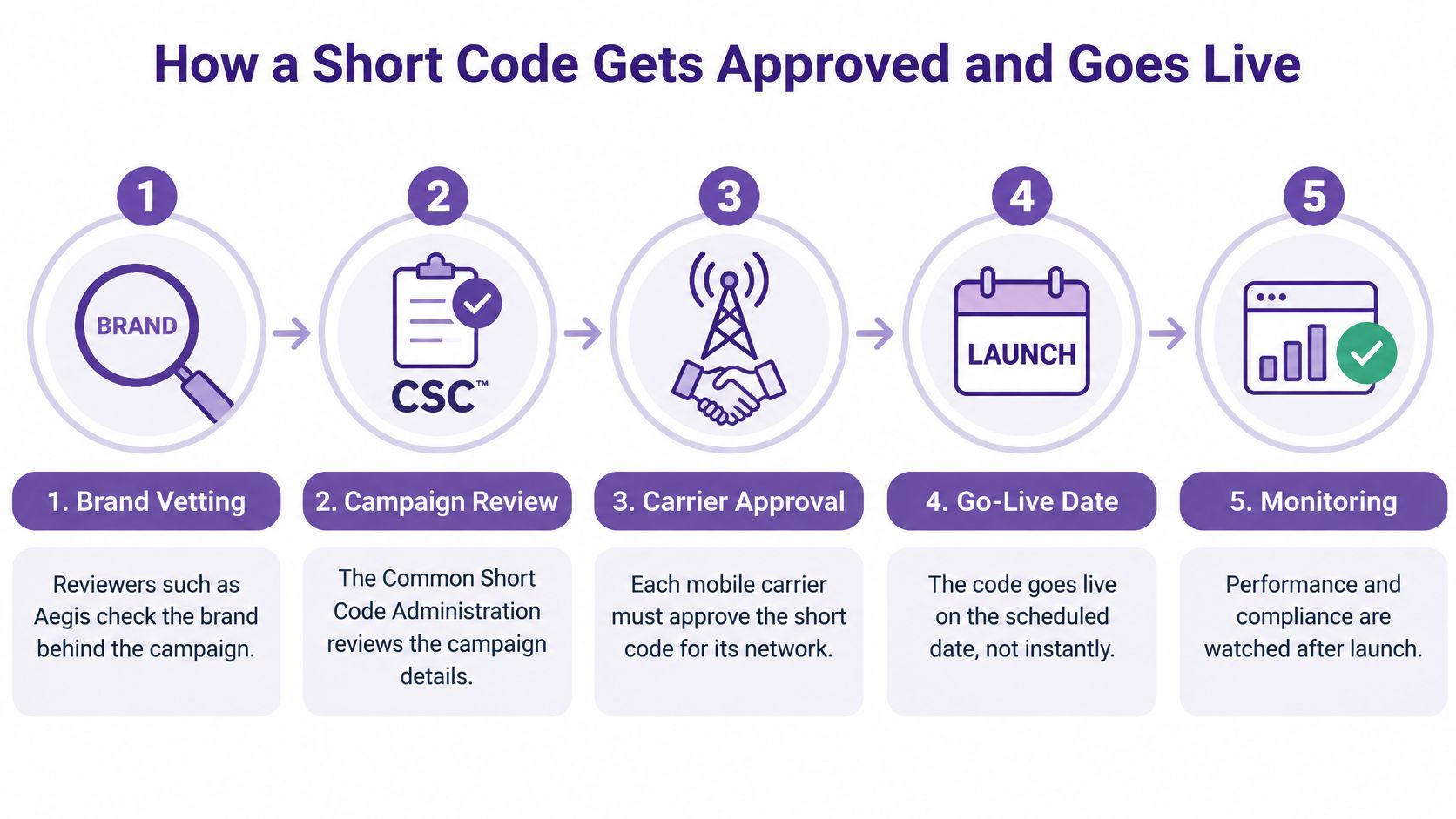
- Brand vetting. A reviewer such as Aegis checks that the business behind the campaign is real: working website, legal name, consistent contact details. Mismatches here cause most first-round bounces, and they're the easiest to fix before you submit.
- Campaign review. The Common Short Code Administration examines the program itself, meaning the use case, how the number gets collected, the exact checkbox or keyword language, sample messages, and the HELP and STOP replies. Samples that don't match what you plan to send come back as a change request, not a rejection.
- Carrier approval. Each carrier that will deliver the traffic approves the code on its own network. Your visibility into this stage is the thinnest, which is why the packet needs to be right on the first pass.
The packet to assemble before you apply
- Business basics: legal name, website, and a support contact that a reviewer can reach.
- Collection evidence: the exact popup or checkbox wording, plus where it appears.
- Sample sends: three to five texts that mirror the campaign, including the offer and the expiry.
- Keyword proof: screenshot-level confirmation that STOP opts out and HELP returns a support route.
- Policy links: terms, privacy policy, and stated message frequency.
Once the code is live, the work shifts to configuration, testing, and phased traffic. This walkthrough covers that handover:
Meanwhile the store keeps selling. Keep cart, checkout, shipping, and post-purchase flows on a compliant long code or toll-free sender while the application sits in review, then migrate only the high-volume promotional program once the code is active. An unapproved number is not a placeholder you can send from, and testing on it puts the whole application at risk.
If the bridge sender is a long code, the 10DLC registration guide walks through the brand and campaign vetting that gets it live. Seasonal creative can be written now. The send date has to sit after carrier approval, not after the design is signed off.
Why 160 Characters Changes What You Pay
Payload comes before offer copy. One GSM short message carries up to 140 bytes of user data, equivalent to 160 characters in the 7-bit GSM alphabet, per CTIA's SMS interoperability guidelines. Step outside that alphabet and the encoding can switch to UCS-2, cutting a single segment to roughly 70 characters. Concatenated messages then spend characters on protocol headers, so later segments hold less usable text.
| Encoding | Usable characters | What triggers it | Store risk |
|---|---|---|---|
| GSM-7, one segment | 160 | Basic Latin letters, numbers, and simple symbols | A tight promo can stay one unit |
| UCS-2, one segment | About 70 | Emoji, many accents, or non-Latin script | One emoji can double the bill |
| Concatenated GSM-7 | 153 per segment | Text past 160 characters | Extra units and a split offer |
| Concatenated UCS-2 | 67 per segment | Long emoji or non-Latin text | Easy to reach three billable parts |
Rewriting one cart text into a single segment
Here's a cart recovery text that looks fine in the editor and bills three times. It opens with a first name and two emoji, drops a full product URL, describes the offer in a long sentence, and buries the opt-out at the very end. On an older handset the offer itself splits across screens.
The one-segment version reads: "Juniper: Sarah, your linen wrap dress is still in your cart. Finish it here [short tracked link]. Offer ends tonight. STOP to opt out." Brand, item, link, expiry, and opt-out all sit in segment one. The only personalization is the name, which stays inside the GSM alphabet.
The house style that keeps costs flat
Calculate the encoded segment count before every send, not after the invoice. Test the rendered text on a real phone rather than trusting a character counter, because a single substituted symbol can flip the encoding and multiply the count. Short links, dynamic coupon codes, and Unicode-aware validation matter most in cart recovery and repeat-purchase flows, where a broken link costs a sale and a flipped encoding costs margin.
I'd lock a written rule for the team: no decorative emoji on high-volume flows unless the extra segment is worth the cost. The SMS character count guide is a reasonable reference to keep next to the template library. Predictable pricing and readable offers come from the same discipline.
Consent Records and Safer Links for Store Texts
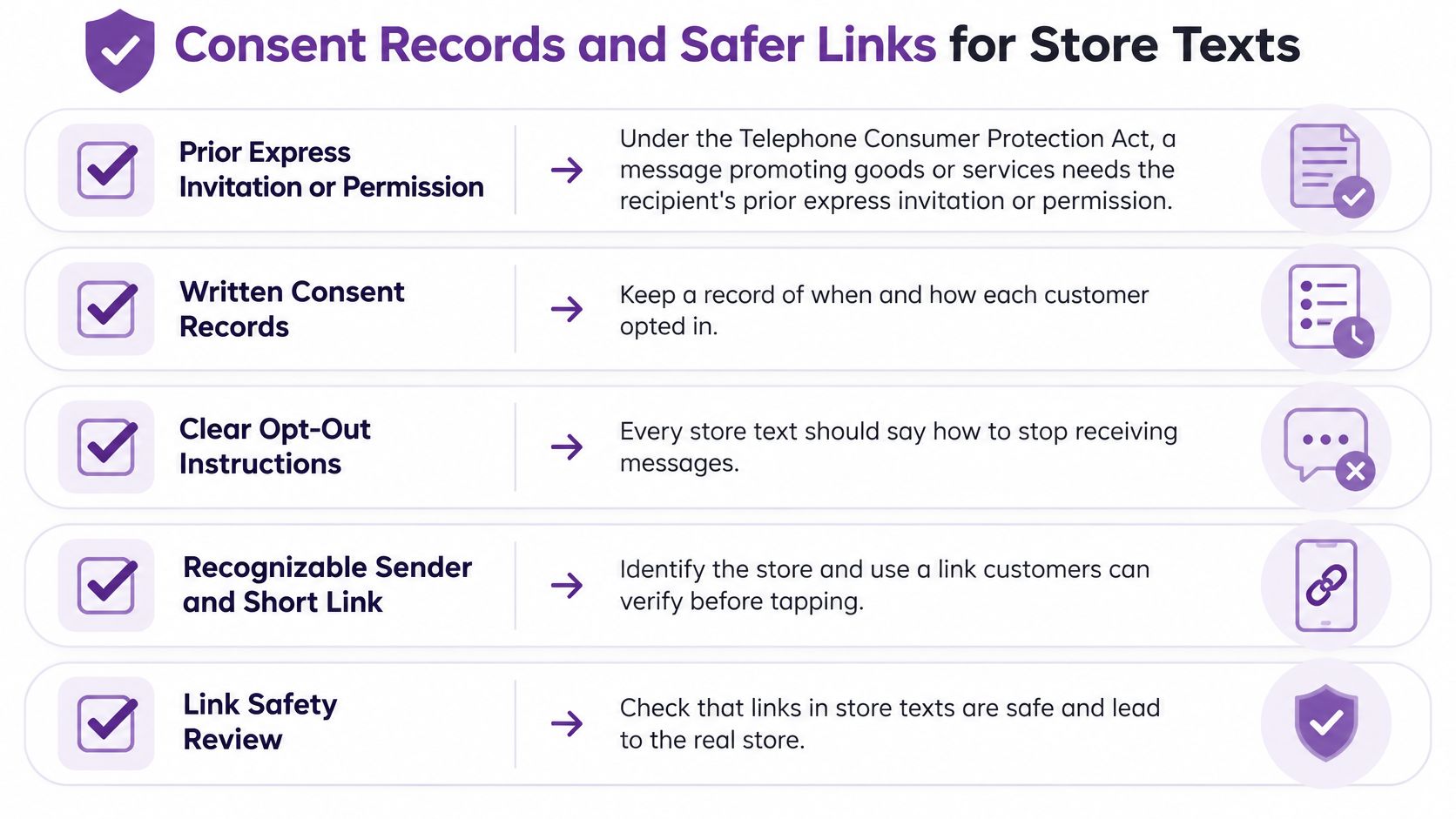
A customer enters a mobile number at checkout, then receives a promotion they only agreed to by email. Avoid that mistake by recording the source page, the exact SMS consent wording, the timestamp, and the number. The FCC's TCPA rules describe unsolicited advertising as messages promoting goods or services without the recipient's prior express invitation or permission. A newsletter opt-in does not, by itself, document permission to send texts.
Revocation is broader than STOP
Make STOP easy to use, and handle other clear requests to stop as opt-outs too. U.S. guidance summarized in Infobip's guide to global SMS compliance laws says consumers may revoke consent through any reasonable method, with businesses expected to process revocations within 10 business days. A reply such as “take me off the promo list” should trigger suppression in the relevant Shopify flows, not wait in a shared inbox.
The UK sets specific consent requirements for unsolicited marketing texts. The ICO's guide to PECR says consent must be informed, freely given, clear, and shown through a positive action, such as ticking a box. Email or call consent does not cover SMS. A limited soft opt-in can apply when a number is collected during a sale, the messages promote similar products from the same business, and the customer is given a free way to refuse both at collection and in later messages.
Separate the marketing and shipping permissions
Keep promotional consent and shipping updates in separate fields. If a customer opts out of promotions, stop sales messages while continuing shipping updates only where their separate permission allows. For agencies managing multiple stores, check the suppression record before adding a number to another account's workflow. A suppression that lives in only one campaign can be undone by a separate flow.
Links are the second half of the permission
A consented message can still expose a customer if its link reveals private information. Use expiring tokens where appropriate, send customers to account pages that require login, and keep sensitive values out of URL parameters. These practices address link risks directly. The concerns differ from visitor network privacy for enterprise IT, which deals with guest Wi-Fi rather than SMS consent or marketing links.
Keep a usable record of each opt-in, maintain separate permission fields, and review destinations before sending. The consent documentation checklist can help organize the consent record.
Why One Short Code Does Not Travel Abroad
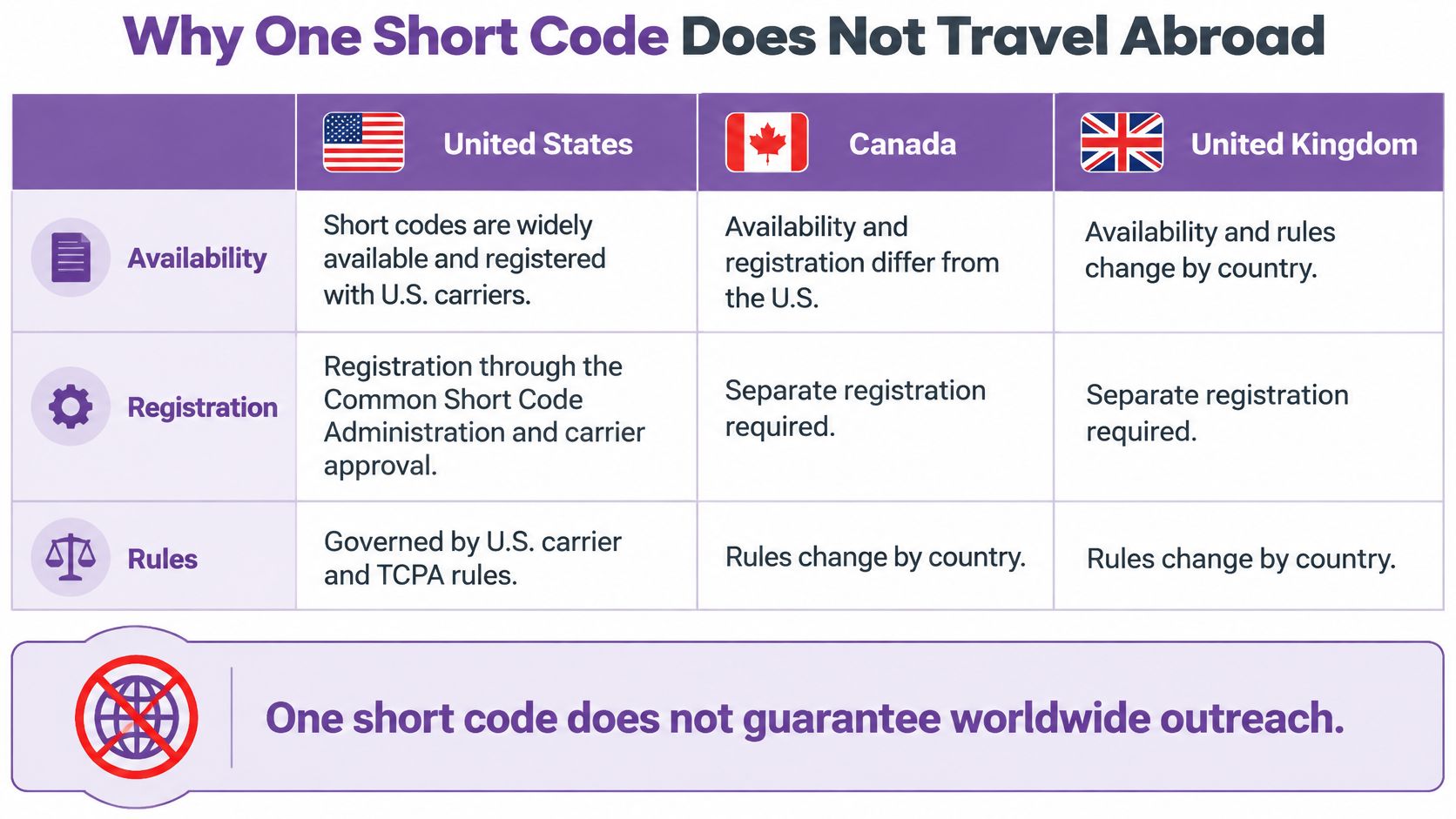
A five- or six-digit code does not follow your customer across a border. Availability and requirements differ by country, and a brand expanding from the United States into Canada, the United Kingdom, or another market usually needs a separate number, a fresh application, local consent language, its own opt-out handling, and its own monitoring, as Sinch's overview of short code texting makes plain. International reach is not the same thing as a portable sender ID.
Six questions to answer before a new market
- Is a short code offered at all by the carriers you need, or does the market run on alphanumeric sender IDs and long codes?
- How long does registration take for that country, and does the queue overlap with your launch window?
- What sender ID appears on the handset, and will customers recognize it as your brand?
- Are there quiet hours you must respect, and does your scheduler know the local time zone?
- Must the copy be in the local language, or will English parse for that audience?
- Can transactional and promotional traffic share one program, or does a marketing opt-out silence shipping alerts too?
When to refuse the short-code path
A smaller Shopify brand with modest volume in a second country is usually better served by a local long code or a toll-free sender where that channel is valid. Lower throughput is cheaper than a second program of the same length running in parallel.
The hidden cost is governance, not lease price. Another market means another opt-out desk, another sample-message packet, another suppression list, and a new place where a re-add can happen. Two suppression lists that disagree is exactly how a customer who asked for quiet gets marketed to again.
Expansion rule: prove the offer in one market on one compliant sender, then add a number only for the country where volume and keyword recall justify the wait.
Pick Your Sender and Launch This Week
- Map every flow to a sender. List checkout, cart recovery, shipping, repeat purchase, and national promotions, then assign each one from the comparison table. A dedicated short code goes only on a keyword that runs for months and fits the review window. Cart recovery and shipping go on a 10DLC long code so they can send now. Toll-free is for support replies and mixed U.S. or Canada alerts where the five-digit memory hook buys you nothing.
- Finish the approval packet before you apply for any sender, short code included. Legal name, collection wording, sample texts, and working STOP and HELP replies are the same documents whichever number you're registering.
- Turn on list capture with a separate SMS checkbox at checkout, then send the first cart-recovery text from the bridge sender. Watch deliverability for a full cycle before adding volume.
- Hold the print run. No packaging, in-store signage, or radio script with a keyword on it until carriers approve the short code. Reprinting a mailer costs more than waiting a week.
For a store that needs a compliant bridge channel now, YipSMS registers numbers for 10DLC and toll-free messaging, so the flows above can go live while a short code application is still in review.
YipSMS Inc. handles 10DLC and toll-free registration so a Shopify store can send cart recovery, shipping, and campaigns while a short code application works through carrier review. The app ships with 10 prebuilt revenue automations that activate in one click, and a 14-day free trial lets you run the setup against your real list before you commit. Visit YipSMS Inc. to start registration and put the first flow live this week.
How this article was made: the YIPSMS team drafts some articles with AI writing tools, then checks pricing, compliance and product details against how YIPSMS actually works before publishing. Spotted something wrong? Tell us through your YIPSMS account.