Two Way Text Messaging for Ecommerce: A Practical Guide
A Tuesday afternoon cart sits loaded with running shoes. The store sends a generic “you left something behind” text, the shopper ignores it, and the retargeting ads keep following them around. A better message asks which color they're considering, or whether they need help choosing a size. A useful reply can remove the buying objection before dinner.
That's the practical difference between one-way SMS marketing and two way text messaging. Most ecommerce stacks already have email, paid ads, and automated retargeting, but those channels mostly broadcast and wait. Two-way SMS adds a conversation layer, particularly valuable when shoppers buy on mobile, make decisions quickly, and expect brands to meet them in the messaging app already on their phone.
This guide treats conversational SMS as an operating system, not a novelty. The central question isn't whether every text should accept replies. It's which moments deserve a reply path, how your team should handle the resulting volume, and when conversation creates more cost than revenue.
Table of Contents
- Why Two Way Text Messaging Matters for Ecommerce
- What Two Way Text Messaging Actually Means
- Business Benefits That Move the Needle
- Five Use Cases That Turn Texts Into Conversations
- When Two Way Stops Working and Adds Friction
- Compliance and Setup Essentials for Shopify Stores
- A Seven-Day Launch Checklist for Your First Campaign
- Choosing the Right Moments to Stay Conversational
Why Two Way Text Messaging Matters for Ecommerce
The abandoned running-shoe cart is common because the first message usually focuses on the merchant's objective, not the shopper's blocker. “Complete your purchase” asks for a decision without finding out whether the problem is color, fit, shipping, price, or simple distraction.
A conversational message gives the customer an easier next action:
Practical rule: Ask one narrow question that can change what you send next.
For example, “Still deciding on the TrailFlex shoes? Reply BLUE for the navy pair, FIT for sizing help, or STOP to opt out.” The reply creates usable intent. “FIT” can route to an agent or a sizing response, while “BLUE” can send the right variant. A generic reminder can only hope for a click.
The missing layer in the stack
Email remains useful for product education and longer offers. Paid media creates demand and retargeting brings shoppers back, but neither channel gives a customer an immediate, low-friction way to explain what's stopping a purchase. Two-way SMS turns a marketing event into a decision-support interaction.
The channel fits ecommerce because many buying moments are short. A customer checking out from a phone may not open an email, search for support, or wait through a contact form. They can reply to the number that already sent the cart, shipping, or product message.
That doesn't mean texting should become a live chat replacement. It means stores should reserve conversation for moments where a short answer changes the next step, such as selecting a variant, resolving a delivery concern, or confirming a preference. Pew's foundational panel experiment found that text-plus-email reminders produced earlier responses than email-only reminders, with 15% responding within the first 30 minutes versus 6%, and a 48% wave-level response rate by day 10 versus 39% for email only, as summarized by Textmagic's coverage of the Pew experiment. The same experiment found that text notifications increased mobile completion behavior, but didn't increase the final response rate over a longer field period.
That distinction matters for operators. Two-way SMS can make action happen sooner and reveal intent, even when it doesn't magically increase every long-run conversion metric.
What Two Way Text Messaging Actually Means
One-way SMS is a megaphone. You send a promotion, delivery update, or reminder and hope the recipient clicks. Two-way SMS is a thread, where the customer can answer and that answer reaches a person, a shared inbox, a helpdesk, or an automation.
A coffee shop makes the difference clear. One-way messaging is a barista shouting today's special across the room. Two-way messaging is the barista asking what you're in the mood for, then recommending a drink based on your answer. The second interaction requires more work, but it produces information the first one never could.
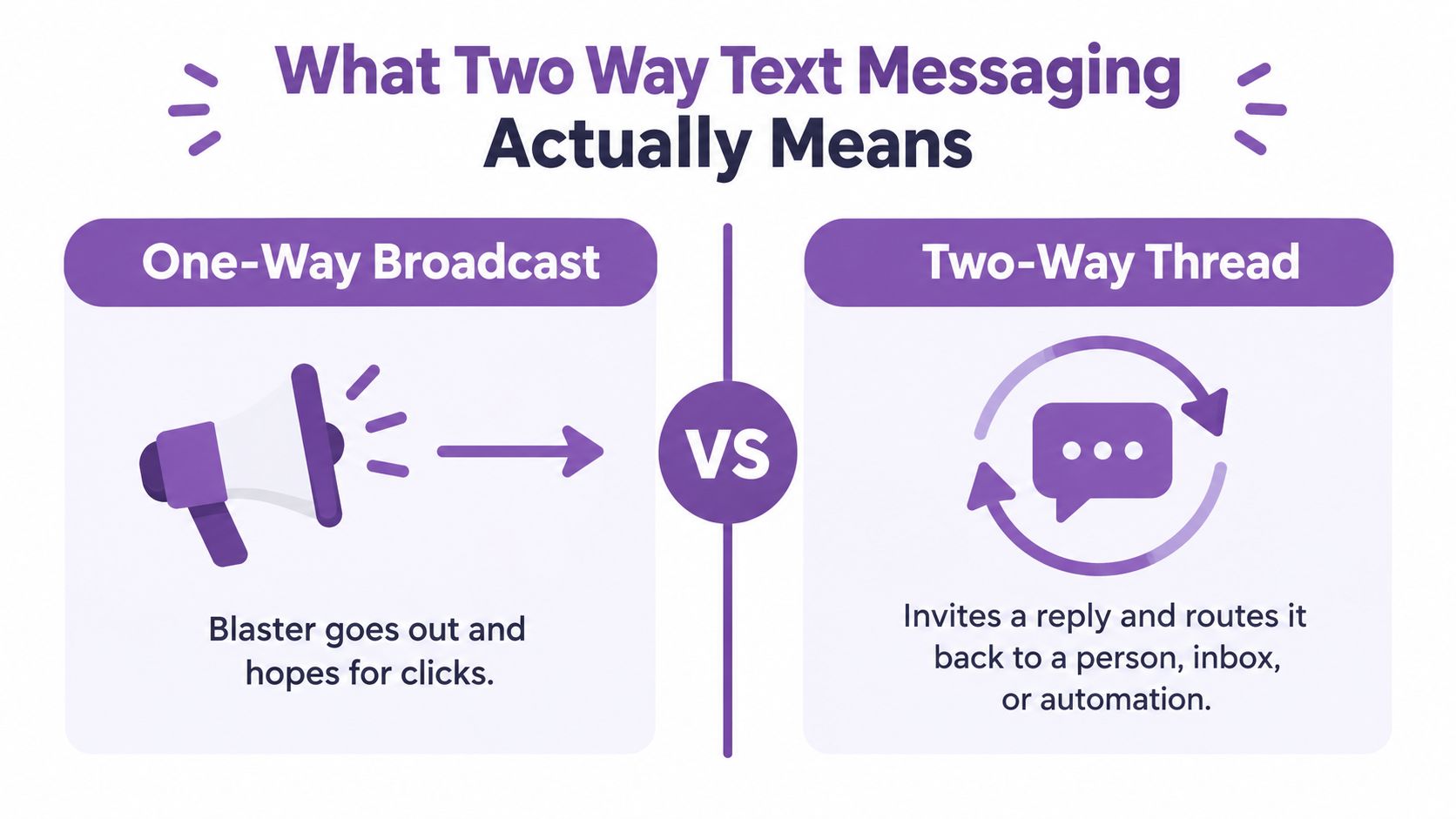
How the reply path works
For US application-to-person traffic, businesses commonly use registered A2P 10DLC local numbers, which are standard 10-digit long-code routes. After brand and use-case registration is approved, incoming replies can arrive on the same number, preserving a familiar area-code presence while supporting support, order updates, and opt-in confirmation workflows, as explained in Twilio's A2P 10DLC documentation.
A basic implementation has four parts:
- Outbound message: Send a clear prompt tied to a specific customer action.
- Inbound capture: Receive the reply in a shared inbox, helpdesk, or messaging platform.
- Routing logic: Use keywords such as “TRACK,” “YES,” “FIT,” “HELP,” or “STOP” to trigger the correct path.
- Human escalation: Give an agent ownership when the question falls outside the automated flow.
Technically, many SMS programs can receive replies. Operationally, that doesn't make them conversational. True two-way messaging means you've designed for the response, assigned responsibility, tested the routing, and decided how quickly someone must answer. Enabling replies without that plan is how a store turns a promising channel into an unattended support queue.
Business Benefits That Move the Needle
Two-way SMS earns its place when a reply affects revenue, customer experience, or segmentation quality. Open rates alone aren't a business model. The value comes from reaching a customer during a high-intent moment and giving them a shorter path to resolution.
Industry sources commonly report SMS open rates around 98%, and abandoned-cart texts are sometimes opened within about 90 seconds on average, according to Ringly's ecommerce cart abandonment benchmarks. Treat that as a timing signal, not a guaranteed result. A fast-opened message still fails if it sends the shopper to an irrelevant product page or leaves a question unanswered.
Speed creates a buying advantage
A customer who replies “Do these run small?” is closer to a decision than someone who merely viewed a product. If the store answers with a useful sizing recommendation, the conversation can remove friction in the same channel. If the store responds hours later, the shopper may have moved to another brand.
Two-way messaging also improves the quality of the data you collect. A reply such as “black,” “wide,” or “gift” is more actionable than a broad click. That preference can shape the next offer, product recommendation, or support response. A customer who voluntarily replies has also demonstrated a stronger signal of intent than a passive subscriber, although the store still needs to respect frequency and consent.
Revenue mechanics versus vanity metrics
| Metric | Two-Way SMS | |
|---|---|---|
| Primary action | Open, click, visit | Reply, click, or resolve a blocker |
| Best ecommerce role | Education, longer offers, retention content | High-intent support and decision moments |
| Customer effort | Open inbox and scan | Reply from the existing thread |
| Merchant requirement | Strong copy and segmentation | Copy, routing, inbox ownership, and automation |
| Main risk | Inbox competition | Intrusive messaging and unmanaged replies |
The trade-off is direct. Conversational SMS can produce faster feedback and more useful intent, but every reply creates an operating obligation. If your team can't answer, triage, or automate the common questions, the channel's reach becomes a liability. Klaviyo's ecommerce SMS guidance supports using two-way messaging for preference collection, FAQs, and high-intent moments such as cart recovery and post-purchase support rather than treating every campaign as an open-ended conversation.
Five Use Cases That Turn Texts Into Conversations
The strongest flows ask a specific question with a short answer. They don't invite vague conversation for its own sake. Each use case below has a trigger, a message, a likely reply, and a practical routing decision.
Cart recovery with an objection prompt
Trigger: A shopper abandons a product with multiple variants.
Message: “Still considering the TrailFlex shoes? Reply FIT for sizing help, BLUE for the navy color, or STOP to opt out.”
Reply: “I'm between sizes.”
Action: Route “FIT” to a sizing macro or agent. Don't send another discount before resolving fit. A shopper asking about size has given you a blocker, not a request for a promotion.
Shipping delay triage
Trigger: An order has a carrier exception or a delivery date has moved.
Message: “Your order is delayed in transit. Reply TRACK for the latest scan or HELP if you need us to review it.”
Reply: “It's for a birthday tomorrow.”
Action: Escalate to support with the order record attached. A tracking link is useful for routine status checks, but it doesn't solve a time-sensitive delivery problem.
Back-in-stock variant selection
Trigger: A customer has opted into an alert for a product that returns in several colors or sizes.
Message: “The Field Jacket is back. Reply BLACK, OLIVE, or SIZE for help choosing before we send your checkout link.”
Reply: “Olive, medium.”
Action: Confirm inventory, send the relevant product link, and store the preference for future segmentation.
Post-purchase feedback
Trigger: The customer has had enough time to receive and use the product.
Message: “How's the fit on your new denim? Reply GREAT, SMALL, or LARGE. We'll help if the size isn't right.”
Reply: “Small in the waist.”
Action: Route the issue to support before asking for a public review. A service recovery opportunity is more valuable than a review request sent too early.
VIP preference capture
Trigger: A high-value customer receives early access.
Message: “VIP access is open. Which would you rather see first, NEW DENIM or ACCESSORIES? Reply with your choice.”
Reply: “Accessories.”
Action: Add the preference to the customer profile and tailor the next message. Keep this focused. VIP treatment doesn't mean unlimited messages.
For customer-service workflows, a shared inbox and clear escalation rules matter as much as the copy. YipSMS's SMS customer service guidance is relevant here because reply-based campaigns and order questions need a defined destination rather than an unattended number.
| Metric | One-Way Blast | Two-Way Reply Flow |
|---|---|---|
| Opening prompt | “Complete your purchase” | “Need FIT or color help?” |
| Customer action | Click or ignore | Reply with a defined need |
| Merchant insight | Broad engagement | Objection or preference |
| Follow-up | Same message logic | Branches by response |
| Operational cost | Lower | Higher, because replies need handling |
The conversational version isn't automatically better. It wins when the reply changes the next action.
When Two Way Stops Working and Adds Friction
The “reply to everything” mindset sounds customer-friendly until the inbox fills with “STOP,” question marks, thumbs-up reactions, and questions no automation can answer. A store can't call every inbound message a success if agents spend their time sorting low-value reactions while genuine order issues wait.
Consumer fatigue also limits the channel. A 2025 SMS spam report from Omnisend notes that around 30% of people receive spam daily or multiple times per day. That doesn't prove a specific store's campaign caused an opt-out, but it does explain why shoppers may treat an unsolicited conversation prompt as another interruption.
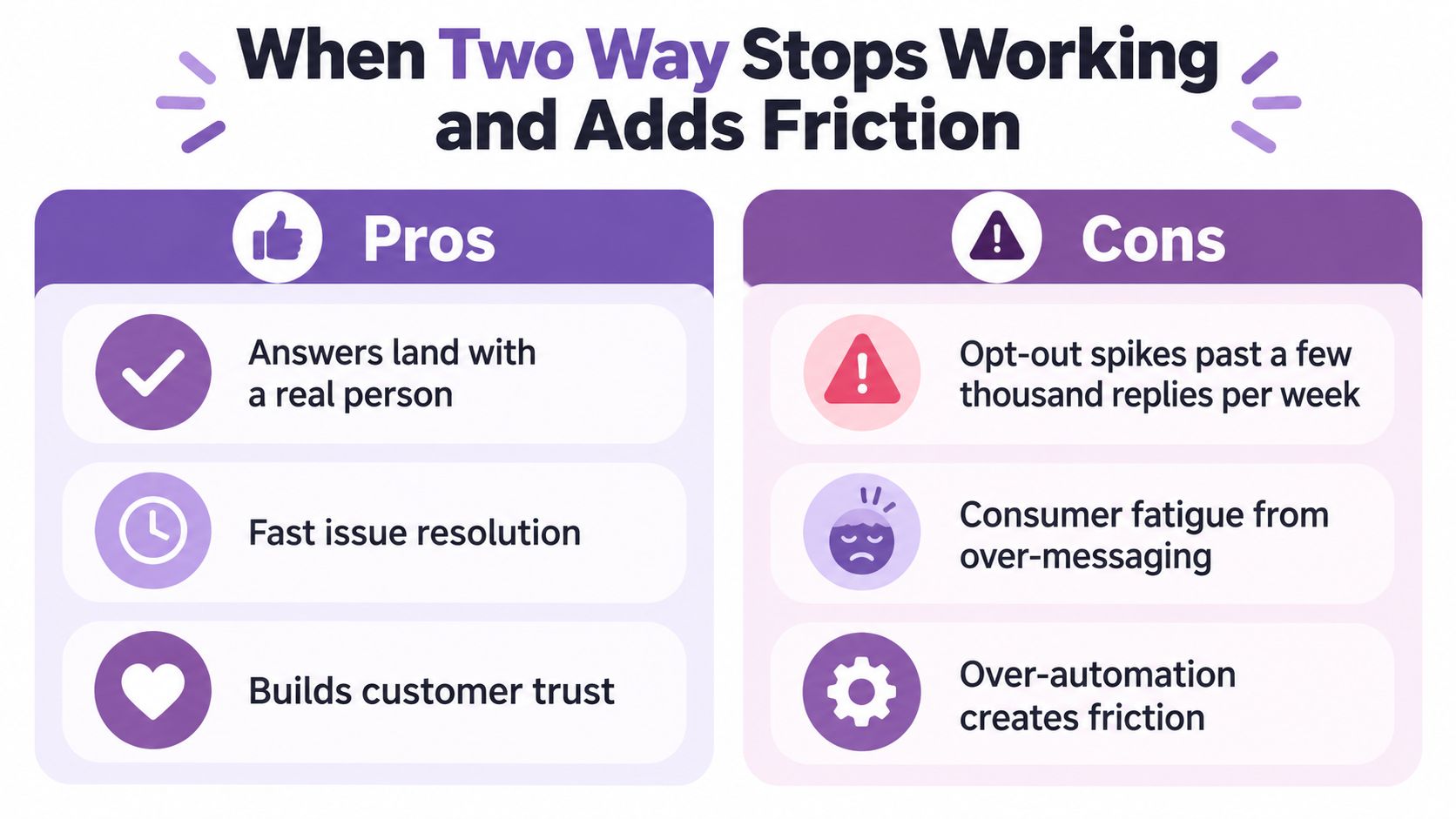
Common failure modes
- Unowned replies: Marketing launches a conversational flow, but no support person monitors the number.
- Slow answers: The brand invites an immediate interaction and then responds after the buying window has closed.
- Overbuilt keyword trees: Customers must guess the exact word instead of writing naturally.
- Dormant-list bait: A store calls an old subscriber “VIP” and asks them to reply, creating fatigue rather than renewed interest.
- Unfiltered automation: A bot sends a coupon when the customer is reporting a damaged order.
Use a simple operator test: if the reply doesn't change a buying decision, collect a preference, or resolve a blocker, it probably belongs in email, push, or a conventional support channel.
You also need to compare recovered contribution margin with the cost of handling conversations. If each useful reply requires manual research, a discount, and several follow-ups, the marginal sale may not justify the labor. Two-way SMS is a service layer, and service layers need staffing limits, escalation rules, and a definition of success.
Compliance and Setup Essentials for Shopify Stores
Compliance starts before the first campaign. For US and Canadian SMS marketing, businesses must obtain express written consent. An unchecked checkbox or another active action should clearly disclose the message type and opt-out terms. Implicit consent isn't enough, as outlined in Bloomreach's TCPA and CTIA compliance guidance.
Your opt-in should identify the sender, explain that marketing texts will be sent, disclose message frequency and message-and-data rates where applicable, and provide a visible STOP path. The exact wording should be reviewed for the regions where you operate, but the interaction must be affirmative and records must be retained.
Build the Shopify flow in the right order
- Choose the SMS app: Confirm it supports inbound replies, shared inbox access, keyword automation, consent records, and Shopify order context.
- Register the number: For US A2P traffic, complete the relevant brand and campaign registration before scaling. Unregistered routes may face filtering or throttling.
- Connect opt-in points: Map consent across your popup, checkout, account creation, and post-purchase forms. Don't assume one checkbox covers every purpose.
- Create routing rules: Send “STOP” to suppression, “HELP” to support instructions, and order-specific terms such as “TRACK” to the order lookup flow.
- Test records: Confirm each subscriber record stores the consent event, source, timestamp, and disclosure shown at signup.
- Test carrier delivery: Send test messages and replies across the major US carriers before launch.
A compliant sample might read: “By checking this box, you agree to receive recurring marketing texts from [Brand]. Consent isn't required to purchase. Message and data rates may apply. Reply STOP to unsubscribe or HELP for help.” Have counsel validate the final language for your jurisdiction and use case.
Operational safeguard: STOP must suppress future marketing across every campaign and automation, not just the flow that received the keyword.
Approved keyword handling should cover STOP for opt-out and HELP for assistance. If you use age-gated products, create a separate, clearly disclosed age-verification path rather than hiding it inside a promotional keyword tree.
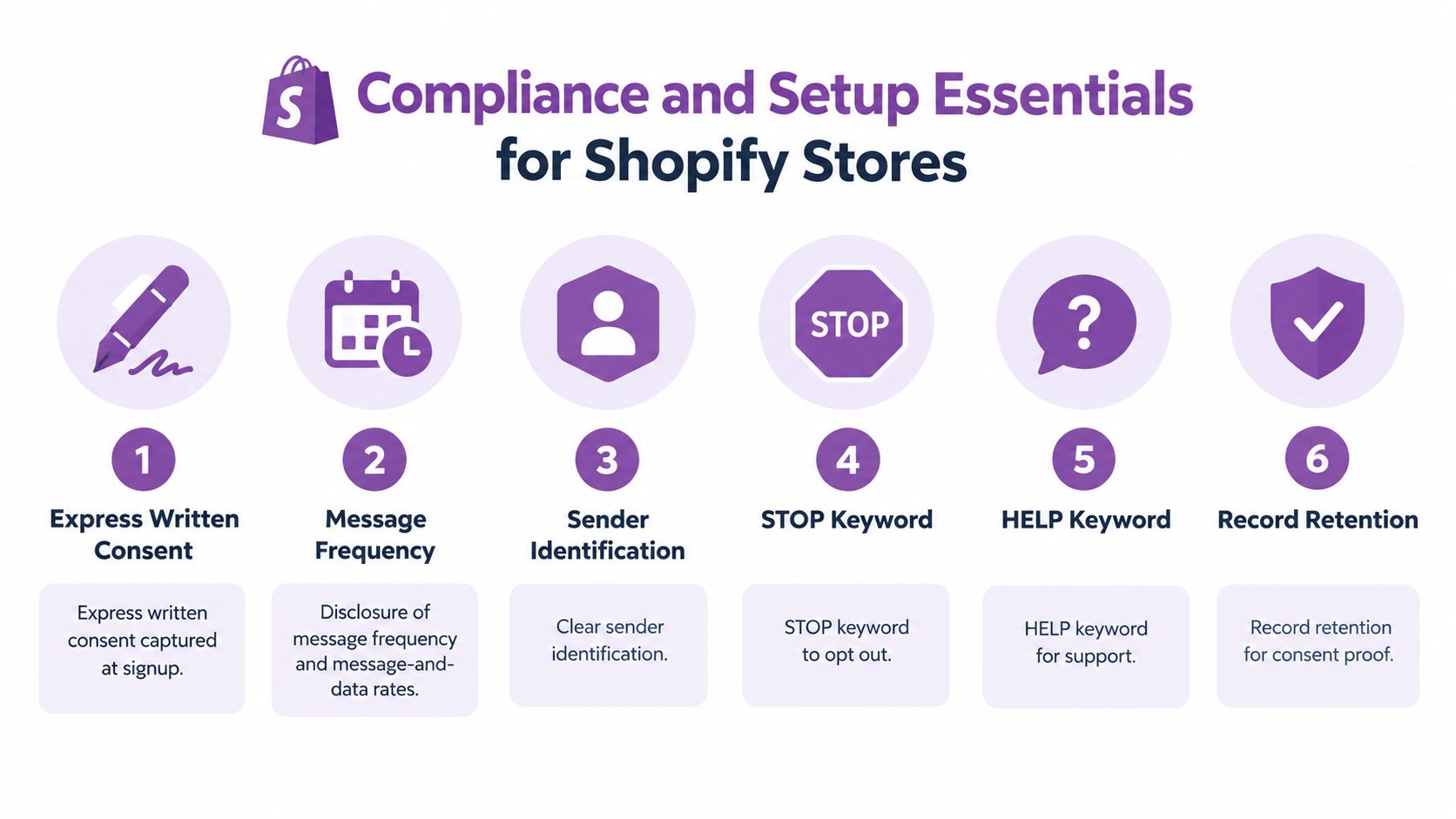
A concise overview of the legal checks belongs beside your technical checklist, not in a forgotten document. See this TCPA compliance checklist for SMS campaigns before collecting subscribers or activating automations.
A Seven-Day Launch Checklist for Your First Campaign
A conversational flow shouldn't go straight from draft to full-list send. Use the first week to prove that consent, routing, copy, and carrier behavior work together.
Day 1 and Day 2
Day 1, select the audience. Start with a recent, clearly consented segment tied to one use case, such as cart recovery or post-purchase support. Don't combine buyers, dormant subscribers, and recent opt-ins in the same first test.
Day 2, confirm consent records. Check the source and disclosure for every selected subscriber. Remove records with unclear permission instead of hoping the customer remembers signing up.
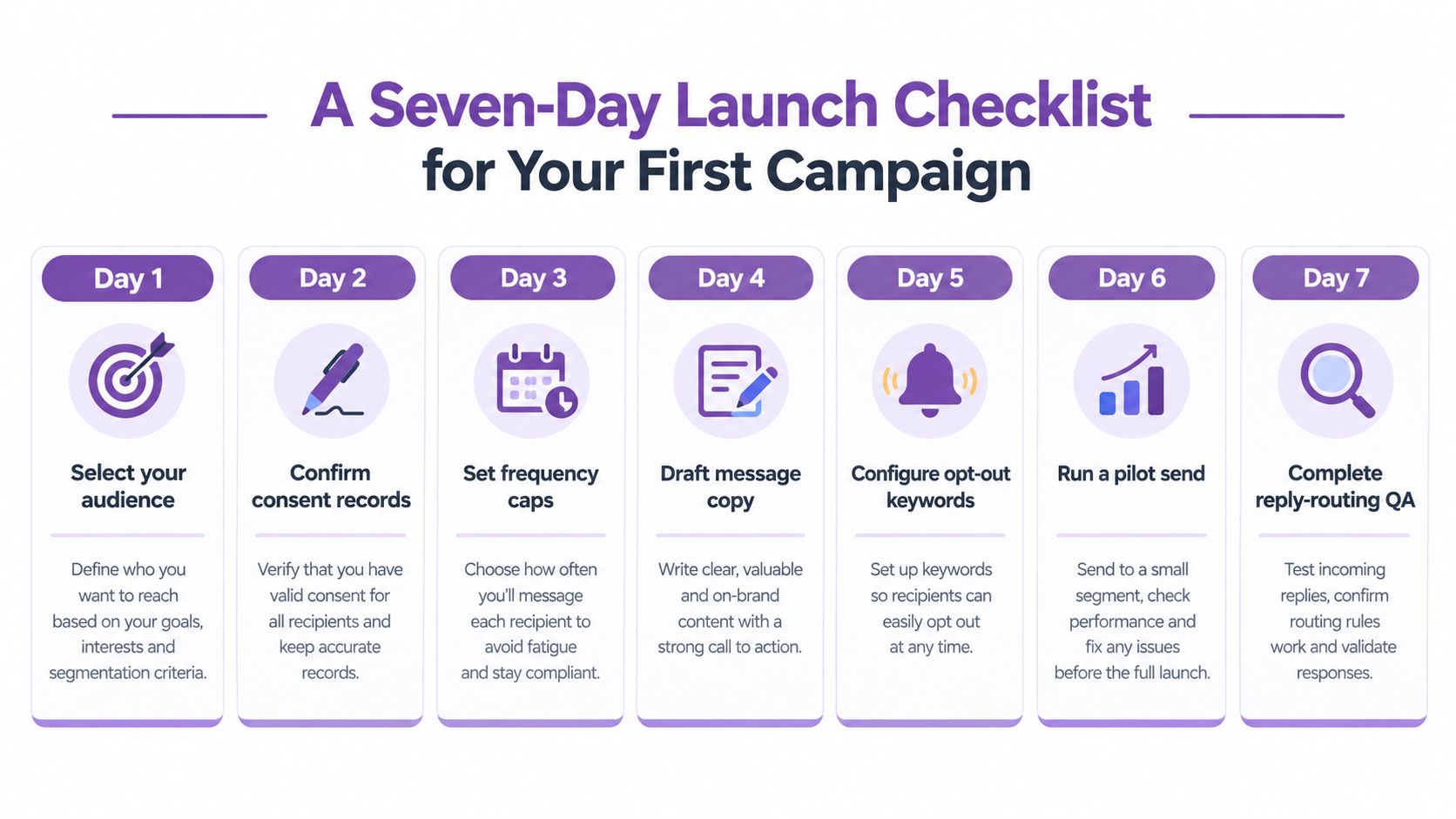
Day 3 through Day 7
- Day 3, set frequency caps: Choose a conservative cap based on your customer journey and document exceptions for transactional messages. Don't treat a recommendation such as 2 to 4 messages per subscriber per month as a universal rule. Test the limit against opt-outs and customer expectations.
- Day 4, draft the copy: Write one clear question, one reply path, and one fallback for unrecognized responses.
- Day 5, configure keywords: Test YES, STOP, and HELP, plus any use-case terms such as FIT or TRACK.
- Day 6, run a pilot send: Send to a small subscriber segment, then monitor delivery, replies, opt-outs, and carrier behavior. A pilot is where you catch confusing copy without exposing the full list.
- Day 7, complete reply-routing QA: Verify webhook responses arrive in under five seconds, STOP suppresses every relevant flow, and the shared inbox or helpdesk assigns ownership before launch.
Monitor deliverability as a system, not a single headline number. Benchmark data cited by DM Text's conversational SMS analysis reports 96.6% deliverability for SMS campaigns and 92.8% for automations, with soft bounces remaining a meaningful issue. That gap makes list quality, pacing, sender reputation, and filter monitoring important when replies and retries increase.
Choosing the Right Moments to Stay Conversational
Use two-way SMS where the customer's answer changes what happens next. Keep the experience simple enough for a shopper to answer from a lock screen, and give your team a clear route when the answer isn't covered by a keyword.
Keep conversation enabled for high-intent moments
- Cart recovery: Ask about size, color, shipping, or product fit.
- Shipping exceptions: Offer tracking and a human escalation path.
- Post-purchase support: Resolve delivery, sizing, exchange, and product-use questions.
- Preference collection: Capture a choice that can improve future segmentation.
Promotional launches, broad seasonal sales, and simple announcements often work better as one-way broadcasts. The customer doesn't need a conversation if the only intended action is “tap the offer.” That keeps the reply burden aligned with the purpose of the send.
Track four signals after each flow: message-to-reply ratio, opt-out velocity, agent backlog, and incremental revenue per handled conversation. Don't borrow universal thresholds without testing your own list. A reply can be positive, neutral, or a support cost, so judge it by the next action and the margin it creates.
Timing also affects performance and customer tolerance. Use this guide to the best time to send text messages alongside your audience's purchase patterns, quiet hours, and support coverage.
The rule is straightforward: make the reply path available where it removes friction, and remove it where it only creates another inbox.
YipSMS Inc. offers Shopify merchants one-click SMS setup, subscriber popups, cart and checkout abandonment flows, shipping notifications, shared-inbox support, and reply-driven automations. If you want to test two-way text messaging without stitching those pieces together yourself, visit YipSMS Inc. and review the available Shopify workflow options.
How this article was made: the YIPSMS team drafts some articles with AI writing tools, then checks pricing, compliance and product details against how YIPSMS actually works before publishing. Spotted something wrong? Tell us through your YIPSMS account.