424 Area Code Text Message: Is It a Scam?
A 424 area code text message shows only that the number belongs to a Southern California numbering region, not that the sender is local, legitimate, or permitted to text you. Popular advice tells you to block every unknown 424 number or, just as confidently, to trust it because it looks local. Both rules fail. Blocking everything can hide real order and delivery updates, while trusting a familiar prefix gives scammers exactly the reassurance they're counting on.
Judge the message by its behavior instead. What does it ask you to do, can you confirm it in an account you opened yourself, and does any record of an order, booking, or opt-in exist? Those checks work for shoppers deciding whether to reply and for store owners who don't want legitimate campaigns mistaken for scams.
Table of Contents
- Is a 424 Text Legitimate? What the Area Code Proves
- Legitimate 424 Texts Versus Spoofed Ones
- Red Flags in Texts That Use a 424 Number
- How to Verify a Text Before You Reply or Click
- Block, Report or Keep a 424 Sender
- What Store Owners Must Do Before Texting 424 Customers
Is a 424 Text Legitimate? What the Area Code Proves
A 424 area code marks a Southern California numbering region covering western Los Angeles County, the South Bay, and nearby coastal areas. That's the verdict, and it's the limit of what the three digits prove. The code doesn't confirm where the sender is today, whether the sender is who they claim to be, or whether a business has your permission to text you.
Where 424 Came From
424 shares the same geographic territory as area code 310. California regulators approved it as an all-services overlay in August 2005 because the 310 region was running short of assignable telephone numbers, according to the history of area codes 310 and 424. Existing customers kept their numbers, while carriers assigned new customers either a 310 or a 424 number.
Mandatory 1+area-code+seven-digit dialing began at 12:01 a.m. on July 26, 2006, and new 424 numbers began being issued on August 26, 2006, per that same record. It was also California's first use of an overlay rather than a geographic split.
Two facts break the link between prefix and person. First, mobile-number portability lets someone keep a 424 number after moving anywhere in the country, so the code records where a number was assigned, not where its owner lives now. Second, caller ID can be faked. The FCC guidance on robocalls, texts, and spoofing warns that scammers spoof local area codes and numbers to increase the likelihood that recipients answer or respond. The displayed number is signaling metadata, not authenticated proof of location.
What Each Signal Actually Proves
What each text signal proves and what it does not
| Signal | What It Proves | What It Does Not Prove |
|---|---|---|
| 424 area code | The number belongs to a Southern California numbering region | Sender location today, legitimacy, or marketing permission |
| Local-looking caller ID | Nothing reliable, since caller ID can be spoofed | Sender identity or physical location |
| Brand name in the message | The sender is claiming a brand identity | Authenticity until checked through an official channel |
| Link to an unfamiliar domain | A destination was supplied | Whether the link is safe |
| Order you can find in your own account | The message likely relates to a real purchase | Anything, if you have not checked the account yourself |
Practical rule: Treat the 424 prefix as a weak signal and judge the message by what it asks you to do, such as clicking, paying, or sharing credentials.
Legitimate 424 Texts Versus Spoofed Ones
A 424 text can be a routine operational message or a spoof dressed up to look local. The prefix won't sort them for you, because legitimate businesses and individuals hold 424 numbers both inside and outside Los Angeles. You sort them by matching the message against your own records.
What Legitimate Messages Usually Look Like
- Order confirmations and delivery updates: These come from a store you bought from and match an order in your account or inbox.
- Appointment reminders: A clinic, salon, or veterinary service you booked confirms a time you recognize.
- Personal messages: Someone you know texts about something in context, with no request for money or codes.
- Marketing you opted into: A brand you subscribed to sends an offer that names the brand and includes a way to opt out.
What Spoofed Messages Usually Look Like
Spoofed texts tend to fail those same checks. The sender has no purchase, booking, or relationship on record for you. The message is a first contact that opens with a casual question, as if you already know each other. A brand is named, but no matching order exists when you check your account. The link leads somewhere other than the company's own domain.
Run every message down both lists. If it matches a transaction you can find in your own account, it's probably operational. If it matches none of your records and asks for a click, a payment, or a reply, put it in the scam pile. One more category catches shoppers out. A marketing text from a real store you never opted into is still unsolicited, even when the sender is genuine, because legitimacy and permission are two different questions.
Red Flags in Texts That Use a 424 Number
Text scams are expensive because they get read. Consumers reported $470 million in losses from scams that began with text messages in 2024, more than five times the reported 2020 amount, and text messages can achieve open rates as high as 98%, according to the FTC announcement on top text message scams in 2024. That combination explains why attackers start with SMS.
The Wrong-Number Opener
The AT&T guide to the 424 area code identifies a common 424 scam pattern as a friendly "wrong number" opener, asking whether you're home or busy tomorrow. If you engage, the sender tries to move the conversation to WhatsApp and eventually promotes an investment opportunity. Other versions impersonate delivery services or employers and include links to fake login pages.
Common text scam patterns and their red flags
| Scam Pattern | Typical Opener | Red Flag |
|---|---|---|
| Wrong-number opener | Asks if you are home or busy tomorrow | Moves the chat to WhatsApp, then pitches an investment |
| Fake delivery notice | Says a package is held or a fee is due | Unfamiliar link to a fake login or payment page |
| Fake bank fraud alert | Says the account is locked or charged | Asks for codes, passwords, or card details |
| Unpaid toll notice | Claims a toll balance is overdue | Payment link with urgency and a short deadline |
| Impersonated employer | Asks you to confirm a shift or job | Link to a fake login page |
When Flags Stack Up
- Manufactured urgency: Phrases like "act now" or "final notice" push you past checking.
- Credential requests: No store needs your password or full card number by text.
- Unfamiliar shortened links: They hide the destination until you've already tapped.
- App switching: Moving to WhatsApp or another app takes you away from carrier filters.
- A brand with no order behind it: The name is real, but your account shows nothing.
One flag on its own can be noise, as these sample spam messages show when you compare patterns side by side. Two or more together are the signal to stop. Don't reply to test the sender, because engagement can signal that your number is active and invite more attempts.
How to Verify a Text Before You Reply or Click
Verification takes about a minute, and it works because you check the claim somewhere the sender doesn't control. Start with the flow below, then work through each step.
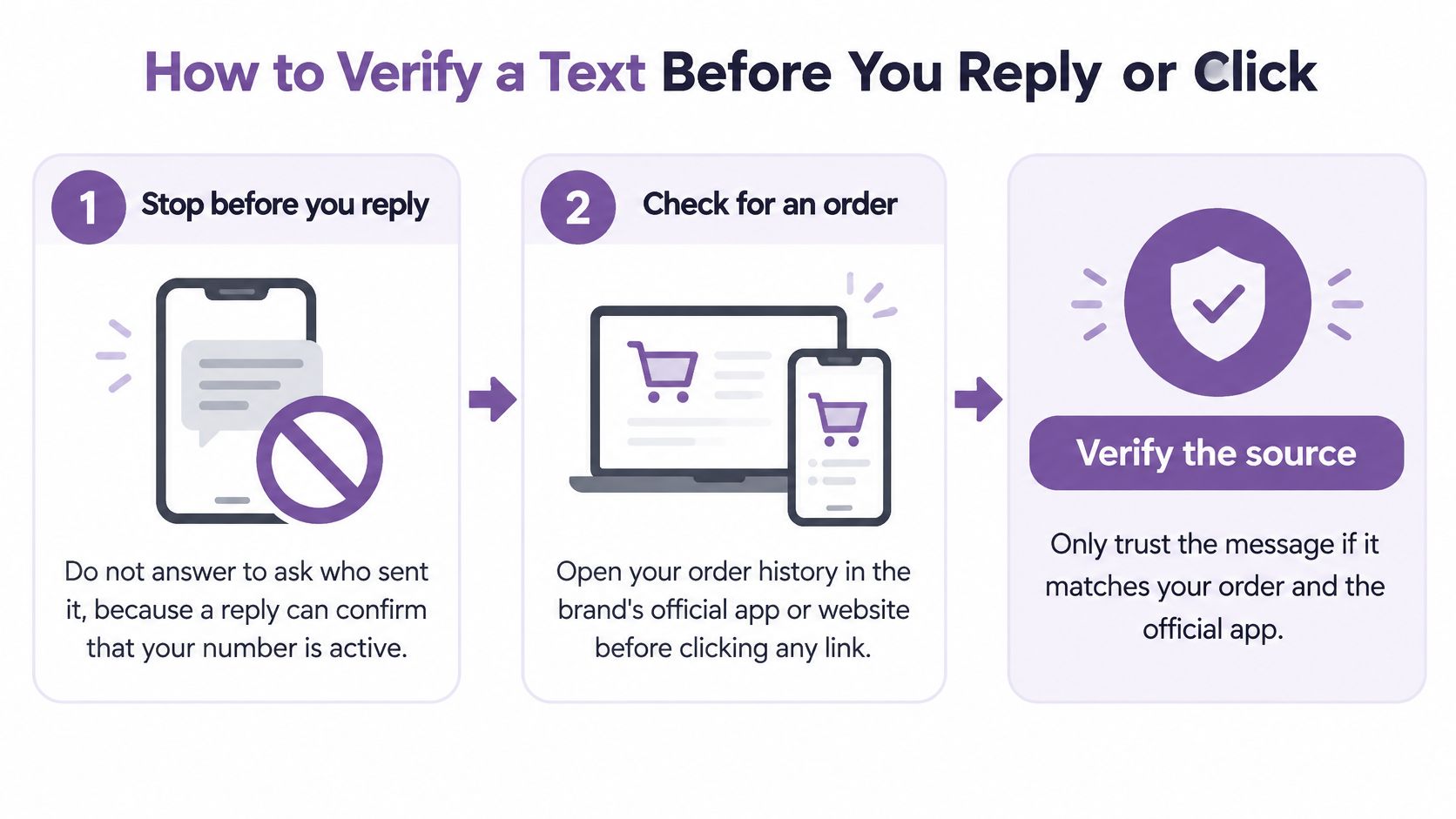
- Stop before you reply. Don't answer to ask who sent it. A reply can confirm that your number is active, and a scammer's answer proves nothing.
- Check for an order. Open your order history in the brand's official app or account instead of following the link in the text. If there's no order, the delivery claim has nothing behind it.
- Type the known address yourself. If you need the website, enter an address you already know or use a saved bookmark. Never trust a shortened link, since it can hide a fake login page built to harvest credentials.
- Check the brand and purpose. Legitimate order texts name the brand and refer to a purchase you made. A vague "your package" message with no brand and no order reference fails this test.
- Never send secrets by text. Don't share passwords, one-time codes, or full card numbers in a reply or through a linked form. Real verification happens inside your account, as explained in this guide to SMS authentication.
- Call through an independent channel. Use a number from the company's official website or your receipt, not a number in the message, because the sender can control numbers they gave you.
- Forward spam and delete it. If the message is unwanted, forward it to 7726 (SPAM) and delete it without replying.
The short video below walks through the same checks visually, so you can see what a suspicious message looks like before you act on one.
A real order text gives you a brand name, an order you can find in your account, and no demand for payment or credentials. If any of those three is missing, verify before you act.
Block, Report or Keep a 424 Sender
Use one decision rule. Block and report when a text is unsolicited and asks you to click, pay, or reply. Keep the sender only when the message matches an order you verified in your own account, and even then treat any later request for credentials as suspicious, because a real number can be impersonated later.
Where Each Report Goes
Reporting matters even when a number is spoofed. The FCC unwanted communications complaint process covers numbers that are spoofed, blocked, or labeled as potential spam, and carrier reports help filters learn which patterns to catch. Match the channel to the problem.
Where to report unwanted or fraudulent texts
| Report To | Use It For | How |
|---|---|---|
| Forward to 7726 (SPAM) | Unsolicited texts from an unknown sender | Forward the message, then delete it without replying |
| Carrier spam option | Repeated texts from the same number | Use your carrier's spam or block option on the message |
| FCC complaint | Spoofed, blocked, or impersonated numbers | File an unwanted calls and texts complaint |
| FTC fraud report | Text scams that cost money or personal data | Report through the FTC's fraud reporting channel |
Blocking one number stops that sender's repeat texts, but scammers rotate numbers, so reporting the pattern matters as much as the single block. Each forwarded message gives carriers another example of the opener, the link style, and the pitch.
For store owners, this is also why registered sending numbers matter. We register customers' numbers for 10DLC and toll-free messaging, and our SMS plan includes automatic STOP/HELP handling, trackable short links, personalization tokens, and real-time analytics. TCPA-friendly compliance, including automatic opt-out language, double opt-in flows, and consent logs, helps your legitimate texts look and behave differently from the ones shoppers are told to report.
What Store Owners Must Do Before Texting 424 Customers
A local-looking number buys you nothing. Shoppers apply the same behavior test to your campaign that they apply to every unknown 424 text: who is this, how did they get my number, and what happens when I say stop. A 424 customer gets the same protection as any other U.S. mobile number, and a local-looking number must never be used to imply a personal relationship you don't have.
Get the Right Consent and Keep the Receipt
U.S. commercial robotexts to mobile phones generally require the recipient's prior express written consent, and a consumer's revocation of consent applies to texts from the entire company rather than only one campaign, according to the Congressional Research Service summary of robotext rules. Informational texts can rely on oral consent in some circumstances. Promotional messages need the stronger standard.
Written consent works like a signed receipt: it proves exactly what the customer agreed to and when. That split should shape your signup forms. A customer typing a number to get a shipping update is answering "where is my order," not "send me offers," so use separate unchecked consent options for marketing and order-related notifications. Keep evidence for every opt-in, including the signup form, the exact disclosure language shown, the timestamp, the source page, and the phone number. If you also capture leads with AI chat on your storefront, apply the same discipline there, and record which channel produced each consent so your SMS list never inherits permission a visitor gave for something else.
Build the Opt-Out Path Before You Send
The CTIA messaging principles and best practices say senders should obtain opt-in consent before texting and provide an opt-out path at any time, including standardized STOP wording in the call to action, terms, and opt-in confirmation. In practice, that means showing expected frequency, brand identity, message purpose, and "Reply STOP to opt out" before enrollment.
Process STOP immediately, send one final confirmation message, and then send nothing more. That single confirmation tells the customer the request worked; anything after it reads as ignoring the opt-out. Suppress the number across all brand campaigns and automated flows, including abandoned-cart, product follow-up, and promotional sequences, plus every storefront you manage. A queued broadcast that lands after an opt-out confirmation undoes the trust the whole system is built on, so test suppression before each big send and keep this TCPA compliance checklist beside your campaign workflow.
Don't Write Like a Scammer
Everything a shopper learned to distrust in a suspicious 424 text applies to your campaigns.
- Skip wrong-number openers: Never open with a casual question like asking whether someone's free tomorrow.
- Name the brand in the first line: The reader shouldn't have to guess who's texting.
- Keep links on your own domain: Promotional destinations should match the company domain customers already know.
- Never ask for payment or passwords by text: Send customers to their account page or order email instead.
- Watch your replies: Monitor for "not my order" responses and complaint trends by area code, since a spike can mean your campaign is being mistaken for a scam or your number is being spoofed.
Pre-send audit: Confirm the consent record, the sender identity, the opt-out suppression list, and the link domain. If any one of the four fails, fix it before the campaign goes out.
If you text 424 customers, or any U.S. shoppers, YipSMS Inc. gives your Shopify store permission-based SMS marketing with consent logs and automatic opt-out handling built into your SMS workflow. Start your 14-day free trial, register your sending number, and send messages your customers can verify instead of messages they have to wonder about.
How this article was made: the YIPSMS team drafts some articles with AI writing tools, then checks pricing, compliance and product details against how YIPSMS actually works before publishing. Spotted something wrong? Tell us through your YIPSMS account.