Text Blast Services: What They Are and How to Choose
Your flash-sale offer is ready, but the SMS send screen raises harder questions than the copy does. Are you paying for recipients or message segments? Will someone who already received a cart reminder get another promotion? And can you prove how every phone number joined your list?
Text blast services are worth choosing on delivered cost, consent records, and subscriber-level frequency controls, not just list capacity. A cheap send isn't cheap if it reaches the wrong customers, arrives after the sale, or produces orders that would've happened anyway.
Table of Contents
- What Text Blast Services Do for Store Owners
- Core Features a Blast Tool Must Handle
- Pricing Models and What a Blast Really Costs
- Consent and Opt-Out Rules Before You Send
- How to Evaluate a Text Blast Provider
- Use Cases That Earn Their Sends
- Frequency Limits and Message Preferences
- Launch Your First Compliant Text Blast
What Text Blast Services Do for Store Owners
Say you run a Shopify store and schedule a flash-sale discount for 8,000 opted-in subscribers at 9 a.m. By lunchtime, you're checking orders, clicks, delivery failures, and unsubscribes. That's a hypothetical campaign, but it captures the job: coordinate a large send and understand what happened afterward.
A text blast service sends one message to a large list of phone numbers, with personalization fields, controlled timing, and campaign reporting. Think of it as your shop's loudspeaker aimed at a mailing list, except each person can hear their own name.
For a merchant, the workflow starts at the same desk where orders, inventory, and customer questions already compete for attention.

What happens beneath the send button
Unlike a personal text, a blast coordinates many individual deliveries. Your opted-in list determines eligibility, your sender number identifies the business, and the carrier network transports each message to the recipient.
Bulk SMS and MMS can reach thousands of people at once, using personalization and dynamic fields. A customer's first name, relevant product, or destination page can change without requiring you to compose each message manually.
- The list answers who: Include eligible subscribers, not every phone number stored in Shopify.
- The sender answers from whom: Customers should recognize the store without saving its number.
- The report answers what happened: Separate queued, delivered, clicked, purchased, and opted-out activity.
SMS remains useful alongside chat apps because recipients don't need a particular messaging application or account, a distinction discussed in the International Telecommunication Union's communications report. That doesn't guarantee delivery, but it avoids an app-install requirement.
For a practical introduction to how stores drive sales with permission-based text messaging, Headline Marketing Agency connects permission with campaign purpose.
The commercial question isn't whether the tool can broadcast. It's whether you can message this list legally and whether those sends will pay for themselves.
Core Features a Blast Tool Must Handle
Evaluate features by the work they perform. A polished composer won't compensate for broken suppression, and an elaborate dashboard won't fix a campaign that sends at the wrong local time.
Sending and audience management
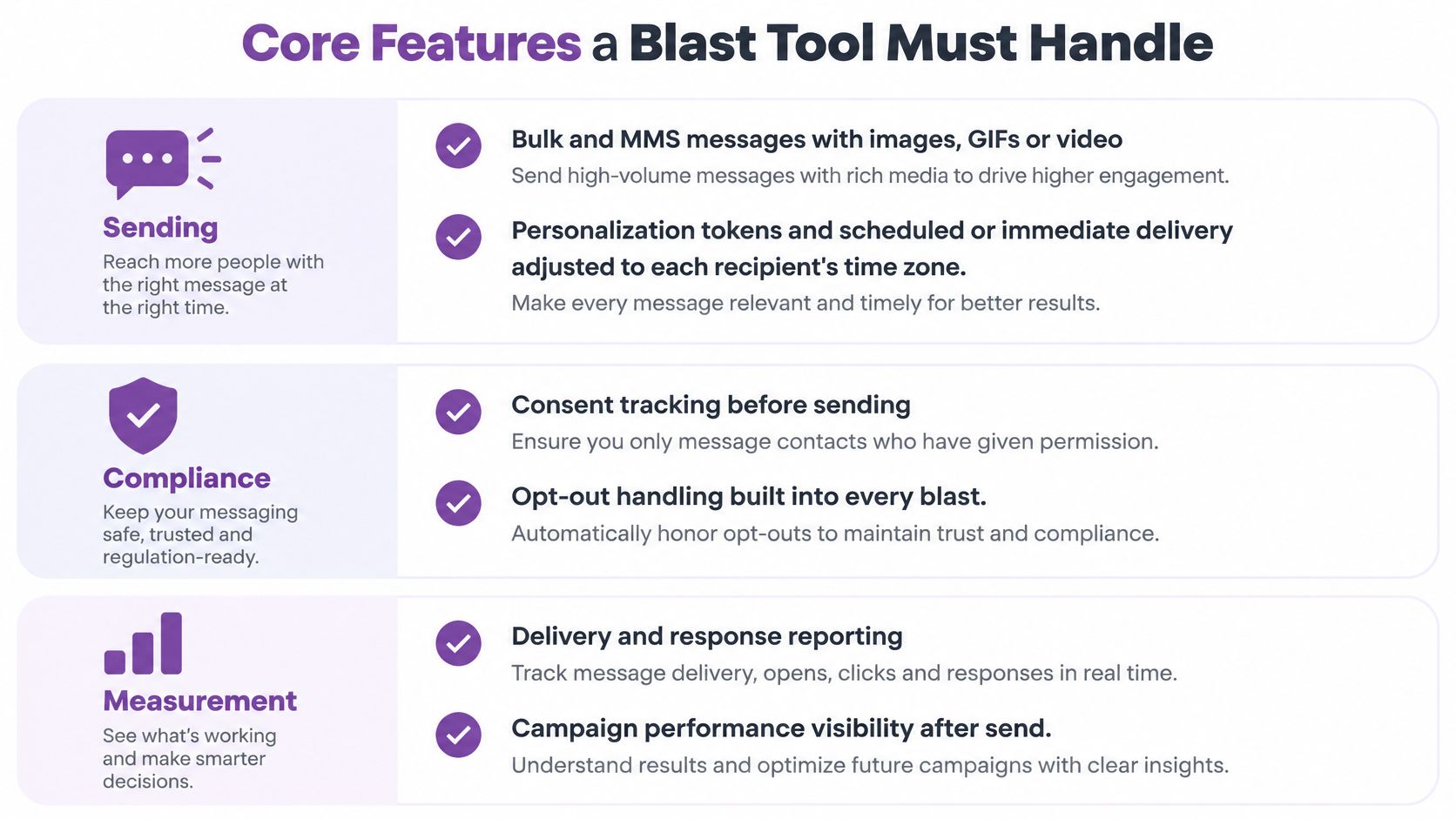
Can the tool deliver the right format at the right time? Look for plain-text SMS, MMS with images, GIFs or video, personalization tokens, and immediate or scheduled delivery adjusted to recipient time zones. Preview missing-name fallbacks so an empty customer field doesn't produce an awkward greeting.
Our SMS plan includes plain text, personalization tokens, trackable short links, automatic STOP/HELP handling, and real-time analytics. Messages can be scheduled at a chosen time across time zones.
Can you build an audience without rebuilding spreadsheets? We support unlimited named lists and a QR code generator for offline-to-SMS sign-ups. Use purchase or browsing behavior for segments, and keep signup source separate from marketing eligibility.
Use this checklist to organize the sending, compliance, and measurement requirements.
Compliance, automation, and reporting
Does a STOP reply remove someone automatically? Automatic replies aren't enough unless the number is suppressed from campaigns and queued promotional automations. HELP should return useful assistance, not send customers into an unattended inbox.
Can Shopify events start and stop messages? Useful flows include abandoned cart, viewed product, welcome, keyword opt-in replies, and shipping or delivery notifications. Inspect cancellation logic as closely as trigger logic, especially when a purchase should end a recovery flow.
Can you connect activity to outcomes? Per-campaign reporting should show deliveries, clicks, orders, and opt-outs, with clear definitions for attributed purchases. Real-time visibility helps you catch a broken destination page while a campaign is still running.
Copy these checks into a provider demo:
- Non-negotiable STOP handling: Demonstrate an actual unsubscribe reply.
- Non-negotiable suppression: Show that an opted-out number can't re-enter a marketing send.
- Non-negotiable scheduling: Preview recipient-local delivery settings.
- Non-negotiable reporting: Open a campaign's delivery, click, order, and opt-out results.
- Audience controls: Build a behavioral segment and exclude recent purchasers.
- Automation controls: Trigger a flow, then demonstrate its exit condition.
Pricing Models and What a Blast Really Costs
YipSMS plan rates per message
| Plan | Monthly fee | SMS per message | MMS per message |
|---|---|---|---|
| Free | $0 per month | $0.025 | $0.055 |
| Gold | $99 per month | $0.018 (28% savings) | $0.042 |
| Premium | $299 per month | $0.015 (40% savings) | $0.030 |
The SMS savings shown compare message rates against Free, not total monthly bills. Subscription fees are additional to message charges, so the lowest unit rate doesn't automatically produce the lowest invoice.
Use this planning formula:
Monthly messaging cost = monthly fee + recipients × billed segments per recipient × segment rate.
For example, suppose 5,000 subscribers each receive one single-segment SMS, with no other usage:
| Plan | Worked calculation | Total |
|---|---|---|
| Free | $0 + 5,000 × $0.025 | $125 |
| Gold | $99 + 5,000 × $0.018 | $189 |
| Premium | $299 + 5,000 × $0.015 | $374 |
Calculated from those rates, Gold beats Free after approximately 14,100 messages per month, while Premium beats Gold after approximately 66,700. Those comparisons assume single-segment SMS and exclude MMS or other charges.
Count segments, then count deliveries
An SMS supports 160 characters in the standard format. Longer messages are split into billed segments, so a promotion spanning two or three segments can cost two or three times as much as a single-segment version. Use the composer's segment preview, especially after adding personalization or special characters.
We also list a flat bulk SMS rate of $0.032 per segment. Treat that as a distinct quoted offer, not the rate used in the subscription calculations above, and confirm which pricing applies to your account before budgeting.
Cost per delivered message is more useful than cost per queued recipient. In a hypothetical campaign, $189 in total spend divided by 4,600 delivered messages equals about $0.041 per delivered message.
Measure profit after the message bill
A sale attributed to SMS isn't necessarily an additional sale. Subtract message costs, discounts, fulfillment costs, and refunds before deciding whether a campaign earned its place.
Product Metrics' explanation of profit on ad spend (POAS) provides a useful profit-first lens, even though SMS also includes owned-channel operating costs. Our SMS marketing cost guide can help organize the messaging side of that calculation.
Before sending, confirm whether your quote covers MMS images and whether a subscription fee continues during inactive months. Paying only for messages sent describes usage charges; it doesn't erase the monthly fee on a paid subscription.
Consent and Opt-Out Rules Before You Send
Start with specific permission for marketing texts, rather than treating a checkout phone number as blanket permission. For UK stores, the Information Commissioner's Office PECR guidance generally requires specific consent for unsolicited marketing texts, given knowingly and freely through a clear positive action.
That can mean ticking an opt-in box that names the organization and communication type. A generic agreement to receive electronic mail isn't specific enough for SMS.
Build evidence into signup
Use a separate, unchecked SMS marketing box that identifies your store and describes the messages subscribers should expect. Don't hide the choice inside general terms or assume email permission transfers to text.
For every subscriber, store the consent timestamp, signup source, and exact wording displayed. Keep a versioned copy of the form so a future redesign doesn't overwrite the evidence associated with older sign-ups.
Our popup builder captures phone, email, and name in one tap, with TCPA-compliant consent and Privacy Policy links built in. That supports collection, but the merchant still needs to configure the offer, audience, and wording appropriately.
- Separate permission from possession: A number collected for delivery coordination isn't automatically a promotional subscriber.
- Preserve the wording: A timestamp alone doesn't show what the customer agreed to.
- Match the market: UK PECR and US TCPA requirements aren't interchangeable.
For US program preparation, use our TCPA compliance checklist as an operational starting point, not a substitute for jurisdiction-specific advice.
Make withdrawal effective immediately
The ICO's electronic-mail marketing guidance calls for an easy withdrawal mechanism, such as replying to a designated number, without a charge beyond the ordinary cost of sending the message. Include a clear instruction such as Reply STOP to unsubscribe in promotional texts.
Process withdrawal immediately, update the suppression list, and prevent automated retries from reaching the number. Keep suppression evidence rather than deleting the contact and risking an accidental reimport.
Carrier expectations also matter. The CTIA messaging framework emphasizes protecting consumers from unwanted traffic through permission-based messaging and network controls.
A working unsubscribe is a system behavior, not just a sentence at the bottom of a text.
Run this pre-send check:
- Wording reviewed: Sender and marketing purpose are clear.
- Records stored: Consent evidence is retrievable per subscriber.
- STOP tested: A real handset confirms the withdrawal path.
- Suppression synchronized: Imports, campaigns, and flows share exclusions.
- Content matched: The promotion fits the purpose disclosed at signup.
How to Evaluate a Text Blast Provider
A low per-message rate does not guarantee an affordable campaign. Compare the full monthly cost, the rate per segment, delivery performance, and the controls that prevent unwanted messages.
| Criterion | What good looks like | Red flag |
|---|---|---|
| Pricing transparency | Per-message rate and monthly fee shown before signup | Rates only revealed after a sales call |
| Contract terms | No contract and no monthly minimum | Multi-month lock-in or minimum spend |
| Throughput | Send rate and queue status are visible | Promises instant delivery to any list size |
| Delivery reporting | Breakdown by carrier, campaign and message type | Only one overall delivery percentage |
| Opt-out handling | STOP is processed immediately and the number suppressed | Opt-outs processed in periodic batches |
| Trial access | Trial lets you assess the service before committing | No trial period |
Throughput matters more than list capacity
A provider may store a large list but still be unable to deliver messages within your sale window. API acceptance is not handset delivery.
CTIA's Messaging Principles and Best Practices describes approximately 15–60 messages per minute per telephone number as typical consumer-scale behavior and notes that a person generally cannot originate more than about one message per second. These figures describe consumer behavior, not a universal business messaging allowance.
As a hypothetical stress test, sending 100,000 messages through one sender could create queues, delays, or filtering. Business traffic needs an approved sender arrangement and rate controls suited to its route. Effective throughput depends on the lowest limit among the provider's API capacity, sender, carrier, and filtering tolerance. More concurrent API calls will not remove a carrier bottleneck.
Inspect the operational evidence
During a demonstration, ask to see queue depth, send rate, carrier response codes, delivery latency, and failure categories. An overall delivery percentage cannot show whether a carrier received a flash sale after its offer expired.
- Test failure handling: Check how the system distinguishes invalid numbers from temporary routing problems.
- Inspect retries: Confirm retries respect suppression and campaign expiration.
- Review support ownership: Find out who investigates delayed traffic and what evidence they need.
For commercial terms, YipSMS offers no contracts, monthly minimums, or surprise fees. Customers pay for messages they send. Its trial lasts 14 days, and new merchants receive $20 in credit after their first review. A paid subscription, if selected, adds its stated monthly fee to message costs.
Keep acquisition costs separate from SMS retention economics. Teams expanding their acquisition stack can compare influencer marketing platforms for 2026 with Clipatra.
Before importing a full subscriber base, run a hypothetical 10-number pilot with consenting staff or testers. Include different carriers, a missing personalization field, an unsubscribe, and a scheduled send. Use the results to assess delivery and handling, not just the provider's headline rate.
Use Cases That Earn Their Sends
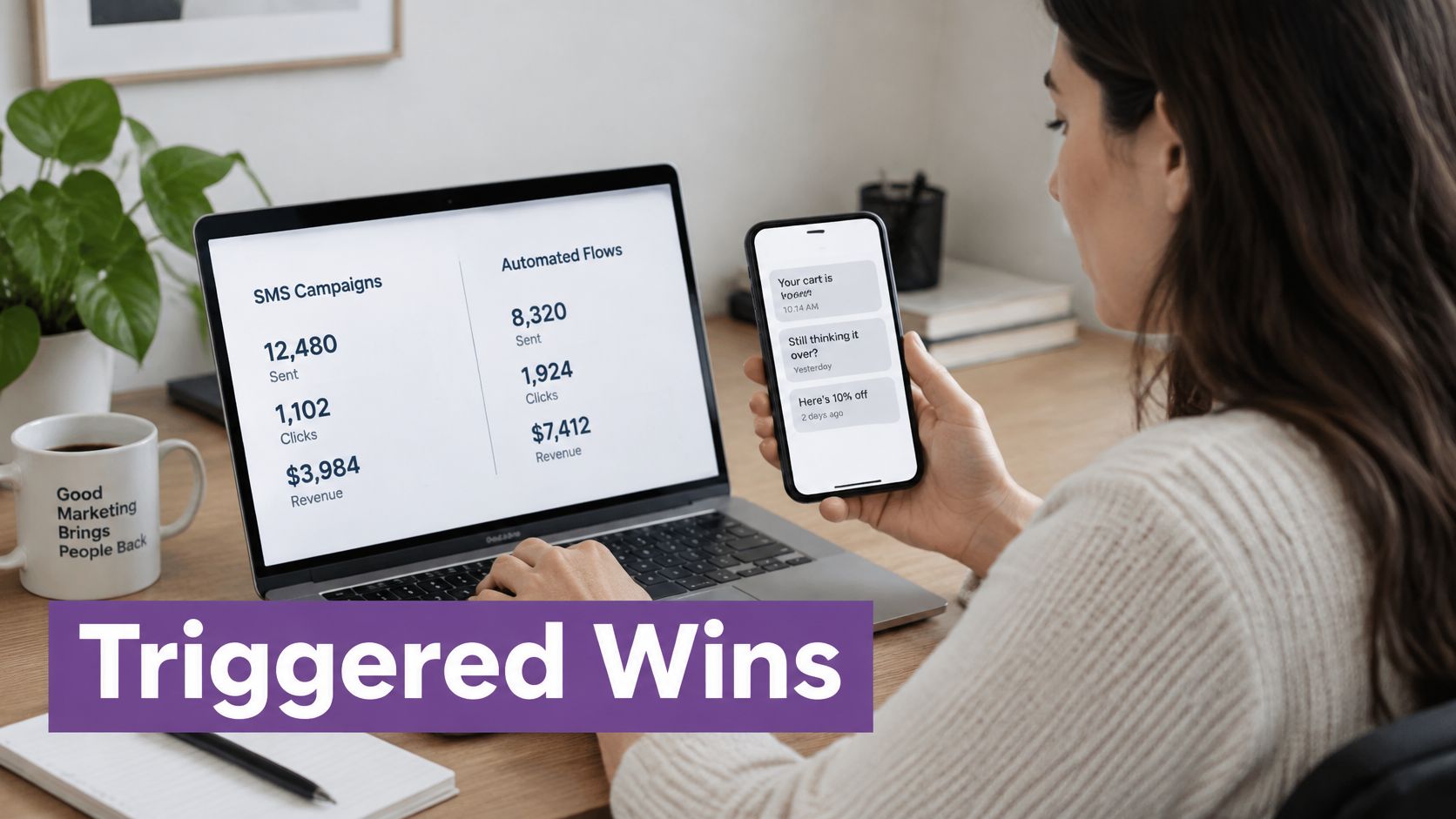
Klaviyo's published SMS benchmarks report an average order rate of 0.27% for campaigns versus 1.9% for flows, with benchmark eligibility requiring at least 25 delivered SMS messages during the previous six months. That supports prioritizing relevant triggers, but the eligibility threshold isn't proof that a small sample produces a reliable result.
Keep campaign and flow results separate when reviewing your dashboard.
Use cases, timing and frequency
The following is an illustrative starting configuration to test, not a benchmark or universal sending rule.
| Use case | Message type | Timing | Frequency guidance |
|---|---|---|---|
| Abandoned cart | Automated flow | Within 1 hour of abandonment | One reminder, then stop after purchase |
| Viewed product | Automated flow | 2 to 4 hours after browsing | One per product per week |
| Welcome message | Automated flow | Right after opt-in | One welcome message |
| Shipping and delivery | Transactional | At dispatch and at delivery | One per order event |
| Flash sale | One-off campaign | Scheduled in recipient time zone | One send per event, excluding recent buyers |
| Win-back | Campaign | Customers inactive 60 days or more | Two or three attempts per quarter |
Start with abandoned-cart and welcome flows because their event triggers don't require elaborate segment building. Add a flash-sale campaign after you understand baseline flow activity, and make purchases cancel pending recovery messages.
Our prebuilt automations include Shipped Notification, Delivered Notification, Popup Subscriber Welcome, AI Chat Response, Keyword Opt-in Reply, and Shopify Segment Entry. Templates reduce setup work, but you still need to inspect eligibility, timing, and exit conditions.
For message-writing ideas, adapt our SMS marketing examples to your product and subscriber expectations. A cart reminder should restore the shopper's context, not automatically surrender margin with a discount.
Use this video alongside your workflow review.
Evaluate flows against a randomized holdout where practical. Compare profit per eligible recipient, not merely attributed orders, and keep transactional notifications outside promotional revenue reporting.
Frequency Limits and Message Preferences
Set a subscriber-level promotional limit, not a separate allowance for each campaign or automation. Otherwise, a cart flow, flash sale, and win-back campaign can all reach the same person while each individual program appears restrained.
As an illustrative starting policy, try two promotional messages per subscriber per week, then adjust through controlled testing. Count flash sales and win-back messages inside that allowance rather than treating them as exceptions.
Let customers choose relevance
In a 2025 Attentive survey of 3,300 consumers in the United States, United Kingdom, and Australia, 81% ignored irrelevant messages, one in four became less likely to purchase after receiving one, and 86% wanted to choose which message types they receive on each channel.
Offer category choices for promotions, new arrivals, and order updates. Make it possible to reduce marketing without unnecessarily losing useful delivery information, and don't interpret an order-update preference as promotional consent.
- Promotional cap: Apply one shared allowance across broadcasts and marketing flows.
- Transactional exception: Exempt genuine order confirmations and delivery updates from the promotional cap, while showing them in preferences.
- Purchase suppression: Remove customers from recovery and acquisition offers once their behavior makes those messages irrelevant.
Before releasing a campaign, check the recipient's send log. If a shopper received an automated marketing text that day, skip or delay the promotion instead of stacking both.
Practical rule: The customer experiences your store's total message volume, not your team's campaign calendar.
Track opt-outs per 1,000 delivered messages as an operational reporting convention: campaign opt-outs divided by deliveries, multiplied by 1,000. When that rate rises, investigate audience relevance and cadence before increasing send volume.
Launch Your First Compliant Text Blast
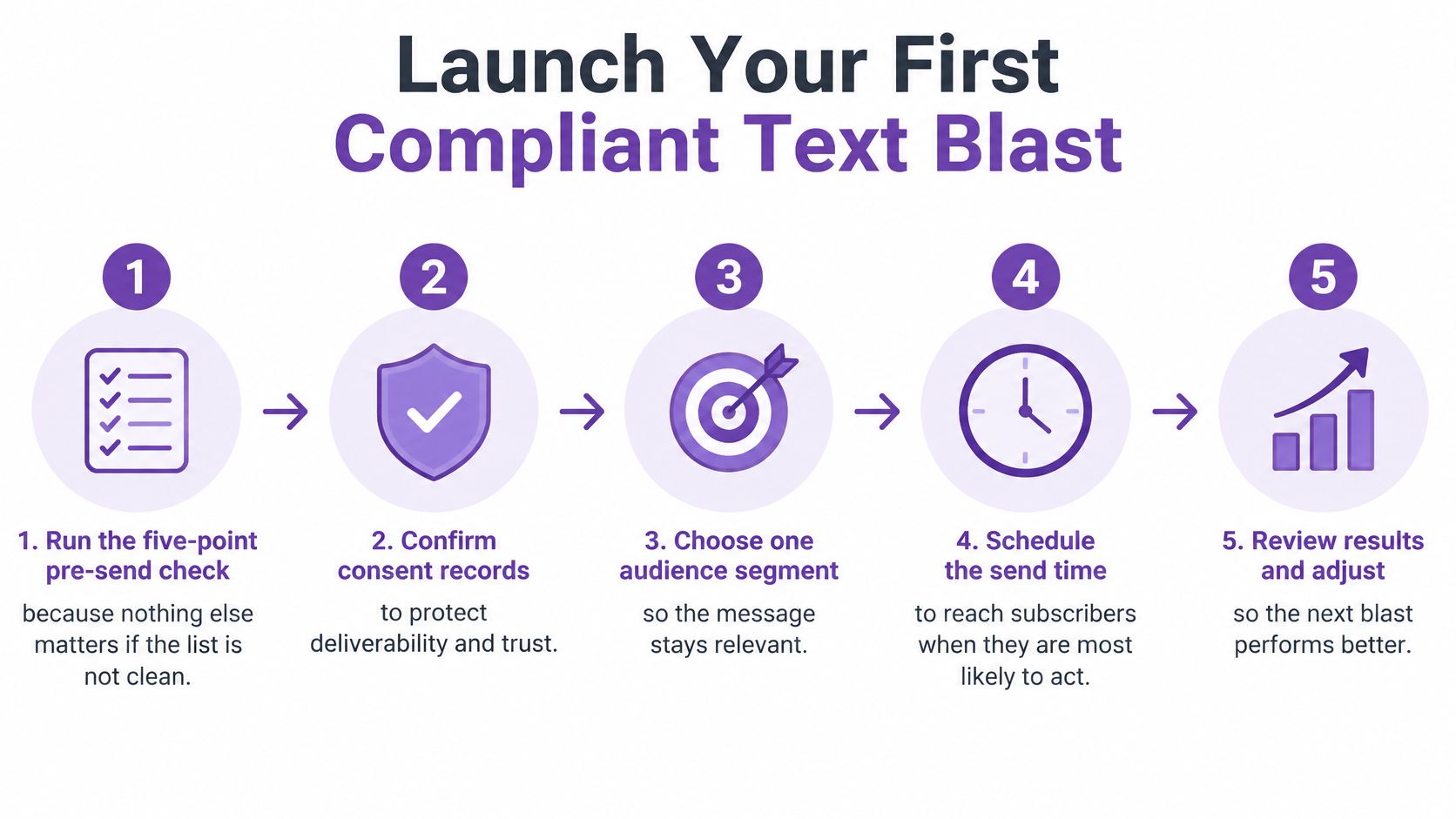
Launch with a narrow audience and an explicit measurement plan. You're testing an operating system, including consent, routing, suppression, and purchase cancellation, not just whether a message looks good on your phone.
Use this visual as a launch checklist.
Run the launch sequence
- Complete the consent check. Review wording, evidence, handset testing, synchronized suppression, and message purpose so an unqualified list never enters production.
- Register the sender. Our Shopify SMS app setup guide covers installation, 10DLC registration, and the first campaign; complete applicable registration before releasing business traffic.
- Import eligible contacts only. Apply existing suppression records during import so historical opt-outs don't return as new subscribers.
- Verify the live STOP path. Confirm the reply changes marketing eligibility, not merely the conversation status.
- Prepare a flow and a campaign, then launch separately. Start with one so overlapping sends don't obscure its results.
- Record the baseline. Track click rate, placed-order rate, revenue per recipient, and total messaging cost using consistent attribution settings.
- Schedule and stagger delivery. Use recipient-local timing and release waves that fit the approved sender's capacity.
- Review a pilot after seven days. This is a suggested review window, not a benchmark; compare orders, complaints, and opt-outs with a holdout, and allow more observation when volume is limited.
Set targets without borrowing someone else's forecast
Klaviyo's apparel and accessories reporting says the top 10% of brands achieve average SMS campaign results of 16.65% click rate, 0.59% placed-order rate, and $0.80 revenue per recipient. Use those figures as testing goals for that category, not a revenue promise for your store.
Change one variable at a time, such as audience, offer, or landing page. Your first move should be the small handset pilot, with full-list release contingent on working controls and understandable reporting.
YipSMS Inc. offers Shopify SMS campaigns, subscriber capture, and prebuilt automations for stores that want to manage messaging without unnecessary complexity. Visit YipSMS Inc. to start a trial and test your consent process, delivered-message costs, and campaign controls before committing your full list.
How this article was made: the YIPSMS team drafts some articles with AI writing tools, then checks pricing, compliance and product details against how YIPSMS actually works before publishing. Spotted something wrong? Tell us through your YIPSMS account.