Cart Abandonment Software for Shopify: A 2026 Guide
Monday morning starts with a familiar Shopify report: traffic looks healthy, products were added to carts, checkout sessions began, and several high-intent shoppers disappeared before payment. Three abandoned carts from the weekend are still waiting in the queue. Nobody followed up, and the revenue walked away.
The baseline is severe. Baymard Institute's aggregation of 50 independent studies puts average online cart abandonment at 70.22%, roughly 7 in 10 shoppers, as summarized by Stripe's cart abandonment statistics guide. Industry summaries also report that average merchants typically recover only 3% to 5% of abandoned carts, while stronger operators reach 10% to 14%, according to Digital Applied's 2026 benchmark analysis.
The math is easy to understand. If your store has a $50 average order value, 1,000 monthly abandons, and a 5% recovery rate, you recover $2,500. At a 15% recovery rate, you recover $7,500. That's a $5,000 monthly difference created by better diagnosis, timing, attribution, and follow-up.
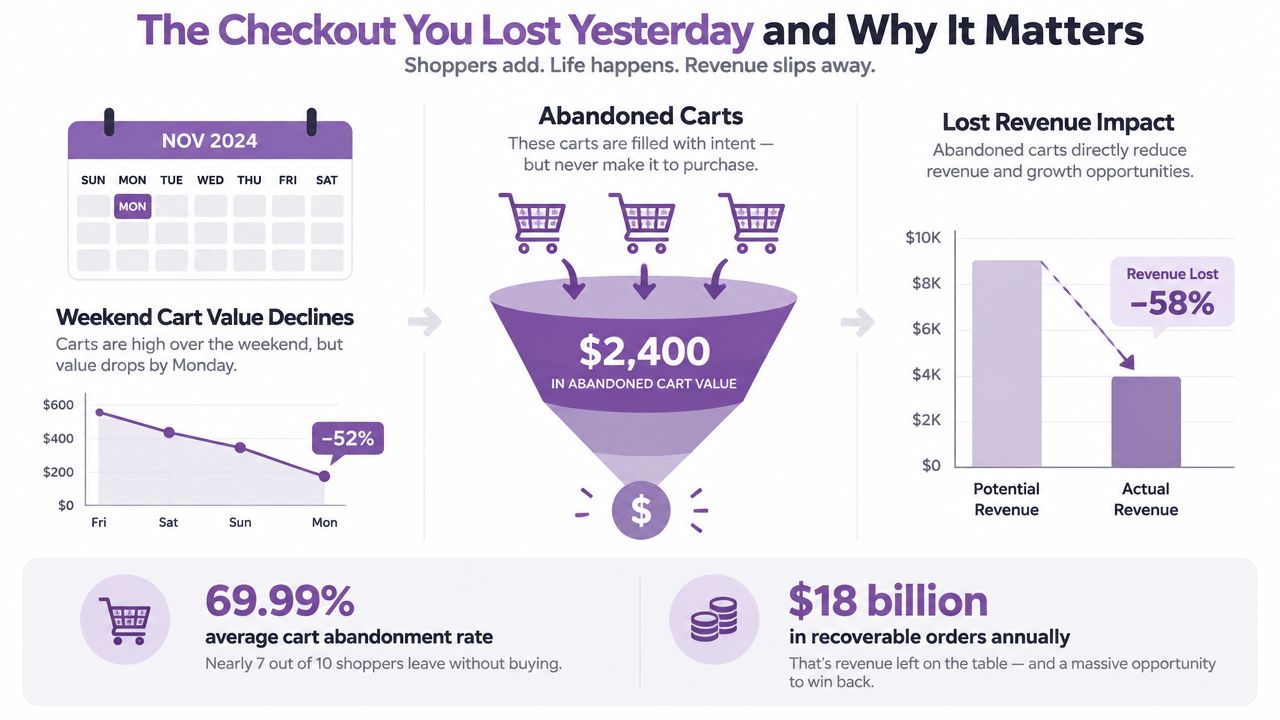
Table of Contents
- The Checkout You Lost Yesterday and Why It Matters
- What Cart Abandonment Software Actually Does
- SMS vs Email vs Push vs WhatsApp for Recovery
- The Five Criteria That Matter When Comparing Tools
- Cart Abandonment Software Side by Side
- Building a Recovery Flow That Actually Converts
- Why SMS-First Tools Win for Most Shopify Stores
- Picking Your Tool and Launching This Week
The Checkout You Lost Yesterday and Why It Matters
A Shopify merchant I'd expect to see this morning isn't asking whether abandoned carts exist. The merchant is asking why a customer who selected a product, entered checkout, and showed buying intent still didn't complete the order. That distinction matters because the wrong recovery tool treats every abandonment as a messaging problem.
The customer may have seen an unexpected shipping charge. They may have been forced to create an account, couldn't find a preferred payment option, or encountered a checkout that felt too long on a phone. A reminder can bring some shoppers back, but it won't fix a structural leak that continues to affect every future customer.
Operator's rule: Don't buy software until you know whether your largest leak is contact capture, checkout friction, message delivery, or weak recovery timing.
The headline abandonment number gives you the size of the opportunity, not the cause. Sendtric's 2026 coverage cites extra costs as the leading abandonment reason at 40% to 55%, with account creation and checkout complexity also major causes. If your store hides delivery costs until the final step, sending more reminders may recover a few orders while leaving the underlying conversion problem untouched.
What the gap costs in practice
Consider a store with a $50 average order value, 1,000 monthly abandons, and a 5% recovery rate. That produces $2,500 in recovered revenue. A 15% recovery rate produces $7,500, leaving a $5,000 monthly difference between a basic program and a better-performing one.
Those figures are a simple operating model, not a promise. Actual results depend on consent coverage, cart value, product category, margin, deliverability, and the reason the shopper left. The point is that recovery rate should be connected to recoverable revenue, not celebrated as an isolated dashboard percentage.
Diagnose before you automate
Start with a checkout funnel report and divide abandoners into useful groups:
- Checkout starters: Shoppers who entered checkout but didn't purchase. They deserve the fastest recovery attempt.
- Known email contacts: Customers you can reach through email, even if they never consented to SMS.
- SMS-consented shoppers: A smaller but more immediate audience that can receive a direct cart link.
- Repeat abandoners: Customers who repeatedly leave similar carts. They may need pricing, shipping, or product reassurance rather than another discount.
- High-value carts: Shoppers where a personal, carefully timed intervention can justify higher communication cost.
The best cart abandonment software turns those groups into actions. It should show where shoppers exit, preserve the exact cart, suppress buyers immediately, and report which message influenced the order. If it only counts sends and opens, it's a broadcast tool wearing a recovery label.
What Cart Abandonment Software Actually Does
Cart abandonment software should do more than send reminders. It must identify a real abandonment event, select a reachable shopper, deliver a controlled sequence, connect any order to the message that influenced it, and adapt the treatment to the reason the shopper left.
The first task is clean event capture. The system must distinguish a product view from an added-to-cart event and a checkout session that ended before payment. It should use available first-party details, such as an email address or properly collected phone consent, instead of treating every anonymous visitor as a contactable lead.
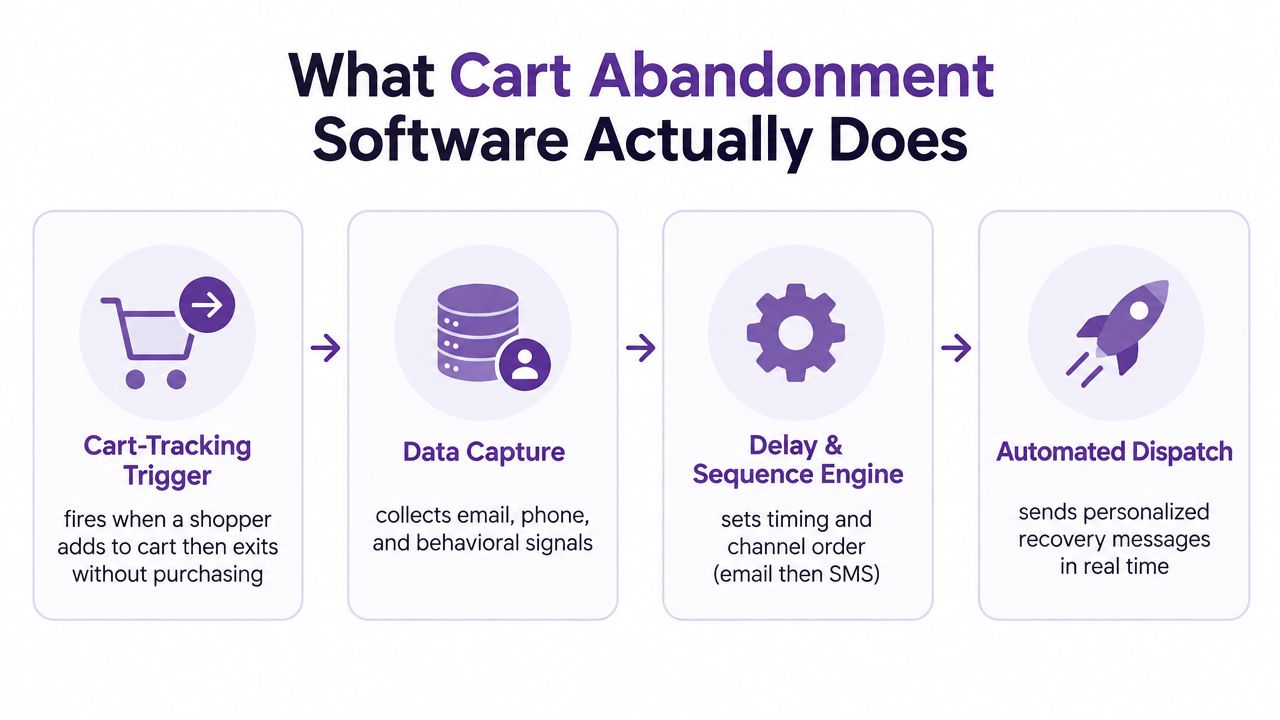
The four mechanics behind the workflow
1. The trigger. A flow starts when a shopper adds a product or begins checkout, then leaves without paying. Reliable tools receive Shopify events through native support or a maintained integration. Poor integrations create duplicate triggers, miss checkout activity, or send a reminder after the customer has already ordered.
2. The sequence engine. A recovery program needs several deliberate touches, not one generic message. The timing should match the store's buying cycle, product urgency, and consent rules. A fast first contact suits a high-intent checkout exit, while a considered purchase may need more product information before any incentive appears.
3. Attribution. The platform should connect an order to the specific message, channel, and timing that preceded it. Revenue per send gives a clearer operating view than opens alone because it shows whether the workflow earns its communication cost.
4. Segmentation. Separate new shoppers, repeat customers, high-value carts, product categories, and previous abandoners. A shopper considering a replenishment product needs different information from someone comparing an expensive first purchase. Cause-based segments are more useful than broad audiences because they point to the leak you need to fix.
Dynamic cart links are required. The shopper should return to the exact cart with selected products and variants restored, not a generic homepage. The software also needs message-level testing, discount rules that prevent accidental stacking, and conversion suppression so a completed order cancels every pending reminder.
Choose the channel after diagnosing the abandonment cause. Use the fastest reachable channel for a high-intent exit, email for broad low-cost follow-up, and product or shipping reassurance when the message, rather than the channel, is the problem. A tool that only blasts reminders will hide the leak instead of fixing it.
Inspect the reporting screen before the template gallery. Templates are easy to copy. Accurate triggers, consent handling, cart restoration, and honest attribution are harder to build.
SMS vs Email vs Push vs WhatsApp for Recovery
A shopper who abandons after viewing delivery details needs a different follow-up from someone who leaves after adding a high-margin product. Choose the channel from the cause, consent status, urgency, and likely order margin. Open-rate claims mean little if the channel cannot legally reach the shopper or its cost exceeds the recovered order's value.
| Channel | Avg Recovery Rate | Cost per Send | Open Rate | Best For |
|---|---|---|---|---|
| 5% to 10% in cited benchmark ranges | Low | Dependent on inbox placement | Broad, low-cost recovery | |
| SMS | 15% to 20% in cited 2026 analyses | Higher than email | About 98% | High-intent, mobile-heavy shoppers |
| Push | 5% to 12% in cited summaries | Low | Depends on opt-in | Stores with an established app or push audience |
| 12% to 40% in cited summaries | Market and template dependent | Depends on delivery and read behavior | International and high-trust commerce |
Email is the default foundation for broad, low-cost follow-up. It gives you room to address delivery concerns, product questions, and comparison behavior, but inbox competition slows the response. If abandoned-cart emails contain links, discounts, or repeated product language, use this practical guide on how to stop email from going to spam in Gmail.
SMS fits high-intent shoppers who have explicitly opted in, particularly on mobile-heavy stores. Recent 2026 analyses cite 15% to 20% SMS conversion rates versus 5% to 10% for email, with SMS opening at about 98% and being read within roughly 3 minutes, according to Geysera's SMS versus email comparison. Keep the message short, answer the likely objection, and link directly back to the cart. Use this SMS versus email marketing comparison to set channel roles rather than copying a vendor's preferred sequence.
Push notifications cost little to send and can arrive quickly, but they only work when a store already has relevant app or browser permission. Without that audience, push cannot repair an abandonment leak. Do not select it because the software includes a push toggle.
WhatsApp suits international stores and categories where shoppers already use the channel for buying or support. Confirm opt-in requirements and approved templates before launch. Choose it when conversational trust and cross-border reach justify the added management.
Decision rules:
- Use SMS for an urgent, high-intent exit when consent is clear and margin supports the send cost.
- Use email for shoppers without SMS permission and for slower follow-ups that handle objections.
- Use WhatsApp where customers already rely on it for commerce or support.
- Use push only when an established app or browser-push audience can receive it.
- If the same cause appears across channels, fix the offer, delivery information, or checkout friction before adding more reminders.
The Five Criteria That Matter When Comparing Tools
Feature lists hide the expensive questions. A tool can offer email, SMS, popups, AI, and segmentation while still missing the one event that matters, a reliable checkout abandonment trigger tied to recovered revenue.
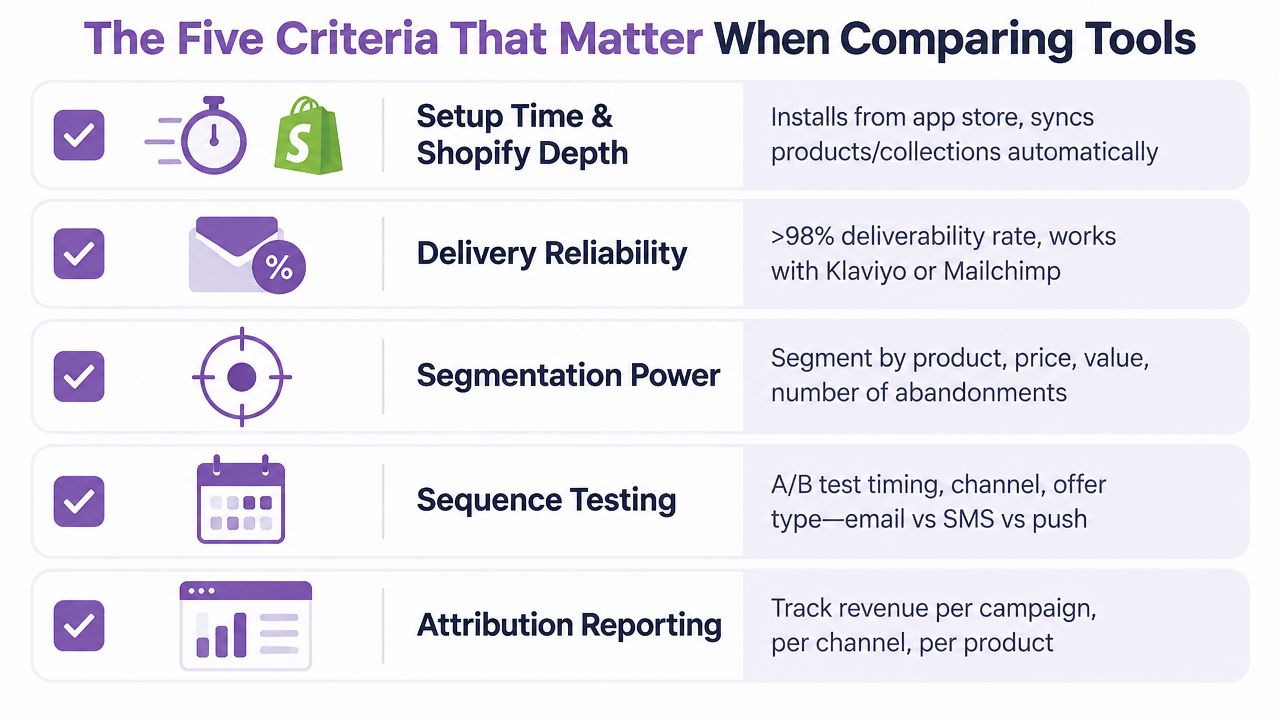
Setup and Shopify depth
Install time matters because every week spent configuring webhooks is a week without a baseline. Prefer a native Shopify app that pulls products, checkout events, discount rules, and customer status without fragile custom work. Confirm that the platform respects Shopify's consent framework and stops messages after purchase.
YipSMS offers a focused Shopify SMS workflow with one-button automation setup, cart and checkout abandonment triggers, consent checks, purchase suppression, timing delays, and cart return links. Treat that as a useful baseline for evaluating any similar tool, not as a reason to skip testing alternatives.
Automation that makes decisions
A reminder sequence should branch. At minimum, it should handle cart value, product category, customer status, consent status, and whether the shopper has abandoned before. A customer with a high-value cart may need trust and delivery information. A repeat abandoner may need a diagnostic survey rather than another coupon.
Look for:
- Conditional branches: Different paths for new and returning shoppers.
- Offer controls: Rules that prevent automatic discounts for customers who would have bought anyway.
- Channel fallbacks: Email for shoppers without SMS permission.
- Suppression logic: Immediate cancellation after purchase or unsubscribe.
- Message testing: Experiments on timing, copy, channel, and offer.
Attribution, pricing, and compliance
Analytics should show recovered revenue per send, channel, product, and abandonment window. Vanity opens don't pay the bill. Production SMS data from CartBoss recorded a 26.8% click rate, a 12.3% click-to-order recovery rate, and 3.3% recovered orders per delivered text across 1,999,408 delivered messages, as reported in its SMS benchmark guide. That benchmark reinforces the need to inspect click tracking, order matching, and delivery-level attribution.
Pricing must be equally clear. Flat tiers are easier to forecast, while per-message pricing can rise quickly as recovery improves. Ask whether carrier fees, phone-number validation, premium features, and overages are included.
Compliance belongs in the buying decision. Twilio's abandoned-cart SMS guidance notes that U.S. commerce texting commonly involves A2P 10DLC registration, explicit opt-in, and clear unsubscribe handling. A tool that makes consent difficult is not saving time. It's creating operational risk.
Cart Abandonment Software Side by Side
These tools solve different problems, so a single winner would be misleading. The practical shortlist depends on whether your store is SMS-first, email-led, prevention-focused, or looking for customer support and messaging in one interface.
| Tool | Primary Channel | Shopify Integration | Automation Depth | Pricing Model | Best For |
|---|---|---|---|---|---|
| YipSMS | SMS | Shopify-focused native app | Prebuilt abandonment and marketing flows, consent and suppression controls | Transparent SMS pricing model | SMS-first Shopify stores |
| Klaviyo | Email and SMS | Deep Shopify data integration | Advanced segmentation, branching, and behavioral flows | Contact and usage based | Email-led stores with complex segmentation |
| Recart | Email, SMS, and social recovery | Shopify-oriented integration | Browse and add-to-cart recovery workflows | Plan and usage dependent | Social and early-funnel recovery |
| SMSBump | SMS and email | Shopify ecosystem integration | Segments, campaigns, and automated flows | Usage and plan dependent | Merchants wanting established SMS tooling |
| Tidio | Chat and customer messaging | Shopify integration | Chat automation with recovery-oriented messaging | Plan based | Stores combining support chat and recovery |
YipSMS fits a merchant that wants a fast, focused SMS recovery layer rather than a broad customer data platform. It's especially practical when the main leak is high-intent checkout abandonment and the store wants cart links, timed messages, consent checks, and purchase suppression in one Shopify workflow.
Klaviyo remains the stronger choice when email is the workhorse and segmentation is the priority. Its flexibility is valuable for stores coordinating abandonment with lifecycle campaigns, but that flexibility also creates more setup and governance work.
Recart makes sense when browse and add-to-cart recovery through social and email are central. It's less compelling if your primary problem is a clean SMS-first checkout sequence.
SMSBump sits in the established SMS marketing category, while Tidio is more attractive when live chat and automated customer conversations share the same operating workflow. Neither should be selected solely because it supports multiple channels. Check trigger coverage and order-level attribution first.
Shortlist two tools, then run both against a real abandoned-cart cohort. Keep the message, timing, audience, and offer as comparable as possible. Judge the result by recovered orders and margin after messaging cost, not by the prettier dashboard.
Building a Recovery Flow That Actually Converts
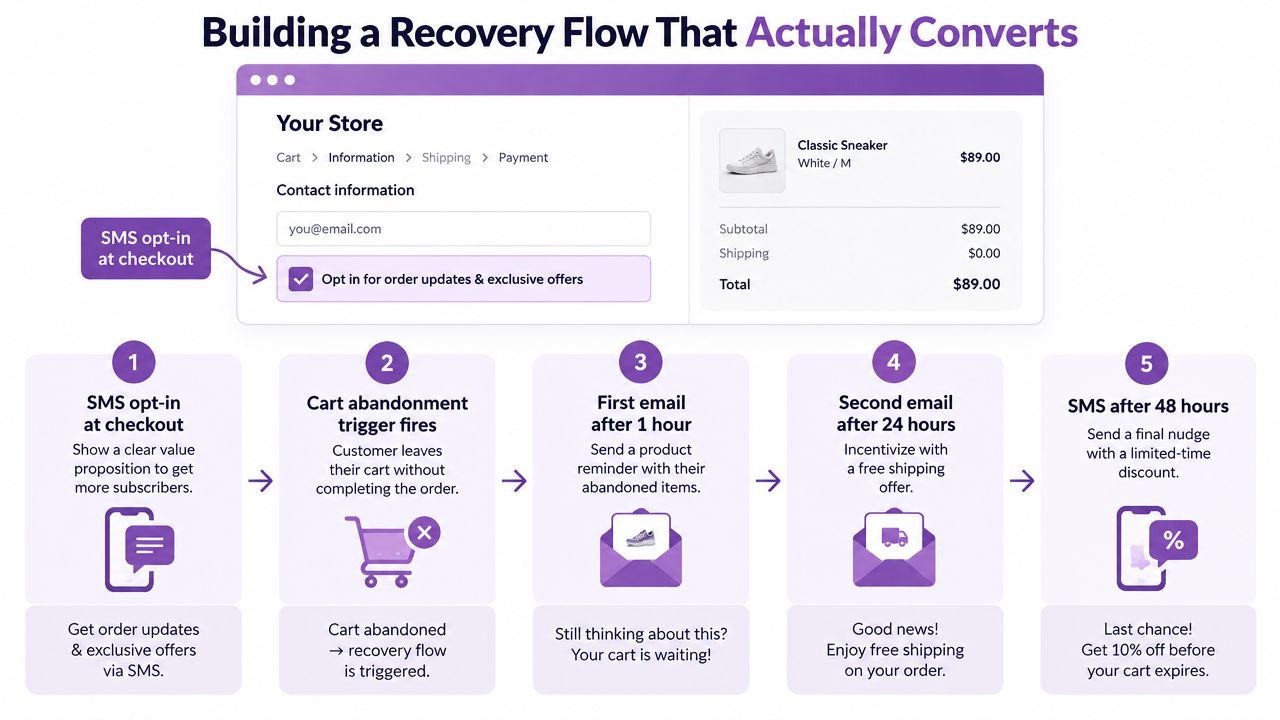
A recovery flow should feel like helpful continuity, not a campaign blast. Start at checkout by collecting SMS consent with a clear value exchange, such as order updates, back-in-stock alerts, or relevant offers. Don't hide the opt-in language, and don't treat consent as an afterthought.
Use a restrained sequence:
- First touch: Send an SMS reminder quickly, ideally within the first hour. Include the customer's first name where permitted, the abandoned product, and a one-tap cart link.
- Second touch: Send an email later with the information most likely to resolve hesitation. That may be shipping cost, delivery timing, returns, sizing, payment security, or product proof.
- Final touch: Send a limited SMS follow-up only if the shopper still hasn't purchased. Use a small expiring incentive only when margin and customer history justify it.
Stripe's guidance supports a structured three-message approach, with the cited AI-optimized sequence using 1 hour, 24 hours, and 72 hours. Your flow doesn't need to copy that schedule exactly. It needs a clear reason for each message and a stop condition when the customer converts.
Write for the return visit
The link is more important than clever copy. Send shoppers back to the exact cart or checkout with their variants preserved. Test the link on a phone, logged out and logged in, with an expired discount and with a completed order.
Use SMS marketing automation for Shopify to manage timing and branching, but keep the workflow understandable enough that a marketer can audit it without opening a developer ticket.
Measure the sale, not the send
Track recovered order rate, recovered revenue per message, margin after discounts, unsubscribe rate, and conversion by channel. Open rate can confirm delivery and attention, but it can't tell you whether the flow creates incremental revenue.
Suppress a shopper as soon as the order is placed. Continuing to message a converted customer is one of the fastest ways to make a useful reminder feel careless.
Why SMS-First Tools Win for Most Shopify Stores
SMS deserves priority when the abandonment leak is high intent and the store has valid consent. It puts a direct checkout path in front of shoppers on the device they used to browse, which makes it well suited to urgent recovery. Start there only when the expected margin from recovered orders covers message costs, carrier fees, discounts, and compliance work.
Diagnose the leak before choosing the channel. If shoppers abandon after entering contact details but before payment, SMS can address a reachable audience. If they leave because shipping costs appear late, payment options are limited, or account creation adds friction, a reminder tool will recover some demand but will not fix the cause. Use checkout analytics, session recordings, and recovery outcomes to separate a channel problem from a checkout problem.
SMS also carries operational requirements. The store needs explicit consent, clear opt-out handling, frequency limits, and compliance with carrier rules. U.S. merchants may need A2P 10DLC registration. Choose software that records consent and suppresses opt-outs inside the workflow instead of forcing the team to reconcile separate systems.
Keep email in the mix. Email supports product education, detailed objections, and lower-cost follow-up, while SMS can focus on consented, high-intent carts. Let the diagnosis set the sequence: SMS-first for reachable high-value abandoners, email-first when consent coverage or margin is weak, and checkout fixes when the same friction repeatedly causes the leak.
Picking Your Tool and Launching This Week
Choose based on the leak, not the brand name. If your store has strong email coverage but weak mobile recovery, shortlist an SMS-first tool and an email platform with better segmentation. If shoppers leave before you capture contact details, add an on-site capture or prevention layer. If customer questions block checkout, include chat or conversational support in the evaluation.
Use this seven-day launch plan:
- Day one: Install the Shopify app and verify cart and checkout events.
- Day two: Import suppression data and define jurisdiction, consent, and unsubscribe rules.
- Day three: Build the three-touch sequence with a direct cart link and a clear stop condition.
- Day four: Design the checkout opt-in and state the value shoppers receive.
- Day five: Test the full flow on mobile devices, including purchase suppression.
- Day six: Turn on revenue attribution and confirm that each order maps to a message.
- Day seven: Launch to a controlled audience and record a 14-day baseline for comparison.
Start with two or three tools, not five. Compare installation effort, trigger reliability, consent handling, recovered orders, and contribution margin. The first metric to watch is recovered order rate, not raw recovery percentage or opens. It tells you whether the tool is bringing back actual buyers.
For a focused Shopify implementation, review the Shopify SMS app from YipSMS alongside broader platforms such as Klaviyo, Recart, SMSBump, and Tidio. Make the final decision after testing a real cohort, not after reading a feature page.
YipSMS Inc. offers Shopify merchants SMS automation for cart and checkout abandonment, consent-aware flows, direct cart links, analytics, and scheduled campaigns through a focused app. If you're ready to test an SMS-first recovery workflow this week, visit YipSMS Inc. and start with the trial.
How this article was made: the YIPSMS team drafts some articles with AI writing tools, then checks pricing, compliance and product details against how YIPSMS actually works before publishing. Spotted something wrong? Tell us through your YIPSMS account.