Cart Abandonment vs Checkout Abandonment for SMS
You're looking at your Shopify recovery report, wondering whether to change the SMS timing or offer a discount. But the shoppers in that report didn't all leave for the same reason. Someone who saved a product while comparing options needs a different response from someone who entered checkout, saw the shipping charge, and stopped.
The practical difference between cart abandonment vs checkout abandonment is what you should do next. Before sending anything, identify the stage, inspect the behavior, and decide whether the shopper needs encouragement, help completing the transaction, or no message at all.
Table of Contents
- Why Abandonment Stages Change the Recovery Strategy
- Overview of the Two Abandonment Funnels
- Cart Abandonment vs Checkout Abandonment Compared
- Tracking Each Abandonment Stage Without Misleading Data
- Recommended SMS Recovery Workflows
- Real-World Decisions for Common Abandonment Scenarios
- Choose and Improve the Right Recovery Strategy
Why Abandonment Stages Change the Recovery Strategy
Consider familiar Shopify journeys. A visitor adds a jacket, looks at other colors, and leaves. Another selects the jacket, enters a delivery address, reaches payment, and exits. Both appear as unfinished purchases, but sending them the same text assumes they have the same obstacle.
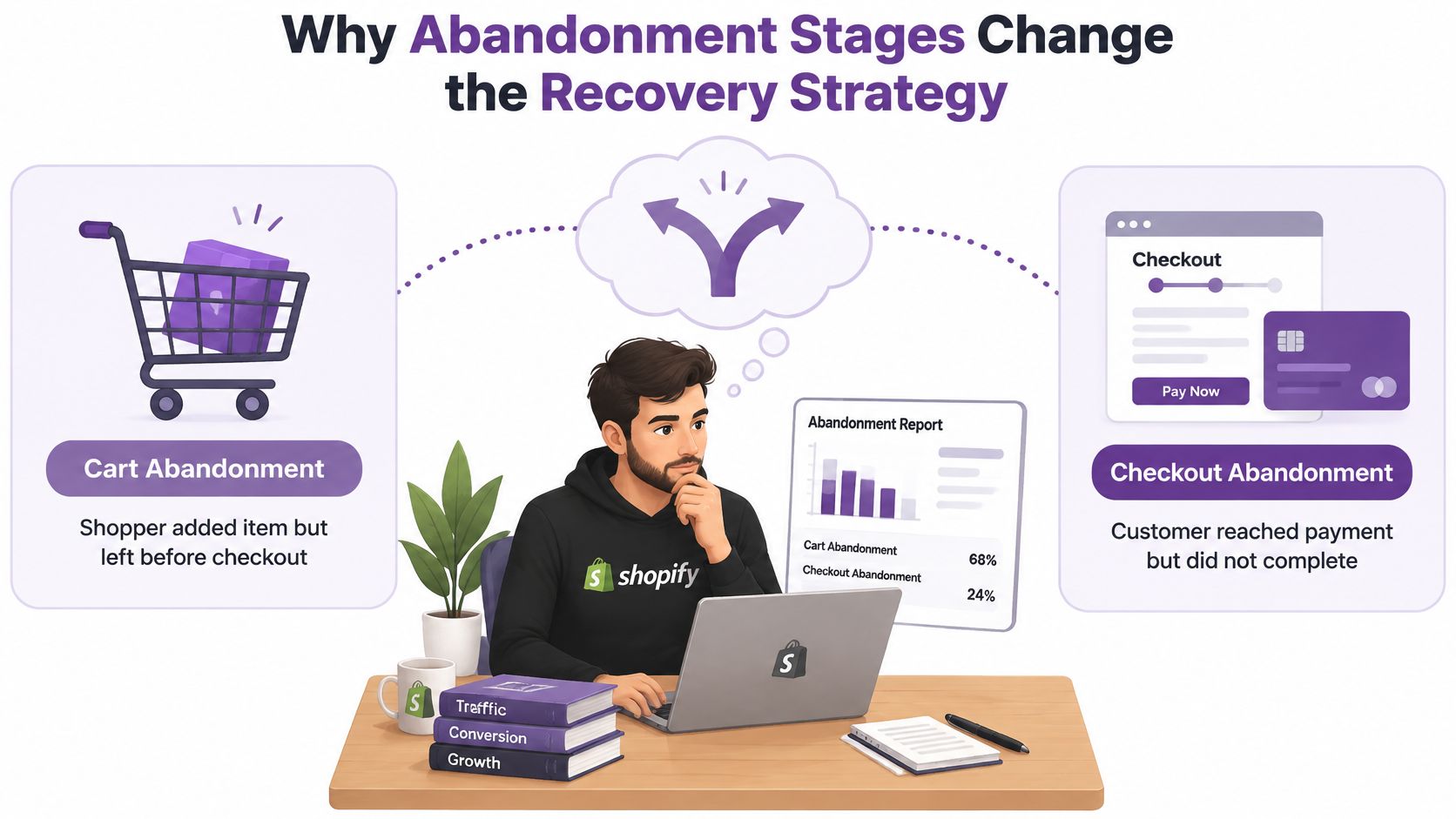
Cart abandonment covers shoppers who add something but don't complete a purchase. Checkout abandonment is the narrower subset who start checkout but don't pay. Checkout entry doesn't necessarily mean someone reached the payment screen.
| Recovery question | Cart-stage exit | Checkout-stage exit |
|---|---|---|
| What happened? | Added a product without starting checkout | Started checkout without completing payment |
| What needs investigation? | Product interest and readiness | Transaction friction and confidence |
| Initial SMS direction | Relevant product encouragement | Help finishing the existing purchase |
Baymard Institute reports an average online cart abandonment rate of 70.19%, described as a 14-year tracking benchmark. That broad population includes shoppers who never begin checkout, so it isn't a checkout-only abandonment rate (Baymard's checkout usability research).
Diagnose before choosing an offer
For the jacket browser, a product reminder might be appropriate. For the shopper who stopped at payment, investigate whether shipping, payment availability, or a technical problem interrupted the transaction.
The distinction changes both timing and incentives. Don't interrupt an active browsing session because a cart exists. Don't offer a discount to a checkout shopper before checking whether the actual problem was a broken payment path.
The recovery decision has a sequence: classify behavior, identify the likely obstacle, confirm contact eligibility, choose the return destination, and measure the relevant outcome. That sequence includes operational work because a reminder can't repair every checkout problem.
This comparison captures the different decisions behind an apparently similar exit.
Overview of the Two Abandonment Funnels
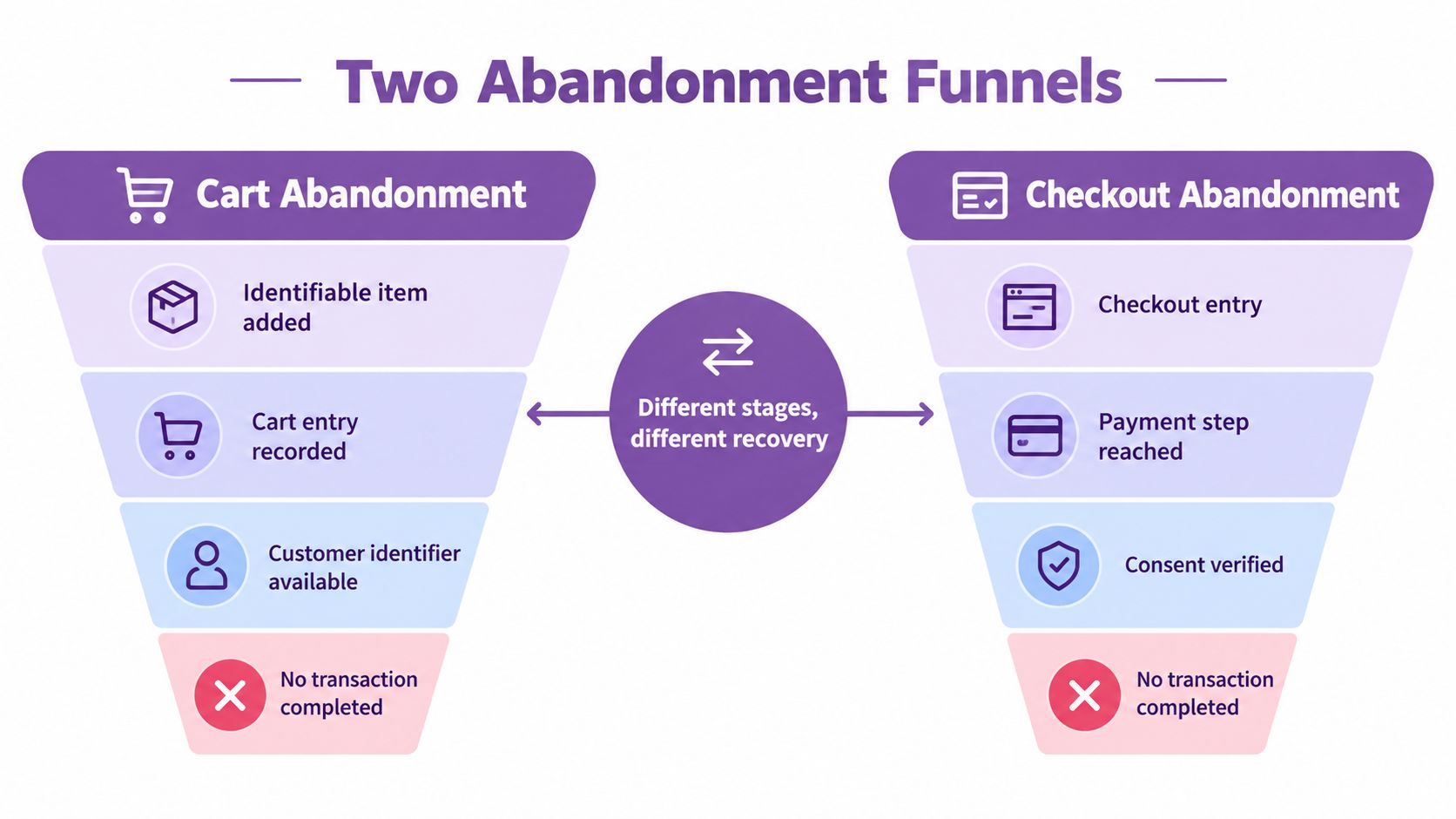
Checkout abandonment sits inside broad cart abandonment. It isn't a separate population you should add to the cart total. For recovery automation, however, mutually exclusive branches are useful: shoppers who haven't started checkout, and shoppers who have.
The funnel map is useful for separating behavioral events from contact eligibility.
What the events actually establish
A product addition establishes product interest, not purchase readiness. A customer identifier establishes that you can associate activity with someone, not that you have permission to text them. Likewise, SMS consent is an eligibility condition, not a stage in the purchase funnel.
Baymard found that 42% of U.S. online shoppers had abandoned a cart because they were browsing or weren't ready to buy during the previous three months (Baymard's ecommerce checkout benchmark). That's why a cart can represent comparison shopping, a saved purchase, or an early attempt to check costs.
Checkout entry generally indicates stronger buying intent, but it doesn't establish the exact reason for leaving. Someone who exits after entering an address may be reacting to delivery information, or may just have been interrupted. Treat behavior as evidence to investigate, not a customer confession.
Keep the denominators separate
Your reporting should distinguish:
- Cart-to-checkout progression: Eligible carts that subsequently produce a checkout start, divided by the relevant cart population.
- Checkout completion: Completed purchases divided by checkout starts within a consistent measurement window.
- Recovery eligibility: Abandoners who meet the identification, permission, and suppression requirements for the selected channel.
Choose whether you're counting carts, sessions, or shoppers, then apply that choice consistently. Otherwise, repeat visits can make movement between stages difficult to interpret.
This video provides an additional visual reference for the purchase journey.
Cart and checkout recovery should work together without competing. When a shopper progresses into checkout, move them out of the cart-only branch rather than allowing both automations to continue.
Cart Abandonment vs Checkout Abandonment Compared
The useful comparison isn't which abandonment type matters more. It's which intervention fits the available evidence, without creating unnecessary discounts or sending shoppers back to an unresolved problem.
Cart Abandonment vs Checkout Abandonment
| Criterion | Cart Abandonment | Checkout Abandonment |
|---|---|---|
| Operational audience | Cart exists, but checkout hasn't started | Checkout started, but payment wasn't completed |
| Stronger intent signals | Repeat visits, product exploration, coupon interaction | Deeper checkout progress, payment attempt |
| Likely investigation | Product motivation, price comparison, readiness | Cost, delivery, trust, forms, payment |
| SMS objective | Encourage a useful next step | Make completion possible and understandable |
| Message content | Product relevance or a purchasing question | Verified help related to the transaction |
| Timing basis | Inactivity and browsing behavior | Exit context and whether the obstacle is resolved |
| Click destination | Restored cart | Preserved checkout |
| Incentive risk | Encouraging shoppers to wait for offers | Discounting an order that needed assistance |
| Suppression priority | Checkout progression or purchase | Purchase, unresolved errors, ineligible contact |
| Main success measures | Checkout progression and recovered orders | Checkout completion and recovered orders |
The underlying friction deserves more attention than the label. A synthesis of Baymard findings reports 40% citing excessive additional costs, 20% slow delivery, 19% payment-security distrust, 18% forced account creation, and 17% an overly long or complicated checkout. These reasons overlap and shouldn't be added together (eMarketer's abandonment benchmark).
Cart recovery asks what would make buying worthwhile. Checkout recovery asks what prevented the shopper from finishing.
Match persuasion to the obstacle
For cart-stage shoppers, product information may be more appropriate than a deadline. A sizing answer, clear return-policy explanation, or relevant product detail gives someone a reason to continue without immediately reducing the price.
Checkout messaging requires a different discipline. Urgency doesn't solve an unavailable payment method or an unrealistic delivery promise. If the customer can't complete the transaction, asking them to hurry only adds pressure.
For a broader diagnostic checklist, Arlo Inc.’s 8 causes of cart abandonment offers a useful companion when organizing possible causes. Use such lists to guide investigation rather than assigning a cause automatically to every exit.
An incentive is a situational tool, not the default treatment. Test it where price sensitivity is plausible and the margin allows it. Compare the resulting orders and retained margin against a helpful, non-discount message, rather than judging the offer by clicks alone.
Tracking Each Abandonment Stage Without Misleading Data
Build the event history before adjusting SMS copy. Your team needs to know what happened, in what order, and whether the shopper's state changed before the scheduled message.
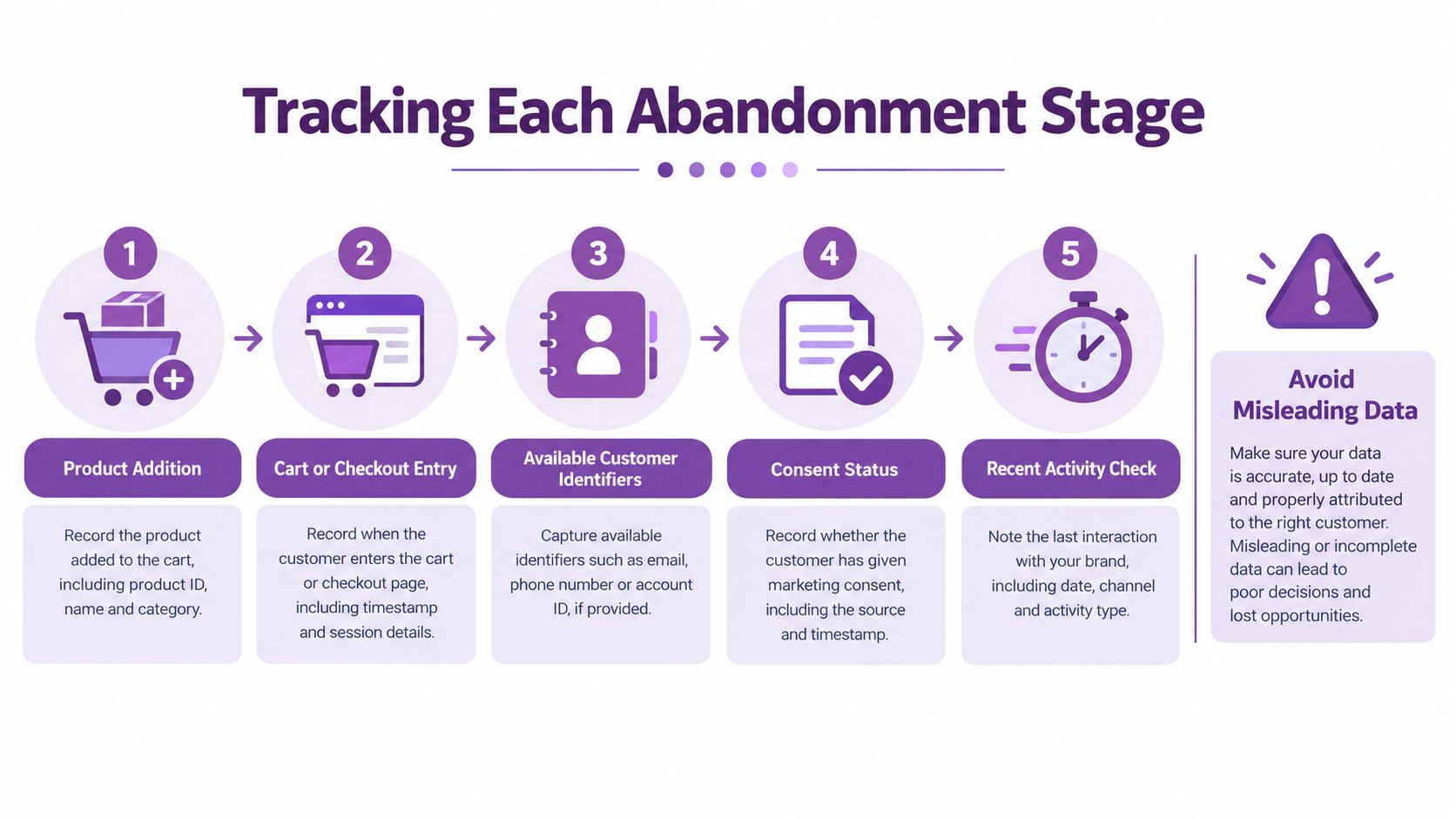
The tracking sequence should connect purchase behavior with the information needed to make a contact decision.
Assemble a usable event chain
Capture the following in Shopify and your connected analytics or messaging system, subject to what your implementation can reliably expose:
- Product and cart activity: Product or variant, quantity, cart reference, and event timestamp.
- Identity and permission: Available customer identifier, phone number, consent status, and the record supporting that permission.
- Checkout progress: Checkout reference, latest completed stage, payment attempt, and observable error state.
- Order completion: The completed-order event and its relationship to the abandoned cart or checkout.
Don't assume every app receives every checkout event. Inspect actual event payloads and run test purchases before building branches around fields that may be missing.
Add country, currency, device, delivery promise, and payment context where available. These fields help distinguish a broad conversion problem from a market-specific or technical failure. A concentration of exits after payment attempts deserves a different investigation from exits before customers see shipping options.
Check the measurement before blaming the message
Calculate stage progression from matched populations and consistent time windows. Keep SMS-eligible abandoners separate from all abandoners so changes in consent coverage don't masquerade as changes in recovery performance.
Baymard's benchmark reviewed more than 30,000 checkout elements across 344 major U.S. and European sites and estimated that the average large-scale site could achieve a 35% conversion improvement through checkout UX changes. That's an estimate of potential, not a promised result for an individual store (Baymard's abandonment research).
Measurement safeguard: A shopper changing devices or revisiting checkout shouldn't automatically become another recovery opportunity.
Deduplicate events, define how repeat abandonment updates an existing journey, and reconcile completed orders against pending sends. Investigate missing identifiers and delayed events before interpreting a sudden change as customer behavior.
Recommended SMS Recovery Workflows
Build separate automations, then connect them with shared suppression rules. The important implementation work happens around eligibility, state changes, and destinations, not just the message text.
SMS is the delivery channel; the flow determines whether sending is appropriate.
Build the cart recovery path
Require an identifiable cart and valid SMS marketing consent. Check that the shopper has stopped interacting, hasn't entered checkout, hasn't purchased, and isn't excluded by recent-message limits.
Start with a behavior-led reminder. For example, a draft could read: Still considering the jacket? Return to your saved cart, or reply if you need help choosing a size. Use reply-based assistance only if your team monitors and handles replies.
Link to the restored cart rather than the homepage. Test whether the link preserves the intended product, variant, and quantity. If the shopper enters checkout, end the cart branch and let the checkout rules determine what happens next.
Build the checkout recovery path
Require a usable checkout reference and a fresh eligibility check. Use observed checkout context to choose the message, but don't present a suspected reason as something the customer told you.
Unexpected costs warrant particular attention: 40% of U.S. shoppers cited shipping, taxes, or fees that were too high as a reason for abandoning. That makes transparent cost and delivery information more relevant than a generic completion reminder (Shopify's recovery guidance).
A responsible draft might say: Review the available delivery options and your order total in your saved checkout. Only promise that information if the destination provides it. Don't claim free shipping, faster delivery, or an available payment method without verifying eligibility.
Set timing and follow-up rules
There's no universal schedule worth copying without testing. Base the delay on recent activity, permitted sending hours, customer context, and whether an identified obstacle has been resolved.
- Recheck before sending: Refresh purchase, consent, and suppression status at execution time.
- Coordinate frequency: Apply caps across recovery flows and bulk campaigns, not separately within each automation.
- Handle opt-outs: Process withdrawal of consent and include the required opt-out instructions for the applicable market.
- Test deep links: Check mobile behavior, expired checkout sessions, and any additional authentication.
- Pause broken paths: Stop affected messages when checkout errors or unavailable shipping options prevent completion.
A later message should provide new value. Reassurance or verified delivery clarity may be more useful than escalating to a discount. If nothing relevant has changed, another reminder may not be justified.
When evaluating a Shopify SMS app, inspect trigger separation, purchase suppression, consent handling, and destination testing rather than choosing on template availability alone.
Real-World Decisions for Common Abandonment Scenarios
Use these scenarios as decision tests, not assumed explanations for every customer. The same visible exit can have several causes, so match your confidence in the diagnosis to the specificity of the message.
A returning browser who never starts checkout
A visitor repeatedly views a product and adds it to a cart without progressing. Classify this as a cart-stage opportunity and use selective product encouragement if permission exists.
A message can offer relevant help or return access to the cart. Avoid invented scarcity. Measure whether the shopper progresses into checkout, not merely whether they click.
Shipping or delivery creates hesitation
A shopper exits after seeing shipping charges. Treat cost exposure as a plausible explanation, then inspect the total and delivery options before sending anything.
Clarify the pricing experience operationally. If an existing shipping threshold or alternative option applies, communicate it accurately. For delivery uncertainty, show a supported estimate rather than promising arrival that operations can't guarantee.
Account and phone fields interrupt checkout
A shopper exits around account creation or a required phone field. Improve guest access, remove unnecessary requirements, or explain why information is needed before directing someone back.
Baymard found that 64% of more than 180 leading ecommerce sites performed only mediocre or worse in checkout UX, while 14% of users would abandon when a required phone number wasn't explained (Baymard's cart and checkout research collection). A phone number supplied for order handling isn't, by itself, marketing consent.
Payment constraints or errors block completion
An unsupported payment method calls for an operational decision, not more persuasive copy. A payment error calls for technical investigation and a safe support route.
- Missing local method: Assess payment coverage for that market before resuming affected recovery.
- Known payment failure: Offer verified assistance without requesting card details by SMS.
- Fraud-related rejection: Review the relevant controls with the payments team rather than automatically relaxing safeguards.
A higher checkout abandonment rate can reflect payment declines or stricter fraud screening, not weak messaging. Measure error resolution and subsequent completion alongside recovery results.
The shopper has already purchased
Send no abandonment SMS. Suppress pending recovery and keep any permitted post-purchase communication separate.
Broader SMS marketing for retail should coordinate these journeys so a customer doesn't receive a recovery offer while waiting for an order confirmation.
Choose and Improve the Right Recovery Strategy
Choose the next action from the evidence, not from the desire to increase send volume. Prioritize cart reminders when product interest is meaningful, checkout reassurance when completion is feasible, and operational intervention when customers can't buy under the current conditions.
Use a decision sequence
- Identify the stage: Route the shopper using the latest reliable event.
- Qualify intent: Consider behavior and customer history rather than treating every addition equally.
- Inspect friction: Separate a plausible messaging opportunity from an unresolved operational barrier.
- Confirm eligibility: Validate consent, channel permissions, and suppression status.
- Activate selectively: Send the matching flow, or choose no contact.
- Verify recovery quality: Check orders, revenue, margin, and customer response.
Use the TCPA compliance checklist as a starting point for reviewing a U.S. program, alongside advice appropriate to your markets and message purposes.
Test a meaningful difference
Compare friction-specific content with a discount while holding the audience and timing consistent. Alternatively, test the delay without changing the offer. Changing everything at once makes the result hard to interpret.
Track recovered orders, recovered revenue per recipient, checkout completion, payment-error rate, opt-outs, and stage progression. Distinguish purchases attributed to a message from evidence that the message caused additional purchases; where feasible, compare against an eligible group that doesn't receive the recovery treatment.
A successful recovery program doesn't text every abandoner. It selects the appropriate customers and avoids bringing them back to the same unresolved problem.
Platform choice comes after that operating model. Evaluate prebuilt flows, campaign coordination, analytics, and cost against the workflow your store actually needs. Those principles apply to any compliant SMS platform, regardless of which templates it includes.
YipSMS Inc. offers Shopify SMS automation for cart and checkout recovery, bulk campaigns, and analytics, with rates starting at $0.015 per SMS and a 14-day free trial, as detailed by YipSMS Inc.. Visit to evaluate separate recovery flows, then start with a consent-qualified audience and test a relevant reminder before adding incentives.
How this article was made: the YIPSMS team drafts some articles with AI writing tools, then checks pricing, compliance and product details against how YIPSMS actually works before publishing. Spotted something wrong? Tell us through your YIPSMS account.