Email and SMS Marketing: How Both Channels Work Together
At a glance
Learn how email and SMS marketing work together for ecommerce: channel strengths, consent rules, automation flows and campaign coordination for Shopify stores.
Roughly one in seven legitimate marketing emails never reaches a visible inbox. According to the Validity 2025 Benchmark Report, global email campaigns averaged 85.0% inbox placement with 9.4% missing mail, meaning a significant slice of your list misses promotional emails before you even test a subject line.
Text messaging sits on the other end of the attention spectrum. In its 2025 Consumer Texting Behavior Report cited by SMS.to, EZ Texting reported that 86% of consumers surveyed in November 2024 had already opted in to receive business text messages. Yet many Shopify merchants burn through that goodwill in weeks by treating texts like louder, shorter email blasts.
Strong email and SMS marketing does not pit one channel against the other. It divides the customer journey by intent, treats consent as a single synchronized preference across every connected tool, and judges every automated flow by incremental revenue rather than inflated opens or isolated clicks.
Table of Contents
- What Email and SMS Each Do Best
- Consent Rules to Set Before Your First Text
- Keeping Opt-Outs in Sync Across Both Channels
- Automations That Pair Email and SMS by Intent
- Measuring Incremental Revenue Instead of Clicks
- How to Launch Your Email and SMS Sequence
- Pick Your Channel Split and Start With Cart Recovery
What Email and SMS Each Do Best
Email works like a showroom floor: room to browse, compare products and read every detail. SMS works like a knock on the door: brief, immediate and hard to ignore. Give each channel its own job before you write a single subject line or text, because a message assigned to the wrong job is what burns consent. And treat that consent as one synchronized preference across both channels, judged by the revenue each message adds rather than the opens or clicks it racks up.
| Factor | SMS | |
|---|---|---|
| Best job | Education, storytelling and longer offers | Time-sensitive alerts, cart recovery and short windows |
| Message size | Long-form with images and layout | 160 characters per SMS; MMS stretches to 1,600 characters plus an image, GIF or video |
| Typical click rate | Median 0.68% in a 17-sender portfolio | Median about 7.96% in the same portfolio |
| Reliable signal | Clicks and conversions, since opens are inflated by Apple Mail Privacy Protection | Clicks and conversions; opens are not a dependable measure |
| Consent rule | Opt-in and unsubscribe required; mailbox providers check engagement | Prior express written consent for promotional texts in the US; STOP honored |
| Frequency tolerance | Moderate; suppress inactive contacts | Low; 73% of users unsubscribe when messages become too frequent |
Why Click Rates and Format Dictate the Split
The gap in click behavior explains why each channel belongs at a different moment in the buying cycle. Benchmark data from 17 active SMS senders compiled by Sweatpants Agency found a median SMS click rate of about 7.96%, with the middle half of senders falling between 4.5% and 20.5%, while the exact same portfolio averaged a 0.68% median email click rate.
A common misread here: shoppers do not click texts more because texts carry better content. They click because a 160-character message lands on a lock screen and asks for a decision right now. That makes SMS the right carrier for cart recovery, low-inventory alerts, delivery notifications and flash-sale windows measured in hours. Email carries what needs space: photography, product comparisons, sizing charts and the brand story a shopper reads when they finally have five quiet minutes.
Why Open Rates Mislead Both Channels
Opens feel like the natural scoreboard, and that instinct steers segmentation wrong on both channels. Although MailerLite's email marketing statistics reported a 42.35% global average email open rate across more than 3 million campaigns in 2025, Apple Mail Privacy Protection pre-loads tracking pixels and inflates open figures whether or not a person read anything. SMS has no dependable open signal at all, so a "delivered" text tells you the carrier accepted it, not that anyone looked.
What each channel rewards is different. Mailbox providers tighten filtering around real engagement, sender authentication (SPF, DKIM, and DMARC alignment) and list hygiene, so email punishes lazy sending gradually. SMS punishes it immediately: a compilation in MMD Smart's 2026 email marketing guide notes that 73% of users unsubscribe when messages arrive too frequently, and an over-texted list loses value far faster than one that receives an extra weekly newsletter.
Working rule: Use email for depth and persuasion, reserve SMS for timing and urgency, and never blast the same message to the same shopper on both channels at the exact same moment.
Retention teams building out both channels often pace broadcast sends differently from lifecycle flows, and our bulk SMS marketing guide covers how to schedule broadcast texts without spiking opt-outs. Agencies managing these retention programs for multiple stores can also pair owned-channel work with predictable client acquisition through commission-only lead generation for agencies from Ever Outbound Inc., freeing account leads to focus on deliverability and flow performance.
Consent Rules to Set Before Your First Text
Text messaging carries stricter legal and carrier rules than email because every message lands on a personal mobile device. In the United States, sending promotional SMS requires prior express written consent alongside a clear, immediate opt-out path, and failing to document that permission exposes your store to carrier filtering and statutory penalties.
International rules follow the same spirit of affirmative permission. In the United Kingdom, Ofcom's guidance on unwanted calls, texts, and emails states that businesses may send marketing texts only when the recipient has agreed to receive them or is an existing customer who has not opted out, and recipients can generally reply "STOP" to unsubscribe when the sender is identifiable or uses a five- to eight-digit short code.
Separating Shipping Updates From Promotional Texts
The most common compliance mistake happens right at checkout. Say a shopper types their mobile number into the shipping form solely to receive tracking alerts for a winter coat. That entry grants permission for transactional updates about that order, not for next week's seasonal discount code.
To keep service messages and promotions legally distinct, place an unchecked, clearly labeled SMS marketing checkbox at checkout or use a dedicated popup or keyword opt-in. Write plain disclosure copy directly beside the box explaining that checking it authorizes recurring marketing texts, that consent isn't a condition of purchase, and that replying STOP ends messages immediately. Before launching US campaigns, walk through a dedicated TCPA compliance checklist so your forms, quiet hours, and disclosures match current requirements.
What Every Consent Record Must Store
Treat permission like financial accounting: if you can't prove where a subscriber opted in, don't text them promotions. Every contact profile in your SMS platform should retain five fields:
- Phone number in standard format: Include the country code so jurisdiction rules and sending windows map accurately.
- Consent source: Log the exact entry point, whether a mobile popup, checkout checkbox, keyword text, QR code, or imported file.
- Timestamp: Record the exact date and time the shopper submitted permission.
- Exact disclosure language: Save the specific wording displayed on the form at the moment of opt-in, since form copy changes over time.
- Jurisdiction: Track the shopper's region so US, UK, Canadian, or EU consent rules apply automatically.
Importing a CSV file from a previous platform doesn't bypass these fields. If a legacy spreadsheet contains phone numbers without proof of when and how each person agreed to promotional texts, suppress those contacts from marketing campaigns until they re-opt in cleanly.
If a phone record lacks documented proof of promotional permission, it stays out of every marketing send.
Keeping Opt-Outs in Sync Across Both Channels
Collecting permission cleanly is only half the operational challenge. Once a store connects Shopify, an email service provider, an SMS tool, a helpdesk, and an external agency account, preferences easily drift out of sync.
Privacy researchers at Airship describe this breakdown as consent fragmentation: a shopper clicks unsubscribe in a promotional email, yet the SMS platform never receives that update and fires an abandoned-cart text two hours later. To the shopper, your brand ignored their request. Chasing a larger list while tolerating broken opt-out sync raises complaint rates, hurts deliverability, and creates unnecessary regulatory risk.
Four Opt-Out Scenarios Every Store Must Handle
Every connected tool needs explicit rules for four everyday customer actions:
- Email-only unsubscribe: Suppress the customer from promotional emails immediately, while allowing SMS promotions to continue only if they explicitly opted into texts and chose to stay subscribed there.
- SMS-only opt-out: Stop every promotional text flow right away, leave email status untouched unless they also opted out of email, and keep order-confirmation or shipping texts separate.
- Global marketing opt-out: When a shopper selects "unsubscribe from all marketing" inside a preference center or emails customer support asking to hear nothing further, suppress both email and SMS promotions everywhere at once.
- A STOP reply to any text: Halt every automated and broadcast promotional text immediately, including mid-sequence cart or browse reminders, while routing transactional delivery notifications through a separate service stream if the customer still expects shipping alerts.
Building a Single Source of Truth
Avoid storing opt-outs in isolated app silos. Designate one customer preference record as your source of truth (typically inside your primary CRM or Shopify customer profile) and connect every messaging app, agency workspace, and automation tool to it through webhooks or an API.
Add a direct link to a unified preference center inside your email footers and periodic SMS check-ins so shoppers can dial back frequency instead of leaving completely. Better yet, ask one simple zero-party data question right at signup, such as which product category they shop for or whether they want weekly updates versus drop-only alerts. Preferences a customer volunteers directly give you a cleaner, more durable signal for segmentation than guessing from page views alone.
Run a quick suppression audit once a month. Export recent opt-outs from your email platform, SMS app, and helpdesk, compare total suppressed counts, and pick three customers who unsubscribed that week to verify that every active cart-recovery and promotional flow excluded them the same day. The standard is simple: a shopper who opted out yesterday must receive nothing promotional today.
Automations That Pair Email and SMS by Intent
Sending the same broadcast message to an entire database treats a window shopper the same way it treats someone who left a $200 item at checkout. Behavioral automations fix that mismatch because the trigger supplies buyer intent, while product data, timing, and customer state determine what to say next.
Aggregate ecommerce benchmarks from thousands of online stores published in Postscript's SMS benchmarks report show how sharply conversion varies by trigger. Notice how abandoned-cart texts convert at 7% to 16%, whereas lower-intent browse reminders convert at 1% to 3%, and keyword opt-in traffic produces the strongest engagement overall with 25% to 38% click-through rates and 10% to 26% conversion rates.
| Flow | Best first channel | SMS conversion range | Email role |
|---|---|---|---|
| Abandoned cart | SMS first | 7%-16% | Follow-up with reviews and objection handling |
| Welcome series | SMS after keyword opt-in | 4%-10% | Brand story and product education |
| Post-purchase | Email for education, SMS for delivery | 2%-7% | Usage guides and replenishment reminders |
| Win-back | Email sequence, SMS sparingly | 1%-5% | Main reactivation sequence |
| Browse abandonment | 1%-3% | Low-intent reminder and product discovery |
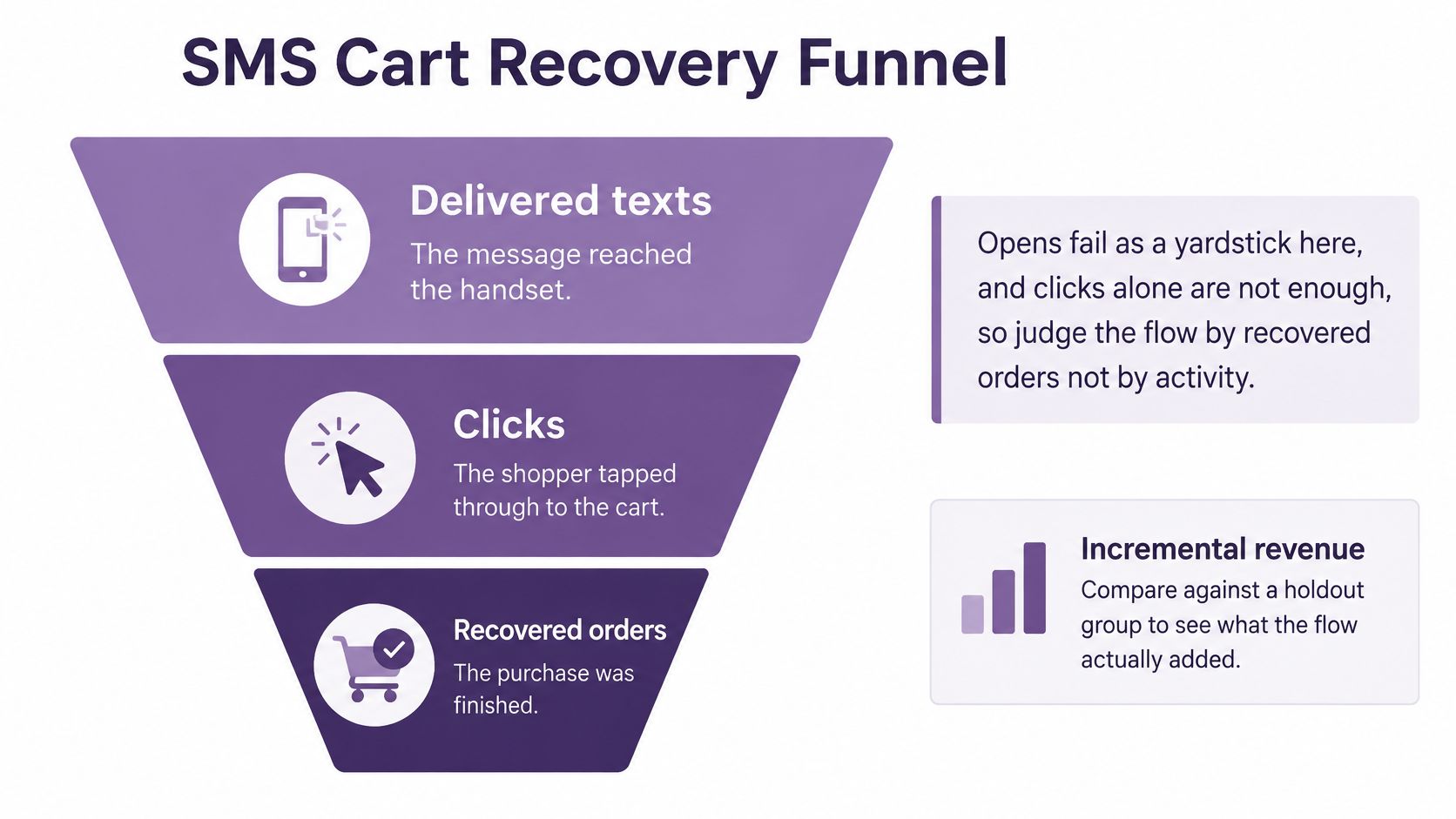
Every stage of an SMS cart flow narrows from delivery to completed checkout, as shown in the funnel below.
A Timed Cart Recovery Sequence You Can Test
Instead of firing an email and a text simultaneously when a shopper leaves checkout, stagger the two channels so each addresses a different objection:
- Hour 1 (SMS): Send a short, plain text linking directly back to the saved cart while the product is still top of mind. Skip the discount here so you don't train shoppers to abandon carts for coupons.
- Hour 24 (Email): If no order arrives, send a rich email showing the abandoned item alongside verified customer reviews, return policy details, and sizing or usage guidance that removes purchase hesitation.
- Hour 48 (Final SMS): Trigger one closing text only if the shopper still hasn't checked out and holds active promotional SMS consent. Keep it concise, and exit the shopper from both channels the instant an order completes.
For a walkthrough of how automated SMS and email triggers work together inside an ecommerce store, watch the short overview below.
Dividing the Remaining Lifecycle Flows
Apply the same intent-first logic across the rest of your customer lifecycle so SMS stays high-signal:
- Welcome series: Split the path immediately by purchase status. If someone opts in via keyword or popup and hasn't bought yet, send a fast SMS confirming their welcome offer, then follow up over email with your brand story, best-sellers, and social proof. If they already placed an order, skip the discount and move straight into care instructions and what to expect next.
- Post-purchase: Let SMS handle real-time shipping and delivery alerts where immediacy shines, while email carries setup guides, care tips, and timed replenishment reminders.
- Browse abandonment and win-back: Keep low-intent product views on email so shoppers don't feel watched on their phone. Reserve SMS for high-intent moments like price-drop or low-inventory alerts, and use it sparingly as a single late-stage nudge inside an email-led win-back sequence.
Because benchmark ranges span wide store categories, test your own timing windows and evaluate conversion rate, unsubscribe rate, and revenue per message separately for each flow rather than averaging all SMS activity into one blended score.
Measuring Incremental Revenue Instead of Clicks
Platform dashboards make every channel look like a hero because both your email tool and your SMS app claim full credit whenever a buyer clicks within a generous attribution window. Evaluating abandoned-cart SMS properly means reading it as a three-stage funnel rather than celebrating click rates in isolation.
A production dataset covering February 2024 through January 2025 published in CartBoss's abandoned-cart SMS benchmarks illustrates why stage-by-stage tracking matters. Across 3,511,850 abandoned carts (many of which were never messaged because the shopper lacked a phone number, hadn't granted SMS consent, or had messaging disabled), stores delivered 1,999,408 cart-recovery texts, generating 534,974 clicks and 65,566 recovered orders.
| Stage | Count | Rate |
|---|---|---|
| Delivered cart-recovery texts | 1,999,408 | Base for all rates |
| Clicks | 534,974 | 26.8% of delivered texts |
| Recovered orders | 65,566 | 12.3% of clickers; 3.3% of delivered texts |
Look closely at the bottom row. Presenting the 12.3% click-to-order conversion rate as your overall recovery rate exaggerates real performance nearly fourfold compared with the 3.3% recovered-order rate across delivered messages. Optimize each funnel step independently: improve compliant opt-in capture to reach more abandoned carts, refine copy and landing speed to lift delivered-to-click rates, and fix checkout friction to convert more clickers.
Using Holdout Groups to Prove True Lift
Even a clean funnel doesn't tell you how many shoppers would have returned to buy on their own. To measure incremental revenue, assign a randomized share of eligible shoppers to a control (holdout) group that receives zero messages from that flow, then compare total orders and contribution margin between the messaged group and the holdout.
Here is how the math works in a hypothetical store test. Suppose 10% of shoppers in your unmessaged holdout group finish checking out anyway within three days, while 14% of shoppers who received your cart-recovery flow complete their purchase. Your flow generated 4 percentage points of incremental lift, not 14%. Reviewing attribution models helps too: resources that compare last-click and time-decay credit show how easily default reporting over-credits the final touchpoint when email and SMS overlap.
Never pay for a channel based on platform-attributed revenue alone. Judge it by the extra orders and profit it creates above an unmessaged control group.
Spotting Fatigue and Channel Cannibalization
Track four health metrics alongside incremental margin: unsubscribe rate, complaint rate, deliverability, and profit per recipient. Short-term revenue spikes can mask two quiet leaks. Fatigue happens when aggressive frequency pushes loyal buyers to reply STOP, shrinking your addressable audience for peak season. Cannibalization occurs when an SMS fires right after an email and steals credit for a sale the cheaper email would have closed anyway.
Set one randomized holdout per channel and review incremental profit, opt-outs, and complaints every 30 days. Solid reporting starts at initial setup, where consent capture, coordinated sequencing, and outcome tracking belong in one workflow.
How to Launch Your Email and SMS Sequence
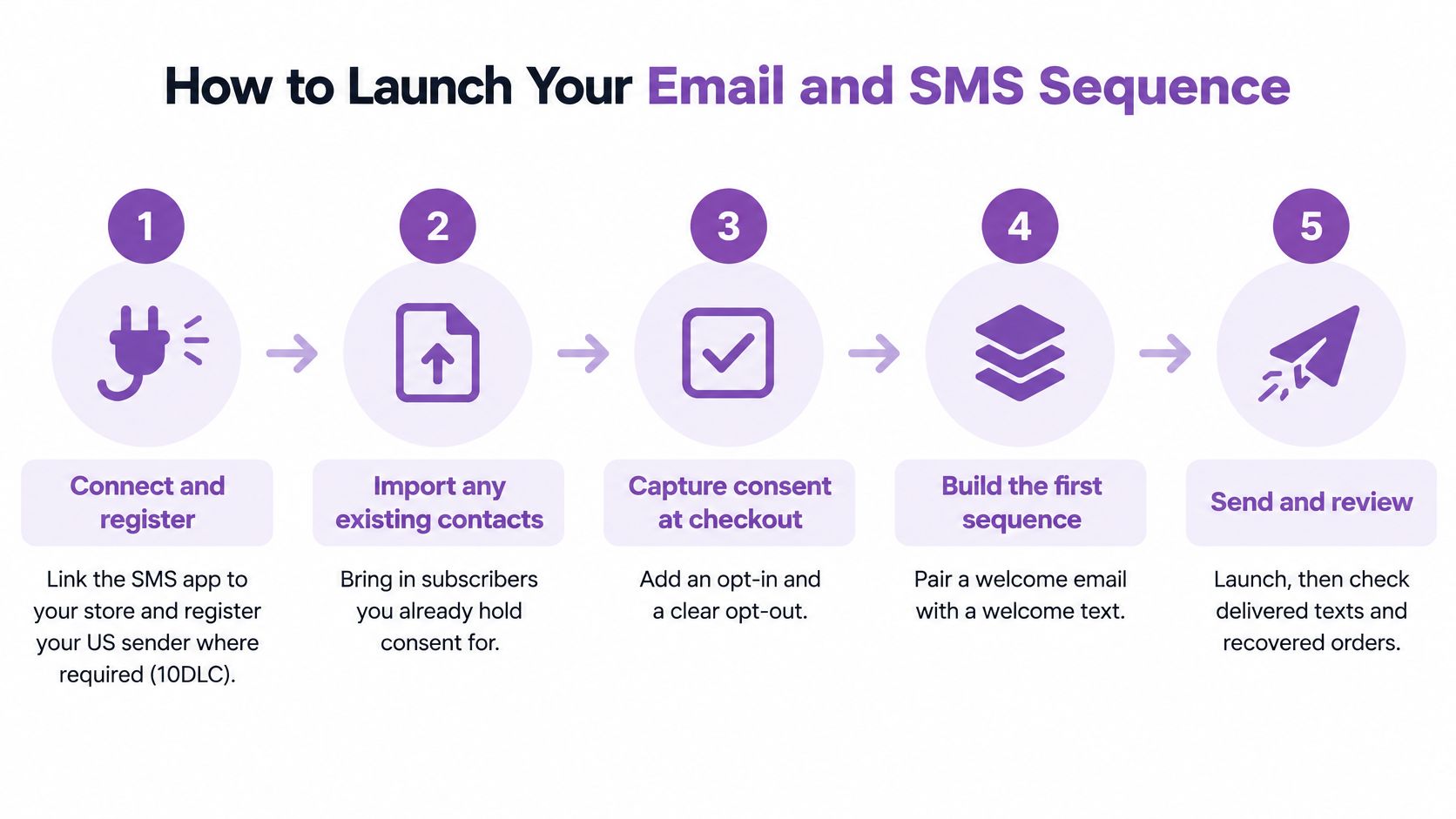
Rolling out both channels works best when compliance, list hygiene, and measurement go live before your first promotional send. Follow the sequence below to get a clean program running without burning early subscribers.
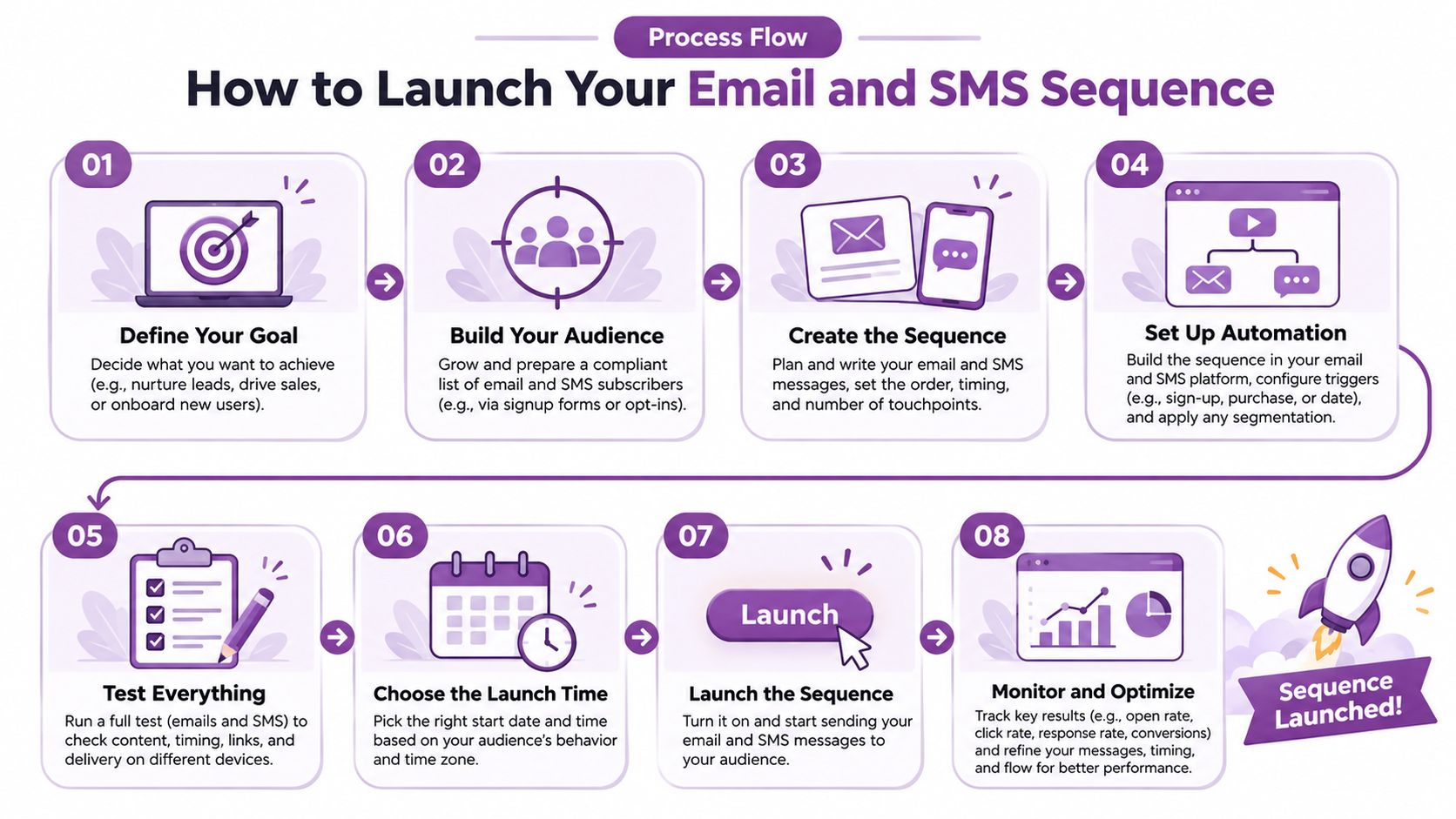
- Connect your store and register your sender identity. Link your SMS app to Shopify and submit 10DLC registration for US traffic before scheduling campaigns; our Shopify SMS app setup guide walks through installing the app, completing 10DLC registration, and sending your first campaign. Skipping carrier registration beforehand is the fastest way to get legitimate texts filtered before they reach handsets.
- Import only verified subscribers. Customers can import an existing subscriber list by uploading a CSV file with phone numbers and any custom fields, and send in seconds after the upload. Never bulk-upload an old order export that lacks a documented promotional opt-in source, because texting unconsented buyers triggers instant complaints.
- Install thumb-friendly consent capture. Place an SMS opt-in checkbox at checkout, configure a mobile-first popup, and set up a keyword opt-in with clear disclosure language right beside the button. Test every form on an actual phone screen; awkward multi-step popups kill opt-in rates on mobile, and burying disclosures behind a tiny footer link creates compliance gaps.
- Activate welcome and cart recovery flows first. Turn on these two automations ahead of everything else because both respond to clear, high-intent shopper actions. Avoid building a sprawling web of six or seven flows on day one, which makes diagnosing delivery or conversion issues much harder.
- Coordinate email follow-ups on the same triggers. Pair your email sequences to the exact same welcome and checkout triggers, using shared exit rules so a completed purchase stops both channels immediately. Running email and SMS on disconnected timers is how stores accidentally send a cart email and a cart text within five minutes of each other.
- Enforce frequency caps and local quiet hours. Set a strict cap on how many promotional texts one shopper can receive per week, and schedule messages with timezone-aware delivery so sends land during daytime hours where the recipient lives. Sending on your warehouse's local clock wakes up customers across time zones and causes immediate STOP replies.
- Enable randomized control groups before going live. Configure your holdout split on both the email and SMS flows prior to launch so your first month produces a clean incremental baseline. Adding holdouts weeks later leaves your team arguing over biased attribution numbers.
Your Mandatory Pre-Launch Opt-Out Test
Before toggling any live campaign switch, add an internal test phone number to your store, reply STOP to opt it out, and trigger a simulated abandoned checkout on that exact profile. Confirm that zero promotional texts arrive and that the opt-out status appears inside your synced preference record. If a test text slips through, fix the suppression webhook before a single real customer sees a message.
Pick Your Channel Split and Start With Cart Recovery
If you're staring at a long retention roadmap, start with abandoned-cart recovery. It delivers the highest SMS conversion potential across automated ecommerce flows and ties every recovered order back to an identifiable checkout, giving you clean revenue proof within weeks. Once your checkout and popup consent capture runs smoothly, turn on your welcome flow next to capture high-intent keyword and popup opt-ins right when shoppers are actively browsing.
Let your current phone list size decide how aggressively you split volume between channels:
- Small or brand-new SMS list: Focus your first month on compliant mobile opt-in growth while email carries the heavy lifting across welcome education, browse reminders, and weekly campaigns.
- Established list with steady keyword opt-ins: Give SMS a primary seat inside cart recovery, first-purchase welcome texts, shipping updates, and short-window inventory alerts while email handles storytelling and reactivation.
Whichever mix fits your store today, keep three essential guardrails in place: verified permission before the first text, one synchronized preference record read by every tool, and incremental profit measured against a holdout group. After running your cart recovery flow for a full month, compare its orders and contribution margin against the control group. Only expand into welcome, browse abandonment, and win-back flows one at a time after each sequence proves positive lift.
For Shopify merchants looking for a straightforward setup, the Shopify SMS app from YipSMS offers one practical option alongside any email provider. YipSMS includes 10 prebuilt revenue automations you can activate with one click, plain text messaging with automatic STOP/HELP handling, trackable short links, personalization tokens, and real-time analytics, all on pay-as-you-go plans with an auto top-up wallet and no contracts, hidden fees, or surprise overages. Regardless of which platform runs your flows, pairing intent-based triggers with disciplined consent sync turns both channels into reliable profit centers.
Ready to pair compliant, high-intent text messaging with your existing email flows without locking into rigid monthly contracts? YipSMS Inc. gives Shopify stores one-click revenue automations, built-in STOP/HELP handling, drag-and-drop opt-in popups, and transparent pay-as-you-go messaging starting with a 14-day free trial. Start building a cleaner cart recovery and welcome sequence today at YipSMS Inc..
Links referenced in this article
- Validity 2025 Benchmark Report
- SMS.to
- Sweatpants Agency
- MailerLite's email marketing statistics
- MMD Smart's 2026 email marketing guide
- commission-only lead generation for agencies
- Ofcom's guidance on unwanted calls, texts, and emails
- Airship describe this breakdown as consent fragmentation
- Postscript's SMS benchmarks report
- CartBoss's abandoned-cart SMS benchmarks
- compare last-click and time-decay credit
YIPSMS publishes educational articles, including AI-assisted content supplied through Outrank. Our internal team reviews Outrank articles for accuracy before publication. Pricing and requirements can change; check current YIPSMS pricing and official guidance before acting. Compliance content is general information, not legal advice. Spotted something wrong? Tell us through your YIPSMS account.