Reminder Advertising Example: 7 SMS Ideas for Ecommerce
Most ecommerce SMS fails because it sounds like a broadcast blast. Reminder advertising works differently. It follows an action the shopper has already taken, such as viewing a product, adding an item to a cart, starting checkout, or waiting for an order. The message doesn't need to explain your entire offer. It needs to bring a relevant decision back to the shopper's attention.
A 2022 Marketing Science study of Dutch State Lottery advertising found that reaching 1% of the population produced a 1.55% increase in online sales during the four hours after exposure. The effect was strong but short-lived, which shows why timing matters in reminder campaigns. The same principle applies to Shopify SMS, but the timing must fit the customer journey.
The seven flows below give you a practical reminder advertising example for each major ecommerce moment. Every flow includes a trigger, copy, send timing, guardrails, and a metric worth watching. For broader creative inspiration, browse iconic TV ad examples, then adapt the lesson to a smaller, more personal channel.
Table of Contents
- 1. Abandoned Cart Reminder
- 2. Checkout Abandonment Nudge
- 3. Viewed Product Follow-Up
- 4. Back-in-Stock Alert
- 5. Replenishment Reminder
- 6. Shipping and Delivery Status Reminder
- 7. Last-Chance Sale Reminder
- Comparison of 7 Reminder Ads
- Turn These Reminder Flows Into a Repeatable SMS System
1. Abandoned Cart Reminder
The shopper added a product but didn't complete the purchase. That action gives you a strong reminder signal, but it doesn't justify sending a discount immediately. Start by making the return path easy.
Trigger: A shopper adds an item to the Shopify cart and leaves without purchasing.
Message copy:
“Hi {first_name}, you left the {product_name} in your cart. It's still available: {cart_link}”
Send timing: Send the first message after 30 to 60 minutes. A 2024 Journal of Marketing investigation found that a message sent 30 to 60 minutes after abandonment reduced purchases relative to a no-message control, even when the early-treatment group had more total purchases. A later message sent after one to three days generated a positive incremental purchase effect and improved advertising ROI. Read the research on ecommerce retargeting timing for the distinction between attributed and incremental sales.
Use the first text as a helpful nudge, not a bribe. If the shopper still hasn't purchased, a later message can introduce a genuine incentive. Always suppress the flow after purchase.
Practical rule: A cart reminder should make checkout easier, not create pressure the shopper didn't ask for.
Set quiet hours based on the recipient's time zone. Don't send before 8 AM or after 9 PM. Track incremental purchases and revenue per recipient against a randomized holdout, rather than counting every attributed order as a campaign win.
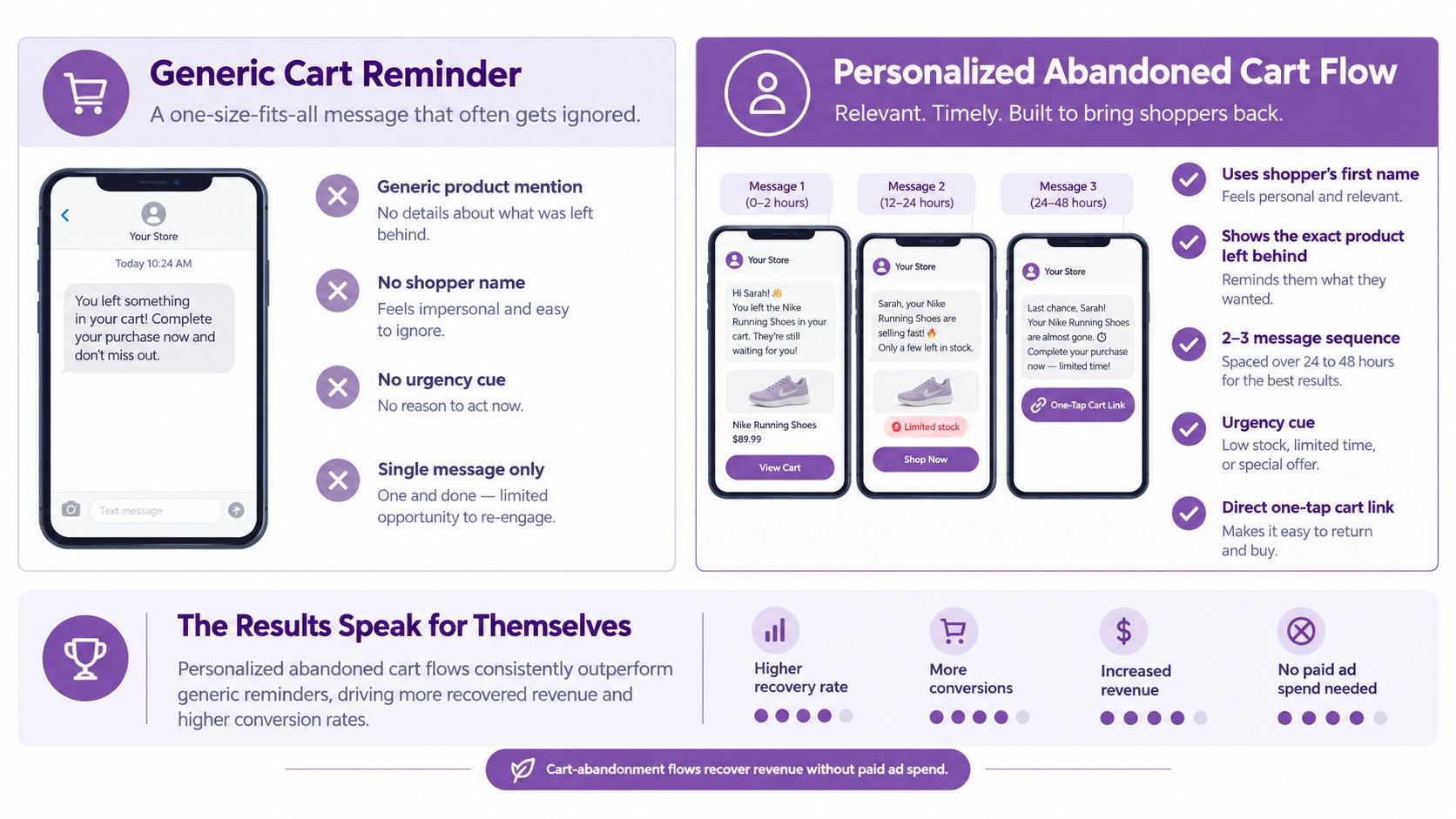
A prebuilt YipSMS cart abandonment flow can provide the starting structure. Test one variable at a time, such as the first send delay, product name, or second-message incentive.
2. Checkout Abandonment Nudge
Checkout abandonment deserves a different message from cart abandonment. The shopper has already moved further into the buying process, so the likely problem may be shipping cost, delivery timing, payment friction, or uncertainty about returns.
Trigger: The shopper starts checkout, enters contact details, and leaves before payment is complete.
Message copy:
“Almost there, {first_name}. Need help finishing your order? Resume checkout here: {checkout_link}”
Send timing: Avoid treating the first few minutes as an automatic sales opportunity. The research on abandoned cart versus abandoned checkout helps separate the two customer states. Test a delayed recovery message against your own control group, and make the copy answer the most likely objection.
For a clothing store, the useful detail may be a delivery date or returns policy. For a furniture store, it may be shipping cost. For a beauty store, it could be payment reassurance or product compatibility.
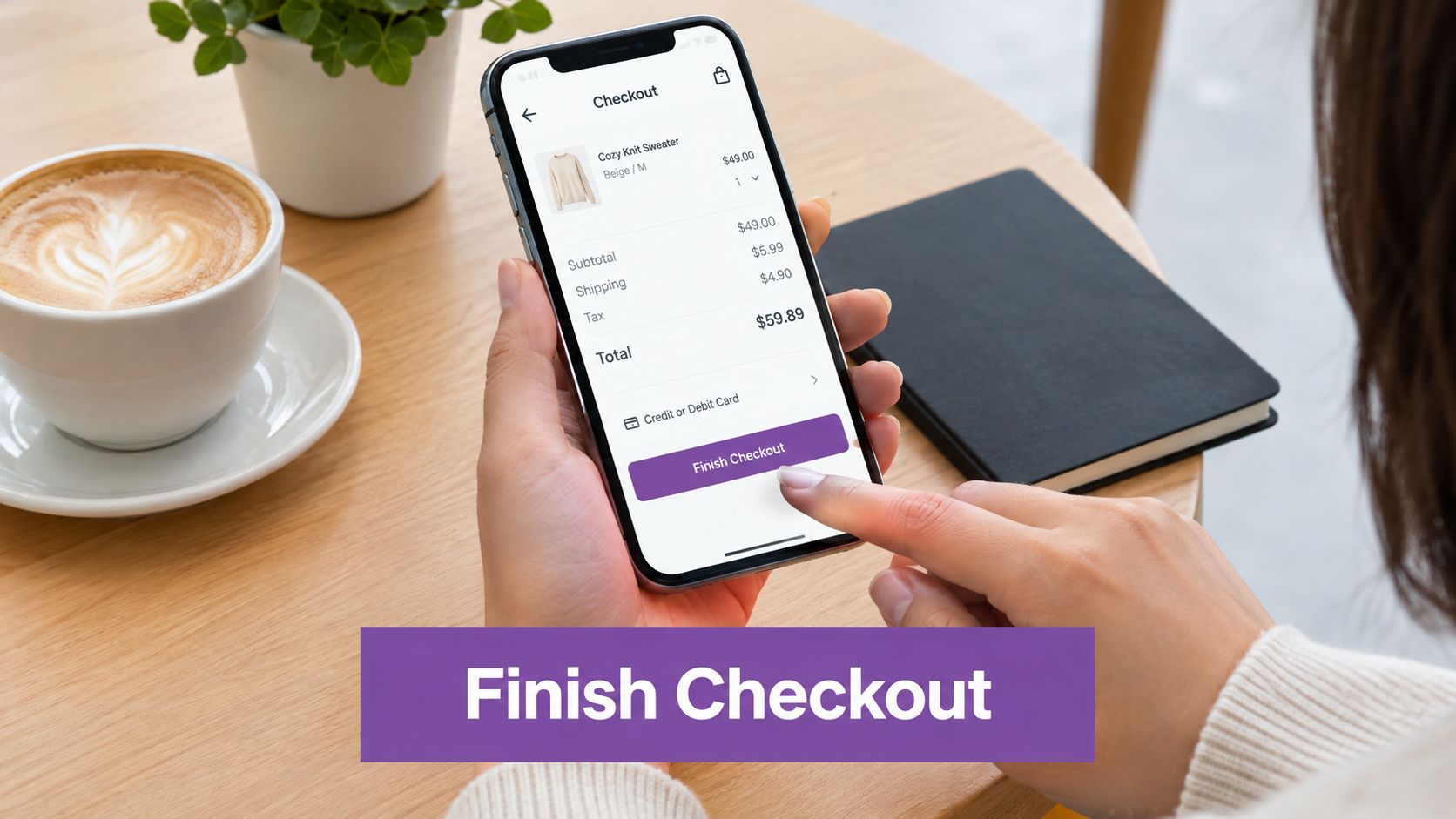
Guardrails: Don't offer free shipping if the customer already received it. Suppress the flow after payment, customer-service contact, or a completed order. Keep the link pointed to the saved checkout, not the homepage.
A reminder cannot repair a broken checkout. Test the payment experience, shipping calculation, mobile layout, and error messages before adding more texts.
Track completed checkouts and profit per recipient. Clicks are useful for diagnosing the message, but they don't prove that the text created the purchase.
3. Viewed Product Follow-Up
A viewed product is a weaker intent signal than a cart or checkout event. The shopper may be researching, comparing options, or browsing casually. Your message should therefore add a reason to return instead of shouting for an immediate purchase.
Trigger: The shopper views a specific product page but doesn't add the item to a cart.
Message copy:
“{first_name}, still thinking about the {product_name}? See why shoppers choose it: {product_link}”
Send one message for the viewed product, then stop. A product-view flow that repeats every time the shopper opens a page quickly becomes surveillance rather than service.
Use a useful detail in the message. A review highlight, a fit guide, a related item, or a top-seller label gives the shopper something new to consider. For example, a skincare store might recommend a cleanser that pairs with the viewed serum. A furniture store might show the matching side table rather than repeating the same product name.
Keep browsing reminders restrained
Cap the total frequency per shopper and exclude anyone who has since purchased the product or added it to a cart. Those customers belong in a different flow. Sending a browse reminder after a completed order makes your data look disconnected.
YipSMS personalized recommendation features can help suggest related items, but the recommendation should follow the observed browsing behavior. Don't infer sensitive characteristics or use data the shopper wouldn't expect.
Track return visits that lead to an add-to-cart action, then compare that result with shoppers who received no message. A visit alone isn't enough. The BuildDirect retargeting experiment found that retargeting produced 14.6% more users returning to the website over four weeks versus the control group, while also warning that more revisits don't automatically prove incremental sales. See the BuildDirect retargeting experiment for the measurement lesson.
4. Back-in-Stock Alert
Back-in-stock messaging starts with an explicit customer request. The shopper has told you which product and, often, which size or variant matters. That makes this one of the clearest reminder advertising examples, but only if the alert lands while inventory is still accurate.
Trigger: A shopper requests an SMS alert for a sold-out product or variant.
Message copy:
“Good news, {first_name}. The {product_name} in size {size} is back in stock. Shop before it's gone: {product_link}”
Send timing: Send immediately after the inventory update confirms the exact variant is available. Don't make the customer wait for a batch campaign. The product page should offer SMS signup beside the sold-out item, including size and colour selectors where relevant.
The alert must take the shopper to the requested product variant. A link to a general collection page creates unnecessary work and can make the customer believe the item is still unavailable.
Use a short message with one clear action. Avoid adding unrelated products, a broad promotion, or an urgency claim you can't support. If stock is limited, say so only when the quantity makes the claim reasonable.
For a deeper implementation reference, see YipSMS's back-in-stock notification guidance.
Track purchase rate by restocked product and variant, then compare sign-up volume with sales after each restock. That information helps buying teams see which products deserve deeper inventory, not just which texts receive clicks.
5. Replenishment Reminder
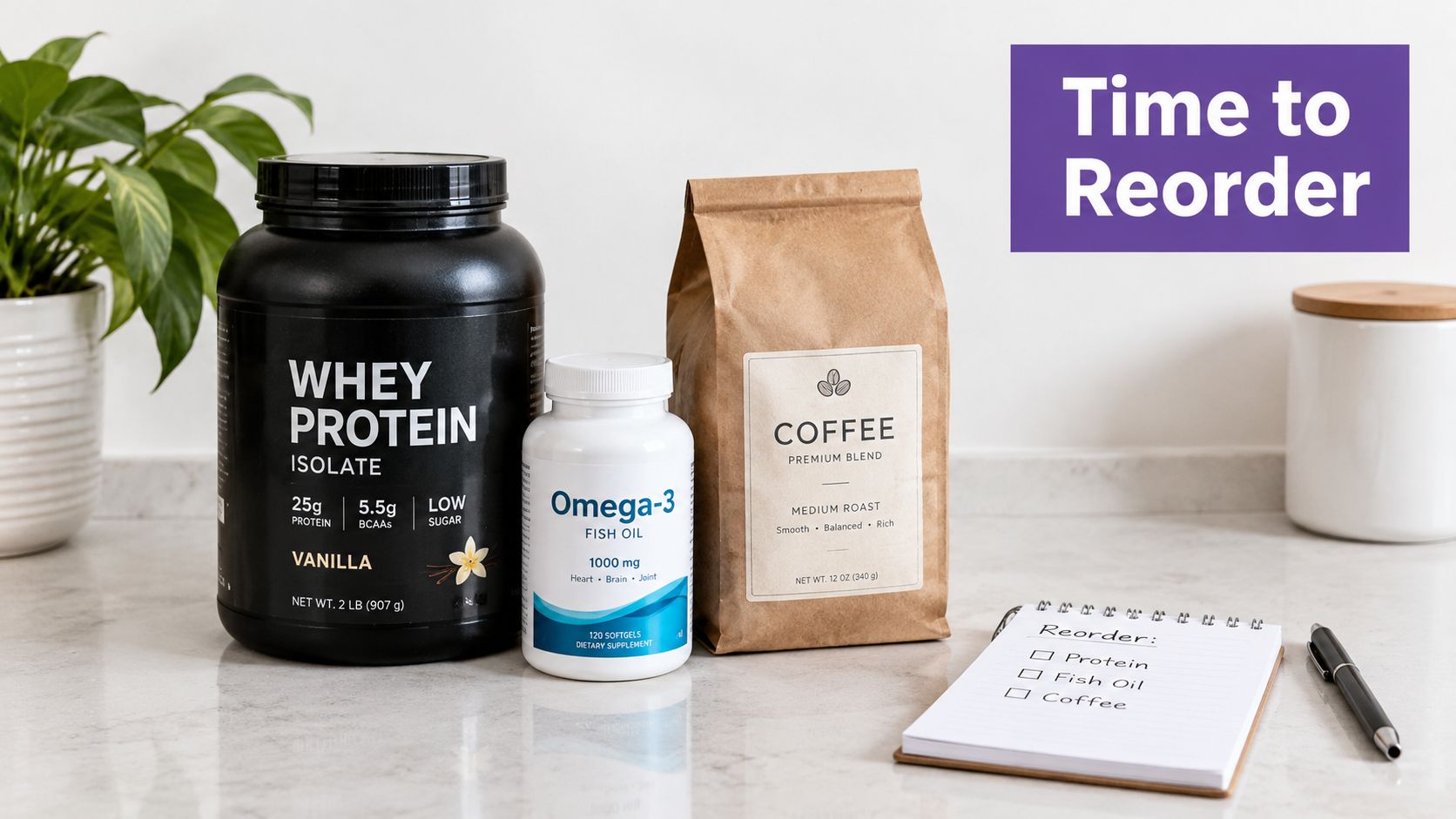
Replenishment reminders work best when the product has a believable usage pattern. Coffee, pet food, skincare, supplements, and cleaning products can all fit, but one default schedule rarely fits every customer or product size.
Trigger: A previous customer is approaching the expected reorder point for a consumable product.
Message copy:
“{first_name}, it may be time to restock your {product_name}. Reorder in one tap: {reorder_link}”
Send timing: Set timing by product and pack size, using actual order history where available. A customer who buys a large bag of coffee shouldn't receive the same reminder as someone who buys a smaller one. Treat the first message as service, then reserve a discount or subscription offer for a later follow-up.
The message should make repetition convenient. Link directly to a reorder page, preserve the customer's variant, and show a subscribe-and-save option when it genuinely improves the buying experience.
A replenishment reminder should arrive before the customer needs to find a replacement brand, not long before the product could plausibly run out.
Suppress the flow after a new purchase, subscription activation, refund, or customer-service complaint. Also exclude customers who recently received another promotional SMS. Replenishment is a retention message, so it shouldn't compete with every other campaign.
Track reorder rate by product, along with the interval between purchases. A strong result isn't just a discounted order. It may be a repeat purchase at a healthy margin or a move into a subscription.
6. Shipping and Delivery Status Reminder
A delivery update is informational, not a sales reminder. Its value comes from reducing uncertainty. Keep it separate from promotional flows so customers can understand why they received the message and what action, if any, they need to take.
Trigger: The order changes status, such as shipment, out-for-delivery, delivery, or pickup readiness.
Message copy:
“Your order #{order_number} has shipped. Track it here: {tracking_link}”
Send timing: Send when the carrier status changes. Add a day-before-delivery reminder when it helps customers prepare, especially for signed deliveries, bulky items, or pickup orders.
Keep the structure tight:
- Identify the order: Include the order number so the customer can recognize it immediately.
- Give one next step: Use one tracking or pickup link, not a list of support pages.
- Separate promotion: Wait until delivery is confirmed before adding a relevant care tip or accessory suggestion.
YipSMS supports SMS delivery notifications, which can help stores build the flow around order events rather than arbitrary campaign dates.
Review consent and local requirements for transactional and promotional texts. In the UK, the Information Commissioner's Office explains that marketing texts to individual subscribers generally require specific consent or a valid soft opt-in. A general newsletter signup doesn't automatically establish permission for SMS marketing. Keep the communication purpose clear when collecting the number, and store the consent record.
Track delivery-related support contacts and post-delivery conversion. The first metric shows whether the update reduces uncertainty. The second shows whether any later follow-up contributes to a useful customer experience without turning a service notification into a disguised promotion.
7. Last-Chance Sale Reminder
Urgency only works when the deadline is real. A last-chance message should close a genuine promotion, not manufacture panic around an offer that returns every week.
Trigger: A subscriber has received a sale or promotion but hasn't purchased or redeemed it before the stated end time.
Message copy:
“{first_name}, your offer expires tomorrow. Use {code} before {deadline} at {sale_link}”
Send timing: Send shortly before the actual deadline, with the time zone included. A second message can work for a major campaign, but repeated “final” notices teach subscribers to wait.
Cap each sale campaign at two or three reminders. The Journal of Consumer Research meta-analysis synthesised 97 verbal-learning studies and found that distributed presentations generally produced better memory than massed presentations. The advertising implication is practical: space reminders across the decision period instead of sending the same message several times in one burst.
Guardrails: Exclude recent purchasers, previous redeemers, and customers already enrolled in another high-priority flow. Identify the exact expiry time. Use local time zones where your platform supports them.
Schedule the campaign in advance, then review opt-out rates and incremental revenue after the sale. A campaign with many attributed purchases can still be weak if most customers would have bought without the reminder.
If the deadline isn't real, don't call it a last chance.
Track incremental profit per recipient, not just total orders or code redemptions. A smaller campaign with fewer discounts and stronger holdout lift is more useful than a large campaign that trains customers to wait for promotions.
Comparison of 7 Reminder Ads
| Flow | Implementation 🔄 | Resources | Expected outcomes 📊⭐ | Speed / Efficiency ⚡ | Ideal use cases 💡 | Key advantages |
|---|---|---|---|---|---|---|
| Abandoned Cart Reminder | Medium, cart sync, triggers, opt-in | Low, short copy, simple assets | High recovery, strong conversions (⭐⭐⭐⭐) | Immediate (30–60 min), quick ROI | Shopify stores with tracked carts, high‑intent buyers | Targets intent, recovers lost revenue with minimal cost |
| Checkout Abandonment Nudge | Medium‑High, checkout capture, exact-linking | Medium, checkout config, testing | Very high recovery for near-complete orders (⭐⭐⭐⭐) | Very fast (15–60 min), high conversion efficiency | One‑tap checkout flows, shoppers who entered contact info | Removes friction, addresses objections (shipping, returns) |
| Viewed Product Follow‑Up | Medium, product view tracking, recommendations | Medium, product data & recommendation logic | Moderate re‑engagement (⭐⭐⭐) | Slower cadence (hours–days), lower immediacy | Top‑of‑funnel browsing and discovery | Low discount risk, introduces alternatives and social proof |
| Back‑in‑Stock Alert | Medium, inventory sync + opt‑in | Low‑Medium, inventory integration, variant data | Very high response from opted‑in users (⭐⭐⭐⭐⭐) | Immediate on restock, very time‑sensitive | Limited drops, popular or variant‑specific products | High intent, creates urgency without discounts; demand insights |
| Replenishment Reminder | Medium, timing per SKU, purchase history | Medium, usage data, reorder/subscription links | High retention / repeat purchases (⭐⭐⭐⭐) | Timed (predictable cadence), efficient for repeats | Consumables (supplements, pet food, skincare) | Increases LTV, converts one‑offs to repeat buyers |
| Shipping & Delivery Status Reminder | Low‑Medium, carrier integration, triggers | Low, transactional templates, tracking API | Very high open/read, reduces support (⭐⭐⭐⭐) | Timely (tracking events), highly efficient | Post‑purchase lifecycle updates, delivery notifications | Builds trust, lowers CS volume, high engagement |
| Last‑Chance Sale Reminder | Low, scheduled campaign + segmentation | Low, promo copy, scheduling tools | Strong short‑term lift but fatigue risk (⭐⭐⭐) | Very fast–effective during deadline windows | Final sale hours, flash promotions | Creates urgency for final conversions; easy to schedule |
Turn These Reminder Flows Into a Repeatable SMS System
Start with the flows closest to a purchase. Abandoned cart and checkout reminders capture existing intent, so they usually deserve attention before broad promotional broadcasts. Build the trigger, message, suppression rule, and measurement method before adding more volume.
Next, add the flows that support retention. Back-in-stock alerts respond to an explicit request. Replenishment reminders bring customers back at a plausible buying interval. Delivery updates reduce uncertainty after the sale. These messages serve different jobs, so they shouldn't share one generic cadence.
Timing deserves as much attention as copy. The spacing research supports distributed reminders rather than a burst of repeated exposures, while the retargeting experiments show that early and late messages can produce different outcomes. Use randomized holdouts wherever possible. Compare incremental purchases, revenue, and profit with customers who didn't receive the message.
Consent and suppression need one system. For UK stores, the ICO says promotional SMS should use specific consent or a valid soft opt-in, and the request should identify the business and communication channel. Every marketing text must identify the sender and explain how to unsubscribe. In the United States, the FCC recognises STOP, QUIT, END, REVOKE, OPT OUT, CANCEL, and UNSUBSCRIBE as reasonable ways to revoke consent. Accept common opt-out words, confirm the suppression, and apply it across every automated flow.
A practical first step is to audit SMS consent and set quiet hours this week. Then launch one cart or checkout flow, test one timing variable or copy variable, and keep a holdout group. YipSMS's prebuilt flows can provide the initial structure, but your store's customer behaviour should determine the final cadence.
Personalization should stay useful and limited. Use the product the customer viewed, the cart they created, or the item they previously bought. Don't collect extra data just to make a message sound clever. The best reminder feels expected because it relates directly to an action the customer remembers taking.
YipSMS Inc. offers Shopify SMS tools for cart and checkout recovery, viewed-product follow-ups, delivery notifications, restock alerts, scheduled campaigns, and personalized recommendations. Visit YipSMS Inc. to review the available flows and build a reminder system around your store's customer actions.
How this article was made: the YIPSMS team drafts some articles with AI writing tools, then checks pricing, compliance and product details against how YIPSMS actually works before publishing. Spotted something wrong? Tell us through your YIPSMS account.