How Much Does a Text Message Cost in 2026? What Drives It
A marketing SMS sent through an app typically costs $0.015 to $0.025 per message, a US sending cost of about $0.012 to $0.013 per one-segment message once carrier fees are included, and a personal text on a phone plan adds no per-message charge.
Two stores can send the same number of texts in the same month and open bills that differ by a few hundred dollars. The headline rate is rarely the reason. Segment counts, the networks their subscribers sit on, and the fixed fees wrapped around the plan do most of the damage.
So the useful question isn't what a text costs. It's what your text costs, at your volume, to your list.
Table of Contents
- Text Message Cost at a Glance
- How Length, Segments and MMS Change the Price
- Carrier Fees and Destination Surcharges
- How to Estimate Your Monthly SMS Budget
- Cutting Waste Without Cutting Sales
- Choosing a Plan and Testing Before You Commit
Text Message Cost at a Glance
A text costs somewhere between nothing and about five cents, and that gap is where most SMS budgets go wrong. On a personal phone plan the answer is easy: US carriers bundle messaging into the monthly allowance, so a consumer text adds no per-message charge. The question only gets real for a store holding 8,000 opted-in numbers and a provider quoting a rate per message.
The price map has four rows, and they don't behave the same way.
| Message type | Typical cost | Who pays | What drives it |
|---|---|---|---|
| Personal text on a US phone plan | Included in the plan | Account holder | Plan allowance, not a per-text charge |
| Marketing SMS through an app | $0.015 to $0.025 per message | Store owner | Plan rate, monthly fee and segment count |
| Marketing MMS with image, GIF or video | $0.030 to $0.055 per message | Store owner | Media message rate, usually about double SMS |
| US sending cost for one segment before app fees | About $0.012 to $0.013 per message | Merchant through the provider | Base rate plus carrier surcharge |
The spread inside that table explains most of the confusion in the market. A message billed at $0.015 and one billed at $0.032 can be the same 160 characters leaving the same platform, differing only in plan, routing and destination network. YipSMS shows how wide that spread runs on a single provider: bulk SMS bills at a flat $0.032 per segment on pay-as-you-go credits, while the Gold plan at $99 a month and the Premium plan at $299 a month trade that monthly fee for per-message rates of $0.018 and $0.015.
Which row a store lands in depends on send volume. At low volumes the flat per-segment rate usually wins, because there is no fixed fee to recover. Past a certain point the monthly plan earns back its cost in per-message savings, and the breakeven math between those two structures is where the serious budget work starts.
Regulators have tracked a version of this gap for two decades. When European authorities began opening SMS interoperability, mobile operators held wholesale termination fees well above the underlying cost of delivery, and those wholesale charges long made up a large share of what consumers paid per text. The pattern still holds wherever an intermediary sets the rate.
Budget rule: if your monthly send count multiplied by your per-message rate already exceeds the revenue you expect SMS to produce, the number needs a closer look before the first campaign goes out.
Treat those ranges as a price map rather than a quote. Destination, network mix and plan choice each move the final figure, and the fixed fee attached to the plan decides which row your bill lands in.
How Length, Segments and MMS Change the Price
A 160-character message and a 200-character message look identical in your composer. On the invoice, one bills as a single segment and the other bills as two. The character counter is the most expensive piece of UI in the app, and few merchants ever look at it.
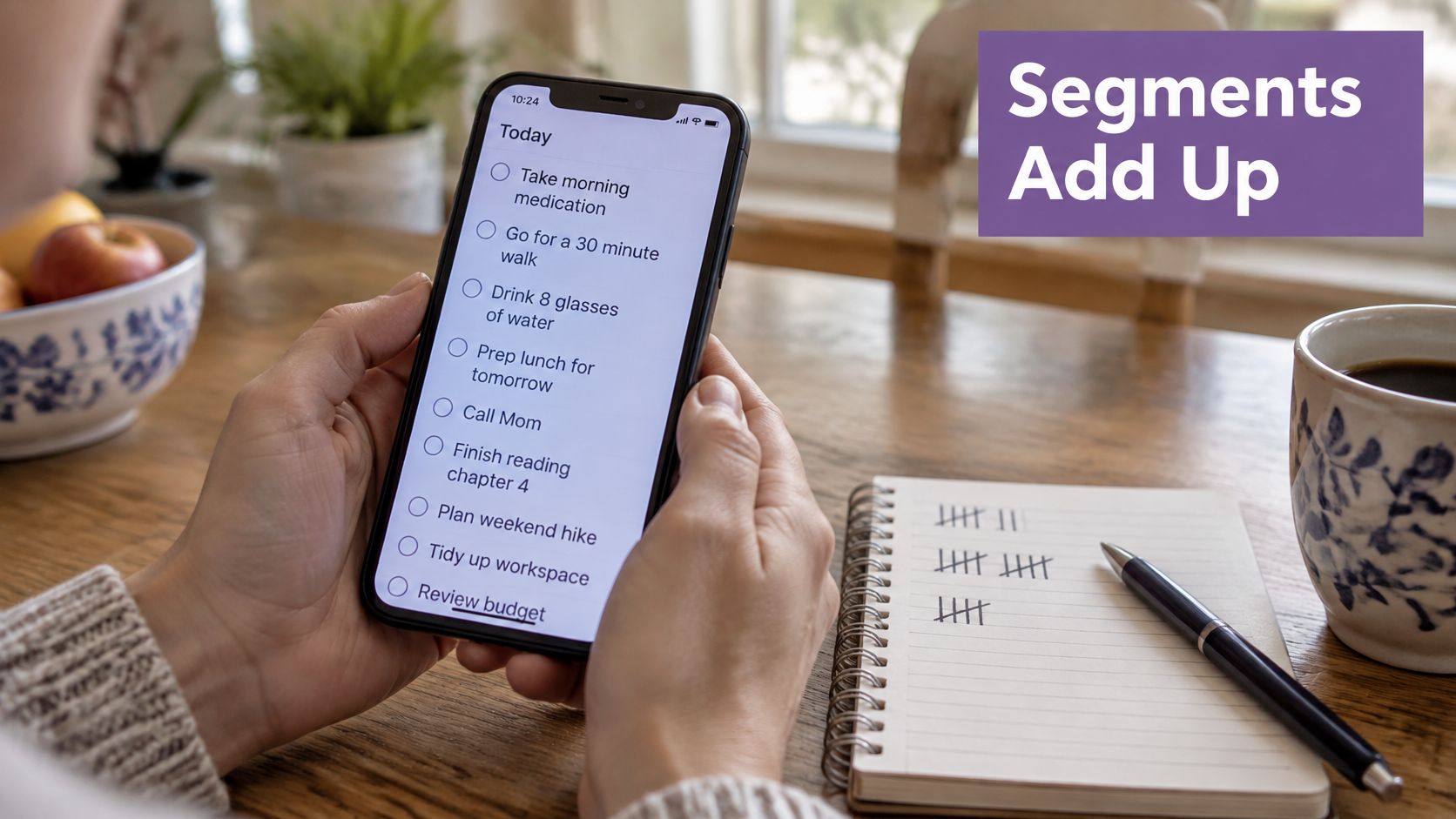
An SMS holds 160 characters, while an MMS holds 1,600 characters plus an image, GIF or short video. Cross the 160-character line and the carrier splits the message into segments, and every segment bills as its own message. That mechanism sits behind most invoice surprises, and it applies before anything else on the bill.
The 200-Character Mistake
Say a restock reminder runs to 200 characters: "Back in stock, your size included, and we've held it for 48 hours at the same price as your last order plus free shipping over $50." One message on screen, two segments on the bill. At $0.015 per segment it costs $0.03 instead of $0.015, and across 5,000 recipients that's $150 rather than $75. Nothing about the campaign changed except the word count.
Emojis and smart punctuation make it worse. Curly quotes, accented characters and most emoji push the message out of the standard GSM alphabet into a different encoding, which shrinks the per-segment limit to 70 characters. A line that reads as 90 characters on screen can become two or three segments. Check which characters trigger the encoding switch before you approve copy.
The same arithmetic runs at higher volumes. On a flat bulk rate of $0.032 per segment, a two-segment message costs $0.064. Send it to 10,000 numbers and you pay $640 for a campaign that would have cost $320 had the copy fit one segment. The second segment earns nothing unless the extra words are selling something.
Segment rule: if the offer doesn't fit in 160 characters, fix the offer, not the character limit.
MMS follows the same per-message logic at a higher rate. On the Premium plan, an MMS runs $0.030 per message against $0.015 for SMS, so the visual has to earn the difference. A product shot of a new colorway, a GIF of a texture, a short video of the product in use: those justify the price. A logo above the same discount copy does not.
Three checks before every send, under a minute total:
- Count characters in the final approved copy, including the link and any personalization tokens that expand on send.
- Scan for emoji and smart punctuation, then decide whether the encoding switch is worth the extra segment.
- Ask whether the image sells the offer, and downgrade to SMS when it's decoration.
Carrier Fees and Destination Surcharges
Every pricing page quotes a base rate. None of them quotes your bill. A provider's advertised rate is the price of its own service, not the full cost of delivering a message to a handset on somebody else's network, and the difference lands on your invoice.
Take a base rate of $0.0083 per outbound segment and one campaign to 10,000 numbers. The arithmetic says $83. The carrier has a different view of the transaction.
Carriers add a surcharge per outbound segment that depends on the recipient's network and the type of traffic you're sending. Those published surcharges sit in a narrow band, and one of them moved recently.
| Carrier | Surcharge per segment | Note |
|---|---|---|
| AT&T | $0.0035 | Published carrier surcharge |
| T-Mobile, 10DLC and toll-free | $0.0045 | Up from $0.0030 on the January 29, 2026 schedule |
| T-Mobile, short code | $0.0045 | Up from $0.0025 on the January 29, 2026 schedule |
| Verizon | $0.0050 | Published carrier surcharge |
| Other carriers | $0.0042 | Published carrier surcharge |
Twilio's carrier fee documentation lists a $0.0045 outbound SMS carrier fee for 10DLC, short-code and toll-free traffic on the January 29, 2026 T-Mobile schedule, up from $0.0030 for 10DLC and toll-free traffic and $0.0025 for short-code traffic. Stacked on the listed $0.0083 base rate, that's an illustrative $0.0128 per message before other applicable charges, so the 10,000-message campaign costs about $128 rather than $83. The fee rose while the advertised base rate stayed put.
Why Destination Mix Beats Average Rate
The recipient's carrier decides the surcharge, which means one campaign can cost two different amounts depending on which subscribers opened it. A list skewed toward one network carries that network's surcharge on every send, month after month.
Destination variation isn't only a US pattern. In its July 2017 data the Body of European Regulators for Electronic Communications put the simple European average SMS termination rate at 2.4057 euro cents per message and the traffic-weighted average at 2.0391 euro cents, and its 2015 comparison ranged from 5.60 euro cents in the Netherlands to 0.15 euro cents in Denmark, per the BEREC termination rates report_227_Termination_Rates_Report_July_2017_publication.pdf). Same short message, different country, a price difference of more than thirty times.
Commercial US traffic on 10DLC adds another layer: registration and carrier fees that are fixed rather than per message. Budget them once, get the 10DLC registration right, and stop treating them as a per-send cost.
Recheck cadence: carrier fee schedules move on the carrier's timetable, not your renewal date, so put a quarterly reminder against the rate card.
Two habits follow. Pull the carrier mix of your list before you set a campaign budget, and compare cost per order for SMS against email and paid retargeting using the all-in per-message cost. A channel that looks cheap at the base rate can lose to email once the surcharges are counted.
How to Estimate Your Monthly SMS Budget
A business text doesn't have one universal price. The total is the provider's base rate plus destination-specific termination charges, carrier surcharges, and any registration or phone-number fees, and Twilio's US SMS pricing page puts a representative API benchmark at $0.0083 per outbound SMS segment before carrier fees, working out to roughly $0.0118 to $0.0133 per one-segment message once published surcharges are added. An advertised rate and a delivered cost are two different numbers.
Forecast the bill before the invoice arrives, in the order below.
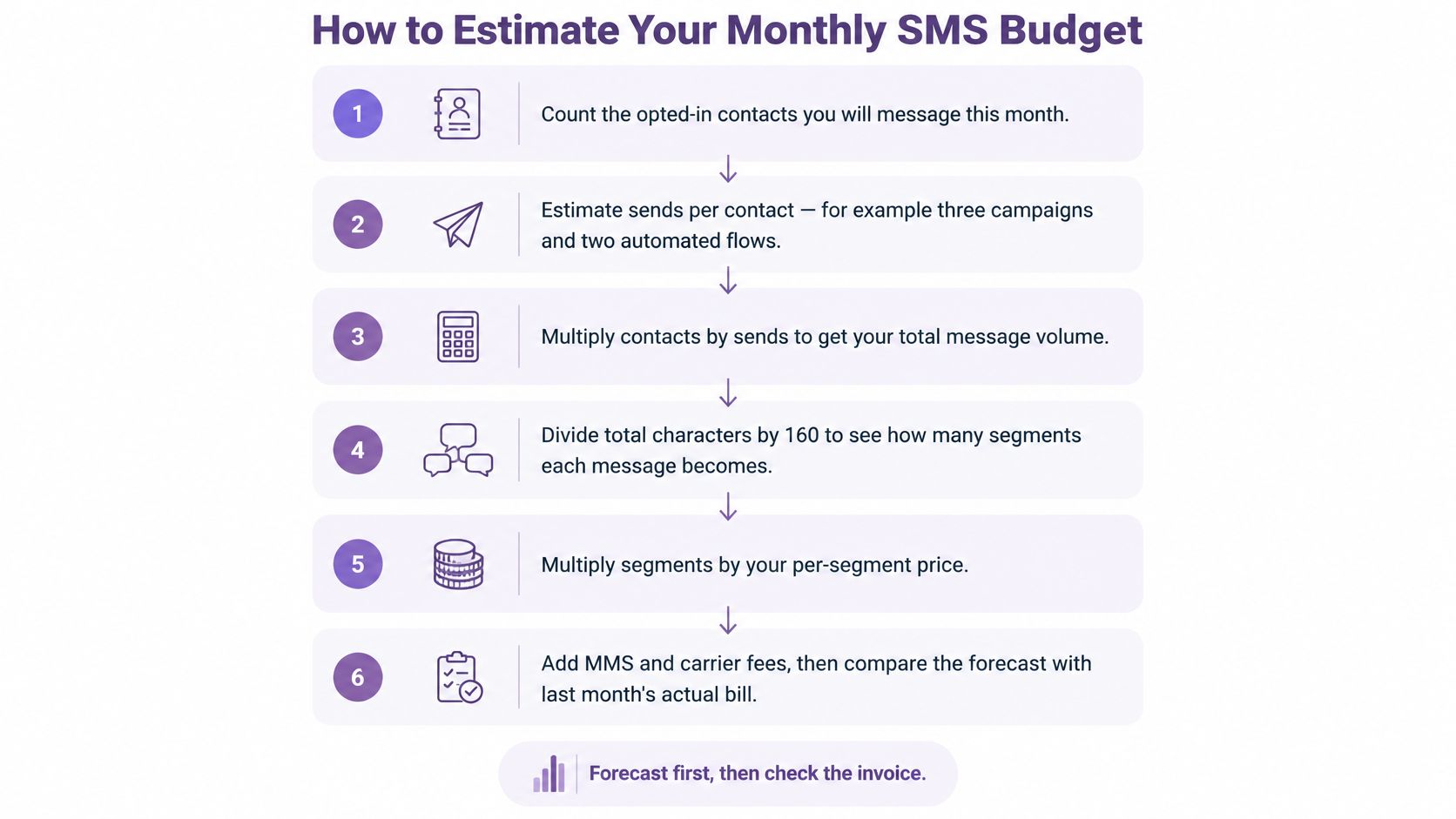
Six Steps, With the Reason for Each
- Count the contacts you'll message this month. Your bill scales with reachable, engaged numbers, not with the size of your list export.
- Set sends per contact. Three campaigns and two automated flows means five sends, and writing the number down stops the "we'll probably send a few" guesswork.
- Multiply contacts by sends, then by segments per message. Divide each template's character count by 160, because segments are the billing unit and messages are not.
- Apply your plan rate to SMS and price MMS separately. Media messages carry their own higher rate, so a mixed calendar needs two lines in the forecast.
- Add fixed costs. The monthly plan fee, number registration, and carrier surcharges if your rate doesn't already include them. Confirm that last point with your provider rather than assuming it.
- Add a 10 to 15 percent buffer. Promotion weeks, a surprise flash sale and a restock alert all add sends you didn't plan for in week one.
A Worked Month at 4,000 Contacts
Take 4,000 opted-in contacts, five single-segment messages each, so 20,000 messages. On the Gold plan at $0.018 per SMS that's $360, plus the $99 monthly fee, for $459. A 10 percent buffer brings the forecast to about $505.
Now add the surcharge. If all 20,000 messages land on T-Mobile handsets at $0.0045 per segment, that's another $90, and the month lands near $550 without a single change to the campaigns. Teams running the raw API start from the $0.0083 base rate and add surcharges the same way.
Plan structure decides how the formula reads. A subscription plan bills the monthly fee on top of per-message charges, while a pay-as-you-go balance has no fixed fee at all, and there customers pay only for the messages they send, which puts the entire cost on the per-message rate.
The spreadsheet line is contacts times sends times segments times rate, plus fixed costs, plus buffer. Paste it into a cell before your next campaign and stop guessing at the end of the month.
Cutting Waste Without Cutting Sales
Waste in an SMS program is rarely one big mistake. It's a hundred small sends to numbers that were never going to buy, and it shows up as a bill that grows faster than revenue. The levers below are ranked by how much they save, cheapest effort first.
Delete dead numbers before every large campaign. Disconnected and invalid numbers still consume sends, and they never convert. Run a validation pass on any list segment you haven't messaged in 90 days. At $0.018 per message, every thousand contacts on the list costs $18 a send, so a stale segment taxes every campaign on the calendar.
Honor STOP and HELP without delay. Every message to a number that already opted out is pure loss, and it's a compliance problem on top of a billing one.
Move budget from blasts into triggered flows. Abandoned checkout, shipping notifications and delivery confirmations reach shoppers who already showed intent, so the same dollar buys more orders. YipSMS ships 10 prebuilt revenue automations that activate with a single click, including Shipped Notification, Delivered Notification, Popup Subscriber Welcome and Keyword Opt-in Reply, which makes this the fastest lever to pull.
Replace repeat blasts with one well-timed send to your most responsive segment. Two mediocre sends to the full list usually cost more and sell less than one sharp send to the people who opened the last three. Skip a single full-list blast and the savings compound across the month.
Frequency cap: decide the maximum number of promotional messages any one number receives per month, and let automation route around that ceiling instead of overriding it.
Collect consent at signup, not after. The CTIA messaging principles and best practices set two baseline requirements for business texting: obtain consumer consent before sending, and give recipients a clear way to opt out. In practice that means your popup states the messaging purpose, captures affirmative permission, and keeps an auditable record. A phone number collected at checkout is not documented marketing consent, and a list built on that assumption is a liability you'll pay for twice.
The same discipline applies outside ecommerce. Programs like guest list texting for nightlife promoters run on confirmed hand-raisers and a tight cap for the same reason: one unwanted message burns trust that took months to build.
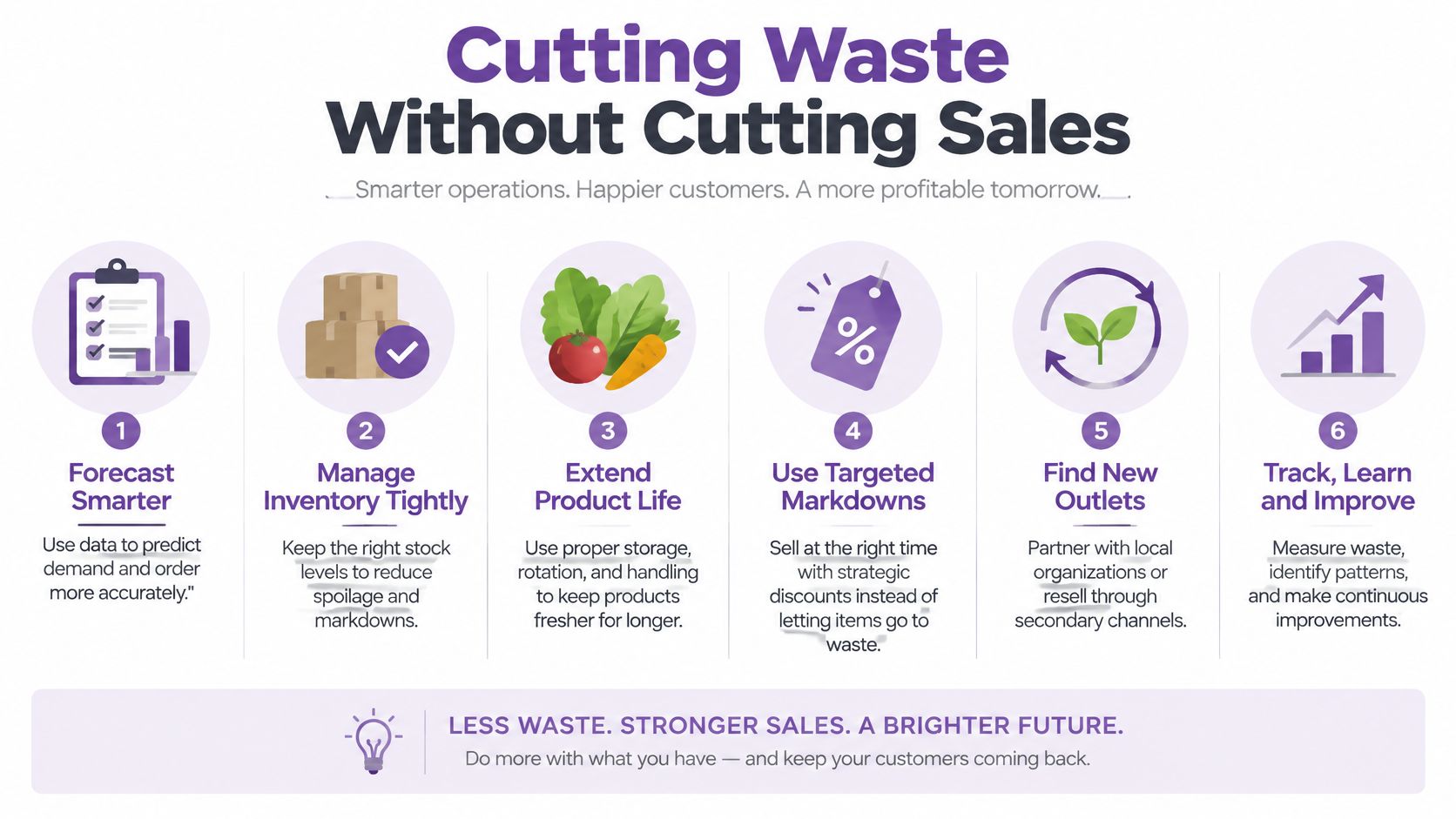
Track one number each month: cost per order from SMS, calculated with the all-in per-message cost rather than the advertised rate. Multi-segment messages, carrier surcharges and the plan fee all belong in that figure, because a campaign can look cheap at the headline rate and lose money once all costs are counted. Any campaign whose cost per order exceeds your margin on that order gets cut, no debate.
Choosing a Plan and Testing Before You Commit
Volume picks the plan. The crossover points are arithmetic, and they're easy to run against your own send count on the YipSMS pricing page.
| Plan | Monthly fee | SMS per message | MMS per message | Breakeven against Free |
|---|---|---|---|---|
| Free | $0 | $0.025 | $0.055 | Not applicable |
| Gold | $99 | $0.018 | $0.042 | About 14,100 SMS per month |
| Premium | $299 | $0.015 | $0.030 | About 29,900 SMS per month |
Where Each Plan Flips
The Free plan charges $0.025 per SMS with no monthly fee, so it wins at low volume and costs nothing in a quiet month. Gold adds $99 and drops the rate to $0.018, and the $0.007 gap covers the fee at about 14,100 SMS. Premium adds $299 and drops the rate to $0.015, which beats Free above roughly 29,900 SMS and beats Gold above roughly 66,700.
Two worked totals make it concrete. At 5,000 SMS a month, Free costs $125, Gold $189 and Premium $374, so Free wins. At 20,000 SMS, Free costs $500, Gold $459 and Premium $599, and Gold takes it.
MMS moves the answer earlier on every paid tier. Gold's MMS rate of $0.042 against Free's $0.055 pays back the fee at roughly 7,600 MMS a month, and Premium's $0.030 rate breaks even against Free at about 12,000 MMS. Add expected media volume before you decide, and step up a tier if you need priority delivery or a heavy MMS calendar.
Test With a Small Send Before You Commit
Pull last month's order count and subscriber numbers, run the forecast on those rather than on your best month, then send one abandoned-cart or shipping flow to a small segment. Set a review date 30 days out and put the actual invoice beside the estimate.
When the gap exceeds your buffer, check two things first. Segment length catches the most, because a template with an emoji and a long link doubled. Destination mix catches the rest, since a list concentrated on one network carries that network's surcharge on every send.
YipSMS Inc. prices SMS in the open, with per-message rates from $0.015, a Free plan at $0.025, and no monthly app fee stacked on top of message costs, so the budget you forecast is the one you can check against the invoice. If you want to see what your own list would cost, install the app, run the six-step forecast on last month's numbers, and send your first triggered flow before the trial ends. Visit YipSMS Inc. to start with the free plan and no credit card.
How this article was made: the YIPSMS team drafts some articles with AI writing tools, then checks pricing, compliance and product details against how YIPSMS actually works before publishing. Spotted something wrong? Tell us through your YIPSMS account.