Personalized Product Recommendations: A Shopify Guide
Product recommendations can punch far above their click share. One benchmark based on 150 million shopping sessions found that visits where shoppers clicked a recommendation made up just 7% of traffic but generated 26% of revenue, and another benchmark reported recommendations can account for up to 31% of site revenue and about 12% of sales on average for ecommerce brands (ecommerce personalization statistics). That's the part many Shopify teams still underuse in SMS.
Most stores treat personalized product recommendations as a widget problem. They install a carousel on product pages, maybe add related items to cart, and stop there. In practice, the sharper revenue move is often to connect recommendation logic to SMS triggers, timing, consent, and flow-level measurement so the right product shows up when intent is still warm.
Table of Contents
- The Moment a Text Message Beats a Banner Ad
- What a Personalized Recommendation Actually Is
- Data Signals That Travel Well Through SMS
- Segmentation and Timing Mechanics for Recommendation Texts
- Recommendation Flows Built on Shopify With YipSMS
- When Personalization Backfires and How to Stay Trustworthy
- KPIs That Prove the Recommendations Are Working
- A One-Week Plan to Launch Your First Recommendation Flow
The Moment a Text Message Beats a Banner Ad
A shopper lands on a Shopify store, browses three jackets, lingers on one black cropped puffer, adds nothing, and leaves. Forty-five minutes later, she gets a text: the exact jacket she spent time on, plus one knit beanie that matches the style and price point. She taps, returns, and decides fast because the recommendation feels current, not generic.
Now compare that to the same shopper seeing a display banner two days later with the same jacket. The product may still be relevant, but the signal is colder. She's likely moved on, bought elsewhere, or forgotten why she cared in the first place.
That's why SMS changes the economics of recommendations. The channel itself gets attention quickly. A 2025 benchmark reported 98% open rates and roughly 90% of messages read within 3 minutes of delivery for SMS (cart abandonment statistics and SMS engagement data). For recommendation flows, speed matters because intent decays.
Why the timing wins
Site banners are passive. They wait for the shopper to come back.
Text messages interrupt, but in a permissioned channel. If the recommendation is specific enough, the interruption feels useful instead of annoying. That's the difference between “still thinking about the Luna Puffer?” and “new arrivals just dropped.”
Operator view: The recommendation itself usually isn't the hard part. Getting the send window right is.
Consumer expectations support this approach when it's done well. In 2025, 42% of consumers expected personalized brand messages and 29% wanted product recommendations based on purchase history (SMS marketing statistics). So the bar isn't whether personalization belongs in SMS. It's whether your store can send a recommendation that still matches what the shopper wants right now.
What a Personalized Recommendation Actually Is
A personalized recommendation isn't a handpicked list a marketer drops into a campaign. It's a ranked output built from shopper signals.
The inputs are straightforward. Product views, cart contents, past orders, category affinity, declared preferences, inventory status, and sometimes price sensitivity all feed into a scoring layer. That layer weighs what matters most in the moment, then returns a short ordered list of products.
Think like a barista
The cleanest analogy is a barista who knows your pattern.
They remember your usual order. They also notice that last week you tried something new, and today you walked in asking about cold drinks instead of espresso. So they don't suggest a random pastry because it has high margin. They suggest the next thing most adjacent to your current behavior.
That's how personalized product recommendations should work in ecommerce, especially in SMS. The point isn't to prove the system knows a lot about the shopper. The point is to surface the one item most likely to get a click now.
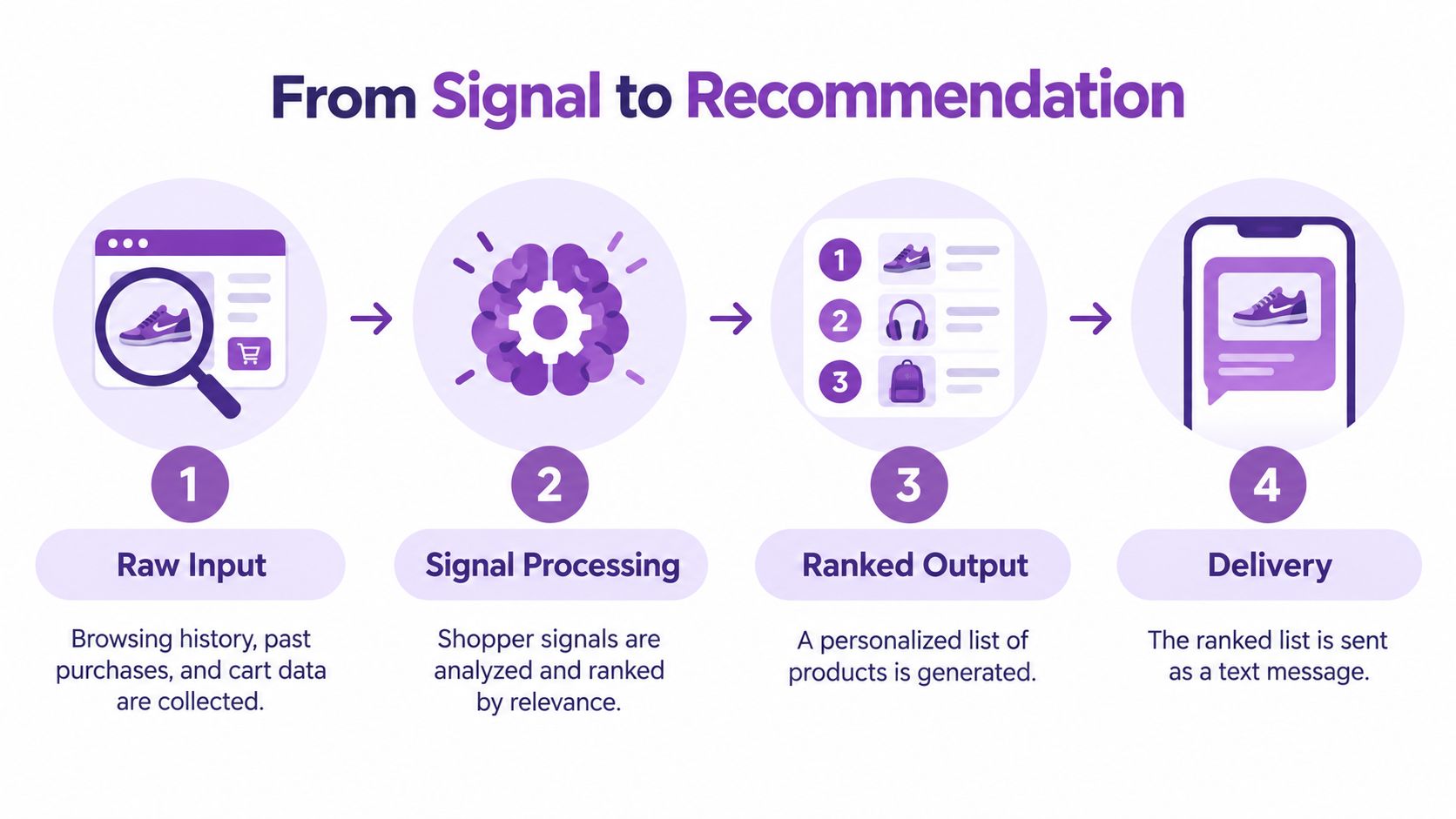
The four moving parts
Raw input
Shopper behavior starts the process. Views, search terms, cart changes, orders, and preference data give the model something to work with.Signal processing
The system weighs recency, category closeness, margin guardrails, stock availability, and whether the shopper already owns the item.Ranked output
Instead of “related products,” you get a prioritized list. Item one is the strongest candidate. Items two and three are backups.Delivery format
SMS forces discipline. You don't have room for six mediocre suggestions. You need one sharp recommendation, maybe two if they clearly belong together.
If you want a useful reference on how retailers structure personalized product recommendations, that guide does a good job of connecting recommendation logic to merchandising decisions. On the messaging side, the same principle shows up in dynamic content for SMS and lifecycle campaigns, where product data changes based on the subscriber and trigger.
Data Signals That Travel Well Through SMS
Not every ecommerce signal belongs in a text message. The ones that travel well through SMS have three qualities: they're recent, they're easy to explain, and they support a single clear action.
The four signals worth using first
Browsing behavior is the easiest place to start. Product views, collection visits, and even on-site search terms often map cleanly to viewed-product and browse-abandon texts. If someone looked at trench coats three times in one session, you don't need a complicated model to know what to follow up with.
Cart activity is hotter. Added items, removed items, and threshold changes usually indicate active buying intent. A recovery text can include the abandoned item plus one small complementary recommendation, not a pile of alternatives that distract from checkout.
Purchase history is slower but powerful. Replenishment timing, category repeat behavior, and last-order SKU all help with post-purchase cross-sell and refill flows. This signal usually works best when the recommendation feels adjacent to the original purchase, not when it jumps into a different category because the algorithm found a broad correlation.
Lifecycle stage shapes the message frame. A first-time buyer, a lapsed subscriber, and a high-value repeat customer shouldn't get the same tone, timing, or frequency.
SMS-Friendly Data Signals and Their Best-Fit Triggers
| Signal | Best-Fit SMS Trigger | Freshness Window | Sample Use Case |
|---|---|---|---|
| Browsing behavior | Viewed product or browse abandon | Short. Usually same day to a couple of days | Shopper viewed waterproof boots twice. Send the exact boot with one matching sock add-on |
| Cart activity | Abandoned cart | Very short. Usually hours | Shopper left a cleanser in cart. Send cart reminder with one travel-size toner |
| Purchase history | Replenishment or post-purchase cross-sell | Longer. Often days to weeks | Shopper bought protein powder. Send shaker bottle or refill reminder later |
| Lifecycle stage | Welcome, win-back, VIP reactivation | Depends on stage | Lapsed VIP gets early access recommendation instead of a blanket discount |
A practical way to improve these flows is to collect better explicit preference data early. Zero-party data collection for SMS and ecommerce gives merchants a cleaner way to ask what customers want instead of inferring everything from clicks.
Signals decay at different speeds. Cart intent is hot for hours. Browse intent can last a day or two. Purchase history can stay useful for weeks.
The mistake is treating every trigger like it deserves an instant send. It doesn't. Match urgency to signal freshness.
Segmentation and Timing Mechanics for Recommendation Texts
Segmentation is what keeps recommendation SMS from turning into a broadcast with a product token inserted.
The core cohorts are usually simple: new subscribers, browse abandoners, cart abandoners, repeat buyers, and lapsed VIPs. The value doesn't come from making the segment tree complicated. It comes from connecting each cohort to one recommendation behavior and one send window.
Trigger windows that usually hold up
Browse-abandon recommendations tend to work best when they land after the shopper has had a little space but before the session is forgotten. Cart reminders should go faster because the buying intent is stronger and more specific. Post-purchase cross-sell needs breathing room so it doesn't feel like the brand is trying to upsell before the customer has even received the original order.
Here's the framework I'd use operationally:
SMS Recommendation Triggers by Segment and Timing
| Segment | Signal | Trigger Window | Suppression Rule |
|---|---|---|---|
| New subscriber | Category preference or signup source | After welcome opt-in is confirmed | Skip if transactional onboarding is still active |
| Browse abandoner | Repeated product or collection view | A few hours after session | Suppress if cart becomes active |
| Cart abandoner | Item added to cart, checkout not completed | Within the same buying session window | Suppress if order is placed |
| Repeat buyer | Last-order SKU or category repeat pattern | After product usage window begins | Suppress if support issue or return is open |
| Lapsed VIP | Time since last purchase and high customer value | Longer reactivation window | Suppress if they already clicked a recent win-back offer |
Cadence matters more than marketers admit
Frequency caps protect the whole program. If a shopper qualifies for browse abandon, cart abandon, and a campaign send in the same week, the recommendation logic can be right and still fail because the volume is wrong.
A few practical rules help:
- Set a weekly cap: Don't let automated flows pile up on the same subscriber.
- Use hierarchy: Transactional confirmations beat recommendations every time.
- Respect local time: Recommendation texts sent too early or too late feel more invasive than helpful.
- Suppress aggressively: If a shopper has an active cart, don't also send browse follow-ups for products they abandoned earlier.
In Shopify environments, teams often build these segments from customer tags, event triggers, and value-based filters such as customer LTV tiers. The specific tool matters less than the logic. The message should arrive when the recommendation still reflects live intent.
Recommendation Flows Built on Shopify With YipSMS
A skincare store makes this easier to picture than an abstract workflow. Say Glow Bar sells cleansers, serums, masks, and replenishment products on Shopify. Three flows usually cover the first layer of recommendation revenue: viewed product, abandoned cart, and post-purchase follow-up.
Near the start of the build, it helps to see how a recommendation text looks on a phone.
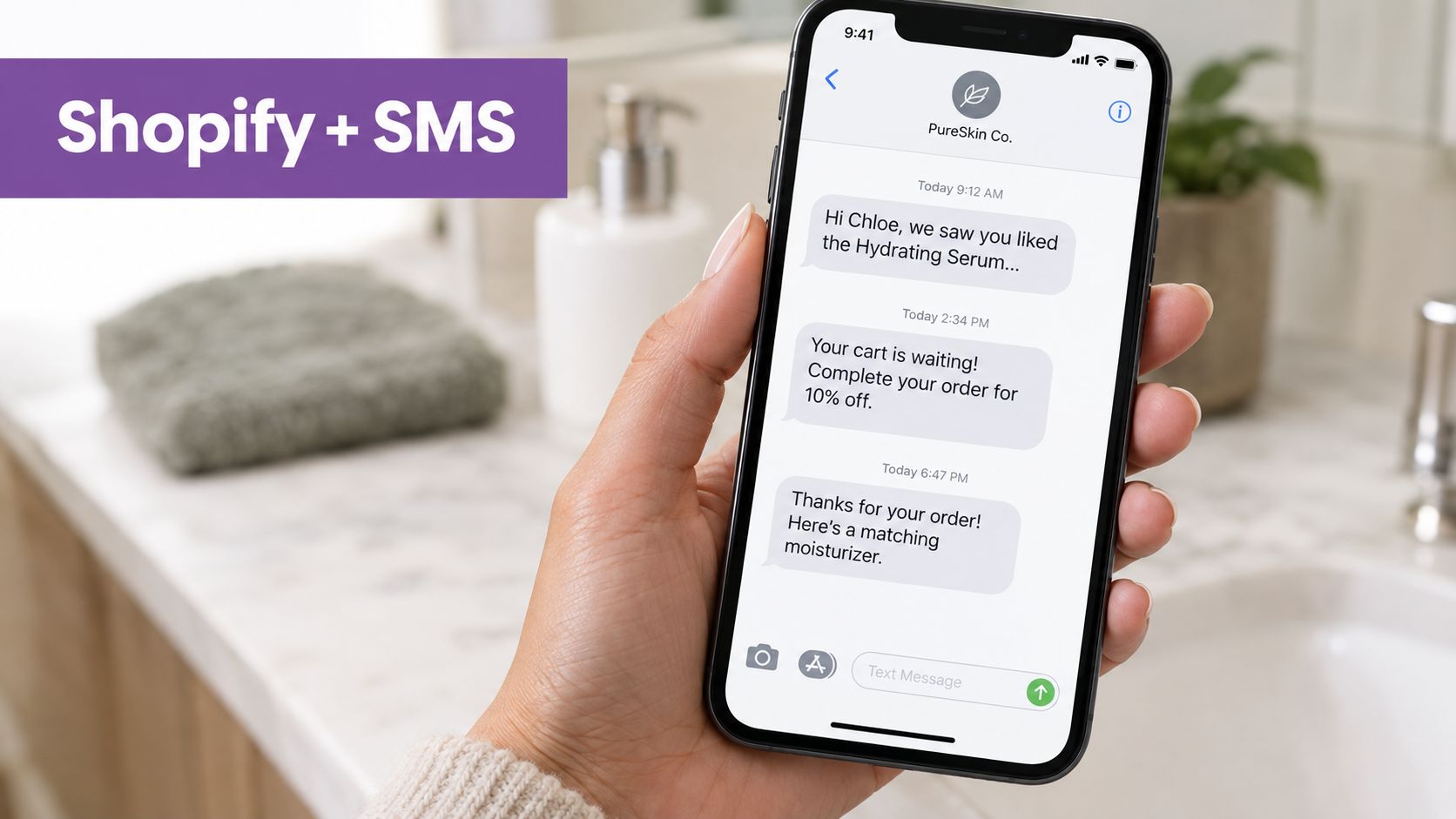
Flow one for product viewers
A shopper spends time on the Vitamin C Jelly Cleanser page, visits the ingredients tab, and leaves.
Glow Bar can trigger a viewed-product SMS a few hours later using the last viewed SKU, collection mapping, and a filter that excludes shoppers who already purchased in that category recently. Example copy:
Glow Bar: Still deciding on the Vitamin C Jelly Cleanser? It's a good fit for dull or uneven skin. Pair it with the Cloud Mist for a lighter routine: [link] Reply STOP to opt out.
That's one product plus one adjacent recommendation. Not four.
Flow two for active carts
A cart abandon flow should stay focused on checkout recovery. If there's a recommendation, it should be a small add-on that doesn't derail the main purchase.
For Glow Bar, that might be:
- Primary item: Barrier Repair Cream left in cart
- Cross-sell item: Mini Ceramide Serum
- Rule: only insert the add-on if it doesn't trigger discount stacking that cuts margin too much
Example copy:
“Glow Bar: Your Barrier Repair Cream is still in your cart. If you want to round out the routine, the Mini Ceramide Serum pairs well with it. Finish checkout here: [link] Reply STOP to opt out.”
Recovery timing matters here. SMS recovery messages sent within 1 hour of cart abandonment convert at 10.7% on average, with top-performing brands reaching 15% to 18% (SMS marketing benchmarks for cart recovery).
If you're building these automations in Shopify, tools differ mainly in how they expose product, tag, and event data. For merchants comparing setup depth and storefront connections, it's worth browsing RecensioAI's Shopify setup to see how another integration layer handles Shopify signals.
A short walkthrough helps if your team is wiring the logic for the first time:
Flow three for post-purchase upsell
Post-purchase is where recommendation quality matters more than urgency. If a customer ordered a gentle cleanser, a harsh active serum ten days later may be technically personalized but commercially sloppy.
A more durable setup inside YipSMS uses Shopify customer tags, product metafields, and last-order SKU data to send a complementary recommendation after a usage interval that makes sense. For Glow Bar:
“Glow Bar: How's your Jelly Cleanser working so far? If you want the matching next step, our Cloud Mist layers right after cleansing: [link] Reply STOP to opt out.”
Consent capture still decides whether any of this works. If checkout opt-in language is vague or buried, your smartest recommendation flow won't have enough qualified subscribers to matter.
When Personalization Backfires and How to Stay Trustworthy
Personalization doesn't fail only when the algorithm picks the wrong product. It also fails when the brand uses the right product in the wrong way.
A September 2026 report found 45% of consumers describe personalized marketing as repetitive, 57% regularly see marketing for items they only glanced at, 61% react negatively when the same brand follows them across channels, and 43% have stopped buying from a brand because personalization felt repetitive, too personal, or off-base (report on bad personalization and customer loss). That lines up with what operators see in SMS. If the recommendation feels stale or creepy, the channel amplifies the mistake.
Where stores cross the line
The common failures are boring, but costly:
- Over-specific references: Mentioning behavior that feels too intimate, especially on a shared device.
- Bad inventory logic: Recommending out-of-stock or discontinued products.
- Poor context awareness: Sending product suggestions after a return, refund dispute, or support complaint.
- No control for the customer: Hiding opt-out language or making preference changes difficult.
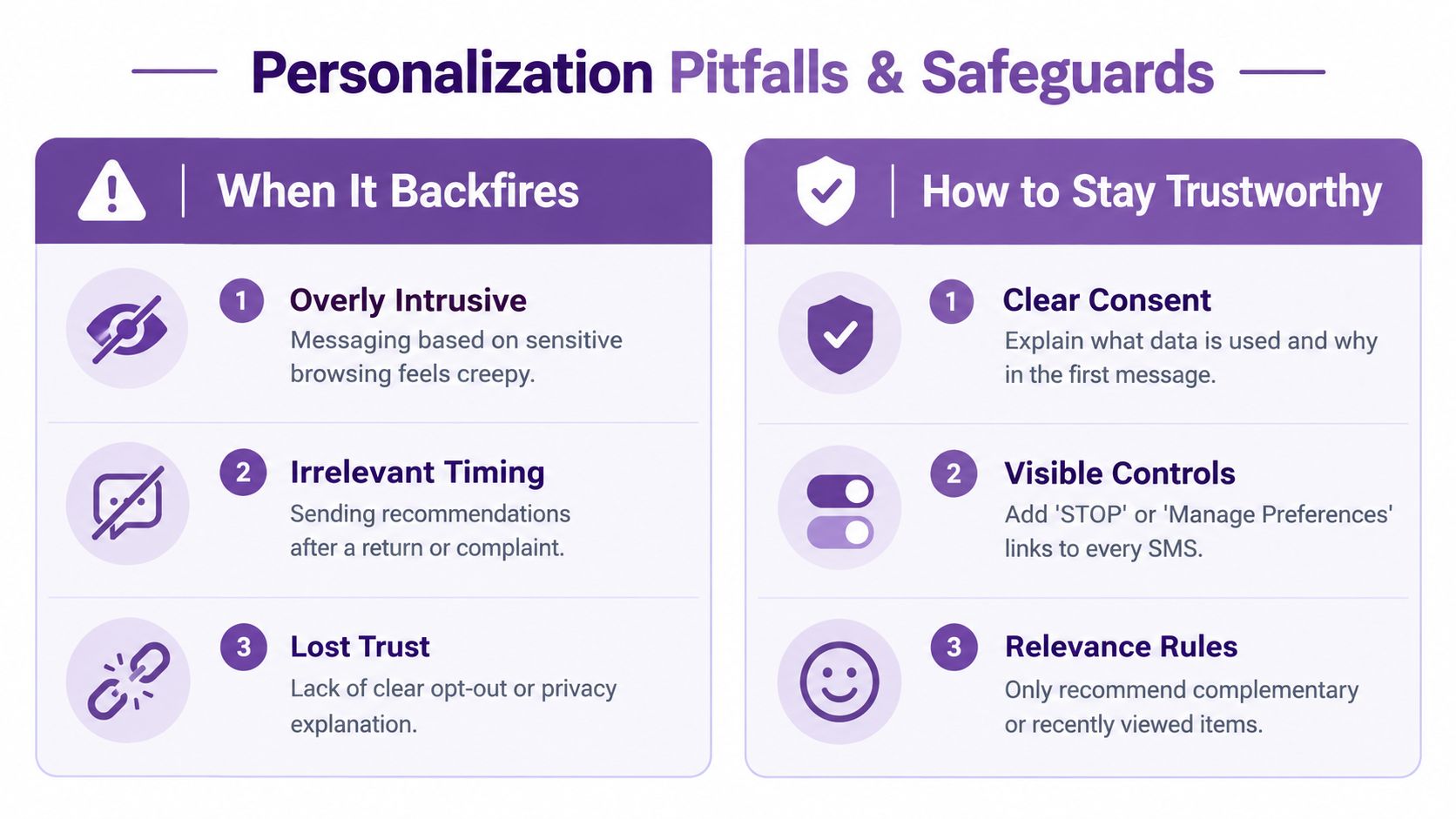
Trust has to be designed in
Recent consumer research shows privacy is the leading concern around AI-driven marketing. 34% cited data privacy as their top worry, 69% worry about personal data privacy being used for hyper-personalization, and 71% want clarity on consent and data use (consumer privacy concerns in AI marketing). For SMS, that means plain-language consent, visible STOP or HELP instructions, and clear explanation of why someone is getting a recommendation.
Tell subscribers what kind of messages they signed up for before you try to impress them with relevance.
I'd also avoid pretending every recommendation is a human-curated favorite. If it's algorithmic, that's fine. Be honest about it. “Based on what you viewed” is more trustworthy than dressing automation up as a personal note from the founder.
KPIs That Prove the Recommendations Are Working
Recommendation flows deserve harder measurement than “the texts got opened.” Open counts tell you almost nothing about whether the recommendation logic improved revenue.
What matters is whether each trigger owns a specific business outcome.
KPI Mapping for SMS Recommendation Flows
| Flow Trigger | Primary KPI | Supporting KPI |
|---|---|---|
| Viewed product | Browse recovery revenue | Recommendation click-through rate |
| Abandoned cart | Cart recovery rate | Revenue per send |
| Post-purchase cross-sell | Average order value from follow-up purchases | Conversion rate from SMS landing page |
| Replenishment | Repeat purchase rate after recommendation flow | Click-to-purchase time |
| Win-back | Reactivation revenue | Opt-out rate per flow |
What each metric proves
Revenue per send shows whether the recommendation is commercially worth the inventory, creative effort, and sending cost. Recommendation click-through rate tells you whether the product choice and copy were compelling enough to restart intent. Conversion from the SMS landing page exposes whether the recommendation itself was right or whether the click was curious but uncommitted.
Opt-out rate belongs in the same dashboard as revenue. If a flow drives short-term sales but trains people to unsubscribe, the math will turn on you later.
For context on how merchants think about persuasive content and conversion behavior more broadly, these advertorial conversion benchmarks from Landra are a useful comparison point when you're judging whether your product framing is doing enough work after the click. For the store-side dashboard, SMS campaign analytics for ecommerce teams is the operational layer I'd review before launching any recommendation flow at scale.
Measurement rule: Pair every recommendation flow with a holdout or a clean pre-launch baseline. Otherwise you're grading the channel, not the recommendation logic.
A One-Week Plan to Launch Your First Recommendation Flow
Most Shopify teams don't need a giant personalization project. They need one clean flow, one strong signal, and one KPI that tells them whether to expand.
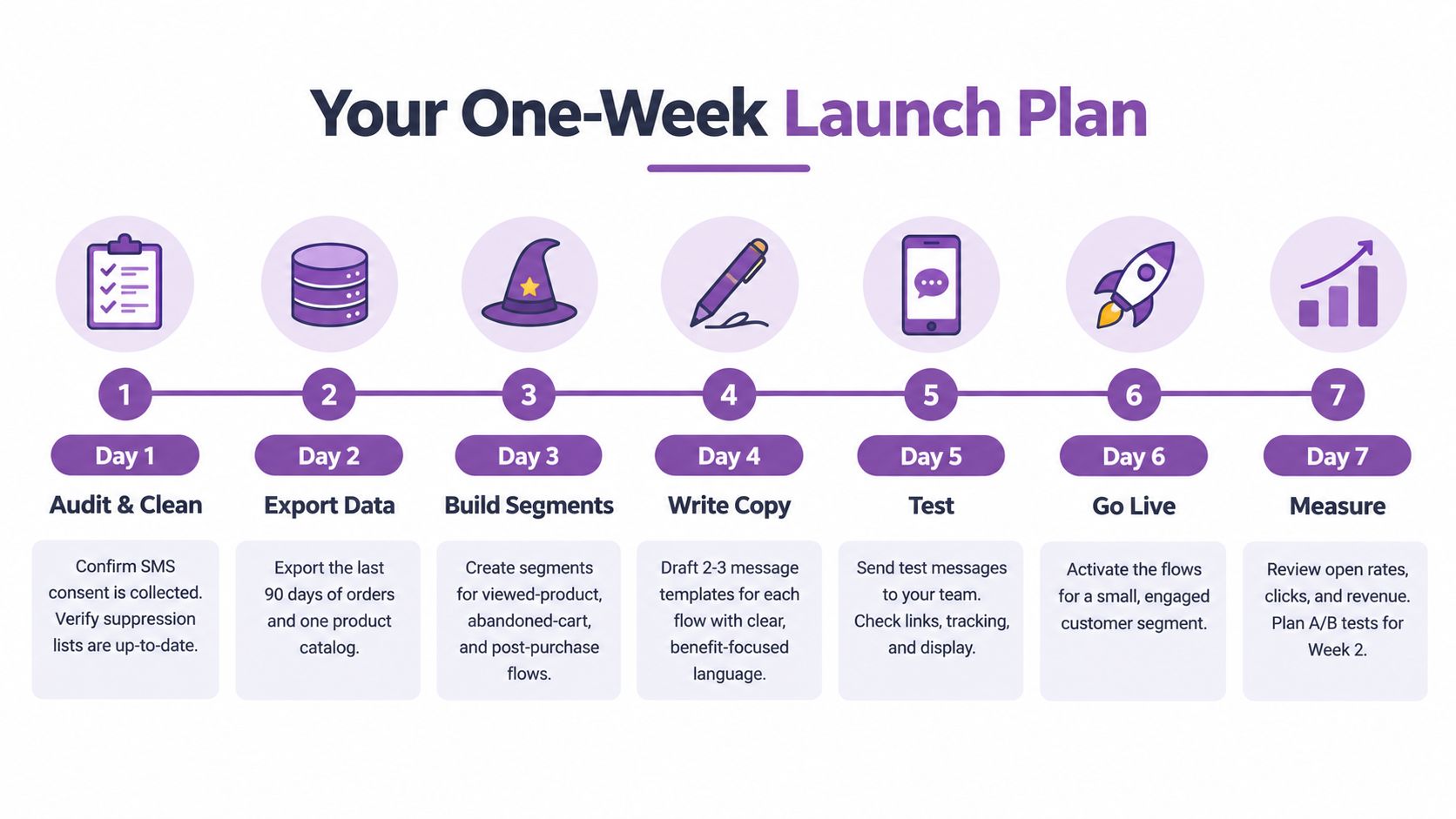
Day-by-day launch sequence
Day 1 is list hygiene and consent review. Confirm checkout opt-in language is clear, suppression lists are current, and transactional messages won't get mixed with marketing recommendations.
Day 2 is signal selection. Pull recent order data and one behavior stream, usually viewed products or cart events. For most stores, browse or cart intent gives the cleanest first test because the recommendation is easy to explain.
Day 3 is segmentation. Keep the first cohort narrow. One product category, one intent signal, one clear exclusion rule is enough to start.
Day 4 is copy. Write three variants. Each one should recommend a single product, use one CTA, and include visible opt-out language.
Day 5 is a limited launch. Send to a small sample first. Watch delivery, clicks, replies, and unsubscribes closely. If the opt-out pattern turns ugly, pause before widening the audience.
Day 6 is review and trim. Look at attributed revenue, click-to-purchase timing, and whether people are replying with support or confusion keywords. Remove any wording that sounds too invasive or too broad.
Day 7 is standardization. Keep the winning message as the default template, assign one KPI owner, and queue the next recommendation trigger only after the first one is stable.
The first flow I'd launch
Start with a viewed-product follow-up if your catalog supports obvious complements and your product page traffic is healthy. Start with cart abandon if your store has stronger checkout intent and simpler recovery paths.
Either way, don't launch with a giant recommendation grid in SMS. Launch with one product and one reason it belongs in that moment.
The first KPI to watch is usually revenue per send for the flow you chose. It balances relevance, click quality, and conversion without letting vanity metrics hide weak recommendation logic.
YipSMS Inc. gives Shopify merchants a way to run recommendation-driven SMS flows tied to browsing, cart, and purchase behavior without building the whole system from scratch. If you want to turn personalized product recommendations into actual text automations with measurable revenue ownership, visit YipSMS Inc..