SMS Marketing Cost Explained for Shopify Stores
About $0.0083 to $0.05 per SMS is a realistic U.S. range, so 10,000 texts may cost roughly $83 to $500 in message fees alone before platform, carrier, or compliance charges. Your true SMS marketing cost also depends on carrier surcharges, sender registration, message segments, and how many sales each send produces.
You may be looking at your Shopify dashboard right now, seeing strong engagement from text messages while wondering whether the channel still makes financial sense at scale. The first bill can look harmless when you send a small campaign. Then abandoned-cart flows, welcome messages, promotions, delivery updates, and repeat-purchase reminders begin running together, and the total becomes harder to explain.
That's why the useful question isn't, “What's the price per text?” It's “What does each recovered order or repeat purchase cost me?” A low headline rate can become expensive when messages split into multiple segments, carrier fees are added, or you send to subscribers who no longer engage. A slightly higher rate can be more efficient if better automation and targeting produce more conversions.
This guide breaks down the full equation for Shopify stores: platform pricing, carrier pass-through fees, compliance setup, international differences, and cost per conversion. The examples use practical YipSMS-style calculations so you can build a forecast before committing to a provider.
Table of Contents
- Introduction Why SMS Marketing Cost Matters for Shopify Growth
- How SMS Pricing Models Work and What You Actually Pay
- Hidden Fees That Change Your True SMS Marketing Cost
- How to Calculate Cost Per Subscriber and ROI Step by Step
- Industry Benchmarks That Show Where SMS Pays Off Most
- Proven Ways Shopify Stores Lower SMS Marketing Cost
- Choosing the Right SMS Setup and Next Steps for Your Store
Introduction Why SMS Marketing Cost Matters for Shopify Growth
A Shopify owner usually starts with a simple test. They collect subscribers through a popup, send a welcome offer, and watch customers click almost immediately. The channel feels direct and inexpensive, especially compared with paid acquisition. But after adding cart recovery, product reminders, shipping notifications, and scheduled campaigns, the owner opens the billing page and realizes that message volume, not just campaign performance, controls the budget.
SMS behaves more like postage than a fixed advertising slot. Each message has a delivery cost, and the total grows with every recipient and every extra segment. U.S. explainers place standard SMS pricing at about $0.0083 to $0.05 per message, which puts 10,000 messages at roughly $83 to $500 before platform or compliance costs according to Salesmsg's SMS pricing overview.
That range is wide because providers don't all charge in the same way. Some use pay-as-you-go pricing, others combine a monthly subscription with message credits, and many lower the effective rate as volume increases. Your store's destination markets, sender type, registration status, and use of MMS can widen the gap further.
Practical rule: Treat the advertised per-message rate as the starting point, not the final budget.
A profitable Shopify program needs three layers of measurement:
- Total send cost: Platform charges, carrier fees, registration, and any extra segments.
- Cost per subscriber: Your monthly spend divided by the number of opted-in contacts you actively reach.
- Cost per conversion: Total SMS spend divided by orders or purchases that the channel generated.
The third figure matters most. If a campaign costs more but recovers high-intent carts, it may outperform a cheaper broadcast that produces few orders. Before choosing a provider, ask whether pricing is transparent, whether carrier fees are passed through separately, how segments are counted, and whether analytics can connect messages to Shopify revenue.
How SMS Pricing Models Work and What You Actually Pay
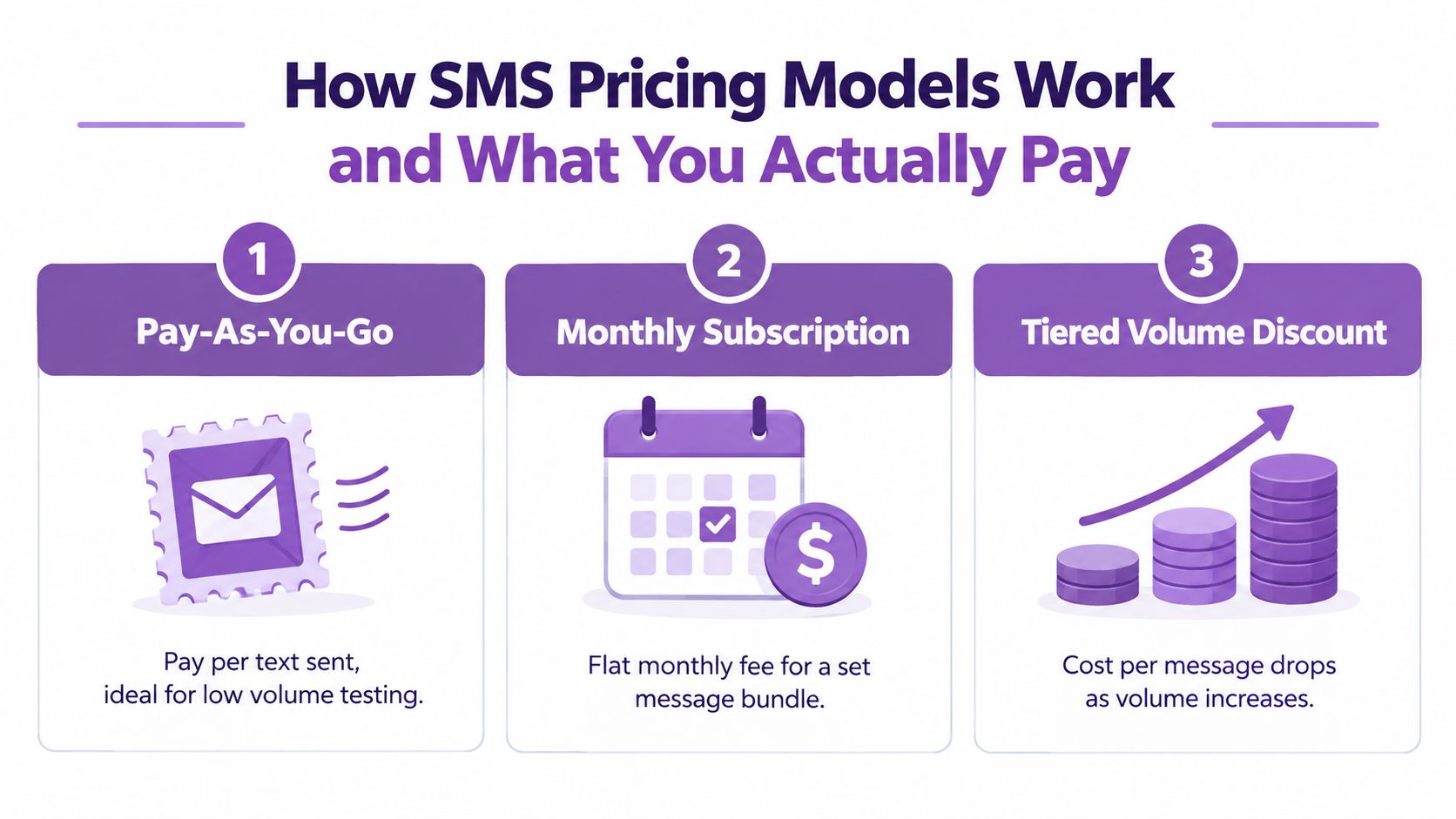
Shopify stores typically choose among three SMS pricing structures: pay-as-you-go, monthly subscription, and tiered volume pricing. The right choice depends on how often you send, how many contacts you reach, and whether the plan's included tools help generate orders.
Pay as you go
With pay-as-you-go pricing, you pay for the messages or billable segments you send. This suits a store testing SMS, running seasonal promotions, or relying mainly on automated flows such as cart and post-purchase messages.
You keep more control during quiet months because there is no large recurring allocation to use. The tradeoff is a potentially higher unit rate, especially when your sending volume increases.
Monthly subscriptions
A monthly subscription combines platform access with some mix of message credits, automations, integrations, analytics, and support. U.S. pricing guides commonly place message charges around $0.005 to $0.01 per segment, with small-business plans starting around $19 to $39 per month, according to DailyStory's SMS marketing cost guide.
The monthly fee works like paying for a store's shipping account. You pay for access first, then use included credits or purchase additional volume. This can fit a Shopify store that sends consistently and uses flows, segmentation, and reporting rather than sending occasional one-off campaigns.
Check what the subscription includes. A low platform fee can still produce a high cost per conversion if your plan includes more credits than you use or adds charges for features your flows need.
Tiered volume pricing
Under tiered pricing, the rate per message falls as sending volume rises. Bulk plans can bring effective domestic rates toward roughly one to five cents per message, while international sends remain materially higher, according to Email Vendor Selection's SMS pricing analysis.
Forecast from real Shopify activity before choosing a tier. Add your abandoned-cart flows, campaigns, welcome messages, and other lifecycle sends. A large allocation only saves money when your store uses it. Unused credits can raise your true cost even when the listed rate looks attractive.
For a quick estimate, multiply recipients by messages in each flow and campaign, then allow for retries and extra segments. Compare that total with the provider's included volume and calculate the expected cost per conversion, not only the cost per send.
A small store with frequent campaigns may need a subscription. A larger store with seasonal demand may prefer usage-based billing. Choose according to sending behavior, then verify the provider's invoice separates platform charges from delivery costs.
Hidden Fees That Change Your True SMS Marketing Cost
The headline rate usually excludes at least some of the costs involved in operating SMS. The biggest mistake is treating the platform's price as the entire marginal cost of delivery.
Carrier fees and registration status
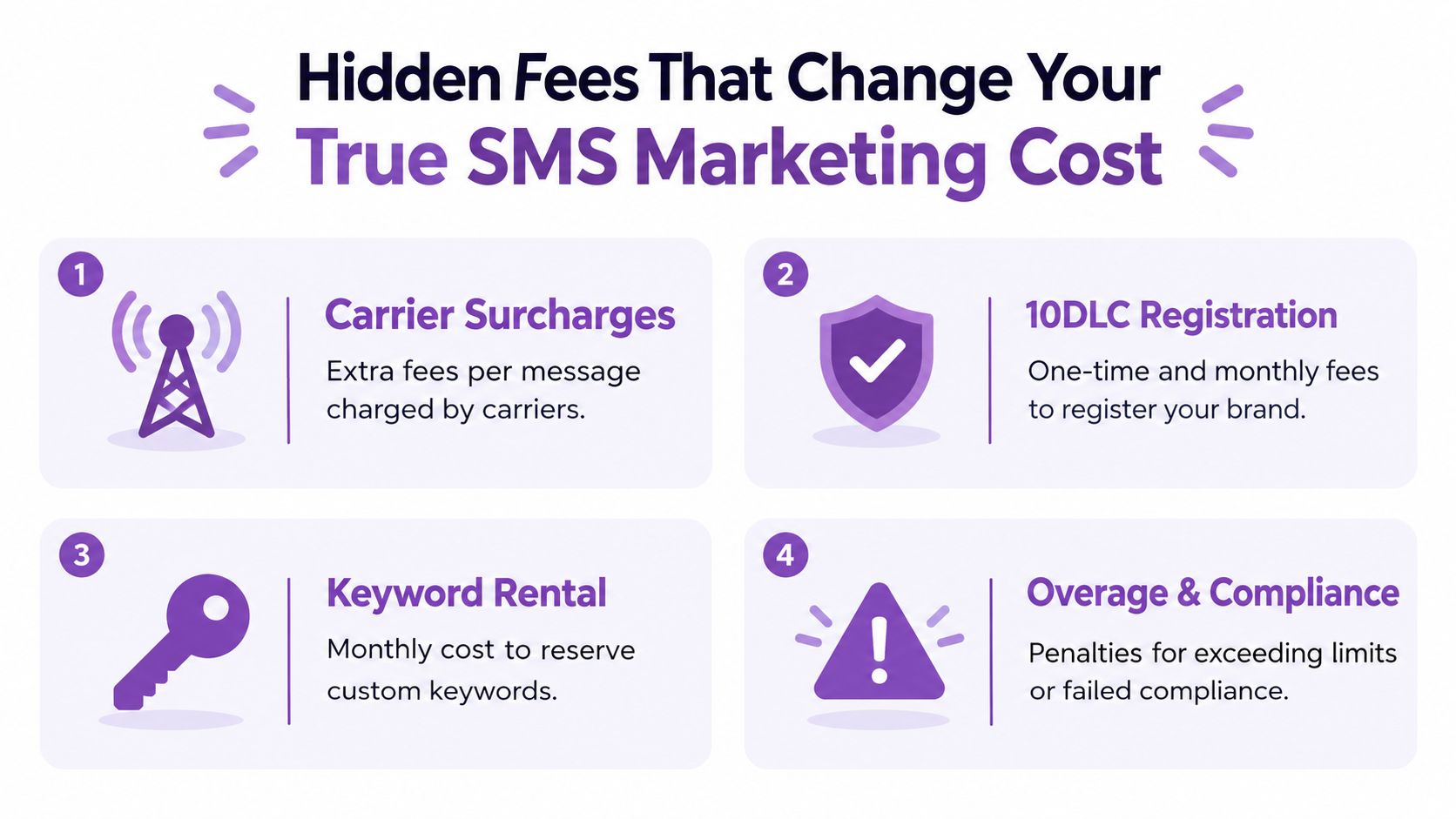
U.S. carriers apply their own surcharges. Registered outbound SMS carrier fees commonly fall around $0.0035 to $0.0050 per message, with examples including AT&T at about $0.0035, T-Mobile at $0.0045, and Verizon moving from $0.0045 to $0.0050, depending on carrier and number type. Unregistered traffic can rise to roughly $0.0100 to $0.0120 per message in some fee schedules, according to Quo's carrier fee breakdown.
That means a provider's rate may contain platform markup, carrier pass-through charges, or both. Ask for an invoice view that separates these items. Otherwise, a campaign that appears to cost one rate may produce a different effective rate after delivery charges are added.
Model spend per delivered segment, not merely per campaign. A long message can split into multiple billable segments, and MMS, retries, or failed delivery attempts can change usage. Review this guide to SMS character counts before writing campaigns, especially when adding links, discount codes, or tracking parameters.
Sender and compliance setup
Sender setup introduces another layer. Recent pricing guidance puts one-time brand registration at about $4 to $20 and campaign registration at $10 to $25 monthly. Sender options vary sharply:
- 10DLC: Roughly $1.50 to $10 monthly.
- Toll-free numbers: Around $2 to $2.15 monthly.
- Short codes: Starting at $1,000 or more monthly, before message fees.
These costs don't make SMS unprofitable, but they do make “cheap SMS” an incomplete description. In the U.S., marketing texts generally require prior express written consent under the TCPA, and reported penalties can reach $500 to $1,500 per message, according to Charle Agency's SMS compliance guidance. Consent records, clear opt-out instructions such as replying STOP, immediate suppression handling, and appropriate registration belong in the operating budget.
Destination markets
International campaigns need country-specific assumptions. Typical per-SMS pricing is reported at about $0.009 to $0.007 in the U.S., $0.025 to $0.019 in Canada, $0.045 to $0.035 in the U.K., $0.07 to $0.05 in the EU, and up to $0.15 or more in other countries, as summarized by Omnisend's SMS pricing guide.
Don't calculate global customer acquisition cost using a U.S. rate. Separate your forecast by destination and message type, then compare revenue by market.
How to Calculate Cost Per Subscriber and ROI Step by Step
A Shopify store can keep SMS math simple. Start with a spreadsheet, then separate what you pay for messages from what you pay to run the program.
Step 1 Calculate message volume
Begin with the number of subscribers you will reach and how often they hear from you. Keep automated flows and promotional campaigns separate, since they serve different jobs and usually earn different returns.
If a store has 1,000 opted-in subscribers and sends four campaigns in a month, the message cost at $0.015 per SMS is:
1,000 subscribers × four sends × $0.015 = $60
That $60 is only the message line. The SMS marketing cost also includes platform markup, carrier pass-through fees, registration, and any extra segments. U.S. pricing is commonly built from a per-message charge plus a platform fee.
Step 2 Calculate cost per subscriber
Use:
Total monthly SMS cost ÷ active subscribers reached = cost per subscriber
If the full monthly bill is $80, then:
$80 ÷ 1,000 = $0.08 per subscriber
This number is useful because it shows how hard each subscriber has to work. A highly engaged segment can handle more sends, while an inactive segment can push up cost without bringing in much revenue.
Step 3 Calculate cost per conversion
Use:
Total SMS cost ÷ SMS-attributed orders = cost per conversion
If the store spends $80 and generates eight attributed orders:
$80 ÷ eight orders = $10 per conversion
That $10 only makes sense next to margin. A $40 order is not profitable by default if product cost, shipping, discounts, and other expenses absorb most of it.
A worksheet you can copy
| Input | Value | Calculation |
|---|---|---|
| Shopify SMS ROI Calculator Example | ||
| Subscribers reached | 1,000 | Subscriber count |
| Campaigns per month | Four | Send frequency |
| Rate per SMS | $0.015 | YipSMS-style starting rate |
| Message fees | $60 | 1,000 × four × $0.015 |
| Platform, carrier, and compliance costs | Add your actual figures | Separate fixed and variable charges |
| Total monthly cost | $80 example | $60 plus additional costs |
| Attributed orders | Eight example | Shopify attribution |
| Cost per conversion | $10 example | $80 ÷ eight |
For a cleaner ROI model, use this guide to calculating marketing ROI and keep your attribution rules steady. Do not count an order as SMS-driven just because the customer received a text. Use a defined click, code, or attribution window, then compare the result with the full cost.
Industry Benchmarks That Show Where SMS Pays Off Most
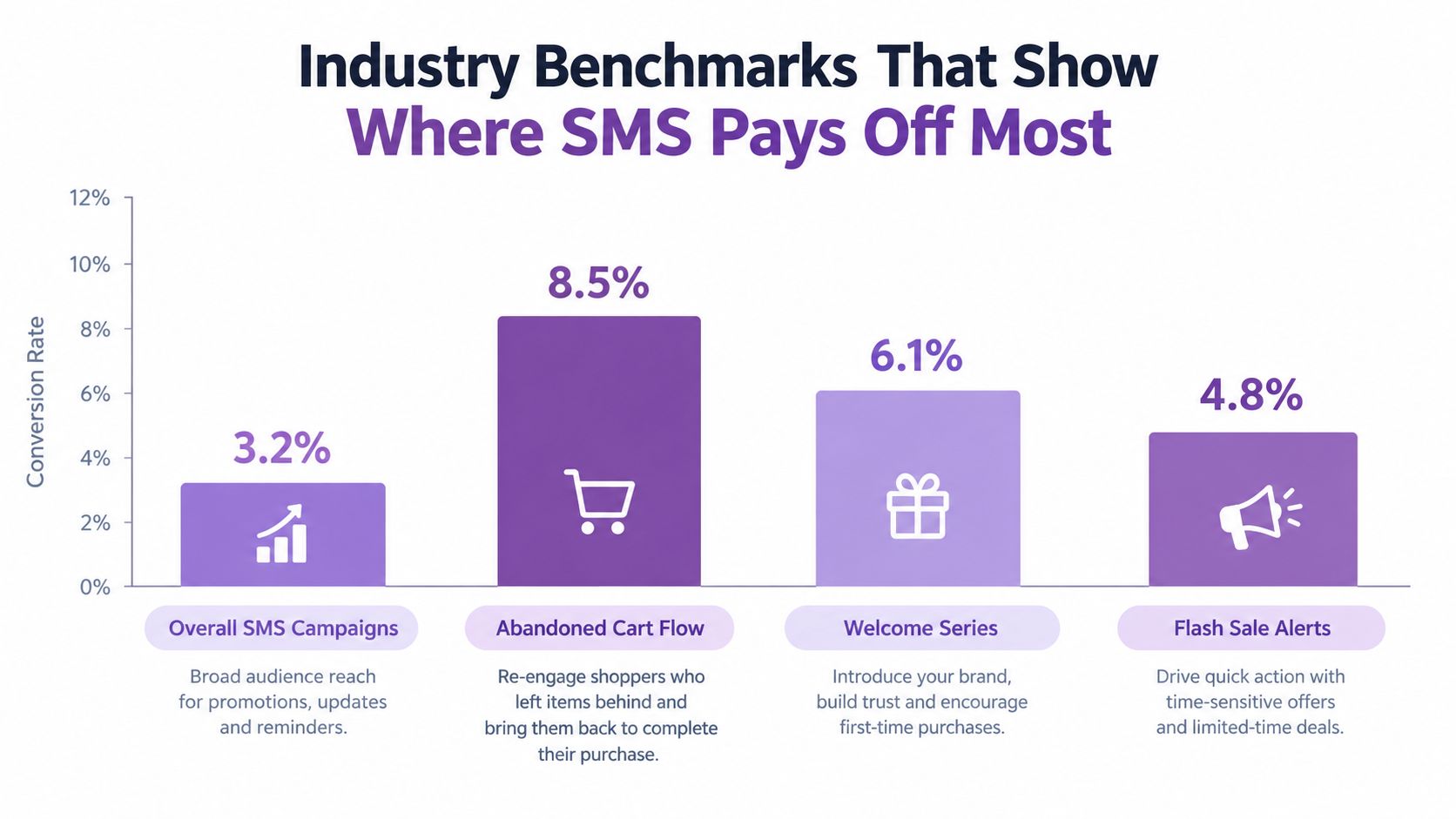
SMS earns its keep most reliably when the customer has already shown buying intent. A cart reminder reaches someone who selected products. A delivery update serves an existing buyer. A broad sale announcement reaches a much colder audience, even if the list is large.
Independent benchmark pages report 21% to 32% overall conversion for well-optimized SMS programs and 24.6% to 39.4% for abandoned-cart recovery sequences, according to DialMyCalls' SMS marketing benchmarks. These figures are benchmark ranges, not a promise for every Shopify store. Results depend on consent quality, offer strength, timing, product category, attribution, and audience intent.
Prioritize the flows closest to purchase
A sensible order of operations is:
- Abandoned-cart and checkout recovery: These messages target shoppers who have already started buying.
- Welcome automation: Give new subscribers a clear reason to purchase while their interest is fresh.
- Viewed-product follow-ups: Reconnect with shoppers who considered an item but didn't add it to a cart.
- Post-purchase recommendations: Encourage a relevant next purchase after the initial order.
- Shipping and delivery notifications: Support the customer experience and reduce uncertainty.
- Broad promotional campaigns: Scale these after the triggered flows have proven their economics.
Bulk pricing can lower the unit rate as volume grows, but lower unit cost alone doesn't create ROI. Sending more messages to weak segments can increase the bill faster than it increases orders.
Regional pricing also changes the calculation. A store with customers across the U.S., Canada, the U.K., and the EU should assign a separate cost assumption to each market rather than applying one domestic rate to every subscriber.
The cheapest message is the one you don't send to an irrelevant or inactive subscriber.
Proven Ways Shopify Stores Lower SMS Marketing Cost
Cost control starts with reducing waste. Shopify merchants often focus on negotiating a lower rate, but better targeting can improve the more important figure, cost per conversion, without sacrificing useful reach.
Clean the list before increasing volume
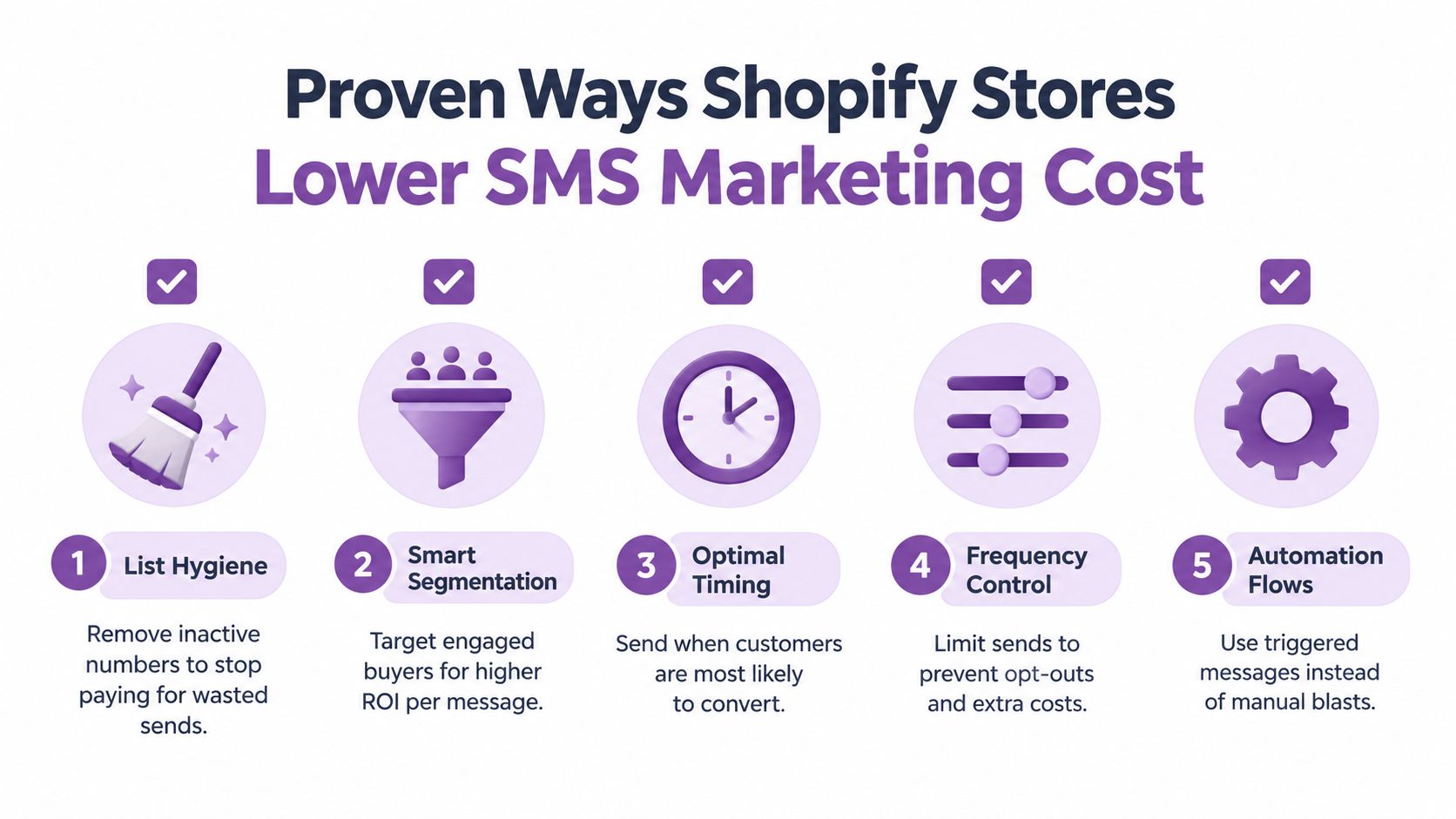
Remove invalid, inactive, and unsubscribed numbers from active campaign segments. Keep suppression lists current so you don't pay to contact people who have already opted out or risk compliance problems.
Use engagement history to distinguish recent clickers, purchasers, cart abandoners, and dormant subscribers. A smaller audience with stronger intent can outperform a larger undifferentiated list.
Shorten the path from message to purchase
Write concise copy, use a clear offer, and send one relevant link. Review character count before launch because a message that becomes multiple segments can raise the effective cost without adding meaningful value.
YipSMS Inc. provides a drag-and-drop popup designer, prebuilt flows for cart and checkout abandonment, viewed-product follow-ups, shipping and delivery notifications, and personalized recommendations. Its real-time analytics can help Shopify teams compare targeting and conversion outcomes rather than judging campaigns only by delivery or click activity.
Control timing and frequency
Set a contact policy for each segment. A cart reminder may deserve different timing from a seasonal promotion, while a recent purchaser may need product education instead of another discount.
Watch opt-outs after every campaign. If a segment produces weak engagement and rising unsubscribes, reduce frequency or exclude it from the next broadcast.
Match the sender to your volume
Sender setup can vary from modest monthly costs for 10DLC and toll-free numbers to much higher short-code commitments. This SMS pricing guide's sender setup comparison explains why the right number type depends on scale, compliance requirements, and messaging needs.
Automate work that repeats
Triggered flows usually make better use of message spend than manually sending the same reminders to everyone. Build the automation once, define entry and exit rules, and review the revenue per flow regularly.
For adjacent retention ideas, Shopify teams can also browse the RecurX widget catalog overview and consider how savings-focused on-site experiences might support repeat purchases before a subscriber needs another promotional text.
Choosing the Right SMS Setup and Next Steps for Your Store
A practical SMS budget has three parts: platform charges, carrier fees, and compliance or sender setup. Add the expected segment count, separate domestic and international traffic, and calculate cost per conversion using attributed Shopify orders.
Before choosing a provider, check:
- Pricing clarity: Can you see platform markup and carrier pass-through fees separately?
- Segment billing: Does the system show when messages split into additional segments?
- Automation coverage: Can you run cart recovery, product follow-ups, post-purchase, and delivery flows?
- Compliance tools: Are consent records, STOP handling, and suppression lists built into the workflow?
- Reporting: Can you connect sends and clicks with Shopify revenue?
- Sender flexibility: Does the number type fit your present volume without forcing an expensive commitment? This comparison of long codes and short codes can help frame that decision.
YipSMS can serve as an illustrative option for stores that want one-click Shopify setup, pay-as-you-go control, a 14-day free trial, and rates starting at $0.015 per SMS. Start by auditing your last billing period, forecasting sends by country, and launching the highest-intent automations before expanding into broad campaigns.
YipSMS Inc. helps Shopify stores collect subscribers with customizable popups, recover abandoned carts, run automated customer journeys, and measure SMS revenue with real-time analytics. Visit YipSMS Inc. to review the setup, start the 14-day trial, and calculate your likely cost per conversion before scaling sends.
How this article was made: the YIPSMS team drafts some articles with AI writing tools, then checks pricing, compliance and product details against how YIPSMS actually works before publishing. Spotted something wrong? Tell us through your YIPSMS account.