Customer Data Analytics for Shopify Growth and SMS ROI
Your Shopify store is getting traffic, collecting orders, and recording customer interactions. Yet the next decision still comes from instinct: send a discount, wait for a repeat purchase, or increase ad spend. The dashboard contains plenty of activity, but it doesn't tell your team which customer needs attention, which journey stage is failing, or which SMS should go out next.
Customer data analytics turns those scattered signals into decisions. It connects clicks, carts, purchases, campaign responses, and support conversations so merchants can see what happened, why it happened, and what action makes sense now. That matters because customer analytics has grown into a major software category. One market estimate valued it at USD 14.57 billion in 2023 and projects USD 48.63 billion by 2030, a 19.2% CAGR from 2024 to 2030 (Grand View Research customer analytics market report).
For a Shopify merchant, the practical question isn't whether to build another dashboard. It's how to connect a useful metric to a privacy-safe segment, then activate that segment through a timely SMS workflow. The path below starts with the core idea, maps data to decisions, builds a lean collection process, addresses consent and signal loss, and turns the result into YipSMS triggers you can test.
Table of Contents
- Introduction Why Customer Data Analytics Decides Growth
- What Customer Data Analytics Really Means for Ecommerce
- Customer Data Types and KPIs That Actually Drive Decisions
- How Shopify Merchants Can Collect and Analyze Customer Data
- Privacy Compliance and Signal Loss Without Losing Confidence
- Turning Analytics Into SMS Workflows That Convert With YipSMS
- Example Use Cases and Your Action Plan for Next Week
Introduction Why Customer Data Analytics Decides Growth
A merchant launches a new product and sees strong traffic during the first week. Visitors view the product page, some add the item to their carts, and support receives questions about sizing and delivery. The store owner notices that orders are lower than expected, but the team can't agree on the cause. One person wants a broader ad audience, another wants a product-page rewrite, and someone else suggests sending every subscriber a promotion.
The store already has data. What it lacks is a decision path.
Customer data analytics gives the team a way to join those clues. A product view without a cart addition may point to uncertainty. A cart addition without checkout may indicate friction, timing, or missing information. A purchase followed by a support contact can reveal an experience problem that a conversion report won't show.
Practical rule: A metric becomes valuable when it tells a person what to do next.
That principle changes how Shopify teams think about acquisition, retention, and lifetime value. Acquisition analytics can show which visitors arrive and engage. Retention analysis can separate first-time buyers from customers with repeat behavior. Support and campaign data can explain whether a customer needs reassurance, education, a replenishment reminder, or no message at all.
The commercial case is also clear. A widely cited industry summary reports that data-driven businesses are 23 times more likely to acquire new customers, while 62% of retailers say analytics gives them a competitive advantage (G2 customer data statistics). The figures don't mean every store needs an enterprise data warehouse. They do show why merchants increasingly treat analytics as a decision layer rather than a reporting afterthought.
The useful workflow is deliberately small. Choose the journey stage, define the customer signal, create a segment, trigger one relevant message, and measure the outcome against a sensible comparison. That discipline helps a growing store make better use of the data it already owns.
What Customer Data Analytics Really Means for Ecommerce
Think of a helpful shop assistant who remembers that a shopper browsed a particular collection, noticed that the shopper hesitated at checkout, and knows that a previous purchase was returned. The assistant wouldn't shout the same offer at every visitor. They'd use context to decide whether to answer a question, remove uncertainty, suggest a related item, or stay quiet.
Customer data analytics works in a similar way. It joins signals from the customer journey and adds context about the stage the shopper is in. A click means something different before a first purchase than after a customer has bought repeatedly. A support conversation about delivery should influence a post-purchase message differently from a product-view event.
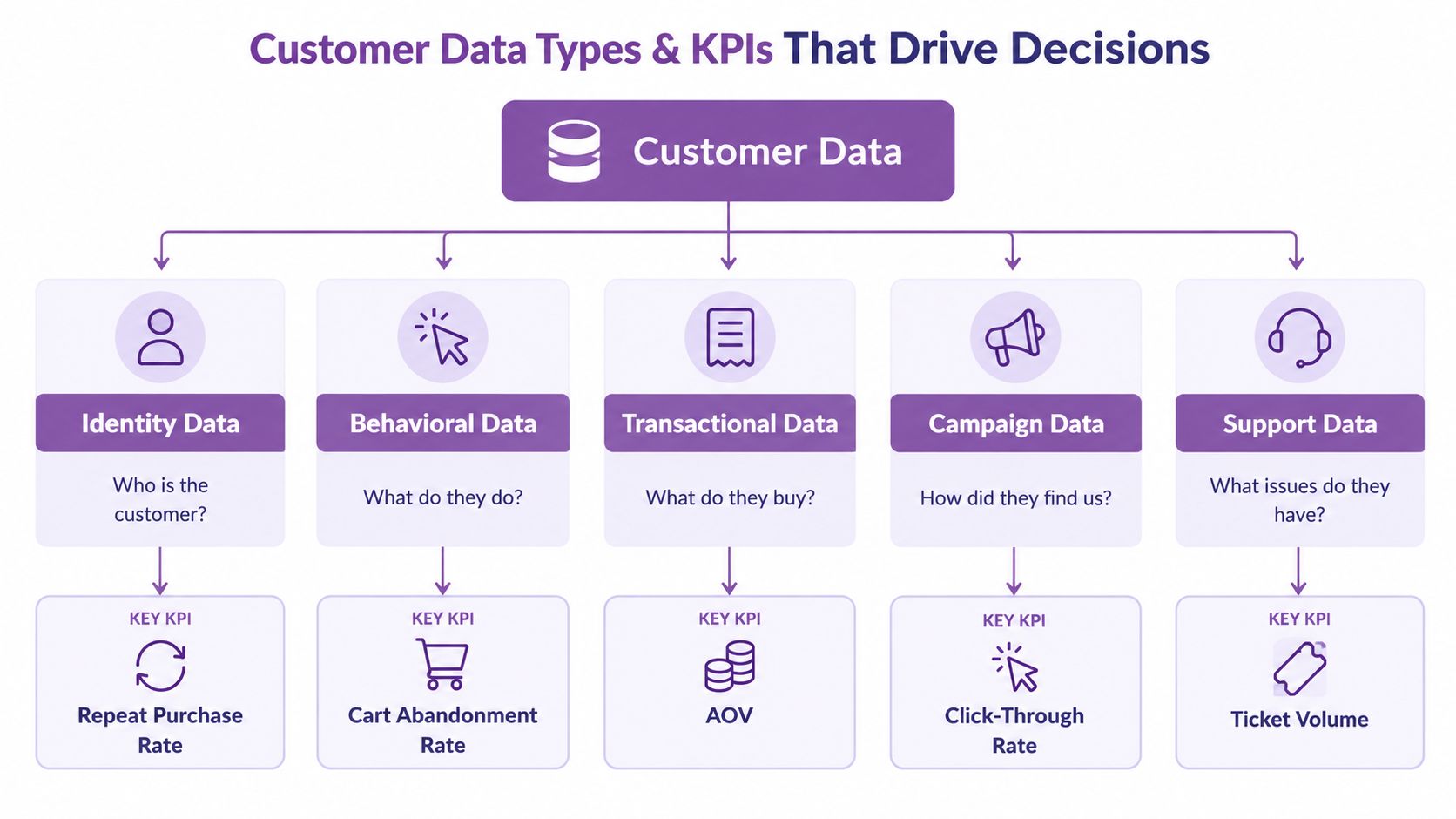
Start with five questions:
- Who is the customer? Identity data provides the usable profile, such as a known subscriber, a first-time buyer, or a returning customer.
- What did the customer do? Behavioral data records actions such as browsing, adding to cart, or leaving checkout.
- What did the customer buy? Transactional data connects products, orders, returns, and purchase history.
- How did the customer arrive? Campaign data provides context about the source or message associated with the visit.
- What problem did the customer report? Support data adds friction and service context that storefront events can't explain alone.
A single dashboard metric can mislead because it removes sequence. High traffic may hide weak engagement. Strong conversion may coexist with poor repeat purchasing. An attractive click rate may produce few completed orders. Journey-based analysis restores the sequence by asking what happened before and after each event.
Customer analytics also connects behavior to experience. Historically, CRM systems mostly recorded transactions. Modern programs try to link behavior, loyalty, support, and experience to revenue decisions. If you want a broader explanation of how digital analytics supports marketing decisions, the digital analytics guide from YipSMS offers useful context.
Customer data analytics isn't a bigger spreadsheet. It's a method for turning customer context into a specific, testable action.
For Shopify merchants, that action might be an SMS sent after a shopper abandons checkout, a product education message after repeated views, or a replenishment prompt based on prior purchases. The analysis is only complete when someone can use it responsibly.
Customer Data Types and KPIs That Actually Drive Decisions
The best KPI is the one that answers a business question. Start with the question, then select the data needed to answer it.
Identity data helps distinguish new visitors, known subscribers, first-time buyers, and returning customers. It supports decisions about eligibility and message frequency. Behavioral data shows intent through product views, cart additions, checkout starts, and exits. It helps a merchant decide whether a shopper needs a reminder, more information, or no intervention.
Transactional data provides the commercial record. Orders, product combinations, returns, and purchase intervals support decisions about repeat-purchase campaigns and customer value. Merchants calculating customer value should keep the assumptions visible, and this guide to LTV calculation for decision-making is a useful reference for defining the calculation before using it in targeting.
Campaign data adds acquisition and message context. It can show whether a subscriber came through a popup, a campaign, or another source. Support data supplies friction signals, including repeat contact, unresolved issues, returns, and delivery questions. These signals often deserve attention before a lagging retention metric changes.
Large-scale digital experience benchmarking now spans 99 billion web sessions across more than 6,500 websites, with 50 or more metrics across nine industries, according to Kantar's data strategy and analytics maturity benchmark. The important lesson isn't to copy every metric. It's to compare behavior by journey stage and cohort instead of treating all traffic as one group.
| Journey Stage | KPI Example | Decision It Informs |
|---|---|---|
| Acquisition | Qualified engagement by campaign source | Which sources deserve more testing |
| Consideration | Product views followed by cart activity | Whether product information or reassurance is missing |
| Checkout | Cart and checkout abandonment | Whether a recovery message is appropriate |
| Post-purchase | Repeat purchase rate | When lifecycle messaging should begin |
| Support | Repeat contact and first contact resolution | Whether service friction may threaten retention |
Independent CX guidance identifies repeat contact, first contact resolution, customer effort, containment quality, and handle-time consistency as metrics closely linked to ROI because they affect both service cost and retention risk (CX Today customer analytics benchmarks). Normalize those measures by intent and channel. A delivery question shouldn't be mixed with a sizing question, and chat shouldn't be compared casually with phone support.
A practical weekly shortlist might include one acquisition KPI, one intent KPI, one checkout KPI, one retention KPI, and one service KPI. That is enough to create a decision loop without drowning the team in vanity metrics.
How Shopify Merchants Can Collect and Analyze Customer Data
A useful Shopify data workflow can stay lean. Collect only what supports a decision, obtain the required permission, connect records through a consistent customer identifier, and make the resulting segment available to the channel that will act on it.
Begin with native store sources. Orders, products, and customer records establish the commercial foundation. Popups and forms capture contact details and preferences, while checkout data adds purchase and delivery context. Post-purchase surveys and reviews bring in feedback, and support logs add tickets, returns, and unresolved questions.
The target is a unified customer view, not a warehouse full of unused fields. A merchant might connect a known subscriber's consent status, recent product interest, order history, and support intent. That view is enough to prevent an irrelevant cart reminder from reaching someone who has already purchased or asked to stop promotional contact.
A lean operating sequence
- Capture with consent. Record what the shopper agreed to receive and the context of the opt-in.
- Unify by identity. Use customer IDs or appropriately governed identifiers to reduce duplicate profiles.
- Segment by intent. Combine actions with conditions, such as a product view without purchase or a cart without checkout.
- Analyze by stage. Compare new and returning customers, channels, product categories, and support intents.
- Test before rollout. Launch one controlled workflow, define the success metric, and check whether the message changed behavior.
The explanation of what is first-party data can help teams separate information collected directly from shoppers from data acquired through other routes. That distinction matters because privacy regulation, disconnected systems, and weaker cross-device identity can make exposure-to-outcome measurement less certain.
Timing also matters. Recent coverage says 40% of CX leaders have real-time access to customer insights, while 23.5% wait more than a week for role-specific insights (Mastercard analysis of customer analytics execution). Faster access doesn't automatically create better decisions, but a delayed insight can't support a timely cart intervention.
Trend leading indicators weekly. If repeat contact rises, first contact resolution falls, or a checkout segment grows, assign an owner and an action. The customer data integration guide from YipSMS provides additional context for connecting data sources without making collection the end goal.
Privacy Compliance and Signal Loss Without Losing Confidence
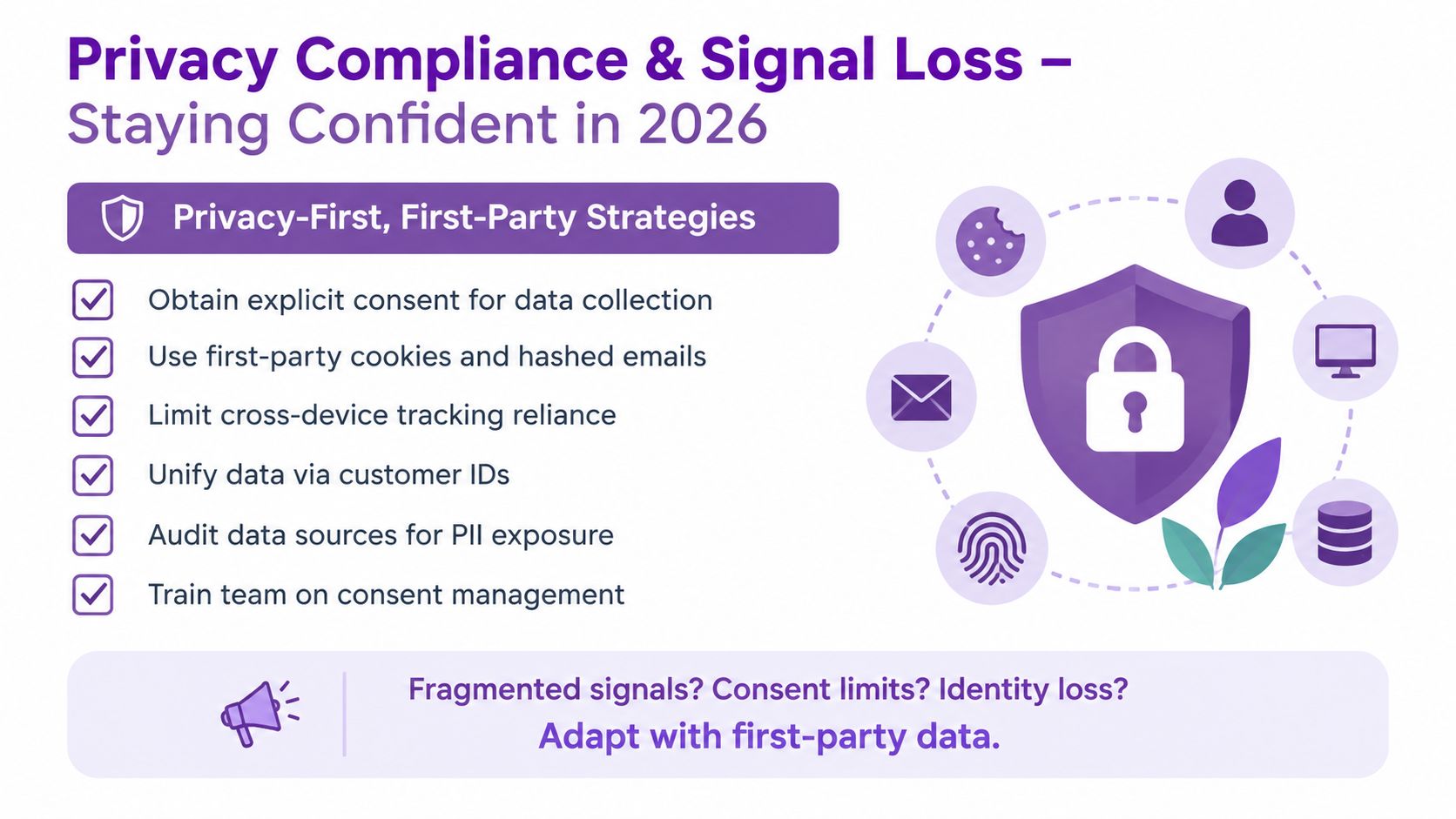
A Shopify shopper can view a product while logged out, return on another device, decline permission, and still expect relevant service. Those events may not connect to one customer record. Clean-room requirements, data-residency rules, and disconnected platforms can further weaken the link between an exposure and a purchase.
Treat missing identity as uncertainty, not an invitation to guess. Build decisions from privacy-safe first-party signals, record what each signal means, and test outcomes at the journey stage where the action occurs. A view, cart, checkout, purchase, or support event can still trigger a useful response without creating an invisible identity trail.
SMS guardrails for Shopify merchants
SMS marketing starts with explicit consent. A checkout checkbox, popup, or keyword opt-in should state clearly that the shopper agrees to receive marketing texts. Unregistered business texting may be filtered by carriers unless the applicable 10DLC campaign is registered, according to eCommerce SMS marketing guidance.
The FCC's one-to-one consent rule took effect on January 27, 2025. Written consent must apply to one seller at a time, and marketing messages need an opt-out path such as “Reply STOP” (SMS marketing compliance guidance). Store those conditions in the consent record and apply them before a YipSMS trigger can send.
Use this operating checklist:
- Consent record: Save the seller, wording, timestamp, and permission source.
- Eligibility filter: Exclude shoppers without the required marketing consent.
- Identity discipline: Treat an uncertain device match as an unconfirmed match.
- Suppression logic: Hold messages for recent purchasers, opted-out contacts, or customers with an unresolved service issue when contact could confuse them.
- Governance review: Restrict personal-information access and audit which systems receive it.
Quiet hours belong in the same workflow logic. Schedule promotional texts no earlier than 8 AM and no later than 9 PM in the recipient's time zone. Configure the store's time-zone and suppression rules before joining a journey-stage benchmark to an automation trigger.
For implementation details, follow the YipSMS TCPA compliance checklist. Personalization should match the quality of the consent and identity signals behind it, while every test should measure a customer outcome rather than assume that a connected profile is complete.
Turning Analytics Into SMS Workflows That Convert With YipSMS
Analytics becomes useful when a segment has a clear trigger and a clear message job. Don't begin with “What can we send?” Begin with “What customer behavior needs a timely response?”
A Shopify store can create a cart recovery segment from shoppers who added an item, haven't completed checkout, and have valid marketing consent. The corresponding SMS should help the shopper return to the cart, answer a known question, or remove uncertainty. A viewed-product segment can support a short follow-up that highlights product information rather than assuming the customer is ready for a discount.
Match the trigger to the message
- Cart abandonment: Send one recovery text soon after the event, with a direct path back to checkout.
- Checkout abandonment: Use the checkout context to reduce friction, but suppress the message if the order completes.
- Viewed product: Follow up with relevant details, reviews, or availability information when the behavior shows meaningful interest.
- Shipping and delivery: Keep transactional updates separate from promotional campaigns so the customer understands the message purpose.
- Post-purchase recommendations: Use prior purchase and product relationship data to suggest a useful next item, not a random promotion.
Timing benchmarks point in the same direction. One 2026 benchmark recommends a single urgent cart SMS within 4 hours, while another recommends triggering within 30 minutes and notes that messages are often opened within 90 seconds on average (Visionary Marketing abandoned-cart benchmark). For a merchant, the practical interpretation is to automate the first message quickly, then keep the sequence minimal to limit fatigue.
YipSMS Inc. can connect Shopify customer segments to cart and checkout abandonment, viewed-product follow-ups, shipping notifications, delivery updates, and personalized recommendations. Its real-time analytics report delivery, failures, clicks, and conversions, while campaign attribution can connect clicks to revenue. The platform also supports drag-and-drop popup creation and scheduled bulk campaigns, so the same measurement discipline can cover list growth and lifecycle activation.
Track more than opens. Check delivery, failures, clicks, completed purchases, opt-outs, and revenue attributed to the message. Compare the result with a defined baseline or holdout where practical, then change one element at a time. A broader explanation of SMS channel strategy is available in this overview from Headline Marketing Agency on SMS.
Example Use Cases and Your Action Plan for Next Week
A new Shopify store often needs a simple recovery loop. The merchant collects explicit SMS consent at checkout, identifies shoppers who added a product but didn't complete checkout, and sends one timely reminder. The segment excludes completed orders and opted-out contacts. The merchant then watches delivery, click-through behavior, completed purchases, and opt-outs before deciding whether the message needs different copy or timing.
A scaling brand faces a different problem. It has enough orders to identify customers who purchased once but haven't returned within the store's normal buying cycle. The team creates a repeat-purchase segment based on product category and purchase history, then sends a recommendation or replenishment message only to eligible subscribers. The success metric is repeat purchase rate, with revenue and opt-outs as supporting checks.
Neither merchant needs another dozen dashboards. Both need a short verification loop.
A focused plan for next week
- Day one: Audit Shopify sources, consent records, customer IDs, and suppression rules.
- Day two: Choose two KPIs, one for immediate conversion and one for retention or service quality.
- Day three: Build one behavioral segment with a clear inclusion and exclusion rule.
- Day four: Write one SMS that matches the journey stage and includes the required opt-out path.
- Day five: Launch the automation within compliant sending hours.
- Following days: Review delivery, failures, clicks, conversions, revenue attribution, and opt-outs. Record the next test instead of changing everything at once.
The strongest improvement may come from removing an irrelevant message rather than adding a clever one. When a store consistently links a customer signal to a responsible action, its analytics program becomes easier to trust and easier to improve.
YipSMS Inc. helps Shopify merchants collect subscribers with drag-and-drop popups, automate cart recovery and post-purchase flows, and measure delivery, clicks, conversions, and attributed revenue in real time. Visit YipSMS Inc. to connect your customer data analytics workflow to practical SMS activation and start testing a focused campaign.