SMS Marketing Templates: 8 Ecommerce Flows for 2026
A store launches SMS, sends one generic sale text, and waits for the first order to come through. Instead, unsubscribes rise, replies stay quiet, and the team decides that SMS “doesn't work.” Usually, the channel isn't the problem. The message arrived without a customer moment behind it.
Effective SMS marketing templates connect a specific event to a useful next step. A shopper leaves a cart, a product returns to stock, an order moves through delivery, or a previous buyer reaches the point where they may need a refill. That context gives the message a reason to exist.
The eight flows below are a working set for Shopify merchants. Each one includes a practical send window, a copy pattern, personalization tokens, and the failure mode worth watching after launch. Treat the examples as adaptable building blocks, not fixed scripts. Your store's buying cycle, consent records, inventory, margins, and customer preferences should decide the final version.
Table of Contents
- 1. Abandoned Cart Recovery SMS Sequence
- 2. Browse Abandonment and Viewed Product Follow-Up
- 3. Welcome Series with Popup Signup Offer
- 4. Shipping and Delivery Notification Flow
- 5. Post-Purchase Thank You, Review Request, and Cross-Sell
- 6. Back-in-Stock Alert
- 7. Win-Back Campaign for Lapsed Customers
- 8. Replenishment and Repeat Purchase Reminder
- 8-Point SMS Template Comparison
- Turn These Eight Templates Into a Measured SMS Program
1. Abandoned Cart Recovery SMS Sequence
Cart recovery works because the customer has already taken meaningful action. They added a product, entered a phone number, and left before completing payment. The message shouldn't introduce your brand from scratch. It should remove the next obstacle.
Use a short sequence of two or three messages. Send the first within an hour, while the product and checkout are still familiar. A simple opening might read:
Hi {first_name}, you left the {product} in your cart. It's still available: {cart_link} Reply STOP to opt out.
If the shopper doesn't return, follow with reassurance rather than an immediate discount:
“Still thinking it over? Our {product} has over 1,000 five-star reviews. Free returns within 30 days: {cart_link}”
The final message can introduce a deadline, but only when the offer is real:
“Last call: free shipping on your cart until midnight tonight. {cart_link}”
Tokens and controls that matter
Use {first_name}, {product}, {cart_link}, and, where supported, a cart-specific discount or shipping token. Keep each message under 160 characters where possible, because longer texts may create multiple segments and additional costs.
Start with a no-discount version. Add an incentive only for shoppers who don't convert after the first reminder. A discount-first sequence can train customers to abandon checkout deliberately, while free shipping may protect margin better than a percentage reduction.
Add UTM parameters to the link so clicks and revenue can be assigned to each message. Respect quiet hours in the recipient's time zone, and review the sequence monthly. Remove any step that doesn't lift completed orders without increasing opt-outs.
Automated SMS deserves priority over occasional blasts. An analysis of 230 million SMS messages found that automated messages generated 18% of SMS-attributed orders from 9% of sends, while their click rates were 147% higher than campaign messages. See the SMS marketing examples for additional campaign ideas.
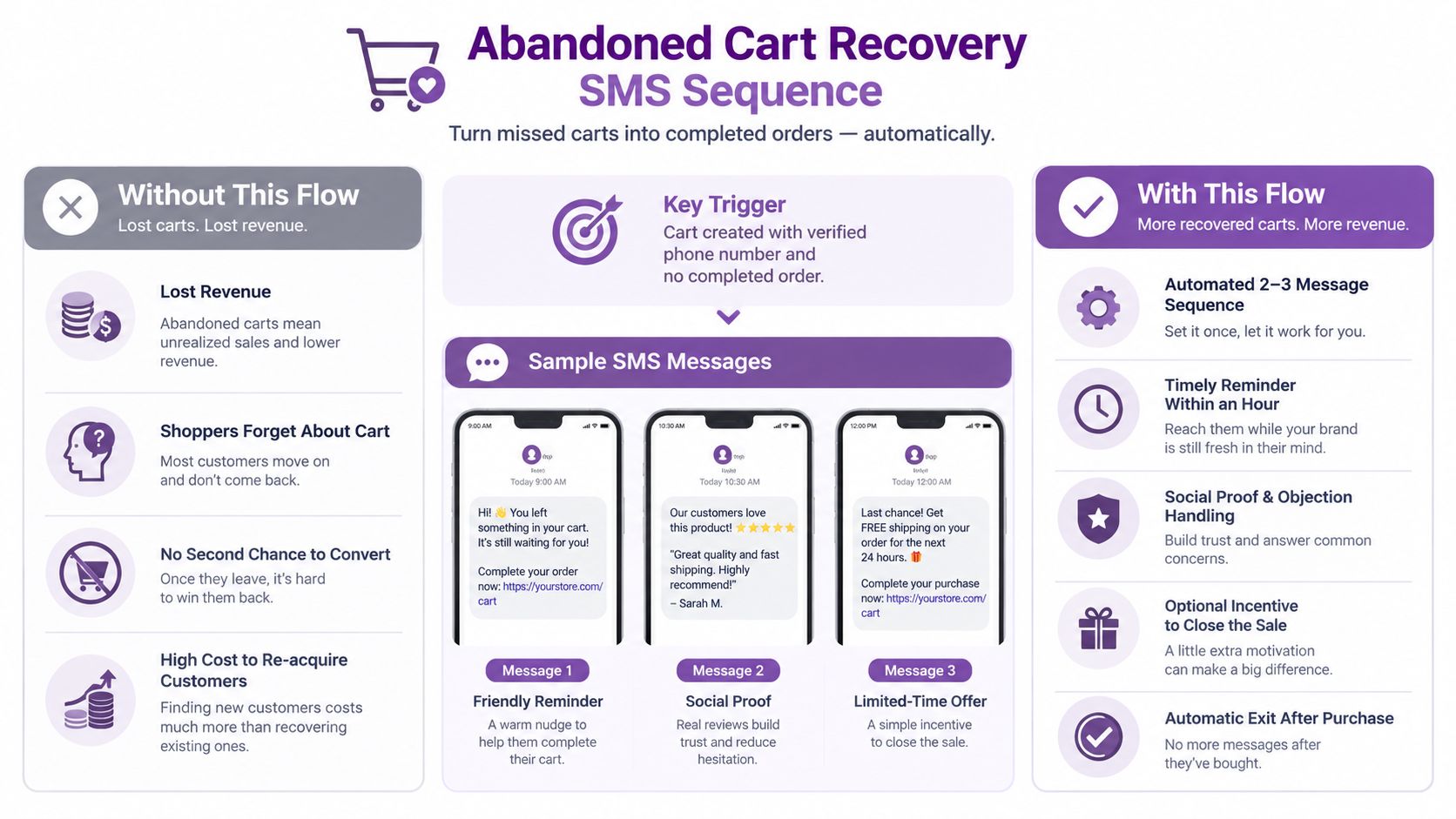
The main failure mode is over-contacting. If a shopper completes the order through email or another device, suppress the remaining cart messages immediately.
Here's a walkthrough of the recovery sequence in practice:
2. Browse Abandonment and Viewed Product Follow-Up
A product-view message needs a lighter touch than a cart reminder. The shopper may have been comparing sizes, checking ingredients, researching a higher-priced purchase, or browsing without immediate intent. Treating every product view like an abandoned checkout makes the brand feel watchful rather than helpful.
Wait at least a few hours before sending anything. Use one browse message per product per week, and contact only subscribers who explicitly opted in to SMS. The copy should explain the value of returning without suggesting that someone is monitoring every click.
For a product with strong customer validation, use:
“Still considering the {product}? It's rated 4.8 by 312 customers. See it here: {product_link}”
For inventory-led relevance:
“Good news: the {product} you viewed is back in stock in your size. {product_link}”
A beauty store might show a serum again alongside a “pairs well with” bundle. That recommendation fits the customer's demonstrated interest better than a generic sitewide promotion.
Personalize without sounding invasive
Useful tokens include {product}, {product_link}, {category}, {variant}, and verified review information. Segment by category so an apparel shopper doesn't receive a skincare recommendation. Use low-risk behavioral signals such as a recently viewed category or a product's return to stock.
Avoid unexplained references to sensitive attributes. A 2025 global study found that 81% of consumers ignore irrelevant marketing, 71% want brands to learn from shopping behavior over time, and 77% are likely to purchase after relevant product recommendations. The same balance matters on the trust side. Another 2025 consumer report identified requests for personal information as a concern for 52% of respondents, while unfamiliar sender numbers concerned 47%. Those findings are summarized in this consumer SMS survey.
The failure mode is false familiarity. “We saw you looking at this” can feel creepy. “The serum you viewed is back in stock” gives a clear reason for the message and lets the customer decide whether to return.
3. Welcome Series with Popup Signup Offer
The welcome flow begins at the moment of consent. The first text should deliver whatever the popup promised, identify the brand, and explain how the relationship will work. Later messages can introduce best sellers, customer proof, product education, or the founder's point of view.
A practical opening is:
“Welcome to {brand}! Here's your 10% code: WELCOME10. Msg freq varies. Reply STOP to opt out, HELP for help.”
The next message can narrow the choice:
“Our customers' favorites this week: {product_1}, {product_2}. Shop now: {link}”
A skincare brand could use a spin-to-win popup with a guaranteed prize, then follow with a three-message welcome flow that delivers the reward, introduces its best-selling routine, and explains how to choose products.
Build consent into the experience
Your signup language should be explicit:
“By entering your phone number you agree to receive recurring marketing texts. Msg & data rates may apply. Reply STOP to unsubscribe.”
Use an unticked SMS-specific consent option where required, and explain the type of communication the subscriber will receive. For UK customers, marketing texts generally require prior consent under PECR guidance from the ICO. Consent should identify the business and the promotional text category. In the United States, the FCC's one-to-one consent rule took effect on January 27, 2025, requiring prior express written consent for each seller individually for marketing robotexts. The FCC order explains the seller-specific requirement.
Show the popup after a delay or on exit intent instead of immediately on page load. Test a free-shipping offer against a percentage discount, because shipping relief can protect margin. A drag-and-drop popup designer makes the initial build faster, but the important test is the headline, offer, and consent clarity.
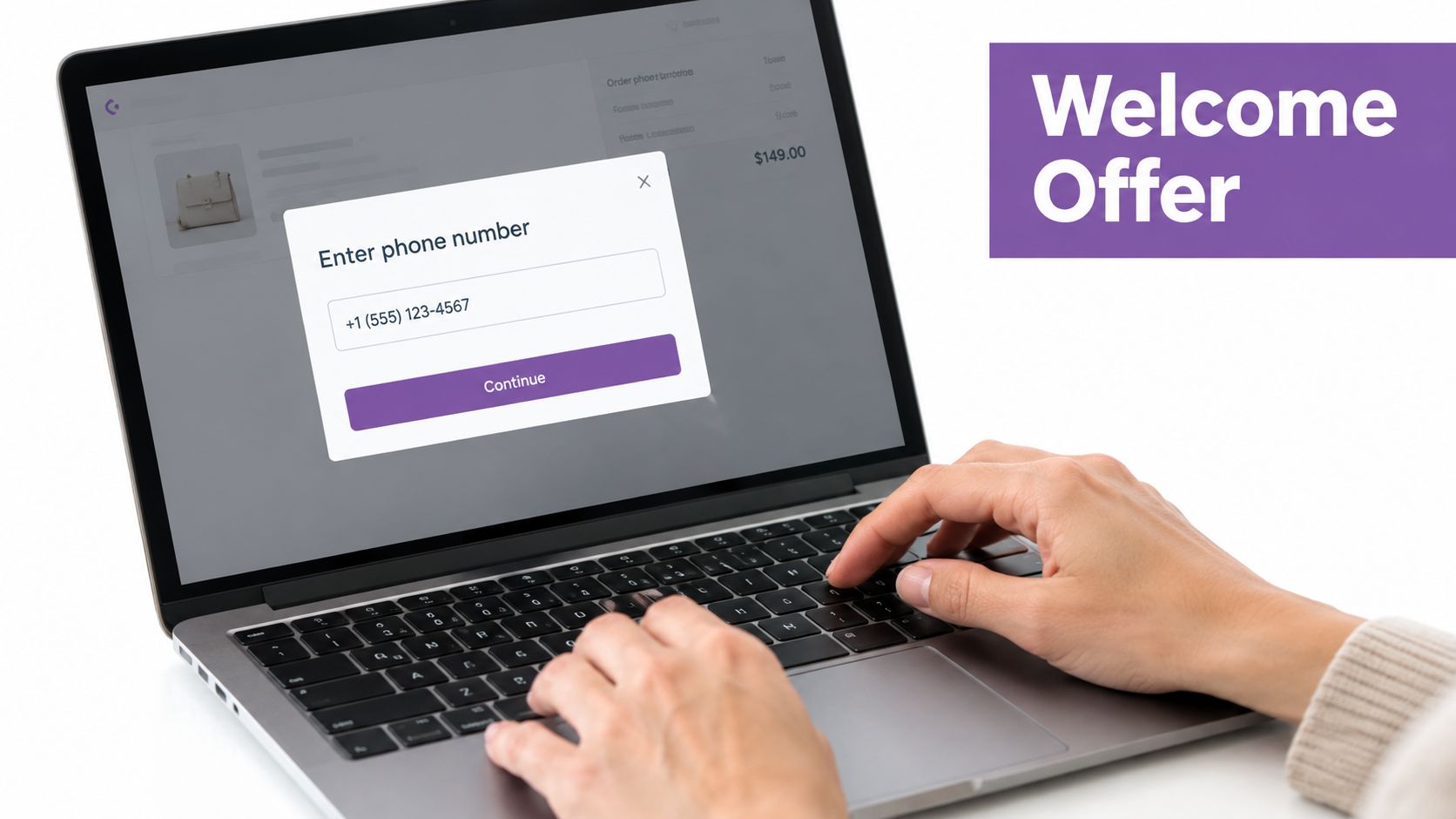
The main failure mode is promising a reward and then burying it under brand storytelling. Deliver the code first. Earn attention for the later messages.
4. Shipping and Delivery Notification Flow
Shipping texts serve a different customer need from promotional SMS. The buyer wants to know whether the order has shipped, where it is, and what to do if something goes wrong. Keep the content operational, identifiable, and easy to act on.
A basic sequence can use these patterns:
“Your order #{order_number} has shipped! Track it here: {tracking_link}”
“Out for delivery today. Please keep an eye out for your package from {brand}.”
“Delivered! Need help with your order? Reply HELP or email support@{brand}.com”
Keep operational messages operational
Use {order_number}, {tracking_link}, {brand}, delivery status, and support details. Send a proactive delay alert before the customer has to contact support. A short explanation and a current tracking link usually builds more trust than silence followed by a late package.
Transactional notifications can include a care tip when it remains primarily informational. A clothing store might add a brief washing instruction after delivery. A promotion should remain separate, because mixing a sales offer into a delivery alert can make a useful service message feel exploitative.
Confirm that your consent language covers transactional messages as well as marketing messages. UK businesses sending promotional texts must identify themselves and provide an opt-out method in every message, as described in the ICO's electronic marketing guidance. Apply the same discipline to automated flows when the content becomes direct marketing.
Track support ticket volume before and after launch. A delivery notification earns its place when it answers common “Where is my order?” questions before they reach the support team. For implementation details, see this guide to SMS delivery notifications.
The failure mode is inaccurate status data. A text that says “delivered” while the carrier still shows an exception creates more work, not less. Sync the flow to carrier events and pause promotional follow-ups when a shipment is delayed.
5. Post-Purchase Thank You, Review Request, and Cross-Sell
The first post-purchase message should make the buyer feel looked after, not immediately monetized. Thank them, provide useful product guidance, and wait until the item has arrived and had time to be used before requesting a review.
A useful sequence might look like this:
“Thanks for your order, {first_name}! Quick tip: wash {product} in cold water to keep it looking new.”
“How's your {product} working out? Leave a quick review and get 15% off your next order: {review_link}”
“Customers who bought {product} also love {product_2}. Enjoy 10% off with code THANKS10.”
Match the message to the product lifecycle
Use {first_name}, {product}, {order_number}, {review_link}, {product_2}, and a relevant next-order offer. A customer who bought running shoes may need care guidance before a cross-sell. A skincare buyer may be ready for a complementary cleanser after learning how to use a serum.
Send the review request after delivery and likely product use, not on the day the order ships. Keep the review link short and mobile-friendly. A one-tap rating or compact form reduces friction. Reward the review rather than a positive rating, because review-incentive rules can vary across platforms.
Practical rule: Don't ask for a review before the customer has had a fair chance to form an opinion.
Cap the sequence at three messages per order. Use purchase history for cross-sells rather than sending every buyer the same bestseller. Monitor review completion, repeat orders, clicks, and opt-outs together. A cross-sell that produces revenue but causes customers to leave the list may not be a good trade.
Use these review request templates as a starting point, then rewrite the copy around the actual product experience. The main failure mode is timing. A perfectly worded review request sent before delivery will still frustrate customers.
6. Back-in-Stock Alert
A back-in-stock alert has built-in relevance. The customer asked to hear when a particular product or variant returned, so the message can be direct without adding a broad promotional pitch.
Send the alert as soon as inventory updates, then reconcile the alert list daily. Variant-level tracking matters. A customer waiting for a medium black jacket shouldn't receive a message about a large red version.
Try:
“Good news: {product} in {size} is back in stock. Grab yours before they sell out again: {product_link}”
For a limited inventory position:
“Only 12 left in {color}. You asked us to let you know when {product} returned. Shop now: {link}”
Make urgency factual
Use {product}, {size}, {color}, {variant}, and {product_link}. Include a low-stock indicator only when inventory data is accurate. False urgency can damage trust faster than a missed sale. If the item sells out again, offer a similar product or let the customer rejoin the alert list.
Track which products generate the most alert signups. That data can help inventory teams prioritize restocks, especially for limited drops, seasonal items, and repeat best sellers. A customer who asked for a notification is high intent, but the alert still needs a functioning variant link and current availability.
The back-in-stock notification guide provides a useful implementation reference. Keep the message focused on availability rather than adding a second offer.
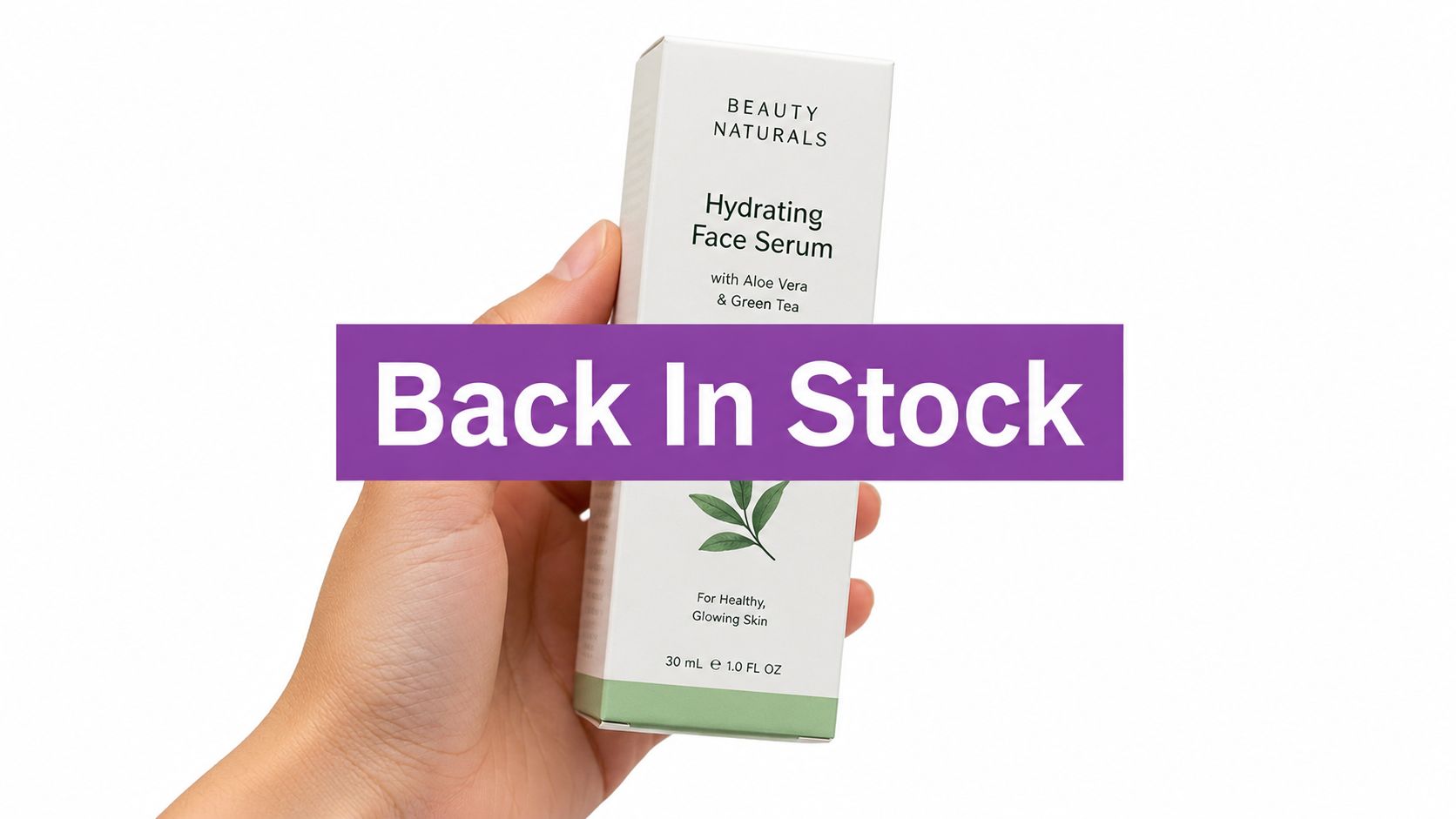
The failure mode is sending the wrong variant or waiting too long. A restock alert that arrives after the item sells out again teaches customers that your notifications can't be trusted.
7. Win-Back Campaign for Lapsed Customers
Win-back timing should follow the product's buying cycle. A customer who buys coffee regularly may become inactive sooner than someone who buys furniture. Define “lapsed” using your own order history, then test the message against customers who have gone quiet.
A compact sequence can start with a product update:
“We miss you, {first_name}! Here's what's new since your last visit: {product_link}”
Then give the subscriber a choice:
“Still interested in {brand}? Reply YES to stay on our list, or tap here to update your preferences.”
If there's still no response, use a clear incentive with a real deadline:
“Welcome back: 20% off your next order, valid for 72 hours only. {link}”
Protect the list before protecting the sale
A 60-day window may fit one category, while 180 days may fit another. Don't import a universal rule. Test a no-discount version first, especially if new products, better selection, or improved service gives customers a credible reason to return.
Use {first_name}, {last_order_product}, {new_product}, {preference_link}, and {winback_code}. A “reply YES” confirmation can help remove disengaged numbers before you spend on discounts. Subscribers who don't respond after two or three messages can move to a low-frequency list rather than receiving repeated reminders.
The main failure mode is treating silence as permission to increase frequency. In a 2025 consumer study, 90% of respondents wanted to customize the frequency and type of messages they receive. Other 2025 reporting found that 13% preferred daily texts, 15% preferred messages every other day, and 21% preferred several messages per week. These findings are covered in this consumer texting behavior report.
Review opt-out rates by message and adjust both timing and copy. The purpose of win-back isn't to keep every number at any cost. It's to identify customers who still want the relationship.
8. Replenishment and Repeat Purchase Reminder
Replenishment reminders turn purchase history into a useful service. They work best for consumables such as supplements, skincare, coffee, pet food, and cleaning products, where the next order can be tied to an estimated usage period.
Start with a direct reminder:
“Running low on {product}? Reorder in one tap and save 10% with subscribe-and-save: {reorder_link}”
Or use the known supply period:
“Your 30-day supply of {product} is almost done. Keep your routine going: {link}”
A coffee brand might send a reminder 21 days after a 250g bag purchase and offer a bundle option. That timing should come from the product and customer history, not from a global automation setting.
Improve the timing with real orders
Use {product}, {variant}, {quantity}, {reorder_link}, {subscription_option}, and the customer's previous order date. The reorder link should prefill the previous variant and quantity where possible. Offer subscribe-and-save only when the customer can understand the commitment and change or cancel it easily.
Ask customers in the post-purchase flow how long the product lasts. Compare expected timing with actual days between orders. A customer who consistently reorders early needs a different reminder from one who stretches each purchase longer.
Measure repeat purchase rate, days between orders, subscription starts, clicks, and opt-outs. The CLV growth playbook for Amazon brands offers broader retention ideas, but Shopify merchants should still calibrate timing from their own catalog.
The failure mode is sending a refill reminder for a product the customer hasn't finished. A message that arrives too early feels like pressure. A message that arrives too late may lose the order to another store.
8-Point SMS Template Comparison
| Flow | ✨ Core trigger & timing | ★ Engagement & quality | 💰 Value proposition | 👥 Target audience | 🏆 Why it excels |
|---|---|---|---|---|---|
| Abandoned Cart Recovery SMS Sequence | Trigger: cart with verified phone → Msg1 15–60min, Msg2 12–24h, Msg3 24–48h; auto-exit on purchase | ★★★★★ high conversion; measurable ROI (often 5x–7x) | 💰 Recovers lost sales; high revenue per message | 👥 Shoppers with purchase intent; retail & DTC Shopify stores | 🏆 Best for immediate recovery; prebuilt flow & dynamic merge tags |
| Browse Abandonment & Viewed Product Follow-Up | Trigger: product page view by subscriber → send 2–6 hrs; optional follow-up 2–3 days later | ★★★☆☆ lower intent than cart; gentle engagement | 💰 Builds consideration without heavy discounts | 👥 High-consideration categories (apparel, furniture, supplements) | 🏆 Nurtures early-funnel shoppers with low-pressure outreach |
| Welcome Series with Popup Signup Offer | Trigger: SMS opt-in via popup/checkout → immediate welcome + offer; 1–2 follow-ups over 4–7 days | ★★★★★ highest initial engagement; reduces unsubscribes | 💰 Drives first purchase & list growth; sets expectations | 👥 New subscribers; DTC brands using popups | 🏆 Most profitable automation; converts new subscribers fast |
| Shipping & Delivery Notification Flow | Triggers: order placed → shipped → out for delivery → delivered; includes tracking links | ★★★★★ very high open rates; expected by customers | 💰 Cuts support tickets; builds trust; low marketing risk | 👥 All purchasers; high-volume retailers & marketplaces | 🏆 Essential operational flow that improves CX and retention |
| Post-Purchase Thank You, Review Request & Cross-Sell | Trigger: order delivered → Msg1 thank-you, Msg2 review request (3–10 days), Msg3 cross-sell | ★★★★☆ boosts reviews & repeat orders; mobile-friendly | 💰 Increases CLV; generates social proof for other flows | 👥 Brands focused on retention (subscription, beauty) | 🏆 Turns one-time buyers into repeat customers; collects reviews |
| Back‑in‑Stock Alert | Trigger: inventory from 0 → in-stock for opted variant → immediate alert with add-to-cart | ★★★★★ very high intent; fast conversions on restocks | 💰 Recovers demand without discounts; protects margin | 👥 Limited drops, seasonal items, sneaker/apparel fans | 🏆 Converts expressed interest quickly; variant-level accuracy |
| Win‑Back Campaign for Lapsed Customers | Trigger: no purchase/engagement for defined period (e.g., 90–180 days); 2–3 msgs over 7–14 days | ★★★☆☆ variable results; can increase opt-outs if mistimed | 💰 Cheaper than new acquisition; cleans list and reclaims revenue | 👥 Lapsed buyers segmented by RFM | 🏆 Reclaims dormant revenue & improves list health |
| Replenishment & Repeat Purchase Reminder | Trigger: calculated reorder date from purchase history → one‑tap reorder or subscribe-and-save | ★★★★★ highly relevant; strong repeat conversion when timed well | 💰 Drives predictable revenue; low discount needs; supports subs | 👥 Consumables (supplements, skincare, coffee, pet food) | 🏆 Builds recurring revenue via timely, service-oriented messaging |
Turn These Eight Templates Into a Measured SMS Program
Don't launch all eight flows at once. Start with the welcome series and shipping notifications. The welcome flow establishes consent expectations and delivers the signup promise. Shipping messages solve a clear operational need and give customers a reason to trust your sender identity.
Add abandoned cart recovery next, then layer in post-purchase, win-back, and replenishment once the store has enough order and engagement data to time them properly. Add browse follow-ups and back-in-stock alerts when your product catalog, inventory events, and behavioral tracking are reliable.
Every flow should have one primary customer moment, one clear action, and a suppression rule. A cart buyer should leave cart recovery immediately. A customer with an unresolved delivery issue shouldn't receive a cheerful cross-sell. A subscriber who changes preferences should move to the right category without waiting for a manual cleanup.
Track the numbers that help you make decisions. Measure opt-out rate, click-through rate, revenue per delivered message, conversion rate, delivery status, and support replies. Because SMS doesn't provide a universal open-tracking mechanism comparable to an email pixel, delivery, click, conversion, and opt-out metrics are more defensible than claiming a precise industry-wide open rate.
Use historical context carefully. Academic research published in 2011 reported an average SMS-ad response rate of approximately 12%, compared with roughly 2% to 3% for direct mail, with country-level rates ranging from 12% in the United States to 5.7% in Germany. The academic research reference supports the case for localized, offer-led templates, but those figures shouldn't become a promise for your store. Your audience, consent quality, offer, timing, and product category will determine current performance.
Modern reach comes with a clear risk. A 2023 global consumer study of 1,218 adults in the United States, United Kingdom, Australia, and New Zealand found that 19% preferred SMS for brand communication, while 90% of texts were read within three minutes. It also found that 96% had felt annoyed by SMS marketing at least occasionally, 56% had purchased less or stopped buying because of annoying messages, and 84% had received company texts from brands they didn't remember signing up for. Those findings make relevance, consent, frequency control, and simple opt-out language part of the template itself, not a compliance footnote. The State of SMS Marketing report provides the source context.
Review every flow monthly. Check whether tokens still populate correctly, whether links resolve to the right product or checkout, whether delivery events arrive on time, and whether incentives are eroding margin. A simple content strategy template can help your team document triggers, audiences, exclusions, message versions, and success metrics in one place. You can also use these content strategy template resources to organize the broader retention program around the SMS flows.
YipSMS Inc. is one option for Shopify merchants that want one-click setup, a 14-day free trial, a drag-and-drop popup designer, prebuilt automation flows, scheduled campaigns, and real-time analytics. Treat the platform as the execution layer. The strategy still comes from matching each message to a real customer moment and giving subscribers control over what they receive.
YipSMS Inc. helps Shopify stores build SMS marketing templates into cart recovery, viewed-product follow-ups, shipping updates, delivery notifications, and repeat-purchase flows. Visit YipSMS Inc. to explore the app, test the available automations, and start organizing your SMS program around useful customer moments.
How this article was made: the YIPSMS team drafts some articles with AI writing tools, then checks pricing, compliance and product details against how YIPSMS actually works before publishing. Spotted something wrong? Tell us through your YIPSMS account.