Text Message Marketing Campaign: A Complete 2026 Guide
You've built the Shopify list, connected an SMS app, and drafted a launch offer. The first campaign goes out, the dashboard shows clicks, and then unsubscribes arrive. That's a common first lesson: an SMS program doesn't fail only because the copy is weak. It often fails because the store hasn't decided how often it should contact each person, or what evidence proves those people agreed to receive marketing.
A sound text message marketing campaign starts with permission and a shared contact budget across automations. Clicks matter, but they don't tell you whether a message created a sale, whether customers are being over-contacted, or whether the people receiving your texts opted in to your specific program.
Table of Contents
- Why Most Text Message Marketing Campaigns Underperform
- Setting Up Compliance and Consent the Right Way
- Automations vs One-Off Campaigns
- Building a Cart Recovery Flow That Actually Converts
- Measuring Incrementality Instead of Just Clicks
- Managing Frequency Without Burning Your List
- Your Launch Checklist and First-Week KPIs
Why Most Text Message Marketing Campaigns Underperform
The first blast can feel like a win. A Shopify owner sees subscribers in the app, sends a discount, and checks the dashboard for clicks. The next morning, a wave of opt-outs makes the true result harder to celebrate. That pattern usually points to a mismatch between what subscribers expected and what the store sent, not a shortage of clever copy.
Two failures sit behind many disappointing launches. The first is sloppy consent capture: a phone number collected at checkout gets treated as marketing permission, even though the merchant can't show that the customer agreed to promotional messages from that sender. The second is ignoring contact pressure: a cart reminder, a sale announcement, a browse follow-up, and a post-purchase message may be configured separately, yet they land on one person's phone as a single stream.
The signals that matter
Don't judge a program by click-through rate alone. Track deliverability, unsubscribe rate, and repeat-purchase lift together. Delivery tells you whether messages are reaching subscribers; opt-outs reveal whether the contact experience is costing you trust; repeat-purchase behavior helps show whether SMS supports retention rather than just capturing a purchase already in motion.
A useful campaign isn't a text sent to everyone who has a phone number. It's a message sent to the right opted-in customer, for a clear purpose, at a moment when the message adds value. That requires the store to coordinate campaigns and automations, not merely write sharper promotions.
My rule: If your team can't explain why a subscriber is eligible for a message, don't send it.
The funnel starts with permission, not creative. Fix consent records and overlapping sends before spending time polishing another offer. What follows is what I would do: audit the source and purpose of every SMS contact, then map every message a customer could receive before scheduling a broadcast.
Setting Up Compliance and Consent the Right Way
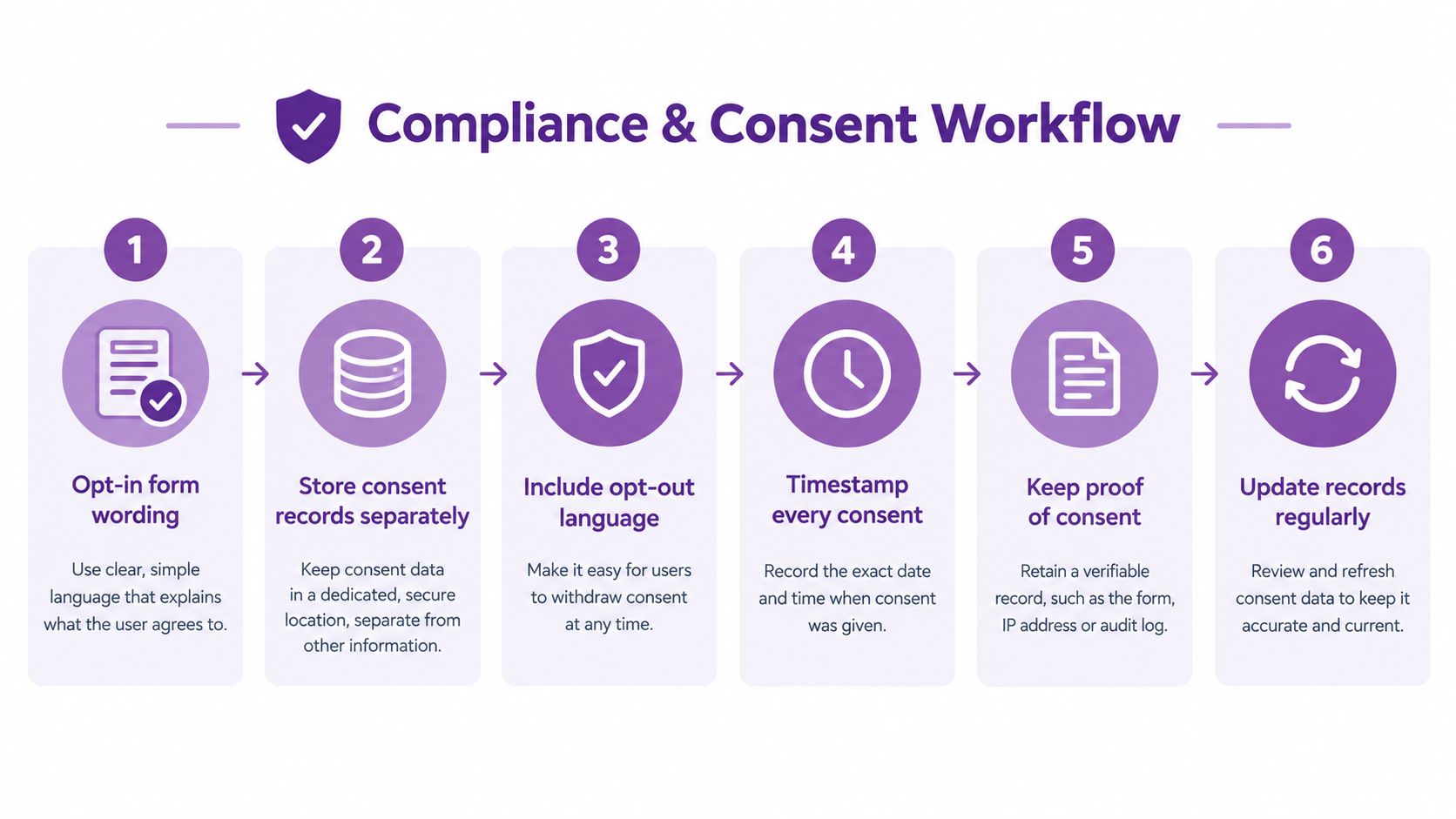
Compliance isn't a popup checkbox you set once and forget. It's a workflow that shows what the subscriber agreed to, when they agreed, and how your store will stop messaging them if they revoke consent. CTIA guidance distinguishes general messaging consent from express written consent for marketing messages, and says consumers must be able to revoke consent. For U.S. short-code programs, the first message after opt-in must be the confirmation message. (CTIA messaging principles and best practices)
Build the permission-and-delivery workflow
Use this operating procedure before launching a new SMS program:
Make the opt-in specific. Your call to action should identify the sender, describe the message purpose, state the expected frequency and applicable fees, and link or refer to program terms. For example: “Sign up for [Brand] promotional texts for product news and offers. Message frequency varies. Message and data rates may apply. Reply STOP to opt out. Terms apply.” Have qualified counsel review the language for the markets where you operate.
Store proof separately. Keep SMS consent distinct from ordinary checkout phone numbers. Record the phone number, timestamp, opt-in source, and form version so your team can establish what a subscriber saw and accepted.
Confirm the subscription. Send an immediate message identifying your brand and explaining how to opt out. For U.S. short-code programs, this must be the first message after opt-in.
Segment by permission and context. Group subscribers by lifecycle stage, purchase behavior, geography, and the purpose for which they consented. Send only content that fits that permission.
Make revocation operational. Maintain a dedicated suppression list, include STOP instructions in promotional messages, and test that opt-outs prevent future promotional sends.
Audit before launch. Check the form wording, stored consent evidence, confirmation message, segmentation rules, and opt-out behavior. A working message platform doesn't fix missing permission records; weak evidence can lead to complaints, filtering, and legal exposure.
For another perspective on permission-based follow-up in a regulated service context, see this guide to SMS strategy for law practices. Shopify merchants can also use this TCPA compliance checklist as a prompt for their own review, while getting legal advice where needed.
I'd test the entire opt-in-to-suppression path with an internal number before sending a promotional message to customers.
Automations vs One-Off Campaigns
A broadcast is easy to schedule, but it shouldn't be the first place you put your effort. Omnisend analyzed more than 246 million SMS campaign sends and 20 million automation sends from 27,000 brands. Its analysis reported 12.39% click-through and 0.12% conversion for campaigns, compared with 20.34% click-through and 0.78% conversion for automated SMS. Average revenue per message was $0.15 for campaigns and $0.75 for automations. (Omnisend SMS marketing benchmarks)
Those results support a practical priority: build the messages triggered by customer behavior before you increase promotional volume. A cart or checkout abandonment message reaches someone who has shown purchase intent. A replenishment reminder can reach a buyer when another order makes sense. A broadcast reaches a broader group, many of whom may not need that offer now.
Put the work in this order
Start with cart and checkout abandonment, with exclusions for completed orders. Then add viewed-product follow-up where the subscriber's consent and the flow design support it. Next, build post-purchase replenishment for products customers may buy again, followed by shipping and delivery updates where SMS is an appropriate service channel. Add broad promotional campaigns once the triggered messages have sensible rules and reporting.
Treat benchmarks as directional, not as a promise for your store. Automations and campaigns reach different audiences, so a high-intent flow can look more productive without proving that every conversion was caused by the text. Compare each flow's clicks, conversions, revenue per recipient, costs, and opt-outs. Use the results to decide whether it deserves more volume.
Transactional updates also need careful design. A merchant coordinating delivery communication across channels may find this overview of WhatsApp delivery notification for builders merchants useful when thinking through how customers receive order updates.
I would launch the highest-intent, consent-appropriate automations first, then judge broadcasts against incremental profit rather than their raw click count.
Building a Cart Recovery Flow That Actually Converts
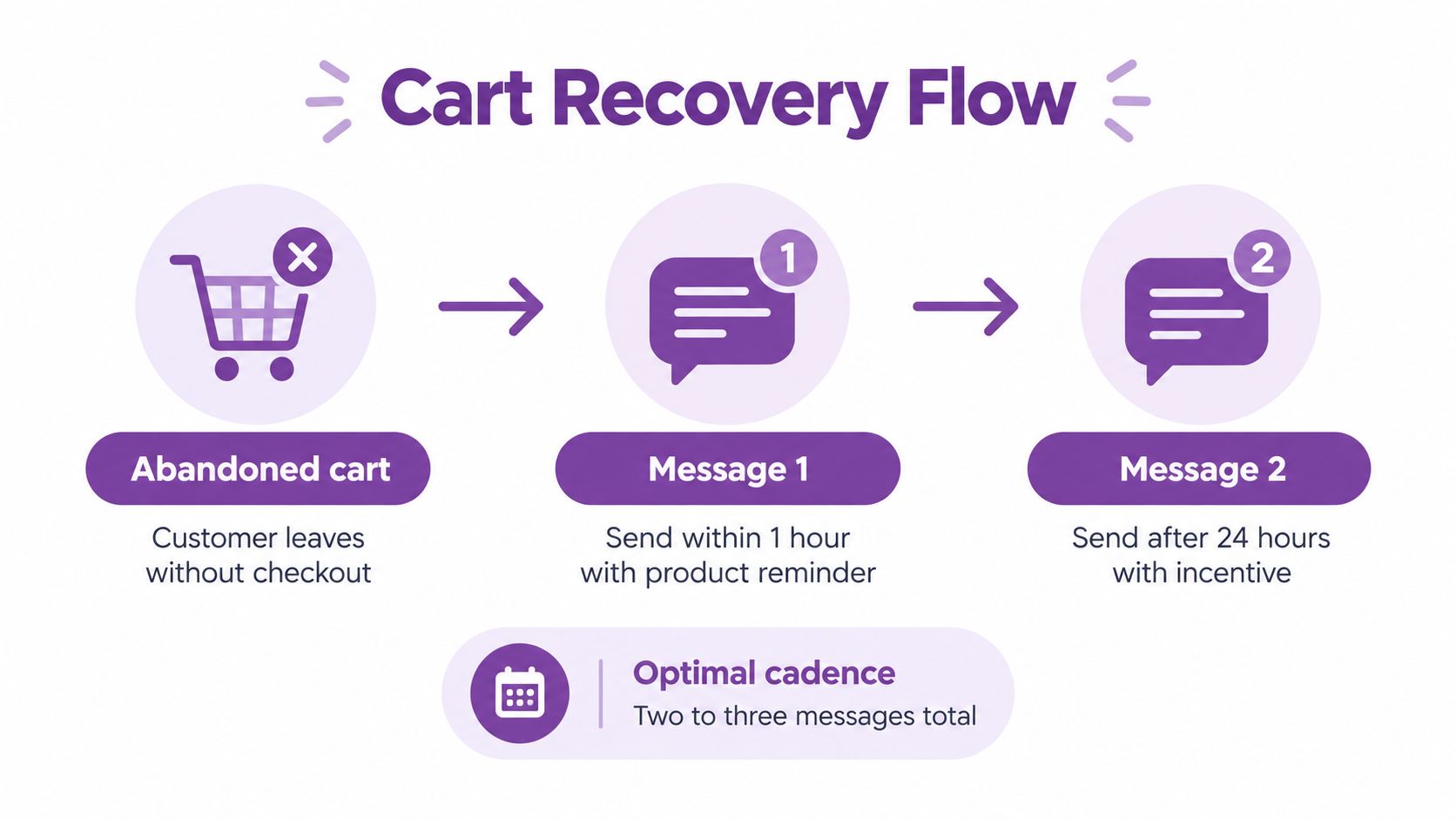
One cart reminder can be easy to ignore. A short sequence gives you room to remind the shopper, address a reason for hesitation, and reserve an incentive for people who still haven't ordered. Klaviyo's ecommerce help documentation, drawing on data from thousands of ecommerce customers, says two to three abandoned-cart messages produce optimal performance. (Klaviyo abandoned-cart guidance)
Use a three-message logic
Message one: remind, don't discount. Send a concise cart reminder after a reasonable delay. Link back to the cart so the customer can resume without searching for the product. The infographic suggests sending within an hour, but treat timing as a test variable, not a universal rule.
Message two: remove friction. If the shopper hasn't ordered, follow up with information that helps them decide. That could be a product detail, a delivery or returns clarification, or an invitation to ask a question. Don't send another generic nudge that adds no new value.
Message three: reserve the incentive. Only consider an offer for subscribers who remain inactive and are eligible to receive it. A discount can recover an order, but it can also train shoppers to wait for a coupon. Test whether the recovered contribution margin justifies the incentive rather than treating every saved cart as a win.
Before activating the flow, exclude customers who complete the order, prevent repeated reminders for the same cart, and apply a shared frequency cap so a cart message doesn't collide with browse or promotional sends. Test timing, incentives, and audience segments separately. Evaluate completed orders and revenue per recipient, not just clicks.
If you're building the automation in Shopify, use this cart abandonment campaign guide as a practical reference. The core principle stays simple: the sequence should become more persuasive only as the shopper remains inactive, not more repetitive.
I would do this: start with the reminder and friction-answer messages, then add an incentive only if the holdout test shows it earns back more than it costs.
Measuring Incrementality Instead of Just Clicks
A message can earn clicks and still fail to create additional sales. That's especially true for checkout abandonment: some shoppers may already intend to return and finish the purchase. If you credit every order after a text to SMS, you may mistake timing for causation.
Ask whether SMS changed the outcome
Use a holdout test. Randomly withhold a message from a control group that's large enough to support a meaningful comparison, then compare purchases and contribution margin between the group that received the message and the group that didn't. The key question isn't “How many people converted after the send?” It's “How many more purchases happened because we sent it?”
Calculate the difference in purchases or contribution margin between the exposed group and the holdout. Then subtract the costs that the campaign created, including message costs, discounts, refunds, and customer-support costs. Keep assisted revenue separate from last-click revenue so your report doesn't give one channel credit for the entire customer journey.
For example, a campaign could show a strong conversion rate and still lose money if the discount is deep, message costs are high, or most buyers would have purchased anyway. Don't invent a conversion benchmark to call that campaign successful. Compare the exposed and control groups, then examine unsubscribe rate and repeat-purchase behavior alongside sales.
Reporting rule: Separate what happened after a send from what happened because of a send.
For a closer look at the limits of last-click reporting, see this guide to last-touch attribution. It's a useful reminder to keep attribution claims aligned with what your test can establish.
This walkthrough offers a visual pause before you set up your own measurement approach.
Here is what I would do: keep a holdout group for important flows and report incremental contribution margin, not just attributed revenue.
Managing Frequency Without Burning Your List
Frequency is a contact-budget problem. A consumer survey summary reports that 53% of consumers cited being texted too often as their reason for opting out, compared with 21% who cited spam-like content and 11% who cited irrelevant messages. Another survey found message frequency was the most common question consumers had before opting in, at 28%. (Consumer survey summaries on SMS marketing)
A subscriber doesn't experience your Shopify automations as separate teams or workflows. They experience every text from your brand in the same inbox. If cart recovery, shipping updates, post-purchase messages, and a sale campaign all fire close together, your internal setup doesn't make the combined contact feel less frequent.
Set a shared contact budget
Define separate rules for promotional, transactional, and post-purchase messages. Transactional messages serve an order-related purpose; promotional sends compete for attention. Don't treat them as interchangeable, but do monitor the full stream customers receive.
Set a weekly promotional cap by segment, then suppress recent purchasers from offers that don't fit their status. Coordinate overlapping automations with shared suppression rules. If a customer has just received a cart reminder, pause a general promotion when the two messages would create an unnecessary pile-on.
Before scheduling a campaign, ask:
- Who qualifies? Check consent purpose, lifecycle stage, geography, and recent behavior.
- What else is scheduled? Review cart, browse, post-purchase, and promotional sends together.
- What's the customer's local time? Schedule with recipient time zones and applicable requirements in mind.
- What happens after a purchase or opt-out? Confirm the relevant flow stops or suppresses the number.
Track unsubscribes and complaints by segment and flow. If customers opt out after overlapping messages, fix the shared contact rules before rewriting the copy. I'd establish one contact-budget owner and make every automation check the same suppression rules before it sends.
Your Launch Checklist and First-Week KPIs
A launch checklist is useful only if someone can run it before pressing send. Keep it short enough to use, but strict enough to catch the failures that damage trust or distort your reporting.
Check these before the campaign goes live
- Consent evidence: Store opt-in records separately from checkout phone numbers, with the source, timestamp, and form version.
- Suppression behavior: Confirm STOP requests remove subscribers from future promotional sends.
- Frequency rules: Set caps by segment and coordinate overlapping automations.
- Measurement: Configure a holdout group for the campaign or flow you need to evaluate.
- Message content: Identify the brand, match the subscriber's consent purpose, and include STOP instructions in every promotional message.
In the first week, watch deliverability, click-to-sent rate, unsubscribe rate, and incremental revenue per recipient. Segment results by campaign or automation so a weak broadcast doesn't hide a useful recovery flow, and a strong click rate doesn't conceal poor profitability. Compare each result with the appropriate holdout where possible.
Don't widen the audience just because the first send gets clicks. Fix delivery problems, investigate opt-outs, and preserve the test long enough to make a fair comparison. Here's what I'd actually do: run the checklist with the person responsible for compliance and the person responsible for reporting, then review the four KPIs before increasing volume.
YipSMS Inc. offers Shopify merchants tools for opt-in popups, consent tracking, scheduled campaigns, and prebuilt automation flows for cart and checkout recovery. If you're ready to manage SMS around permission, shared frequency rules, and measurable results, visit YipSMS Inc. to explore the platform.
How this article was made: the YIPSMS team drafts some articles with AI writing tools, then checks pricing, compliance and product details against how YIPSMS actually works before publishing. Spotted something wrong? Tell us through your YIPSMS account.