10 SMS Marketing Examples That Drive Real Sales
The highest-performing SMS marketing examples are trigger-based flows, abandoned cart recovery, welcome, shipping notifications, and win-back, each tied to a specific moment in the customer journey, and the copy and timing matter more than the discount. Shoppers expect speed and relevance, with 57% wanting a business reply within 15 minutes, 74% wanting one within an hour, and 81% likely to ignore a text that isn't relevant.
Those reply and relevance figures come from a 2025 consumer-texting summary. The same summary reported that 86% of consumers opted in to business texts, up 20% from 2021, that 79% were more likely to buy from a business they subscribed to, and that 55% of UK consumers had purchased an item marketed by text. A blast that ignores that bar gets skipped.
Most stores still paste one promo across the whole list and then watch opt-outs climb. The texts worth copying are short conversations fired by a real event, a cart left behind, a signup, a carrier scan, a restock, or a quiet customer. The first SMS went out on December 3, 1992, and by 2012 worldwide traffic had passed 8.5 trillion messages, which is why one clear action still beats long copy, as the history of SMS makes obvious.
The ten flows below cover cart and browse recovery, welcome, shipping, restock and price alerts, flash sales, replenishment, cross-sell, VIP access, and win-back. Each one gives you the trigger, the timing window, the copy pattern, the metrics to watch, and a takeaway you can launch on Shopify the same day, without a developer.
Table of Contents
- 1. Abandoned Cart and Checkout Recovery Text
- 2. Browse Abandonment and Viewed Product Follow-Up
- 3. Welcome Series with Popup Opt-In Incentive
- 4. Post-Purchase Shipping and Delivery Notifications
- 5. Back-in-Stock and Price Drop Alerts
- 6. Flash Sale and Limited Drop Announcements
- 7. Replenishment and Repeat Purchase Reminders
- 8. Post-Purchase Cross-Sell with Personalized Recommendations
- 9. VIP and Loyalty Early Access Texts
- 10. Win-Back Campaign for Lapsed Customers
- 10 SMS Marketing Examples Comparison Table
- Your First SMS Flow This Week
1. Abandoned Cart and Checkout Recovery Text
Send the first text inside the first hour after a cart or checkout is left unfinished, then one more later that day or the next morning. The later text carries the stronger nudge, a deadline or a small incentive, not both stacked in every send.
The shopper already picked the product. Your job is to remove friction, not to restart the pitch.
What to send
- Trigger: cart or checkout abandoned after a phone number and marketing consent are already on file.
- Copy: product name, a link that restores the saved cart, and one next step.
- Hold the promo: if they left over shipping cost, test shipping thresholds with Cedar & Lily Clothier before you discount the item.
- Metrics: recovered revenue, conversion rate, and opt-outs on this flow alone.
Cart exit and checkout exit aren't the same leak. Split them using cart abandonment versus checkout abandonment so the second text matches where they stopped.
Monsoon paired category targeting with automated cart and welcome flows and attributed a 20% revenue increase to SMS against a holdout. Wedding-category texts hit a 10.2% click-through rate and an 18.5% conversion rate. Welcome automation averaged a 15% conversion rate, and abandoned-cart messages averaged 19%. A £10 reminder did 13% CTR and 45% CVR. A £40 reminder did 16% CTR and 57% CVR. Bigger money moved the rate, and it also trains people to wait if you lead with it every time.
Practical rule: Prior express written consent has to exist before the cart event. A webhook doesn't create permission to text. If the consent record is incomplete, don't send a promo.
2. Browse Abandonment and Viewed Product Follow-Up
Someone opened a product page, often more than once, and never added it. That's interest, not a buying decision. Treat the text like a clerk who noticed what they held, not like a closer.
Trigger, window, copy
Fire it on product views inside a set window, and only for people already opted into marketing. Wait longer than you would for a cart, typically several hours, so you aren't texting someone who is still on the site. Name the product, add one benefit or a bestseller note, and link the product page. Skip the hard deadline on the first touch.
- Segment: category or repeat views, not the entire list.
- Tone: a softer nudge than cart recovery. One product, one link.
- Stop rule: no second browse text if they didn't click the first.
- Metrics: click rate, conversion rate, and unsubscribes per send. Volume only matters if opt-outs stay flat.
Viewing a page doesn't mean they want a pitch. If the same person hits three categories in an hour, pick the one they viewed most and ignore the rest. Over-messaging here is how a useful reminder starts to feel like surveillance.
A smaller audience who viewed the item twice will beat a blast to everyone who bounced.
3. Welcome Series with Popup Opt-In Incentive
A welcome series sets the quality of the list. Trigger it as soon as someone completes a popup opt-in. Send the incentive and brand introduction first, then follow up the next day with texting frequency and opt-out instructions. A third message can feature a bestseller instead of another coupon. State on the form that messages are recurring and automated, and link the terms and privacy policy. Save the signup timestamp, source, and exact consent wording.
Trigger: successful SMS opt-in. Timing: first message immediately, second the next day, then a product-focused message. Copy: deliver the promised offer, identify the brand, explain message frequency and how to stop texts, then show one relevant product. Watch first-order conversion, series opt-outs, and revenue by flow. This gives a store owner a runnable starting point without making every welcome message a discount.
A phone number collected at checkout, or an email checkbox, does not grant SMS marketing consent. The FCC's commercial texting rules require written consent for commercial texts to wireless numbers, and the Telephone Consumer Protection Act treats texts as calls. Use a separate SMS permission checkbox on the popup, loyalty signup, or post-purchase page.
YipSMS supports the popup-to-flow handoff on Shopify. To start without a day-one coupon, use these text signup ideas without a forced discount.
Over four months, BulkSupplements added 85,000 SMS subscribers and $853,000 in attributable revenue. Its welcome flow generated $437,000, abandoned cart $216,000, and promotions $136,000, according to its SMS program results. Those figures put about 51% of revenue in lifecycle automation, about 25% in cart recovery, and about 16% in promotional sends. Build the welcome flow before increasing broadcast frequency.
Track subscriber growth, first-order conversion, opt-outs from the series, and revenue by flow. A large list that never enters a sequence adds cost without doing the work.
4. Post-Purchase Shipping and Delivery Notifications
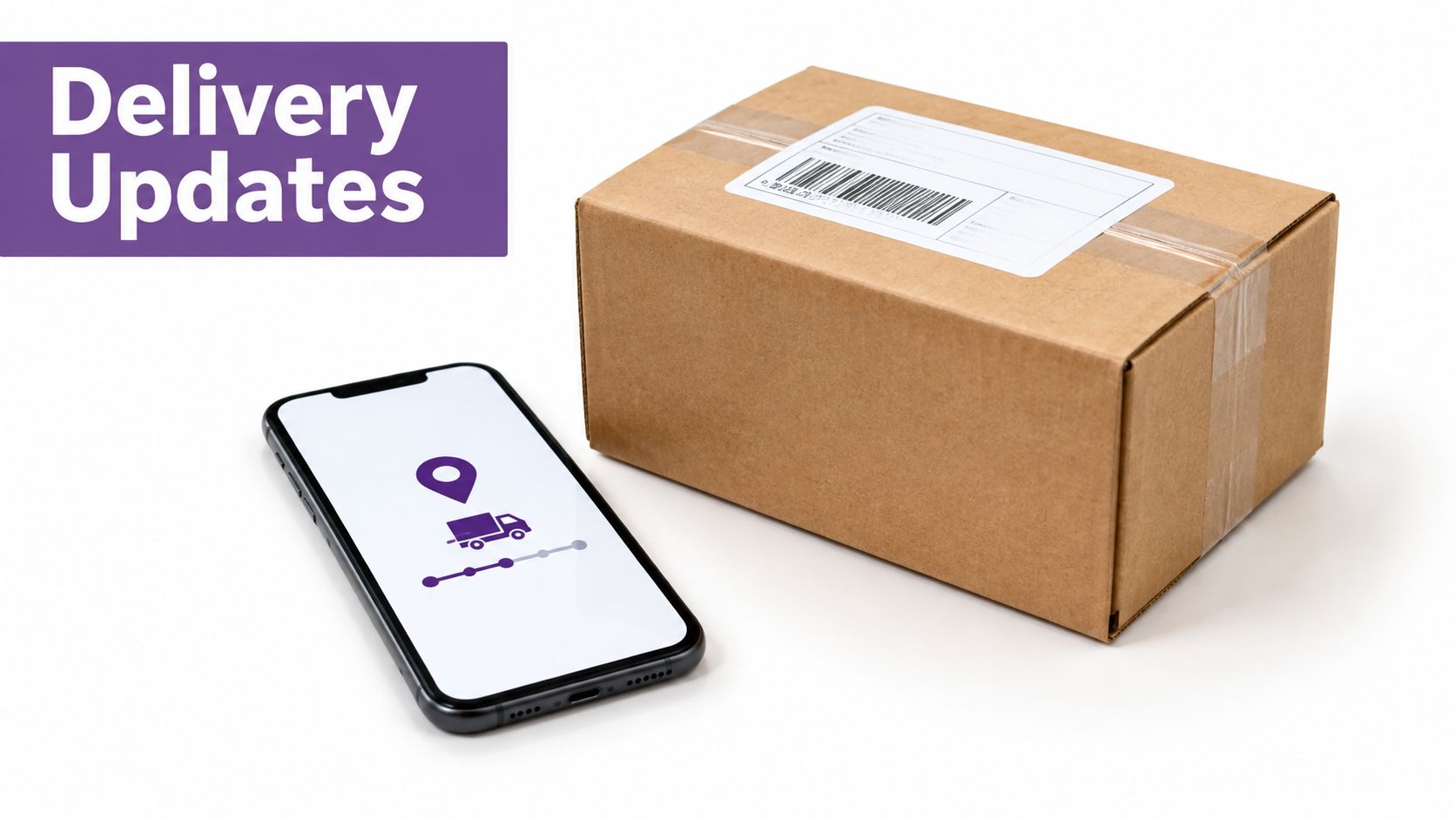
These texts earn trust because the customer is waiting on them. Order confirmed, shipped, out for delivery, delivered. Keep each one to the order number, a tracking link, and a plain status line.
Trigger them from fulfillment and carrier updates, not from your promo calendar. Brand the sender name so it doesn't look like a random short code. Don't fold a sale into the same bubble as "your package is on the truck."
Keep the permission narrow
Express consent covers only the purpose it was given for, and it doesn't extend to other products or other companies, which is the line in CTIA messaging principles. An order-status signup can carry shipping updates. It shouldn't enroll someone in a sale sequence without them realizing.
- Flags to store: transactional, promotional, replenishment, and anything third-party, each captured with its own disclosure.
- Metrics: delivery rate, support tickets that mention tracking, and opt-outs after a status text. A spike in tickets usually means the carrier feed is late, not that the copy failed.
- Cross-sell later: wait until after delivery, in a separate flow, so the tracking text stays useful.
If carrier data lags, say the status you have. A wrong "delivered" text creates more tickets than it prevents.
5. Back-in-Stock and Price Drop Alerts
This flow converts demand you already lost to a sold-out size or a price the shopper wouldn't pay. They asked, or they viewed that exact variant. The text should sound like news, not a campaign.
Trigger on an inventory change or a price change for subscribers who requested the alert or viewed the item. Limit it to the size, color, or variant they cared about. Link straight to that variant. Send as soon as the sync is trustworthy, then cap repeats so a noisy stock feed doesn't text them every hour.
Copy that doesn't train waiting
- Restock: "The navy runner in your size is back. [link]." No code required when stock is thin.
- Price drop: name the new price and the product. Use it rarely, or shoppers learn to wait.
- Metrics: alert-to-purchase rate, time from text to order, and complaints about items that were already gone.
- Guardrail: if inventory sync is sloppy, don't launch. A false restock burns the list faster than silence.
One alert per subscriber per restock cycle. A second text only if a new size they wanted comes back.
6. Flash Sale and Limited Drop Announcements
Use a scheduled send for a real event, a seasonal sale, a drop, or a short early-access window. If every Tuesday is a "flash," subscribers learn to ignore you.
One deadline or one quantity limit. One link to the sale or the product, not the homepage. Segment by recent engagers and past buyers first. Quiet subscribers can get a shorter version, or none.
Before you hit send
- Inventory: confirm you can fulfill the spike. Overselling turns a win into refunds.
- Copy: "Ends tonight at 9. 20% off outerwear. [link]." Nothing else.
- Frequency: a few true events a season, not a weekly habit.
- Metrics: revenue per delivered message, margin after the discount, and the unsubscribe rate in the 24 hours after the send.
Deep discounts feel fast and often aren't profitable. Run the same announcement three ways on a slice of the list, a broad code, a no-discount reminder to recent viewers, and a high-margin recommendation. Keep the version that wins on profit, not on clicks.
7. Replenishment and Repeat Purchase Reminders
Consumables pay the bills on the second order, not the first. Supplements, skincare, coffee, pet food, and cleaning supplies have a cycle. Time the text to that cycle, not to your promo calendar.
Trigger off days since purchase, or off a stated lifespan if you have it. Include a one-click reorder link. Offer a bundle or subscription only after the straight reorder is clear. If you don't know the cycle, start with a conservative window and read the replies, not a guessed "30 days" for every SKU.
What works and what doesn't
- Good: "Your protein tub is about due. Reorder the same one: [link]."
- Bad: a reminder a week after delivery, or any replenishment text on a one-time gift item.
- Segment: product type and past interval. A 90-day buyer shouldn't get a 30-day nag.
- Metrics: repeat purchase rate, days between orders, and opt-outs tied to this flow.
Wrong timing feels nosy. Right timing feels like you remembered. If unsubscribe on this flow beats your other automations, the window is off, so lengthen it before you add a discount.
8. Post-Purchase Cross-Sell with Personalized Recommendations
Wait until the order is delivered, or a set number of days after purchase, then recommend one complementary product based on what they bought. A second text is optional. Two recommendations is the ceiling.
Relevance is the whole game. "Customers also bought" from the same order history beats a sitewide bestseller. A limited incentive is fine on the second touch, not the first. Too soon, and it feels like you cashed the first sale and immediately asked for another.
The logic for picking that single item is the same discipline as personalized product recommendations. One link. The product name. A reason tied to the original purchase.
- Trigger: delivered, or day 7 to 14 for items they need to try first.
- Data you need: category relationships and a real purchase, not a single page view.
- Metrics: attach rate, average order value on the follow-up, and unsubscribe rate.
- Kill switch: if the recommendation isn't in stock or isn't clearly related, don't send.
Irrelevant add-ons teach people that your texts are ads. Relevant ones raise order value without a new customer acquired.
9. VIP and Loyalty Early Access Texts
Top customers don't need a deeper discount. They need to hear about the drop before everyone else. Build the segment on spend, order count, or loyalty tier, and text that group hours or a day before the public send.
Use a personal tone and an access link or a code that expires when the public sale starts. Thank them without groveling. If you don't have a real tier, don't fake one. A "VIP" text to half the list is just a blast with extra words.
How to run it
- Who: a small high-spend or high-frequency slice you can explain in one sentence.
- When: before the public announcement, with a clear end to the early window.
- Copy: "You're in early. The new drop is live for you until 10 a.m. [link]."
- Metrics: revenue from the early window, repeat rate of this segment, and complaints from people who weren't included.
Exclusivity fails when the public gets the same code an hour later, or when non-members see the sale and feel shut out with no path to join. Publish the rule for how someone gets on the list. Early access protects margin only if the public offer comes later, not secretly identical.
10. Win-Back Campaign for Lapsed Customers
Pick a quiet window that matches the product, often somewhere between a few months and half a year, and text people who bought before and then stopped. Lead with what's new. Hold the discount for a later step, or for the slice that has been quiet the longest.
A short sequence beats one desperate coupon. Message one is a product or update. Message two, several days later, is a narrower offer if they didn't click. Then stop. Segment by past category and past spend so a high-value lapsed buyer doesn't get the same text as a one-time bargain hunter.
Consent still applies on the way out
- Trigger: no purchase inside your window, and a live marketing opt-in.
- Metrics: reactivation rate, revenue per message, and complaint rate. Low clicks with low opt-outs can still be worth a light touch. Complaints are not.
- Opt-out: honor STOP, END, CANCEL, QUIT, and UNSUBSCRIBE, confirm once with no sales pitch, and suppress the number everywhere. CTIA's messaging principles treat anything after that opt-out as unsolicited. Coming back requires a fresh yes.
Don't mail the dead part of the list a "last chance" after they already quit. That's how a win-back becomes a compliance problem.
10 SMS Marketing Examples Comparison Table
| SMS Example | 🔄 Implementation Complexity | ⚡ Resource Requirements | 📊 Expected Outcome | ⭐ Ideal Use Case & Key Advantage |
|---|---|---|---|---|
| Abandoned Cart and Checkout Recovery Text | Low–medium; automated trigger and timed sequence | Cart data, captured phone number, consent, recovery link | Recovers high-intent shoppers and otherwise lost sales | Shoppers who leave items in cart; direct cart links reduce checkout friction |
| Browse Abandonment and Viewed Product Follow-Up | Medium; product-view tracking and suppression rules | Product-view data, traffic, opt-ins, product links | Converts early-stage interest into purchases | Shoppers who viewed products but did not add them to cart; enables relevant, category-based nudges |
| Welcome Series with Popup Opt-In Incentive | Low–medium; signup capture and short automated sequence | Popup tool, consent language, welcome offer, subscriber data | Grows the SMS list and encourages first purchases | New subscribers; sets expectations and introduces the brand from the first message |
| Post-Purchase Shipping and Delivery Notifications | Low–medium; fulfillment and carrier-status triggers | Order and tracking data, transactional messaging setup | Reduces delivery inquiries and improves customer confidence | Customers awaiting orders; provides timely, expected status updates |
| Back-in-Stock and Price Drop Alerts | Medium; inventory or price-change integration | Accurate product data, alert signups, variant-level inventory | Converts demand for restocked or discounted products | Shoppers interested in unavailable or wishlisted items; reaches high-intent buyers quickly |
| Flash Sale and Limited Drop Announcements | Low; scheduled bulk campaign and audience segmentation | Subscriber list, campaign calendar, inventory readiness | Drives rapid traffic and short-term sales spikes | Seasonal promotions, launches, or limited drops; reaches many subscribers quickly |
| Replenishment and Repeat Purchase Reminders | Medium; purchase-history triggers and timing rules | Order history, usage-cycle estimates, reorder links | Increases repeat purchases and customer lifetime value | Consumables with predictable usage cycles; makes reordering convenient |
| Post-Purchase Cross-Sell with Personalized Recommendations | Medium–high; product relationships and purchase-based personalization | Purchase data, product catalog, delivery status | Increases average order value through complementary products | Customers after delivery; relevant recommendations extend the value of an order |
| VIP and Loyalty Early Access Texts | Medium; customer scoring and segment management | Reliable loyalty or purchase data, exclusive links or codes | Strengthens retention and engagement among top customers | VIP and loyalty segments; rewards customers through exclusivity rather than broad discounts |
| Win-Back Campaign for Lapsed Customers | Medium; inactivity rules, segmentation, and sequence setup | Purchase history, inactivity data, targeted content or offers | Re-engages past buyers and identifies responsive segments | Customers inactive for a product-appropriate period; can recover revenue at lower cost than acquisition |
Your First SMS Flow This Week
Pick the first flow based on where your store loses the most revenue. If shoppers hesitate at checkout, start with abandoned cart recovery after confirming consent. For consumables, build replenishment alongside the welcome flow. If sales depend on product drops, set up welcome messages and one planned flash event. Clean up popup permissions before launching any flow if your consent records are incomplete.
For the first 30 days, measure each flow separately. Track revenue per delivered message, conversion rate, opt-out rate, and repeat purchase rate. Benchmark data puts median SMS revenue per message at $0.98 and the 90th-percentile result at $4.54. Subscriber acquisition rates range from about 0.45% at the 25th percentile to 5.22% at the 90th percentile, according to SMS benchmark data. If a flow is near the lower end, review its audience and offer before increasing send volume.
Set triggers and timing windows around customer actions. Start with welcome messages and consent capture, then cart and checkout recovery. Keep shipping messages transactional. Add browse follow-ups, restock alerts, and replenishment reminders when their triggers and timing are clear. Test delivery messages before adding post-purchase recommendations. Reserve VIP access and flash events for engaged subscribers. Use win-back messages for past buyers who have gone quiet, not subscribers who have never purchased.
For each flow, document the trigger, delay, and copy pattern. A cart message should link to the saved cart; a restock alert should link to the available product. Watch delivered revenue, conversion, opt-outs, and repeat orders to see which step needs work. Test one change at a time, such as the delay or opening line, and keep a holdout group to measure incremental revenue rather than last-click sales.
The FCC's consent-revocation rules allow up to 10 business days to honor a revocation. Suppress opted-out subscribers promptly so queued promotions do not arrive after STOP. YipSMS Inc. offers Shopify tools for popups, automated flows, and scheduled sends. To turn planned campaigns into message briefs, an AI listicle builder for DTC brands can help organize event ideas before you write the copy.
How this article was made: the YIPSMS team drafts some articles with AI writing tools, then checks pricing, compliance and product details against how YIPSMS actually works before publishing. Spotted something wrong? Tell us through your YIPSMS account.