What Are SMS Fees? a Merchant's Cost Guide for 2026
An SMS fee starts with each billable message segment, then adds carrier surcharges and any fixed registration or number costs. For a U.S. merchant, Twilio's listed reference charges include a base rate of $0.0083 per segment, plus outbound carrier fees of $0.0035 per segment for AT&T and $0.0045 per segment for T-Mobile.
A quoted per-text price is the smallest line on the bill. When forecasting a Shopify campaign, check the full sending cost: one long message can become multiple billable segments, while routing, registration, number, or failed-send fees can add further charges. Like pieces in a stack, each cost builds on the quoted rate.
Table of Contents
- What an SMS Fee Actually Covers
- How Message Length Multiplies Your Bill
- How Sender Type Changes What You Pay
- Hidden Fees Most Quotes Leave Out
- How to Estimate and Cut Your SMS Costs
- Compare Quotes and Confirm the Full Cost
What an SMS Fee Actually Covers
A Shopify campaign quote may show one small per-message price, while the bill adds charges for the provider, mobile carriers, registrations, and other services. The quoted rate is only one part of the cost. To read the bill correctly, first separate what your store pays to send application-to-person (A2P) messages from what a phone subscriber pays to send personal texts.
The fee stack changes by destination country, carrier, message type, route, volume, and message length. There is no single global rate. The historical overview of mobile messaging prices describes consumer pricing models such as per-message charges, monthly flat fees, and messages included at no extra cost to selected numbers. Commercial A2P rates can differ from consumer prices, and a long text may count as multiple messages.
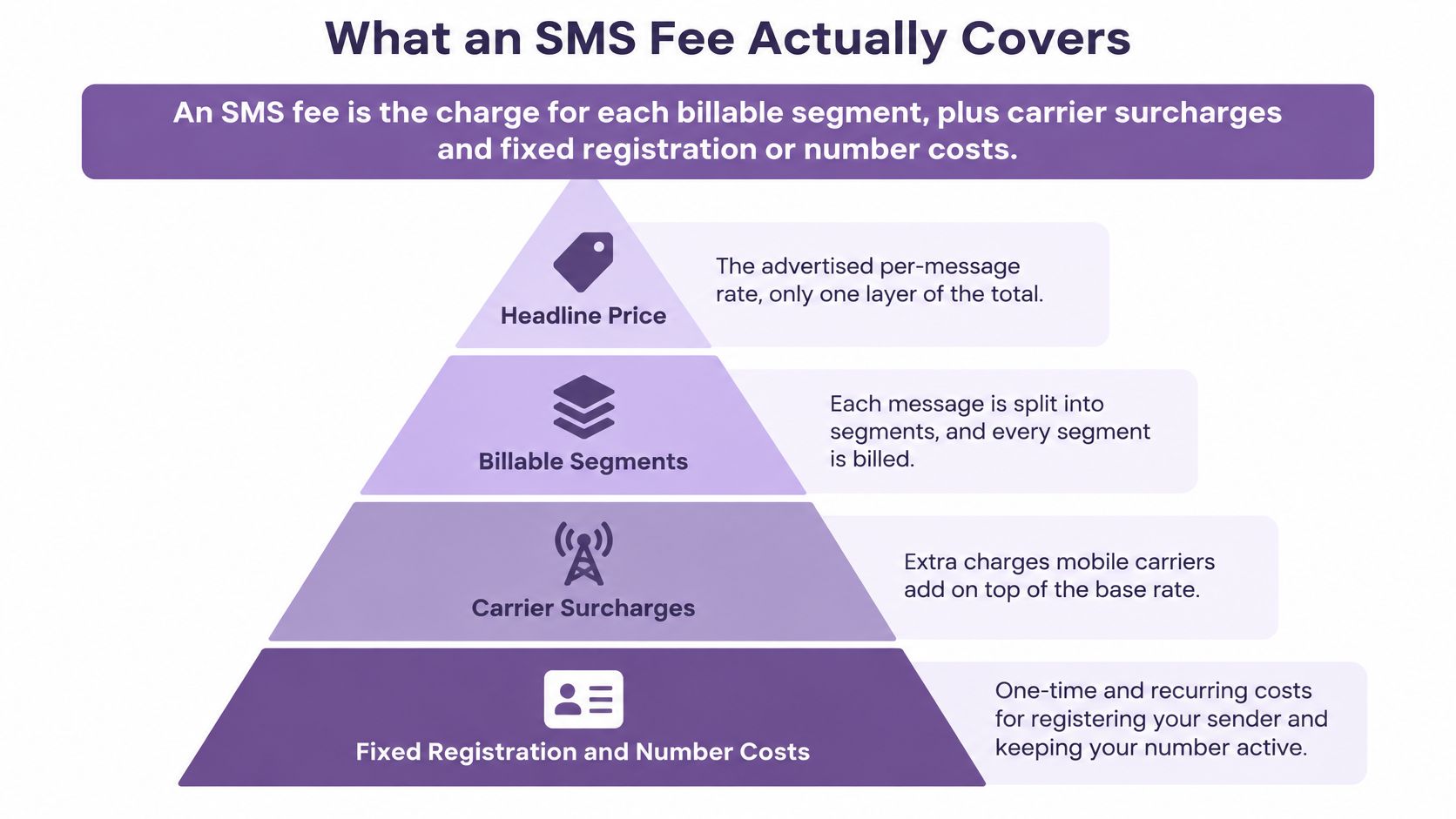
Read each line of a U.S. business bill as a different layer of the cost:
| Fee component | Who charges it | How it is billed | Reference value |
|---|---|---|---|
| Provider rate | Your SMS provider | Per billable segment | From $0.015 per SMS at YipSMS's stated starting rate |
| Base transport rate | Provider and upstream routes | Per outbound segment | Provider-specific |
| Carrier surcharge | Recipient's mobile carrier, passed through | Per outbound segment | Varies by carrier |
| A2P 10DLC registration | Brand and campaign registration | Fixed and recurring campaign charges | Set by the registration and campaign fee schedule |
| Failed-message fee | Provider | Per message ending in Failed status | Provider-specific |
| Number rental | Provider | Monthly per sending number | Set by the provider and number type |
The provider rate is the amount charged for sending; carrier surcharges are passed through for delivery to the recipient's network. Registration and number rental are separate costs, while a failed-message charge may apply based on the message status. Ask whether the quote includes each line before comparing offers. A low per-segment rate can still leave carrier and account costs outside the headline price.
Total cost = billable segments × base rate + carrier fees + registration and platform fees. This formula shows why the quoted per-SMS price is only the starting point: the full bill also depends on how many segments are sent and which additional charges apply.
How Message Length Multiplies Your Bill
The source of many unexpectedly high campaign bills is simple: providers generally charge by SMS segment, not by the complete message you see on screen. A standard GSM-7 segment holds up to 160 characters. A message using Unicode, including emoji or many non-Latin characters, typically holds 70 characters; when a long message is joined across segments, the effective limits fall to about 153 GSM-7 or 67 Unicode characters per segment. Twilio's SMS pricing documentation confirms per-segment billing and notes that rates depend on destination and sender type.
That boundary can change a campaign's cost in one character. A 161-character GSM-7 reminder is two segments, while a 141-character Unicode message is generally three. A URL, a customer's name, or an emoji can push the final text over a limit, so the message that matters is the rendered version, not the draft template.
The table uses Twilio's U.S. base rate plus the listed outbound carrier fee. These are calculated costs for 1,000 recipients, before any fixed charges.
| Message | Segments | AT&T total | T-Mobile total |
|---|---|---|---|
| Plain text, 160 GSM-7 characters, AT&T recipient | 1 | $11.80 | Not applicable |
| Plain text, 160 GSM-7 characters, T-Mobile recipient | 1 | Not applicable | $12.80 |
| Plain text, 161 GSM-7 characters, AT&T recipient | 2 | $23.60 | Not applicable |
| Two full GSM-7 segments, 306 characters, AT&T recipient | 2 | $23.60 | Not applicable |
| Emoji message, 70 Unicode characters, AT&T recipient | 1 | $11.80 | Not applicable |
| Emoji message, 141 Unicode characters, AT&T recipient | 3 | $35.40 | Not applicable |
The calculation for each AT&T segment is $0.0083 + $0.0035, or $0.0118. For T-Mobile, it's $0.0083 + $0.0045, or $0.0128. A long letter needs more postage even if it still looks like one letter in the composer. Use a character-count guide for SMS when drafting, then preview the final message in your provider's composer, count its segments, and only then multiply by recipients.
How Sender Type Changes What You Pay
Your sender type affects the fixed costs you carry and the per-message charges you pay. In the United States, a business sending through standard 10-digit numbers may use A2P 10DLC, the carrier framework for application-to-person traffic. The Twilio carrier-fee guidance describes a layered bill: provider transport, carrier-imposed charges, and A2P 10DLC brand and use-case registration. Carrier fees generally apply to every outbound segment, and some carriers also charge for inbound traffic.
The main options don't have identical provisioning or pricing:
- Registered 10-digit long codes: These suit stores that want to send from a standard local-looking number. Registration adds campaign costs, and your use case needs to reflect the messages you send.
- Toll-free numbers: These follow a different provisioning and pricing model. Ask for the total, including number costs, carrier fees, and any verification requirements.
- Short codes: These have their own provisioning and pricing structure. They may suit a high-volume promotional program, but compare the fixed commitment with the expected per-segment cost before switching.
Registration affects delivery operations as well as billing. Unregistered 10DLC traffic can incur additional carrier fees and receive lower throughput, meaning messages may not send at the capacity you expect. Keep promotional messages separate from transactional notifications, and make each campaign description match its real traffic. For a closer comparison of the number options, see this guide to long codes versus short codes.
Ask every provider: Are carrier pass-through fees included? Are A2P registration and number rental billed separately? Are inbound replies, including STOP or HELP messages, charged?
Low-volume stores often prefer a per-message route without a large fixed lease. High-volume promotional senders should compare the full per-segment cost with the fixed costs of another sender type. The right choice depends on your traffic, your message patterns, and what the quote really includes.
Hidden Fees Most Quotes Leave Out
For a Shopify store, the quoted per-SMS rate is only the smallest line on the bill. A campaign can also trigger carrier pass-through charges, registration costs, or fees tied to inactivity and noncompliant traffic. These are different from the routine cost of sending a message, so check what event triggers each charge before comparing quotes.
The T-Mobile 10DLC fee guidance lists specific pass-through charges. Treat them as possible costs tied to campaign status or traffic, not as the price of every message.
| Event | Typical charge | Trigger | Prevention |
|---|---|---|---|
| Campaign with no associated number for 60 days | $250 non-use fee | Inactive registered campaign | Keep an active linked number or retire the campaign |
| Certain grey-route traffic | $10 per message | Traffic routed outside approved channels | Use registered sender routes only |
| Specified text-enablement or content violation | Up to $10,000 | Noncompliant content or enablement | Enforce prohibited-content rules and consent checks |
| Message ends in Failed status | Provider per-message fee on failed sends | Carrier or number rejects delivery | Clean invalid numbers before sending |
| Unregistered 10DLC traffic | Carrier fees for unregistered traffic | No brand or use-case registration | Register the brand and each use case before high volume |
| Inbound replies on some U.S. carriers | Carrier charge for inbound SMS or MMS | Carrier bills inbound messages | Ask whether inbound is included |
A seasonal store should check that its number remains associated with an active campaign when promotions pause. Otherwise, campaign inactivity can lead to a non-use fee. Agencies managing multiple stores should also confirm who owns each sender, campaign, and consent record. Unclear ownership, weak registration, or poor consent controls can turn a low quoted rate into a more expensive route.
Make a regular billing check part of campaign operations. Review campaign status and sender verification, test opt-out handling, and check content rules before publishing a template. For setup details, use this 10DLC registration guide alongside your provider's current fee schedule. A quote is easier to compare when you can match each line item to the event that triggers it.
How to Estimate and Cut Your SMS Costs
The per-SMS rate is only the starting line on the bill. Estimate your total by counting eligible recipients, calculating how many segments each rendered message uses, and adding the charges attached to its route.
Count sendable recipients. Use subscribers who consented and remain active, rather than your full list. This ties the estimate to people you can message.
Map each message flow. List abandoned-cart texts, shipping updates, promotions, support replies, and STOP or HELP responses. Separating flows helps you estimate their different volumes and billing patterns. Plan post-purchase texts separately from promotions so each message has a clear purpose.
Measure the rendered text. Count URLs, personalization fields, and emoji. A draft that fits in one segment may cross a boundary when a name or link is inserted.
Calculate the full cost. Multiply recipients by segments and the applicable per-segment rate, then add fixed registration and number costs. If the rate is split, include both the provider rate and carrier fee. Allow for failed sends and inbound replies if your provider charges for them.
For example, 5,000 consented recipients receiving a two-segment promotion over AT&T would cost 5,000 × 2 × ($0.0083 + $0.0035) = $118 before fixed costs. The quoted per-message rate can look small, but segment multiplication and carrier fees build the actual send cost. If an emoji pushes the message to three segments, the calculation becomes 5,000 × 3 × $0.0118 = $177, or $59 more for that send.
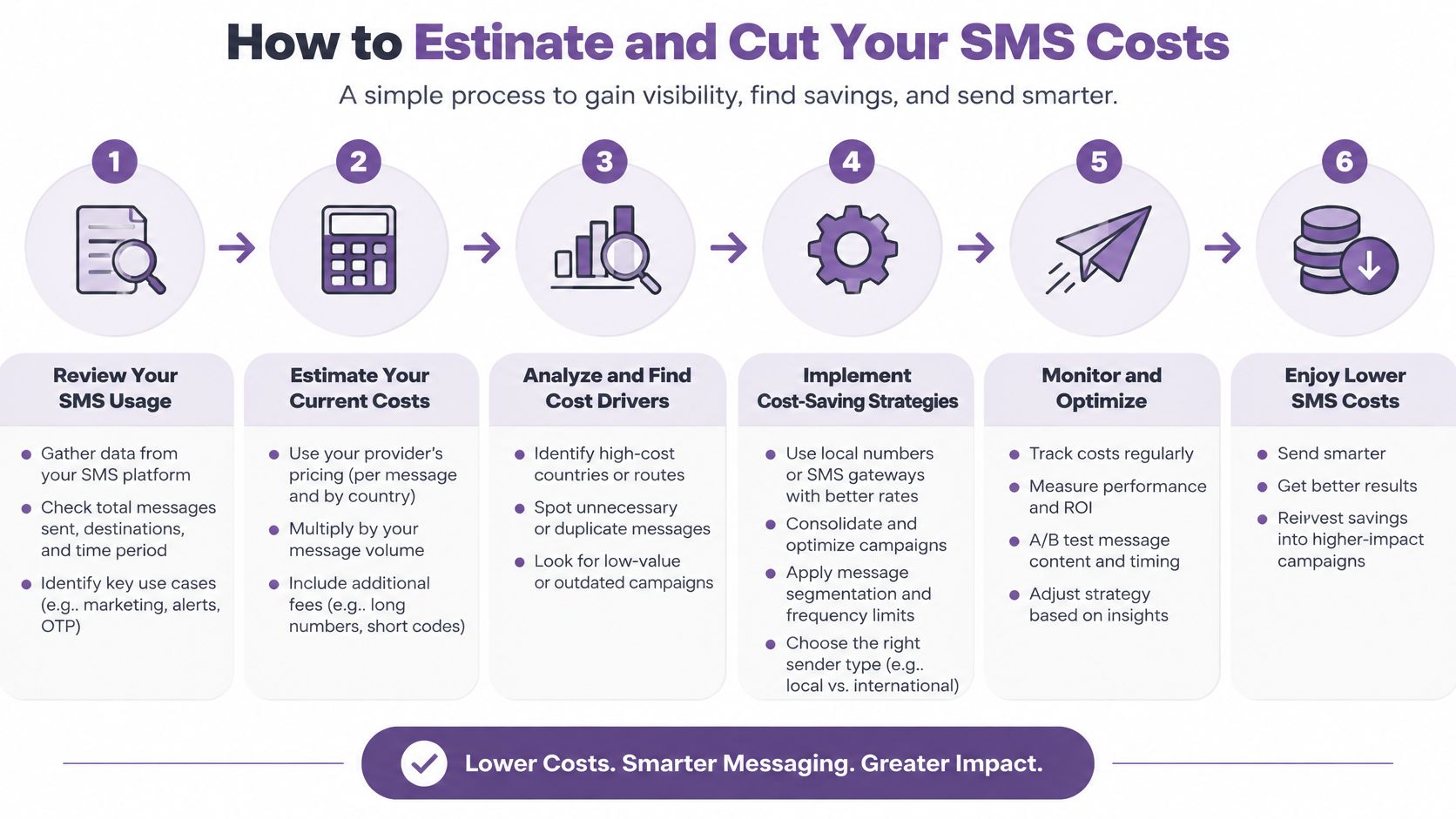
Trim copy where it makes sense. Keep routine promotions concise, remove repeated phrasing, use shorter links, and avoid unnecessary emoji. Fewer segments mean fewer billed units.
Clean the list and target deliberately. Remove invalid numbers, suppress hard bounces and opt-outs, and send relevant offers to recent buyers instead of the entire audience. That reduces wasted sends.
Separate traffic and register use cases. Keep transactional and promotional messages distinct, and make campaign registration match the messages you send. This aligns your setup with the traffic and throughput requirements.
Review performance each month. Track failed-message counts, segments per campaign, cost per recipient, and revenue per send. YipSMS provides real-time analytics, which can help you compare campaign costs with results and see whether a lower bill also affects outcomes. For relevant post-purchase follow-up, consider automated review requests as a separate message flow.
Compare Quotes and Confirm the Full Cost
A starting rate is a useful point of comparison, but it isn't automatically the amount you'll pay per delivered customer message. YipSMS lists a starting rate of $0.015 per SMS, offers a 14-day free trial, and claims 97% deliverability. Confirm what the rate includes, especially carrier pass-through fees, registration, and routing. A headline price may bundle some charges while another provider lists them separately.
The table converts several rates to the cost of 10,000 single-segment messages. Twilio's U.S. SMS pricing page lists its base rate and the AT&T and T-Mobile carrier fees shown below.
| Pricing line | Rate | What to confirm |
|---|---|---|
| YipSMS starting rate | $150 at $0.015 per SMS | Whether carrier fees and registration are included |
| Twilio base rate only | $83 at $0.0083 per segment | Provider margin and routing not shown |
| Base plus AT&T carrier fee | $118 at $0.0118 per segment | Whether the carrier fee is passed through |
| Base plus T-Mobile carrier fee | $128 at $0.0128 per segment | Recipient network mix in your list |
| Registration and number rental | Set by the registration and number fee schedules | Billed separately or bundled |
These are not like-for-like quotes. The Twilio reference calculation includes its stated base rate, but excludes provider margin, registration, and number rental. The YipSMS starting rate may include some costs, so ask for an itemized estimate before treating the totals as directly comparable.
Send each provider the same questions in writing:
- Are carrier fees included in the quoted price or passed through separately?
- Are registration and number rental charged separately, or bundled?
- Do you charge for inbound replies?
Then check how failed messages are billed, what happens if you pause a campaign or unlink a number, and how the provider counts long messages and emoji. A provider should be able to explain how the final text is segmented and show the resulting billable count.
Choose based on the shape of your traffic. If your store mostly sends short transactional messages, compare per-message prices and avoid a large fixed cost you won't use. If your promotions run long or use many emoji, compare segment counts before headline rates. If you manage several stores, confirm how sender, registration, and carrier costs are assigned to each client.
Before committing, run a one-week test on the 14-day free trial using real campaigns. Export segment counts and charges, compare them with your estimate, and verify the invoice lines against the provider's written answers.
YipSMS Inc. offers Shopify SMS marketing tools, including campaign and automation features, with a 14-day free trial and rates starting at $0.015 per SMS. Visit YipSMS Inc. to review the pricing and test your own message costs before you commit.
How this article was made: the YIPSMS team drafts some articles with AI writing tools, then checks pricing, compliance and product details against how YIPSMS actually works before publishing. Spotted something wrong? Tell us through your YIPSMS account.