Best Black Friday Shopify Sales App for CRM and SMS
At a glance
Best Black Friday Shopify Sales App picks, CRM segments and SMS timing for holiday sales, plus how YipSMS starts texting within minutes of signup.
Shopify merchants generated $14.6 billion in global sales during the 2025 Black Friday and Cyber Monday weekend, a 27% jump from the prior year, according to Shopify's 2025 BFCM press release. Across those four days, more than 94,900 merchants hit their highest-selling day ever on the platform.
Where those buyers completed checkout changes which tools deserve space in your stack. According to Drip's Black Friday statistics report, smartphones drove roughly $6.5 billion, or 55.2% of all U.S. Black Friday online sales in 2025, climbing steadily from 47.1% in 2022. When more than half of holiday revenue comes through a phone screen, choosing the best Black Friday Shopify sales app isn't about stacking flash-sale countdown bars or bulky discount popups.
It's about putting a fast, margin-conscious SMS channel directly inside that mobile buying journey. Paid social costs climb every November, email inboxes bury promotions under dozens of competing blasts, and slow apps drag down mobile checkouts right when intent peaks. Most store owners lose holiday profit in one of two ways: paying bloated monthly subscriptions for SMS software that sits idle nine months a year, or blasting identical discounts to every subscriber without checking purchase history.
Ranking Shopify SMS apps by time to first text and real cost per message during peak weeks flips the usual comparison on its head. Pair those criteria with clean CRM segments and holdout-tested margin, and your Black Friday and Cyber Monday campaigns stop burning ad spend and start compounding net profit.
Table of Contents
- Best Black Friday Shopify SMS Apps Compared
- What CRM Data Means for Black Friday Texts
- Customer Segments That Decide Who Gets Which Offer
- Coordinating Black Friday and Cyber Monday Texts
- Measuring Real Lift and Protecting Checkout Speed
- Confirm Your Holiday Texting Setup Before the Sale
Best Black Friday Shopify SMS Apps Compared
YipSMS offers one-click Shopify installation, with a first Scratch-to-Win popup and abandoned cart automation ready to launch in under 10 minutes. That is a setup milestone, not a promise of immediate campaign delivery: the setup guide also covers 10DLC registration and sending your first campaign. Rank apps by those separate steps before comparing peak-week message costs.
For seasonal stores, YipSMS offers no monthly subscription through its pay-as-you-go option, using an auto top-up wallet. Its Premium plan has different economics. Keep those options separate when comparing Klaviyo, Postscript, Attentive, Yotpo SMSBump, and Privy.
| Factor | What to compare across the five alternatives | YipSMS |
|---|---|---|
| Monthly subscription | Check the current plan and any recurring commitment | Pay-as-you-go option; Premium costs $299 per month |
| Wait before first text | Separate installation, registration, and campaign readiness | One-click installation; first popup and abandoned cart automation in under 10 minutes; setup includes 10DLC registration |
| Platform fee on top of messages | Include any software fee in the total sending budget | No monthly app fee on top of message costs for the pay-as-you-go option |
| Message rate | Compare SMS, MMS, and any additional charges on the quoted plan | Premium: $0.015 per SMS, $0.030 per MMS |
| Trial and credit | Check trial access and conditions attached to credits | 14-day free trial, $20 free credit after first review |
| Volume pricing | Request pricing for your expected holiday sending volume | Volume discounts available at scale |
Use this as a buying checklist, not a blanket claim that every alternative requires a retainer. Compare current quotes against the same audience size, message format, and sending volume. A lower advertised message rate does not settle the decision if accessing it adds a recurring fee.
Running the Peak-Week Cost Math
Sending 20,000 plain SMS messages at $0.015 each produces $300 in message spend. Those are YipSMS Premium rates, so include the $299 monthly plan charge in your budget rather than treating the message subtotal as the full bill. Compare that total with a pay-as-you-go quote for the same campaign.
Media format changes the calculation. At $0.030 per MMS, that same audience costs $600 in message spend before the Premium plan charge. Reserve MMS for visual gift guides or flagship products where the image can generate enough additional margin to justify the higher cost. Use plain SMS for urgent reminders, early-access links, and cart nudges.
Clicks alone cannot justify that upgrade.
Judge the extra spend against completed orders and margin after discounts. A campaign that attracts more clicks while giving away more profit is not the stronger campaign. Apply the same test to subscription pricing: steady year-round sending may justify a recurring plan, while concentrated holiday volume needs a different calculation.
The 14-day free trial lets new stores explore the workflow, and $20 in free credit follows a first review. Use that period to check campaign creation, automation setup, and reporting before committing your holiday budget.
Audience Controls and Storefront Speed Checks
Pricing only matters if the app can reach the right customers. Use Shopify's Cyber Monday guide to frame your holiday preparation, then check each shortlisted app for audience filters, suppression rules, consent records, unsubscribe handling, and revenue reporting.
For YipSMS, imported Shopify segments stay live through webhooks. That matters when customers purchase between audience selection and campaign launch. One-off Shopify discount codes can also be generated while writing a campaign message, keeping offer creation inside the sending workflow.
Check how holiday acquisition connects to retention programs such as the BonusQR loyalty platform. Treat that as a workflow to assess, rather than assuming a native integration. First-time sale buyers need a relevant reason to return after the promotion.
Storefront speed rule: Test script weight and asynchronous loading on a staging theme before enabling a promotional app. Check mobile product rendering as well as whether the popup works.
Across 19 Shopify DTC brands, median Black Friday conversion reached roughly 3.0%, versus 1.9% in October, with mobile accounting for 73.1% of holiday traffic, according to DTCPages' BFCM conversion rate benchmark. Test storefront additions before demand peaks.
- Choose a subscription platform when its full quoted cost fits your year-round sending pattern and its audience controls suit your CRM workflow.
- Choose pay-as-you-go with YipSMS when seasonal flexibility matters. Compare its quote with Premium pricing, distinguish setup speed from sending readiness, and judge results by incremental margin rather than clicks.
What CRM Data Means for Black Friday Texts
Think of your CRM as the store's memory of every customer, much like a sharp shop assistant who remembers a regular's jacket size, favorite color, and what they bought last month. Without that memory, every holiday text sounds like a megaphone on a crowded sidewalk. With it, your message lands like a personal note from a brand that pays attention.
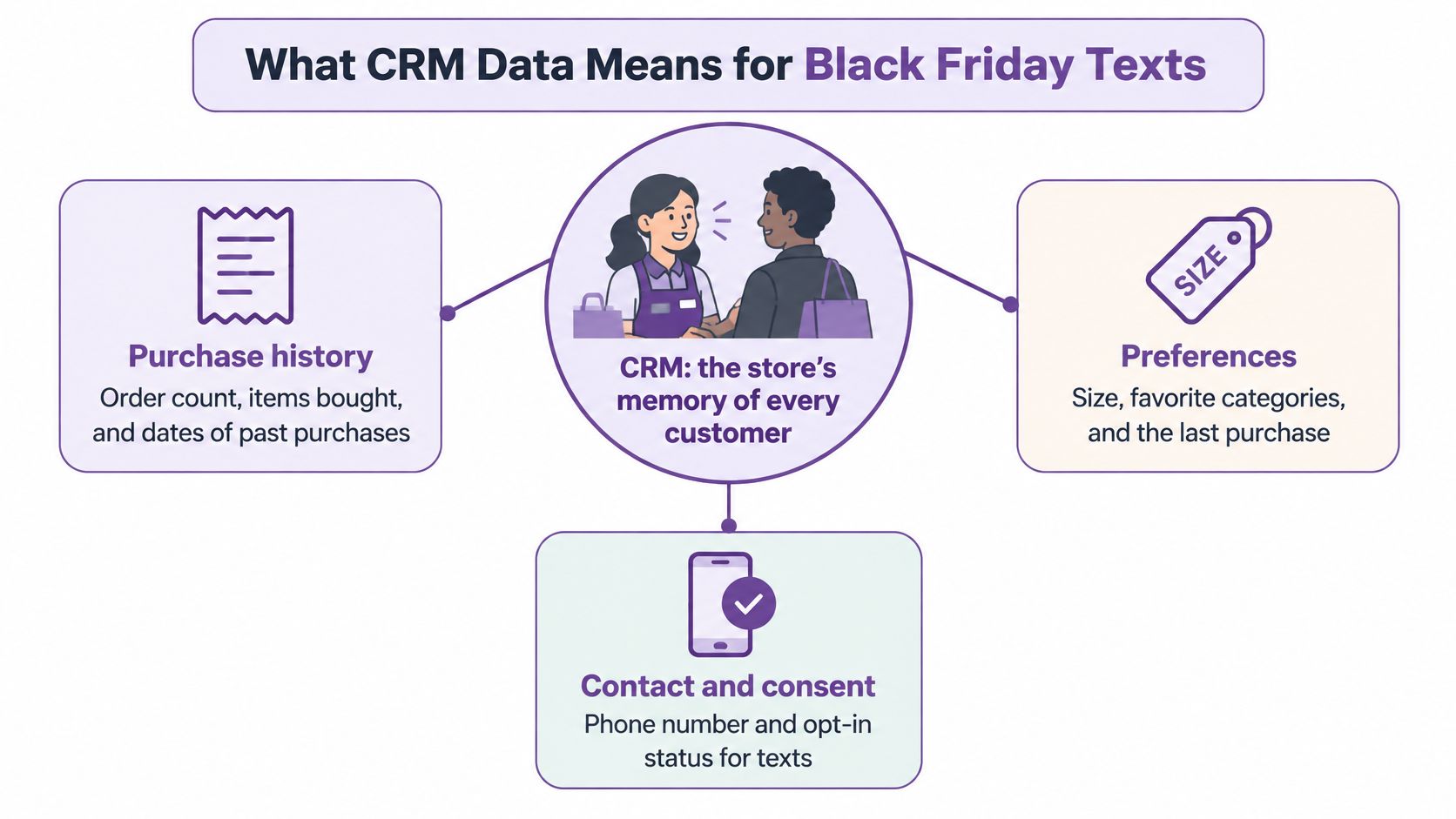
Three distinct record types inside your ecommerce CRM system control whether a Black Friday text converts or triggers an immediate STOP reply:
- Purchase history: Order count, last order date, items purchased, and average order value tell you whether a shopper needs a first-order nudge or a VIP bundle.
- Engagement signals: Opt-in dates, link clicks, two-way replies, and live cart activity show who's actively browsing right now versus who hasn't interacted since last winter.
- Acquisition source: Knowing whether a phone number came from a site popup, Scratch-to-Win game, keyword text, AI chat, QR code, or CSV upload tells you what promise brought that buyer onto your list.
Picture what happens when a store ignores those three records. A shopper buys a winter coat on Thursday afternoon, then gets an automated "your cart is still waiting for 20% off" text on Friday morning. That single misfire makes your brand look sloppy and pushes a loyal customer to opt out before Cyber Monday even arrives.
Why Scattered Lists Break Under Holiday Pressure
Competition inside your buyers' text inboxes is steeper than ever. According to SimpleTexting's 2025 SMS marketing report, 66% of businesses used SMS marketing software in 2025, and 67% increased their SMS marketing budgets. Shoppers aren't forgiving toward brands that spam them with irrelevant offers when dozens of retailers are texting the same week.
A Black Friday text is only as good as the customer record behind it.
Fragmented phone lists create most of those mistakes. When popup signups sit in one app, QR code scans sit in a spreadsheet, and support chats live somewhere else, suppression rules break. In our setup, every opt-in from a popup, scratch game, keyword, AI chat, QR code, or CSV upload is dual-written into one master All Customers list so your store never loses track of a subscriber's consent or history.
Quick Five-Minute CRM Audit
Before writing a single holiday text, open your Shopify admin and your SMS dashboard and answer three questions:
- Order visibility: Can you filter subscribers by exact order count and days since last purchase without exporting a CSV?
- Behavior tracking: Do cart abandoners and recent link clickers update automatically inside your messaging tool?
- Source unity: Are phone numbers from popups, QR codes, keywords, and imports landing in one master list with clear opt-in timestamps?
Whichever of those three record types is missing today is the exact leak you need to patch before Black Friday traffic arrives.
Customer Segments That Decide Who Gets Which Offer
Blasting a sitewide 30% discount to your entire subscriber list is the fastest way to torch Q4 contribution margin. Global shopper behavior backs up a more selective approach: DHL's 2025 Black Friday trends report, surveying 24,000 shoppers across 24 countries, found that while discounts and savings motivated 71% of Black Friday spending, exclusive deals motivated 49% and limited-time offers motivated 44%. Plenty of buyers will convert on early access, curated bundles, or loyalty perks without requiring your deepest markdown.
Good customer data segmentation pairs every audience slice with both an offer and a strict suppression rule. Knowing who to exclude protects your margins and keeps opt-out rates low.
| Segment | Black Friday message | Suppress when |
|---|---|---|
| Recent subscribers (joined in last 30 days) | Early-access offer | Already bought since opting in |
| Repeat buyers | Loyalty or replenishment offer | Ordered in the last 7 days |
| Subscribers who never bought | First-purchase welcome offer | Unsubscribed or replied STOP |
| Customers inactive for 180 days | Single reactivation offer | Purchased recently or ignored prior win-back |
| Abandoned carts | Cart recovery with one-off code | Checkout completed |
Walk through those five rows from top to bottom. Recent subscribers already raised their hand for your brand this month, so giving them VIP early access converts them before competitors flood their phone on Friday morning. Suppress anyone who already purchased after signing up so you don't irritate a brand-new buyer with a deeper discount two days later.
Repeat buyers don't need a margin-crushing clearance deal to buy again. Send them a replenishment nudge, a gift-with-purchase tier, or a loyalty bundle, and automatically suppress anyone who placed an order in the last seven days.
For subscribers who never bought, friction is usually trust or price hesitation. A clean first-purchase welcome offer solves that, provided your system strictly suppresses anyone who unsubscribed or replied STOP.
Customers inactive for 180 days carry the highest unsubscribe and carrier-filtering risk. Cap them at one crisp reactivation text for the entire holiday weekend rather than hammering them across all five days, and exclude anyone who recently placed an order or ignored your prior win-back sequence.
Abandoned carts represent your highest-intent revenue on the table. Trigger a fast recovery text with a unique one-off code, and rely on live sync so checkout completion cuts off the sequence immediately. Imported Shopify segments stay live and in sync through webhooks, meaning a buyer who finishes checkout drops out of the cart segment automatically without anyone uploading a fresh CSV.
Capturing Clean Consent Before You Segment
Segmentation falls apart if phone numbers lack clean opt-in records. Our popup builder captures phone number, email, and name in one tap, with TCPA-compliant consent language and Privacy Policy links built directly into the form. That keeps every new holiday lead legal to text and tied to a full customer profile from the moment they join.
Worked Example A Candle Store With 3,000 Subscribers
Say a Shopify candle brand enters November with 3,000 SMS subscribers. Instead of sending one mass blast, the marketing manager splits the list into four core groups: recent signups get a Thursday night early-access link to seasonal scents, repeat buyers get a Friday morning "buy three, get a limited holiday wick trimmer" offer (suppressing anyone who ordered in the past week), non-buyers get a first-order percentage discount, and inactive buyers from six months ago receive a single Friday afternoon win-back text and nothing else unless they click.
Follow three steps to mirror that setup in your own store:
- Build segments from order and opt-in data inside Shopify and confirm live webhook sync to your SMS app.
- Lock in suppression rules before writing copy so no recent buyer, completed checkout, or opted-out contact slips into a broadcast.
- Draft one specific message per segment and double-check every send against its suppression filter before hitting schedule.
Coordinating Black Friday and Cyber Monday Texts
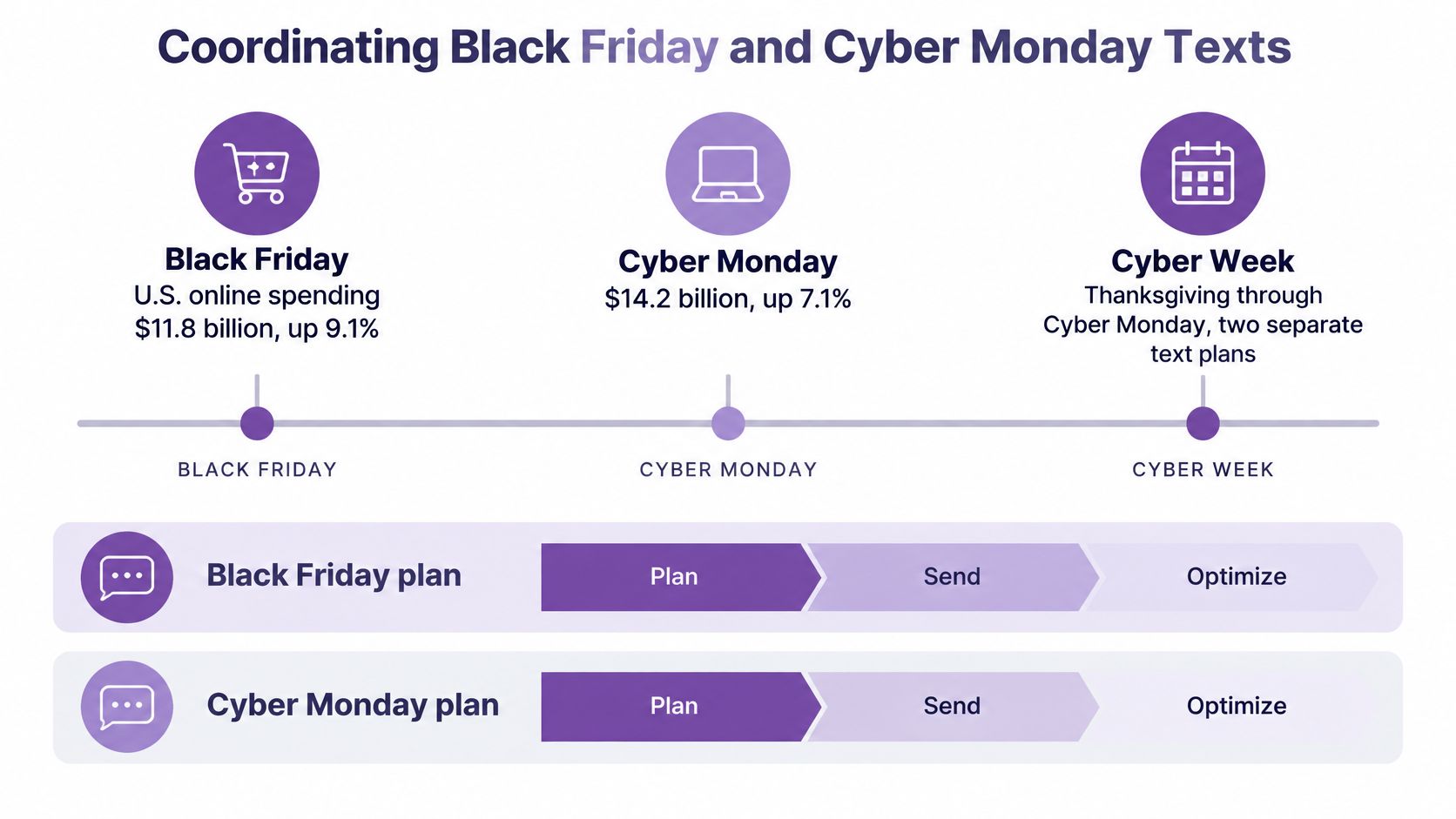
Treating Black Friday and Cyber Monday as one stretched-out promotion wastes half the weekend's momentum. According to Adobe's 2025 Cyber Monday report, U.S. consumers spent $11.8 billion online on Black Friday 2025 (up 9.1% year over year) and $14.2 billion online on Cyber Monday (up 7.1%), bringing five-day Cyber Week spending from Thanksgiving through Cyber Monday to $44.2 billion (up 7.7%). Cyber Monday outspent Black Friday by more than two billion dollars online.
Buyer timing is stretching earlier too. As EcommercePro's 2025 Black Friday trends breakdown points out, 24% of shoppers planned to start shopping sales earlier in November, turning holiday execution into a coordinated multi-day sequence rather than a single Friday morning blast.
Here is how a two-track holiday timeline looks across the five key moments from pre-Friday early access through Cyber Monday close:
| Moment | Audience | Goal | Offer type |
|---|---|---|---|
| 1. Early-access text before Black Friday | Recent subscribers | Build first-day demand | Early-access offer |
| 2. Black Friday morning offer | Buyer segments by type | Convert peak traffic | Offer matched to buyer type |
| 3. Black Friday evening cart reminder | Abandoned carts | Recover checkouts | One-off cart code |
| 4. Cyber Monday urgency message | Viewed but did not buy | Re-engage | Urgency offer with stock messaging |
| 5. Final-hours reminder on Cyber Monday | Engaged subscribers | Close the sale | Last-chance code |
Walking Through the Five-Moment Playbook
Say an apparel merchant runs this exact schedule over Thanksgiving weekend. On Wednesday or Thursday evening (Moment 1), recent subscribers get an early-access text to access bestsellers before sizes sell out. Because order data flows straight through live segment sync, anyone who buys during early access is already excluded before Friday morning.
At Friday morning launch (Moment 2), separate texts go to repeat buyers and non-buyers, each matched to their purchase history. While drafting each campaign message, the marketer generates a one-off Shopify discount code inline inside the editor. Keeping Friday's code distinct from Monday's code ensures clean attribution and stops coupon-browser extensions from leaking codes across days.
By Friday evening (Moment 3), shoppers who loaded carts during lunch breaks and got distracted receive an automated abandoned-cart text with a fresh single-use code. No manual CSV export is required, and if your store runs custom workflows or an external CRM, webhooks and an API let your developers connect YipSMS with just a few lines of code.
Shifting Volume Between Black Friday and Cyber Monday
Sunday night is your pivot point. Instead of blindly repeating Friday's promotion on Monday, review Friday and Saturday conversion rates, net revenue per message, and remaining inventory by SKU.
Watch how the timing, offer rotation, and pacing come together across a full BFCM SMS campaign in this short walkthrough:
If a bundle outperformed a flat percentage cut on Black Friday, shift Monday's message volume toward bundles for Moment 4, targeting subscribers who viewed products over the weekend without buying and calling out low-stock sizes. Then fire Moment 5 three to four hours before midnight on Cyber Monday, reaching only engaged subscribers who clicked or opened earlier in the week with a final-hours code.
Campaign pacing principle: Apps built for scheduled sends, instant segment updates, and live revenue checks beat heavy enterprise suites that require weeks of engineering setup before you can tweak a Monday morning offer.
Measuring Real Lift and Protecting Checkout Speed
A high click-through rate on a Black Friday text feels great until you realize half those buyers were already typing your URL into Safari. Vanity metrics hide cannibalized margin. Real performance measurement answers one blunt question: how much extra contribution margin did your texts generate beyond orders that would have happened anyway?
Checkout friction muddies that picture even further if your promotion breaks at payment. According to Baymard Institute's cart abandonment research, extra costs like shipping, taxes, and fees drive roughly 40% of surveyed shoppers to abandon carts, while 20% cite slow delivery, 18% cite forced account creation, and 17% point to a checkout that's too long or complicated.
If your Black Friday text promises 20% off, yet the discount fails to apply automatically in the mobile cart, hides the free-shipping threshold, or conflicts with a subscription item or gift card, shoppers bail right at the finish line. Test stacked discounts, multi-currency markets, tax-inclusive pricing, and mobile cart refreshes before your first send goes live.

Setting Up a Clean Holdout Experiment
The cleanest way to prove incremental lift in your SMS campaign analytics is a randomized holdout group. Before launching your first holiday broadcast, hold back a fixed slice of each segment (for example, 10% on a list large enough that the gap between groups isn't statistical noise) and send them no texts during the test window.
Meanwhile, track exposed shoppers down to the completed order. Each send is tagged with yipclid and supports branded short links, and click attribution is reconciled directly against Shopify checkout completion events (confirm exact yipclid and branded domain settings against current product documentation before launch). Our real-time analytics dashboard shows delivery, failures, clicks, and conversions as they happen, combining campaigns, automations, and subscriber growth into one unified revenue view.
Run your measurement and speed check in five ordered steps:
- Lock the holdout before Moment 1 so every segment has an unexposed baseline group from the start of the weekend.
- Tag every promotional link with click-to-checkout tracking and test that branded short links resolve cleanly on iOS and Android.
- Audit delivery and failure rates in hour one to catch carrier filtering or broken discount codes while you still have time to fix them.
- Compare exposed versus holdout cohorts after Black Friday across incremental conversion rate, average order value, contribution margin, and refund rate, while simultaneously checking mobile load speed, JavaScript errors, and checkout completion against your October control period.
- Roll the highest-margin offer into Cyber Monday and cut any variant that drove clicks without lifting net profit.
Judge every Black Friday SMS campaign by incremental contribution margin per recipient, never by raw clicks or gross attributed sales.
Confirm Your Holiday Texting Setup Before the Sale
Holiday demand doesn't trickle in smoothly across four days; it slams your storefront in violent spikes. According to PropelCommerce's breakdown of Shopify 2025 BFCM statistics, more than 81 million customers bought from Shopify-powered businesses over the weekend, hitting a peak of $5.1 million per minute at 12:01 p.m. Eastern Time on Black Friday.
Trying to troubleshoot carrier registration, broken links, or missing opt-out copy while traffic surges at noon on Friday is a guaranteed way to burn peak revenue. Even when an SMS app lets you start sending minutes after signup, compliance checks and phone-level testing still belong ahead of launch day.
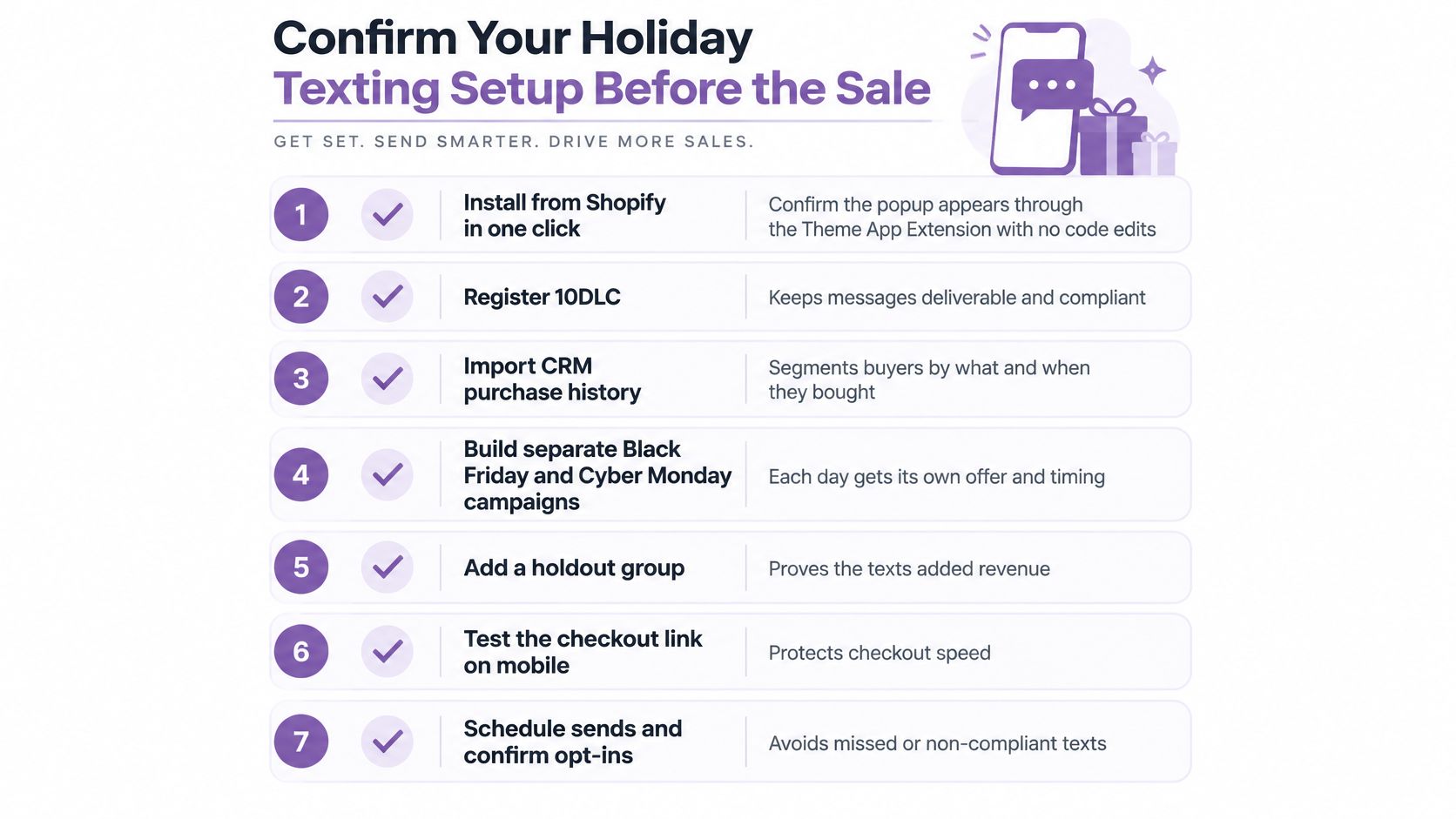
Work through these seven pre-flight checks before your first holiday message leaves the queue:
- Install from Shopify in one click and confirm your opt-in popup loads through the Theme App Extension, so zero theme code edits touch your live storefront.
- Complete 10DLC registration early by following our Shopify SMS app setup guide from installation through your first live test message to keep carrier deliverability clean.
- Approve every Black Friday and Cyber Monday template with a second pair of eyes, verifying brand identification and clear STOP opt-out wording on every single text.
- Verify list dual-writing by opting in through your own popup on a personal phone and checking that your contact appears immediately inside the master All Customers list.
- Tap every discount code and short link on mobile over cellular data (not just office Wi-Fi) to confirm the code auto-applies in cart and checkout loads without lag.
- Assign your holdout group inside each segment before scheduling Moment 1, otherwise you lose your clean baseline once messages start firing.
- Fire a full internal test campaign to your team's phones, checking exact message formatting, click attribution, and cart completion end to end.
If your store doesn't have holiday SMS live yet, don't wait until Thanksgiving week to test under pressure. Start a 14-day free trial today, install the app in one click, and send your first internal test text within minutes of signup so your first live run happens on a calm Tuesday afternoon instead of Black Friday morning.
Ready to launch high-margin Black Friday and Cyber Monday SMS campaigns without paying a monthly software subscription? Start your 14-day free trial with YipSMS Inc. to install in one click, sync your Shopify segments automatically, and send pay-as-you-go holiday texts starting at $0.015 per SMS within minutes of signup.
Links referenced in this article
- Shopify's 2025 BFCM press release
- Drip's Black Friday statistics report
- Shopify's Cyber Monday guide
- BonusQR loyalty platform
- DTCPages' BFCM conversion rate benchmark
- SimpleTexting's 2025 SMS marketing report
- DHL's 2025 Black Friday trends report
- Adobe's 2025 Cyber Monday report
- EcommercePro's 2025 Black Friday trends breakdown
- Baymard Institute's cart abandonment research
- PropelCommerce's breakdown of Shopify 2025 BFCM statistics
YIPSMS publishes educational articles, including AI-assisted content supplied through Outrank. Our internal team reviews Outrank articles for accuracy before publication. Pricing and requirements can change; check current YIPSMS pricing and official guidance before acting. Compliance content is general information, not legal advice. Spotted something wrong? Tell us through your YIPSMS account.