How to Collect Phone Numbers for SMS Marketing in 2026
30% of people who experienced a cyberattack or digital scam in the prior year said it began through a text message or messaging app in the Consumer Reports 2025 Consumer Cyber Readiness Report, up from 20% the year before. That's why learning to collect phone numbers is a permission problem first. A shopper isn't giving you another email address. They're giving you the channel scammers already use, and they'll judge your first text accordingly.
Table of Contents
- Six Places to Collect Phone Numbers and What Each Offers
- Consent Rules by Market Before You Launch
- Building a Consent-First Popup Step by Step
- Capturing Numbers at Checkout and After Purchase
- Incentives That Earn Numbers Without Eroding Trust
- Sample Disclosure and Confirmation Copy
- Setting Up Capture and Opt-Outs in Shopify
- Confirm Your Opt-In Numbers Before You Scale
Six Places to Collect Phone Numbers and What Each Offers
You can collect phone numbers at six practical points, and each one suits a different offer. According to EZ Texting's 2025 Consumer Texting Behavior Report, 86% of surveyed consumers opted in to receive business text messages in 2025, based on 1,074 respondents surveyed in November 2024. Shoppers aren't closed to SMS. They need a reason that matches what they're already trying to do.
| Collection point | Trigger | Offer that fits | Best message type |
|---|---|---|---|
| Exit-intent or timed popup | Visitor about to leave | Discount or early access | Promotional |
| Scratch-card or spin popup | Visitor browsing for a deal | Revealed discount tier | Promotional |
| Checkout phone field | Shipping step | Delivery updates | Transactional, with separate promotional consent |
| Keyword text-in | Ads, social posts or package inserts | One-time coupon sent in immediate reply | One-time response only |
| QR code | Events, shop counters or packaging | Restock alert or early access | Promotional |
| Back-in-stock or price-drop form | Sold-out or price-sensitive product | Restock or price alert | Product-specific |
The matching principle matters more than the format. A visitor staring at a sold-out size wants a restock alert, not a generic discount. A first-time visitor with no product in mind may respond to early access, while a buyer at checkout mainly wants delivery certainty.
If you're still building owned audiences beyond SMS, this guide on how to turn store visitors into engaged subscribers is a useful companion for pairing email and phone capture without merging their consent.
Practical rule: Start where traffic already exists, and add only two collection points at first. You'll learn faster, and you'll spot a bad offer before it damages trust everywhere.
A scratch-card popup can work when it reveals a discount tier before asking for the number, but don't let the game hide the disclosure. The code is the reward, not a substitute for consent.
Consent Rules by Market Before You Launch
One popup and one checkbox rarely serve a global store cleanly. In the U.S., the FCC guidance on the Telephone Consumer Protection Act makes the starting point clear. A phone number collected during checkout doesn't automatically create permission for promotional SMS, and marketing texts generally require prior express written consent for autodialed messages that advertise or introduce an advertisement.
Your U.S. form should say the customer agrees to receive marketing messages, identify automated technology where applicable, and never make consent a condition of purchase. Use a separate, unchecked opt-in box, and keep transactional order messages operationally distinct from campaigns.
| Market | Consent standard | What it means for your form |
|---|---|---|
| United States (TCPA) | Prior express written consent for marketing texts | Separate unchecked box, never a condition of purchase |
| European Union (GDPR) | Explicit, purpose-specific consent with a record | Separate consent for each purpose, timestamped evidence |
| Canada (CASL) | Express consent, with implied consent narrowly defined | Do not assume checkout data equals marketing permission |
| United Kingdom (PECR) | Prior consent for marketing messages | Separate marketing opt-in, clear sender identity and opt-out |
The Insider global SMS compliance guide notes that the EU generally expects explicit, purpose-specific consent with a record of what the subscriber agreed to, while Canada's CASL distinguishes express consent from narrowly defined implied consent. That's more than wording. If someone gives a number for shipping updates in the EU, don't reuse it for a sale blast.
If you sell into Europe, read Carti's guide to Shopify GDPR compliance alongside your form build, then work through this TCPA compliance checklist for SMS programs before launch. Neither replaces a lawyer, and high-risk or multi-country programs deserve qualified review.
Keep these records for every opt-in:
- Phone number: The submitted value, normalized and linked to the customer record.
- Timestamp and source: When consent happened, plus the URL, form ID, keyword, or storefront.
- Disclosure version: The exact consent language shown at that moment.
- Purpose: Whether permission covers delivery updates, product alerts, promotions, or a combination the customer selected separately.
A keyword coupon is a narrow case, not a shortcut. If the shopper requested one code, send that code once, immediately, and don't turn the reply into the start of a recurring campaign. Later broadcasts need their own marketing consent.
Building a Consent-First Popup Step by Step
Build the popup as an auditable flow, not just a design. The CTIA Messaging Principles and Best Practices distinguish general messaging consent from express written consent for marketing and require a usable revocation mechanism, so the form has to prove what the shopper agreed to.
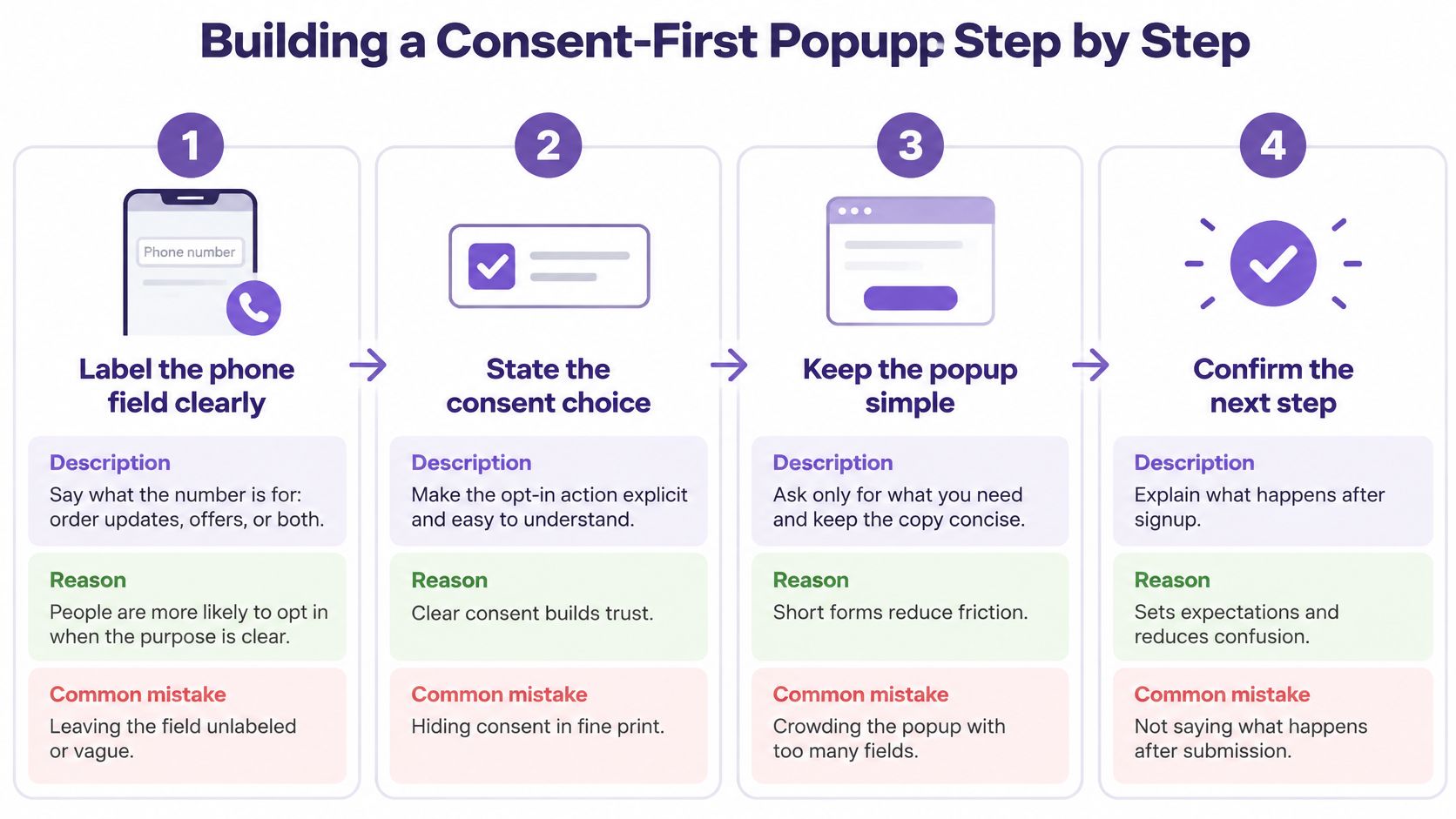
Steps 1 to 3 Set the Permission
- Label the field by purpose. Write "Phone for order updates and offers" or split those purposes if the customer can choose only one. The common mistake is a bare "Mobile number" field that forces shoppers to guess why you need it.
- State the full deal beside the field. Name your brand, the message purpose, recurring frequency, that message and data rates may apply, and link your terms and privacy policy. Don't bury this below the button or behind a vague "Learn more" link.
- Add a separate unchecked promotional box. Entering a number isn't the same as agreeing to marketing. Never pre-tick the box, and never block checkout or a download because someone declines promotional texts.
If you're adapting the same discipline to paid lead capture, this walkthrough on how to set up Google Ads lead forms shows why field purpose and post-submit expectations should be decided before the ad goes live.
Steps 4 to 6 Make the Record Usable
- Store the evidence, not just a yes flag. Save the number, timestamp, source URL or form ID, disclosure version, and exact consent language. If you can't reproduce the screen the shopper saw, your record is weak.
- Clean the number before any send. Normalize it to E.164 format, validate the country code, and suppress duplicates. A duplicate isn't two customers. It's one person at risk of getting the same campaign twice.
- Send a confirmation that resets expectations. Name the program, state the recurring-message disclosure and fee note, and include STOP to cancel and HELP for help. This message confirms membership. It shouldn't smuggle in an unrelated promotion.
A healthy opt-in record lets you audit one submission from first click to first text without asking your developer to reconstruct it.
I would test a two-step popup before adding more fields. Ask for email or the product interest first only if each step saves independently, then make the phone request with its own consent screen. More steps won't rescue a weak reason to join.
Capturing Numbers at Checkout and After Purchase
Checkout is your highest-intent moment and the easiest place to overreach. This short video shows the customer side of a clean phone capture before you map the fields in Shopify.
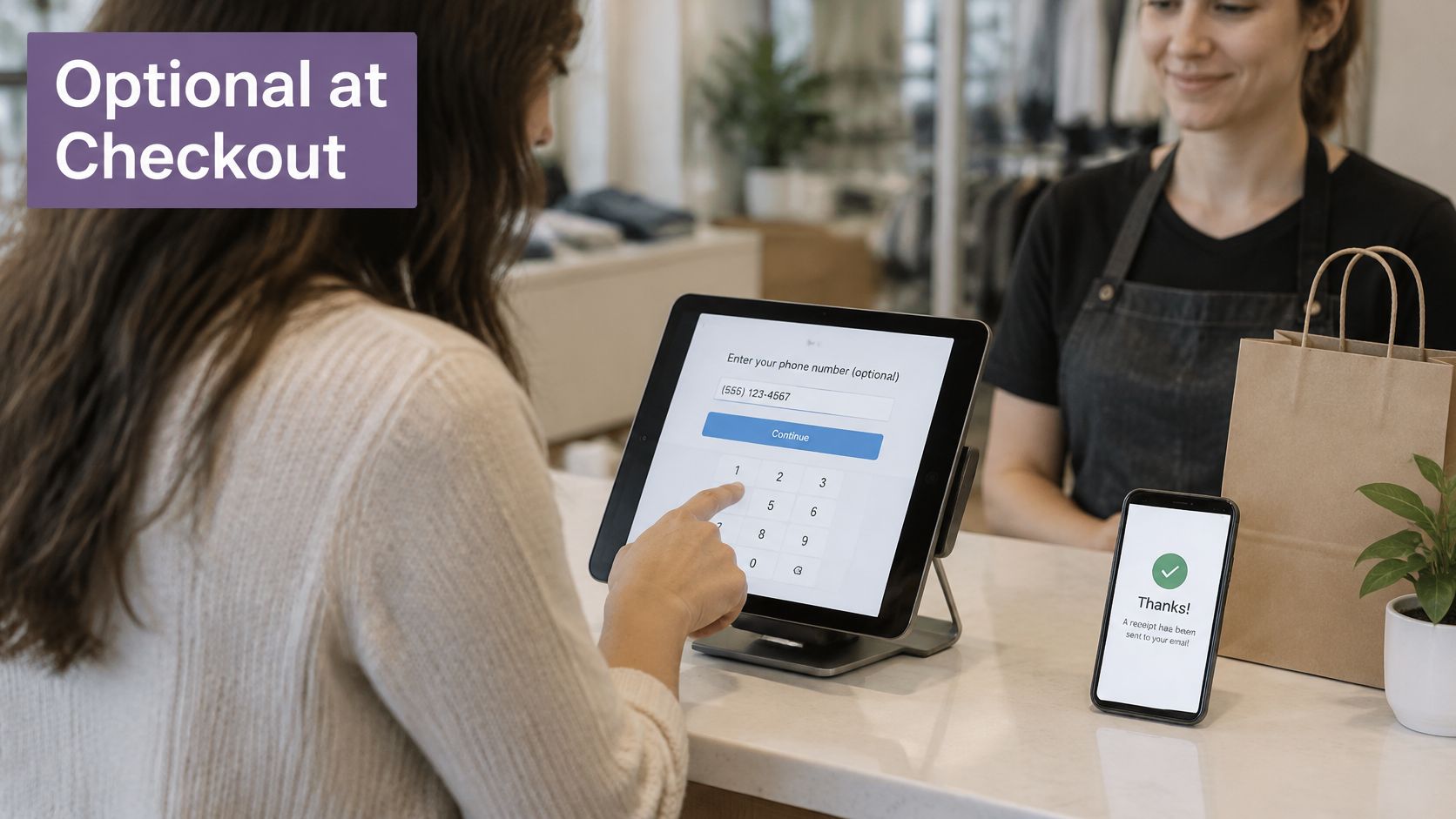
Make the checkout phone field optional unless your carrier needs it, and put the purpose directly beside it. "For delivery updates if the courier needs directions" gives the shopper a concrete benefit. Baymard's checkout research on seemingly unnecessary fields reports that 14% of online shoppers abandon checkout when a phone number is required, and shoppers often enter false information when the field lacks an explanation.
Use an international phone input with a country selector, helpful formatting, and a clear correction message. Don't rewrite a valid number without notice, and don't reject a legitimate format because your validation only understands one country.
The in-store version of the same moment looks like this, where the customer can see what they're entering and why.
After the Order Is Placed
Say a fashion store puts a delivery-updates opt-in on the confirmation page. The shopper has already paid, so the ask can focus on shipment tracking without contaminating checkout conversion. Promotional permission gets a separate unchecked choice below it.
Say a supplement brand sells out of a popular product. Its thank-you page and first shipping email can offer restock alerts for that item, while asking separately whether the customer also wants offers. The narrow alert will usually feel safer than an open-ended marketing subscription.
Measure checkout opt-in and abandonment by device. A country selector that's awkward on mobile can fail while your blended desktop and mobile average still looks acceptable.
Incentives That Earn Numbers Without Eroding Trust
A discount gets numbers quickly, but it also attracts people who only wanted the code. That's not automatically bad. It's a trade you should price into your expectations for clicks, repeat purchases, and early opt-outs.
Free shipping can be stronger because it removes a cost the shopper already resents. In Attentive's 2025 UK SMS and email marketing report, 43% of 1,000 surveyed UK consumers said they would share their phone number in exchange for free shipping. Use it where shipping cost is a real objection, not as a blanket promise your margins can't sustain.
Utility offers work differently:
- Early access: Best for limited drops, seasonal launches, and customers who fear missing stock.
- Restock alerts: Best when intent is attached to one named product, size, or shade.
- Order tracking: Best immediately after purchase, when delivery certainty matters more than another offer.
- Price-drop alerts: Best for considered purchases, wish lists, and products shoppers monitor over time.
Use this sequence for any incentive. State exactly what the shopper receives, show the expected frequency, display the STOP instruction before submission, and deliver the promised value immediately. If the first text is an unrelated sale blast, you've taught the subscriber that your disclosure was decoration.
The downside is permanent. In Textmagic's consumer SMS survey, 70% of 1,800 surveyed U.S. consumers said in March 2025 that they had blocked a business phone number. A block gives you no polite unsubscribe page and no second chance to explain.
Send fewer, more useful messages in the first 30 days. Early restraint is part of the incentive.
I would rather collect a number for one restock alert than win a broad opt-in that dies after one campaign. The smaller permission is less impressive in a dashboard, but it's often the one that survives contact with a real customer.
Sample Disclosure and Confirmation Copy
Adapt these lines with your brand name, actual frequency, and legal review. Don't publish a frequency you don't intend to follow.
Popup disclosure
Acme sends recurring texts about new drops, up to 4 msgs/month. Msg and data rates may apply. Consent is not required to buy. Reply STOP to cancel, HELP for help.
Place your SMS terms and privacy policy links beside the field, where the shopper can open them before agreeing.
Unchecked promotional box
Yes, text me offers from Acme. I agree to the SMS terms.
Leave it empty by default. The customer performs the agreeing, not your form designer.
Checkout helper text
For delivery updates only. We won't text promotions unless you opt in below.
This line protects the purpose boundary at the exact place shoppers worry you'll cross it.
One-time keyword reply
Acme: Your code SAVE10 is ready. This is the single message you asked for. Msg and data rates may apply.
Send it once and immediately. The ZwillGen analysis of the FCC TCPA order stresses that this treatment is narrow. The message must contain only the information requested, and later campaigns need separate consent.
Confirmation after a recurring opt-in
Acme alerts: You're in for new drops and offers, up to 4 msgs/month. Msg and data rates may apply. Reply HELP for help, STOP to cancel.
Product-specific restock consent
Text me when Magnesium 300mg is back. This alert is only for that product.
Store the exact line shown, its version, the timestamp, and the source with the number. Copy without that record is just a screenshot waiting to be argued about.
Setting Up Capture and Opt-Outs in Shopify
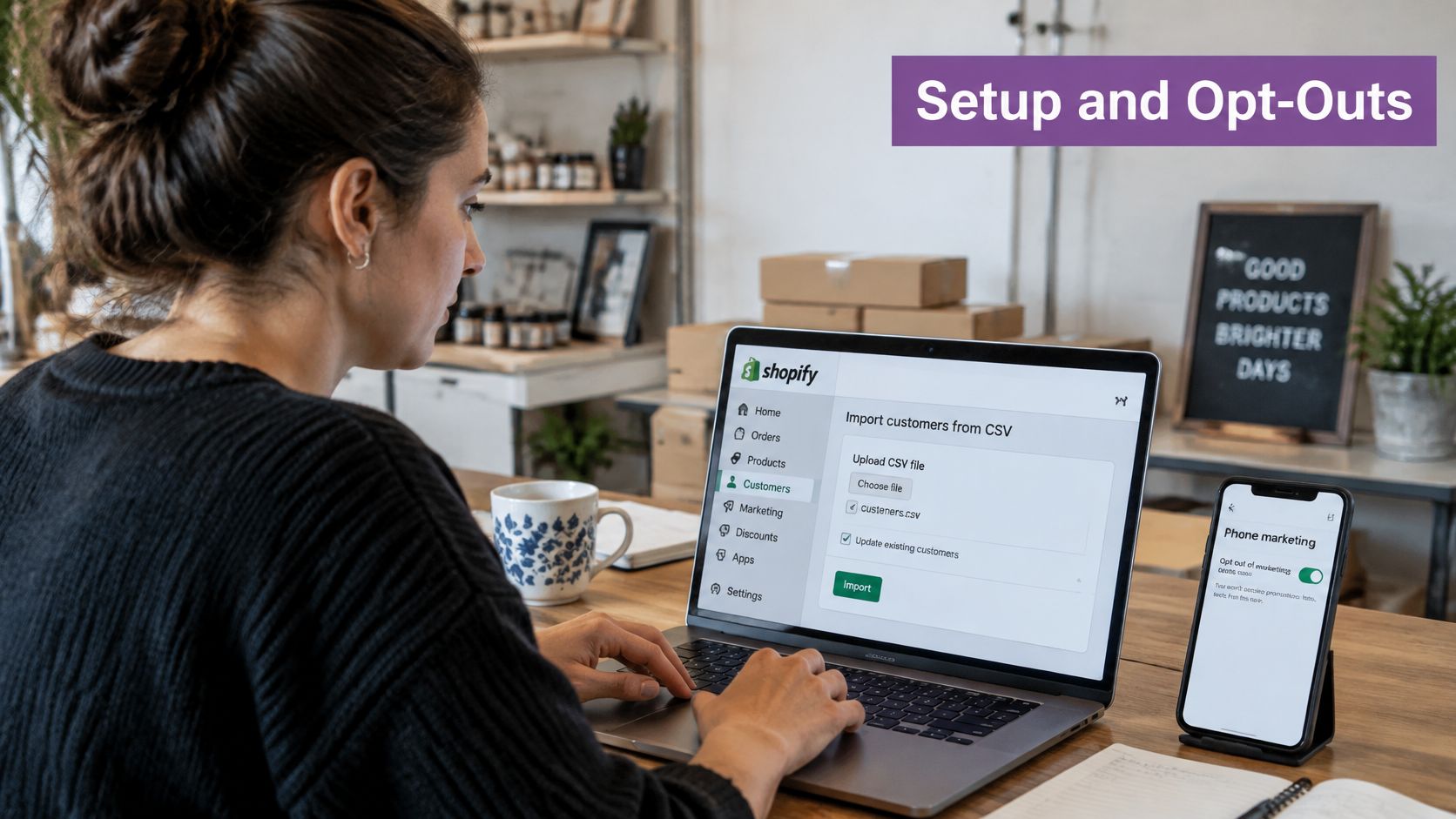
Start with the list you already have. Customers can import an existing subscriber list by uploading a CSV file with phone numbers and any custom fields, and they can send in seconds after the upload. Before that first send, confirm the upload is deduplicated and formatted by YIPSMS and that opt-ins are tracked.
Build the Capture Sources as Separate Lists
Create separate lists for popup, checkout, keyword, QR code, and restock opt-ins. Source separation lets you compare engaged subscribers, not just raw volume, and it stops a weak source from hiding inside a healthy master list.
Our Shopify SMS app setup guide covers installing the app, registering 10DLC, and sending the first campaign. Complete registration and suppression testing before you drive paid traffic to a keyword or QR code.
Configure Every Exit Route
Set STOP, END, CANCEL, QUIT, and UNSUBSCRIBE to suppress the number immediately across campaigns and automations. Then test each keyword from a real phone. "It should work" isn't a test result.
Support needs the same authority as the keyword system. The McGuireWoods alert on the FCC's TCPA opt-out rules explains that consumers may revoke consent through reasonable means, including verbal or written requests. Train support to process opt-outs from email, chat, and phone calls, then sync them to the suppression list the same day.
Multi-store operators need extra discipline. If several storefronts share a customer or sending program, use one suppression process so an opt-out in one place doesn't leave the same number active somewhere else.
Pre-Launch Check
- Consent mapped: Every imported and newly captured number carries its purpose and evidence.
- Duplicates suppressed: The same customer can't enter through popup, checkout, and QR code as three subscribers.
- Opt-outs tested: Keywords and support-led requests stop campaigns and automations.
- Transactional stream separated: A promotional opt-out doesn't accidentally stop legitimate order updates the customer still wants.
Confirm Your Opt-In Numbers Before You Scale
Run two capture points for 30 days before adding a third. Track one funnel from form exposure to phone entry, consent completion, first message delivered, and opt-outs within 30 days. Read those stages together, because a strong completion rate means little if subscribers leave after the welcome text.
Split the funnel by device, traffic source, country, incentive, and form location. A paid social visitor who joins for a discount may behave nothing like a product-page visitor who asks for a restock alert. That difference should decide where you spend next, not the blended opt-in rate.
Consider a confirmation step when invalid numbers, bots, or low-intent discount seekers are polluting the list. This guide to double opt-in for SMS helps you weigh cleaner consent against the subscribers you'll lose between form submission and confirmation.
Use a simple decision rule. If 30-day opt-outs stay low and the first message earns clicks, replies, or redemptions, add the next collection point. If opt-outs climb, rewrite the disclosure, narrow the promise, or change the incentive before sending more traffic.
Keep shipping texts on their own stream throughout the test. A customer who rejects promotions may still want delivery updates, and mixing those streams turns one refusal into a worse service experience.
YipSMS offers a 14-day free trial, and signing up is free with no credit card required to start. Customers only pay when they send, which makes a contained 30-day capture test easier to run without committing to a bigger program first.
When you're ready to collect phone numbers with consent records, source-level tracking, and opt-outs that hold across your Shopify store, visit YipSMS Inc. to set up your first capture points and test them properly. Start with two placements, deliver the value you promised, and scale only the sources that produce subscribers who stay.
How this article was made: the YIPSMS team drafts some articles with AI writing tools, then checks pricing, compliance and product details against how YIPSMS actually works before publishing. Spotted something wrong? Tell us through your YIPSMS account.