Is SMS Marketing Effective? 2026 Guide for Shopify Brands
SMS marketing generates an average response rate of 12%, four to six times higher than direct mail, and automated flows can drive disproportionate revenue relative to send volume. That makes SMS marketing effective for Shopify brands, but only when it creates incremental profit instead of taking credit for purchases customers would have made through email, search, or direct traffic.
A text message reaches a personal device, so customers notice it quickly. That visibility is both the channel's advantage and its risk. A relevant abandoned-cart reminder can recover intent at the right moment, while a generic discount sent to everyone can consume permission without creating durable value.
The practical question isn't “How many people opened the message?” It's “What did SMS cause that wouldn't have happened otherwise?” That distinction changes how you select flows, compare channels, manage frequency, and decide whether scaling is financially sensible.
Table of Contents
- What Makes SMS Marketing Actually Work
- Measuring Incremental Value Instead of Vanity Metrics
- Building Automated Flows That Prove Worth
- SMS vs Email and Choosing the Right Channel for Each Moment
- The Hidden Cost of Permission Fatigue
- Staying Compliant Without Losing Momentum
- Real Shopify Store Examples That Drive Results
- Your Next Steps for Testing and Scaling SMS Profitably
What Makes SMS Marketing Actually Work
Academic research supports SMS as a direct-response channel, but it doesn't support treating SMS as universally superior. A peer-reviewed study reported an average SMS advertising response rate of approximately 12%, compared with roughly 2–3% for direct-mail advertising, while country-level response rates varied from 12% in the United States to 5.7% in Germany. The study also examined willingness to receive messages, whether recipients read or deleted them, and purchase intention, which shows that sending a text is only one part of effectiveness. (Peer-reviewed SMS advertising study)
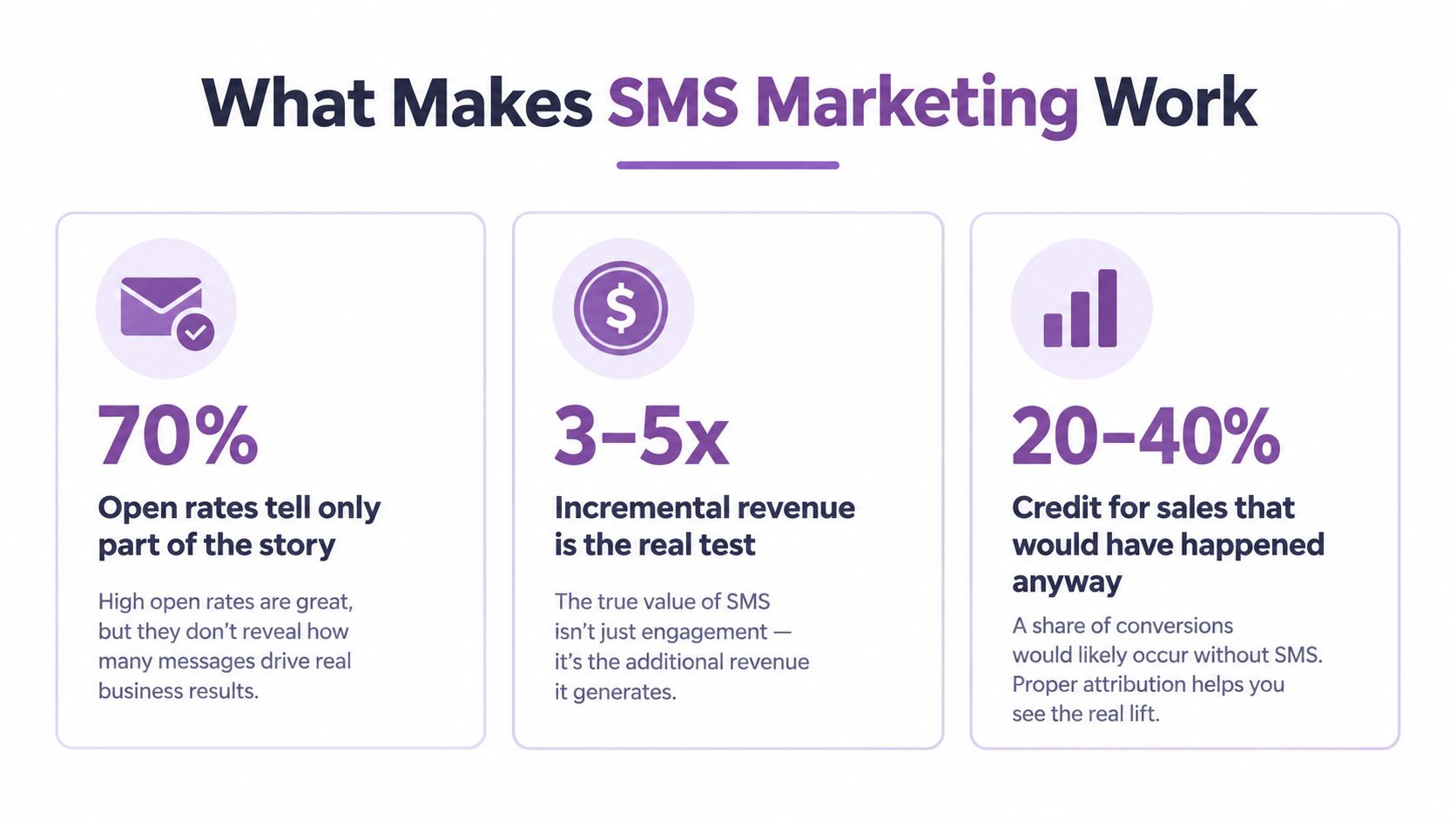
That evidence reframes the usual conversation. Reach and response are not the same as profitable growth. A message may receive a click because a customer was already returning to the store. A discount may close a sale while reducing contribution margin. An automated campaign may claim revenue that email or direct traffic would have generated anyway.
The merchant's definition of effectiveness
For a Shopify store, SMS earns its place when it produces additional net value after:
- Discounts: Subtract the offer cost rather than treating discounted revenue as equal to full-price revenue.
- Refunds: Remove refunded orders from the result.
- Message costs: Include the cost of every delivered promotional message.
- Opt-outs: Account for the future value lost when a subscriber leaves.
- Assisted conversions: Separate customers who received several channel touches from customers whose purchase was genuinely influenced by SMS.
The right baseline is a comparable group that doesn't receive the text. Randomly suppress SMS for that group, then compare purchases and contribution margin with the exposed group. This holdout approach is more demanding than reading a dashboard's attributed revenue, but it answers the question that matters: did the message add profit?
SMS works best as a scarce permission for high-intent moments. Cart recovery, delivery communication, replenishment prompts, and limited offers usually have a clearer reason to interrupt a customer than a routine broadcast. Merchants looking for practical reactivation ideas can also review Machine Marketing on SMS reactivation while designing messages around customer behavior rather than list size.
Measuring Incremental Value Instead of Vanity Metrics
A channel-wide average hides too much. Cart recovery, post-purchase communication, replenishment, win-back, and promotional broadcasts serve different customer states, so they should have different success criteria.
Independent benchmark summaries found that automated SMS generated 18% of SMS-attributed orders from only 9% of sends, while automated messages achieved click rates 147% higher than campaign messages. Those figures point toward a useful operating assumption: behavior-triggered messages may be more productive than undifferentiated blasts, but attributed performance still isn't proof of causation. (SMS automation benchmark summary)
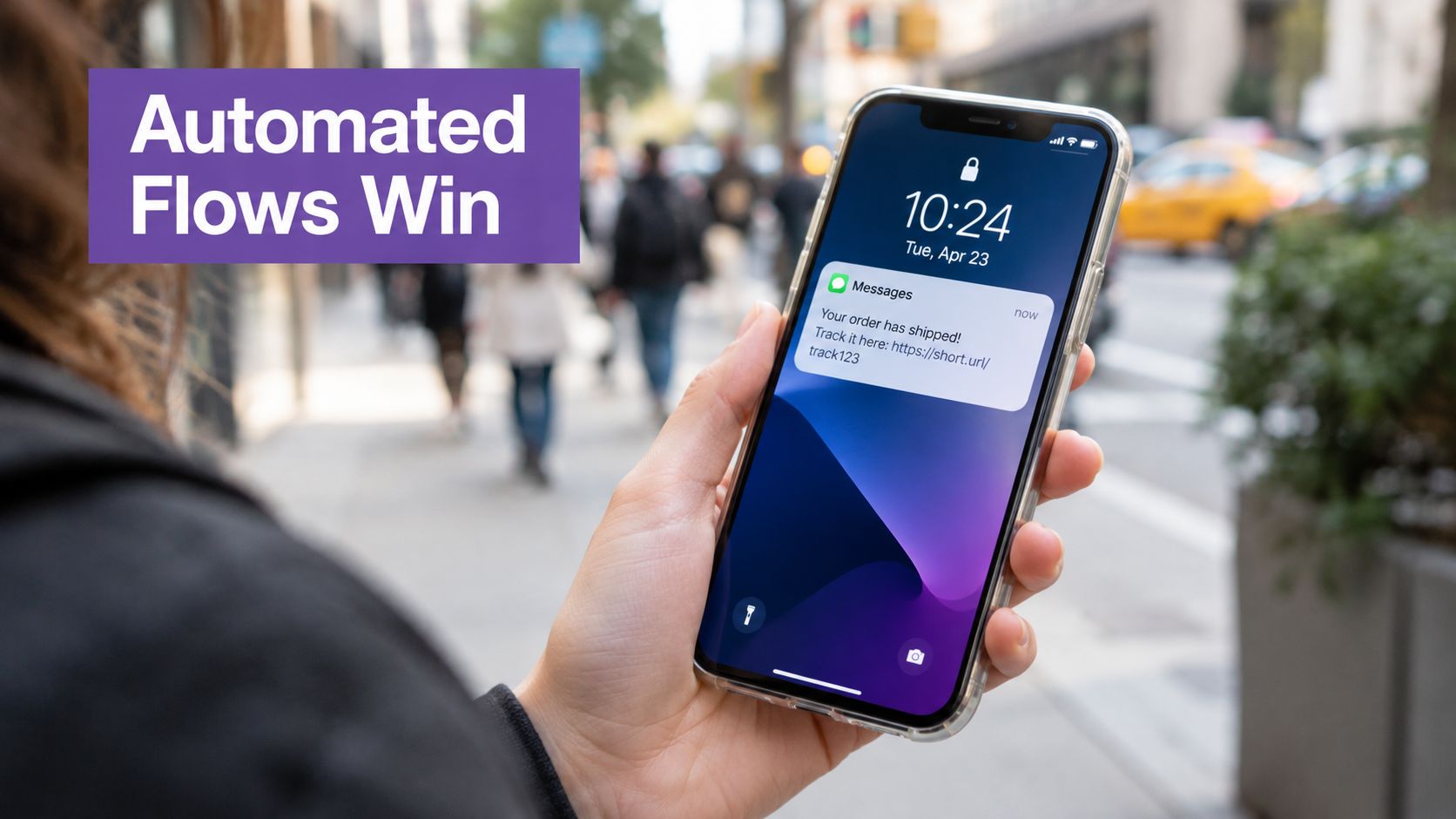
Start with a simple measurement sheet for each flow. Record delivered messages, clicks, purchases, revenue, discounts, refunds, message costs, and opt-outs. Then add the metrics that reveal longer-term damage or value, such as repeat purchases, complaint rate, and profit per subscriber.
A practical holdout design
Randomly split an eligible audience into an SMS group and a suppressed control group. Keep the groups comparable by purchase history, product category, geography, and customer status. Don't compare a highly engaged VIP segment with a dormant list and call the difference an SMS effect.
Calculate the result using net contribution rather than gross attributed revenue:
Net SMS contribution = incremental sales margin minus discounts, refunds, message costs, and relevant opt-out impact.
You don't need an advanced analytics team to begin. A spreadsheet can compare the exposed group with the holdout group, provided the test rules remain consistent and the store records who was suppressed.
Measurement rule: If the test can't show what happened without SMS, the dashboard is reporting attribution, not incremental value.
Review each use case independently. A delivery update may improve the customer experience without being judged like a promotional campaign. A win-back message may create a purchase but also train customers to wait for discounts. A replenishment reminder may perform well because it arrives close to a natural buying cycle, so compare it with customers who reached the same stage without receiving the message.
For broader experimentation principles, data-driven marketing measurement tips can help your team build a consistent testing habit. Shopify merchants evaluating the financial side of the channel can also use this SMS marketing ROI framework to organize revenue, cost, and conversion data.
Here is the second visual checkpoint for a measurement workflow:
Scale only after a flow produces positive contribution against its control group. If a campaign looks strong on clicks but weak on incremental margin, improve targeting or offer economics before increasing send volume.
Building Automated Flows That Prove Worth
Automation creates value when the trigger reflects a customer's current intent. It creates waste when a store turns every customer event into a reason to send another promotion.
The first architectural decision is to separate promotional flows from service notifications. Promotional messages include discounts, flash sales, product launches, upsells, and win-back campaigns. Informational messages include order confirmations, shipping updates, delivery notifications, appointment reminders, and password resets. These categories carry different consent expectations and different customer expectations. (SMS consent and flow guidance)
Build the promotional journey
Collect explicit promotional consent before sending revenue-oriented automations. Then create separate journeys for:
- Abandoned carts: Remind a shopper about the product they left behind, explain the next step clearly, and avoid assuming a discount is necessary.
- Viewed products: Follow up with the item the shopper considered, but suppress the message if the customer has already purchased it.
- Recommendations: Use viewed products, prior purchases, and category interest to make the message specific.
- Repeat purchases: Trigger replenishment prompts around product usage patterns instead of sending on a fixed schedule to every buyer.
- Win-back: Reserve reactivation for customers whose inactivity makes the message meaningful, and test whether an incentive improves contribution margin.
Every flow should have an entry condition, an exit condition, and suppression rules. A customer who completes checkout should leave the cart journey. A recent purchaser shouldn't receive a competing promotional message immediately after placing an order. An inactive subscriber who hasn't engaged should not remain in every broadcast audience indefinitely.
Keep service communication separate
Use transaction-triggered messages for fulfillment updates, order confirmations, delivery alerts, and account notices. Keep unrelated promotional offers out of those messages unless the consent and applicable rules support that use. This separation improves clarity, protects trust, and makes reporting cleaner because the store can distinguish service value from sales activity.
Shopify's app ecosystem makes implementation accessible. A drag-and-drop popup can collect consent with clear expectations, while prebuilt flows can handle cart recovery, viewed-product follow-ups, and delivery notifications. Schedule bulk campaigns according to each recipient's local time, not the merchant's headquarters time.
Operational rule: Every automation needs a reason to send, a reason to stop, and a metric that can disqualify it.
Use the same holdout logic for automations as for broadcasts. If a cart flow receives credit for customers who were already returning to checkout, its attributed revenue will overstate the true result. The flow proves worth only when exposed customers deliver better net outcomes than comparable customers who didn't receive it.
SMS vs Email and Choosing the Right Channel for Each Moment
SMS and email solve different communication problems. SMS is concise, immediate, and interruption-heavy. Email gives a merchant more space for education, product comparison, imagery, and storytelling.
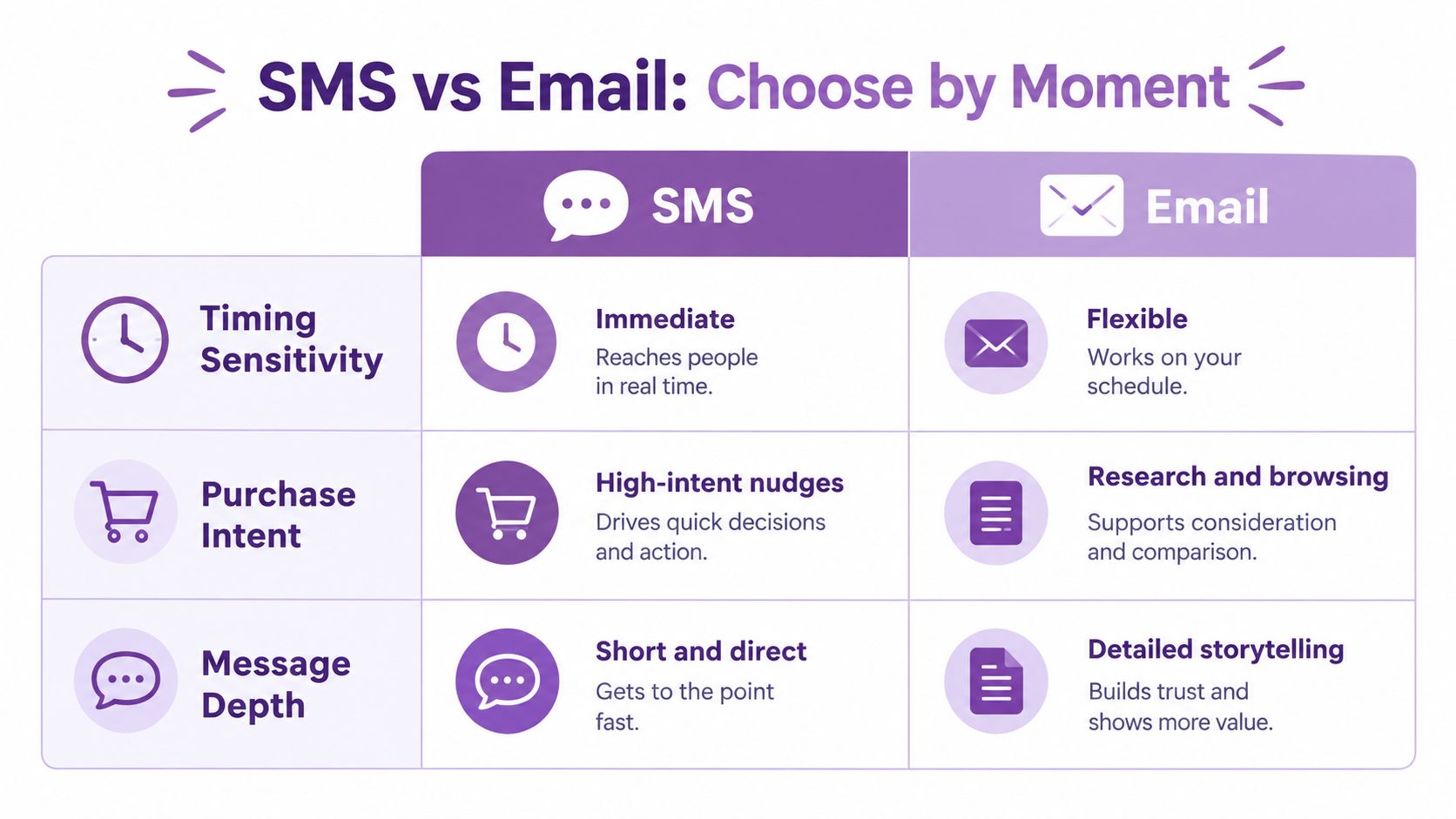
Choose the channel based on the customer's moment, not the marketer's preference.
| Decision factor | SMS | |
|---|---|---|
| Timing sensitivity | Use for a deadline, delivery change, cart reminder, or brief alert. | Use when the customer can read later and consider the message. |
| Purchase intent | Best for a high-intent nudge tied to a known action. | Better for discovery, comparison, education, and browsing. |
| Message depth | Keep the copy short, direct, and action-oriented. | Use richer detail, multiple products, images, and longer explanations. |
| Frequency tolerance | Treat permission as scarce and send selectively. | Support ongoing nurturing with a broader content rhythm. |
| Attribution risk | Test whether the text caused the purchase. | Compare overlapping journeys rather than assigning all credit to the last click. |
An abandoned-cart shopper who reached checkout may need a concise reminder. A customer considering a technical product may need an email explaining specifications, use cases, and alternatives. A flash sale with a narrow window can justify SMS, while a seasonal buying guide belongs in email.
The strongest setup is coordinated rather than competitive. Email can introduce a collection, SMS can remind an engaged shopper about a relevant deadline, and post-purchase communication can use the channel that fits the information. Suppress customers from overlapping messages when they've already acted, and don't send an SMS just because an email campaign exists.
For merchants building the email side of that system, this eCommerce email automation guide offers useful planning context. The corresponding SMS versus email marketing comparison can help teams map each message to the channel that matches its urgency and depth.
The premium of SMS is justified when immediacy or intent matters. Email remains the better choice when the customer needs room to think.
The Hidden Cost of Permission Fatigue
SMS effectiveness deteriorates when merchants treat consent as a one-time acquisition event instead of an ongoing relationship. A subscriber may agree to receive texts and still leave when messages become repetitive, generic, or disconnected from recent behavior.
A 2025 consumer survey cited in industry coverage found that 53% of respondents identified texting too often as the leading reason for opting out. Spam-like content accounted for 21%, and irrelevant messaging accounted for 11%. Another survey reported that 64% of shoppers considered brand messages too generic, while 73% were more likely to buy after receiving relevant product recommendations. (Consumer SMS preference survey coverage)
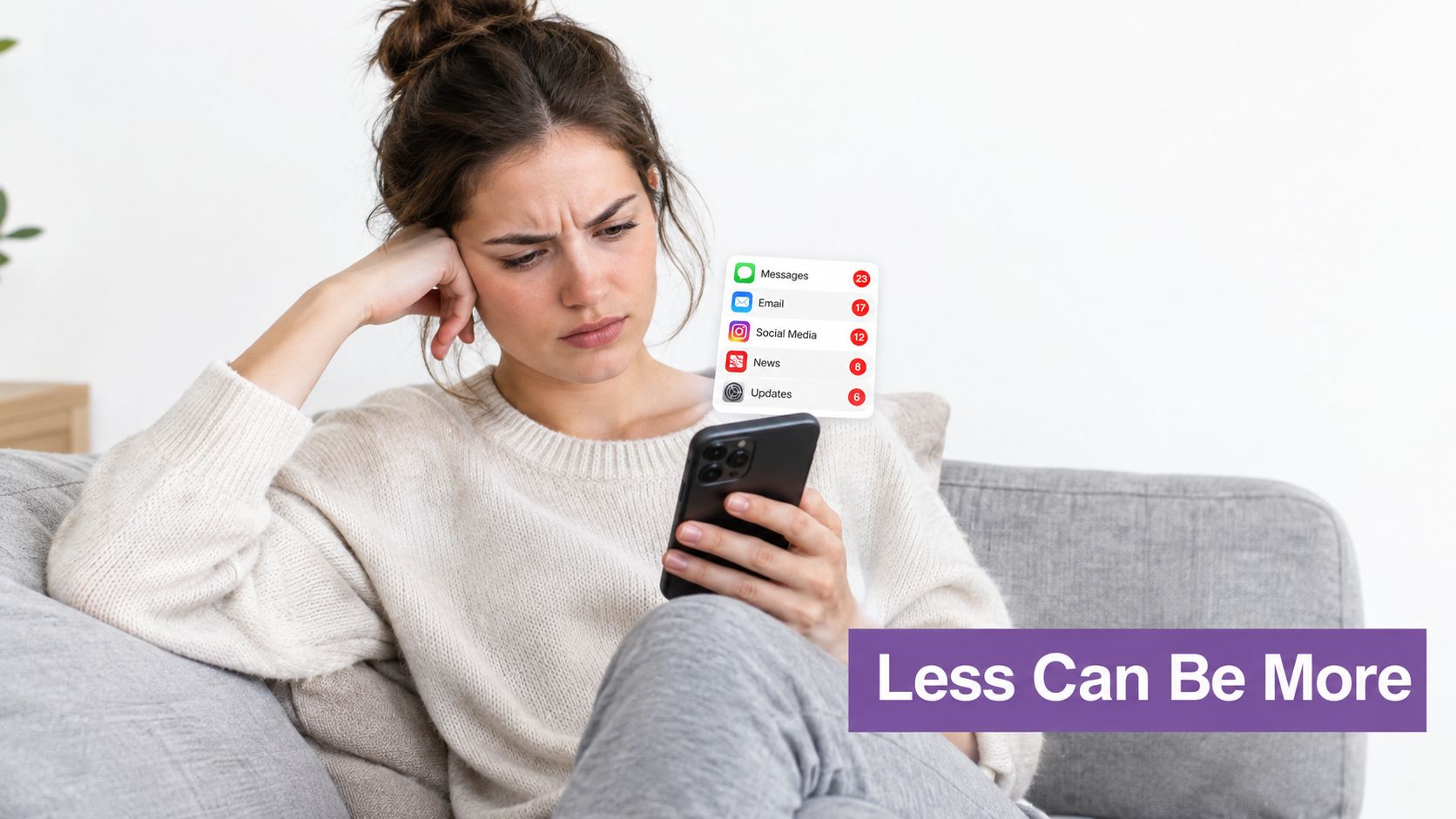
These findings expose a common trap. A promotion can produce immediate sales while shrinking the future value of the list. If the same subscribers receive repeated discounts, they may delay purchases, expect incentives, or opt out entirely.
Test frequency as a profit variable
Don't choose a send cadence because another brand uses it. Run a controlled frequency test with comparable customer groups, then monitor both immediate and delayed outcomes:
- Unsubscribe rate: Identify whether higher frequency causes more list loss.
- Complaint rate: Watch for signals that customers see messages as intrusive or spam-like.
- Repeat-purchase rate: Check whether the schedule supports future buying.
- Profit per subscriber: Include discounts, message costs, refunds, and the value of retained permission.
- Revenue by segment: Compare new buyers, repeat customers, VIPs, and inactive subscribers separately.
Set suppression rules before launching. Exclude recent purchasers from promotions that no longer fit their situation. Pause inactive subscribers rather than repeatedly trying to force a response. Let customers choose preferences where your tooling supports it, such as product categories or message types.
Frequency also depends on purpose. A shipping update can reassure a customer because it answers an expected question. A promotional broadcast consumes permission because it asks the customer to act. Treating both as equivalent messages makes the list look fuller than its usable value.
Permission is an asset with a balance. Every send should either create useful action or strengthen the customer's reason to stay subscribed.
Staying Compliant Without Losing Momentum
Compliance belongs in the campaign workflow, not in a review after the message has been scheduled. U.S. Shopify stores sending promotional SMS generally need prior express written consent under the Telephone Consumer Protection Act. The consent must be affirmative and documented, identify the business, explain that automated marketing texts may be sent, and state that consent isn't required as a condition of purchase. (FCC TCPA guidance)
A preselected checkbox isn't sufficient. A customer entering a phone number during checkout also shouldn't automatically be treated as permission for promotional campaigns. Transactional messages, such as order confirmations, shipping updates, and account alerts, generally use a lower consent standard when the number was provided for a directly related transaction.
Separate collection from promotion
Keep the checkout phone field separate from the promotional SMS opt-in. The opt-in should state what the subscriber is agreeing to and identify the sender. Store the consent record with the time, source, wording, and subscriber details so your team can demonstrate how permission was obtained.
Use a clear operational split:
- Promotional permission: Required for discounts, launches, cart reminders, recommendations, upsells, and win-back messages.
- Transaction-related communication: Used for fulfillment and account information tied directly to the customer's transaction.
- Consent records: Retained for every subscriber, including where and when the opt-in occurred.
- Suppression controls: Applied across campaigns and automations when a customer revokes permission.
Marketing messages should identify the sender and include a simple opt-out method, commonly allowing subscribers to reply STOP. Configure automated STOP handling, suppress opted-out numbers promptly, and don't send additional promotional content after revocation. Commonly cited federal quiet hours run from 8 a.m. to 9 p.m. in the recipient's local time, although state rules or carrier requirements can be stricter. (SMS texting law guidance)
Schedule bulk sends by recipient time zone. Maintain one suppression list that every campaign and automation checks. For a practical implementation reference, use this TCPA compliance checklist for SMS marketing, then obtain legal advice for the jurisdictions where your store operates.
Real Shopify Store Examples That Drive Results
A useful store example doesn't start with a revenue claim. It starts with a customer event, a permission state, and a testable reason for sending.
Consider a Shopify store selling consumable products. A customer buys once, provides promotional consent separately, and receives a replenishment reminder based on the product's expected usage pattern. The message names the product and offers a direct reorder path. The store suppresses customers who already reordered, then compares the flow with a similar group that didn't receive the reminder.
A fashion merchant can use a viewed-product follow-up without turning browsing into a permanent invitation to discount. The store sends only when a shopper has shown meaningful interest, excludes customers who bought the item, and tests product relevance against a generic promotion. If the message creates clicks but no incremental margin, the merchant changes the product recommendation or removes the offer.
Cart recovery offers another practical test. One group receives a concise reminder, while the holdout group receives no SMS. The merchant measures completed purchases after discounts, refunds, message costs, and opt-outs rather than accepting the platform's attributed order total.
Post-purchase recommendations need the same discipline. A customer who bought a coffee machine may be eligible for accessories, but the recommendation should match the purchase and arrive after the service journey has completed. A store shouldn't insert unrelated promotions into operational delivery messages merely because the customer is temporarily engaged.
These examples don't prove that every store will achieve the same result. They show the operating pattern that makes results credible:
- Trigger: A meaningful customer behavior.
- Consent: Promotional permission collected separately where required.
- Suppression: Exit the journey when the customer acts or becomes ineligible.
- Control: Compare against a similar audience without SMS.
- Economics: Judge net contribution, not attributed revenue alone.
Your Next Steps for Testing and Scaling SMS Profitably
Start with an audit, not a broadcast. Export your subscriber records and confirm which contacts have documented promotional consent, where that consent was collected, and whether your suppression process works across every campaign and automation.
Then choose one high-intent flow. Abandoned-cart recovery is a practical starting point for many stores, while replenishment may be better for products customers buy repeatedly. Keep the first test narrow enough that you can identify the trigger, message, offer, and customer segment responsible for the result.
Use this launch sequence:
- Audit permission: Separate promotional opt-ins from phone numbers collected for transactions.
- Select one flow: Choose cart recovery, replenishment, viewed-product follow-up, or another behavior with clear intent.
- Define the economics: Include discounts, refunds, message costs, and opt-out impact.
- Create a holdout: Suppress SMS for a comparable customer group.
- Set guardrails: Monitor unsubscribe rate, complaint rate, repeat purchases, and profit per subscriber.
- Review by segment: Break out geography, customer status, product category, and purchase history.
- Scale selectively: Expand only when the flow produces positive incremental contribution.
A tool such as YipSMS Inc. can support this workflow with Shopify SMS automations, trackable links, campaign analytics, conversion reporting, and opt-out monitoring. The software won't solve weak consent or poor measurement, but it can make the data and operational controls easier to manage.
The answer to is SMS marketing effective is conditional. SMS can generate meaningful direct response, but its durable value depends on relevance, automation, consent quality, controlled frequency, and proof that the sale was incremental. Treat the channel as a scarce permission rather than a broadcast megaphone, and let contribution profit decide where it belongs.
YipSMS Inc. helps Shopify merchants collect subscribers with a drag-and-drop popup, launch cart and checkout abandonment flows, send delivery notifications, and track clicks and conversions in real time. Visit YipSMS Inc. to test a measurable SMS workflow and evaluate whether it adds incremental profit to your store.
How this article was made: the YIPSMS team drafts some articles with AI writing tools, then checks pricing, compliance and product details against how YIPSMS actually works before publishing. Spotted something wrong? Tell us through your YIPSMS account.