Omnichannel Marketing Strategy for Shopify Growth
A shopper discovers your product through Instagram, checks reviews on a phone, opens your email later on a laptop, and finally returns to Shopify to complete the order. Your team may see those actions as separate channel events. The customer experiences one brand, and every awkward handoff feels like a broken promise.
That's the practical meaning of an omnichannel marketing strategy. It isn't about publishing the same promotion everywhere. It's about assigning each channel a useful role, connecting customer data, and using SMS as the immediate trigger when intent is high. The system below is designed for Shopify merchants who want fewer disconnected campaigns, cleaner consent, and measurable improvements in conversion and retention.
Table of Contents
- Why Omnichannel Matters for Shopify Stores Today
- Mapping the Customer Journey Across Every Touchpoint
- Choosing Channels and Building Your Shopify Tech Stack
- Putting SMS to Work Inside Your Omnichannel System with YipSMS
- Measuring What Matters and Optimizing for Growth
- Your Omnichannel Playbook and Next Steps to Launch
Why Omnichannel Matters for Shopify Stores Today
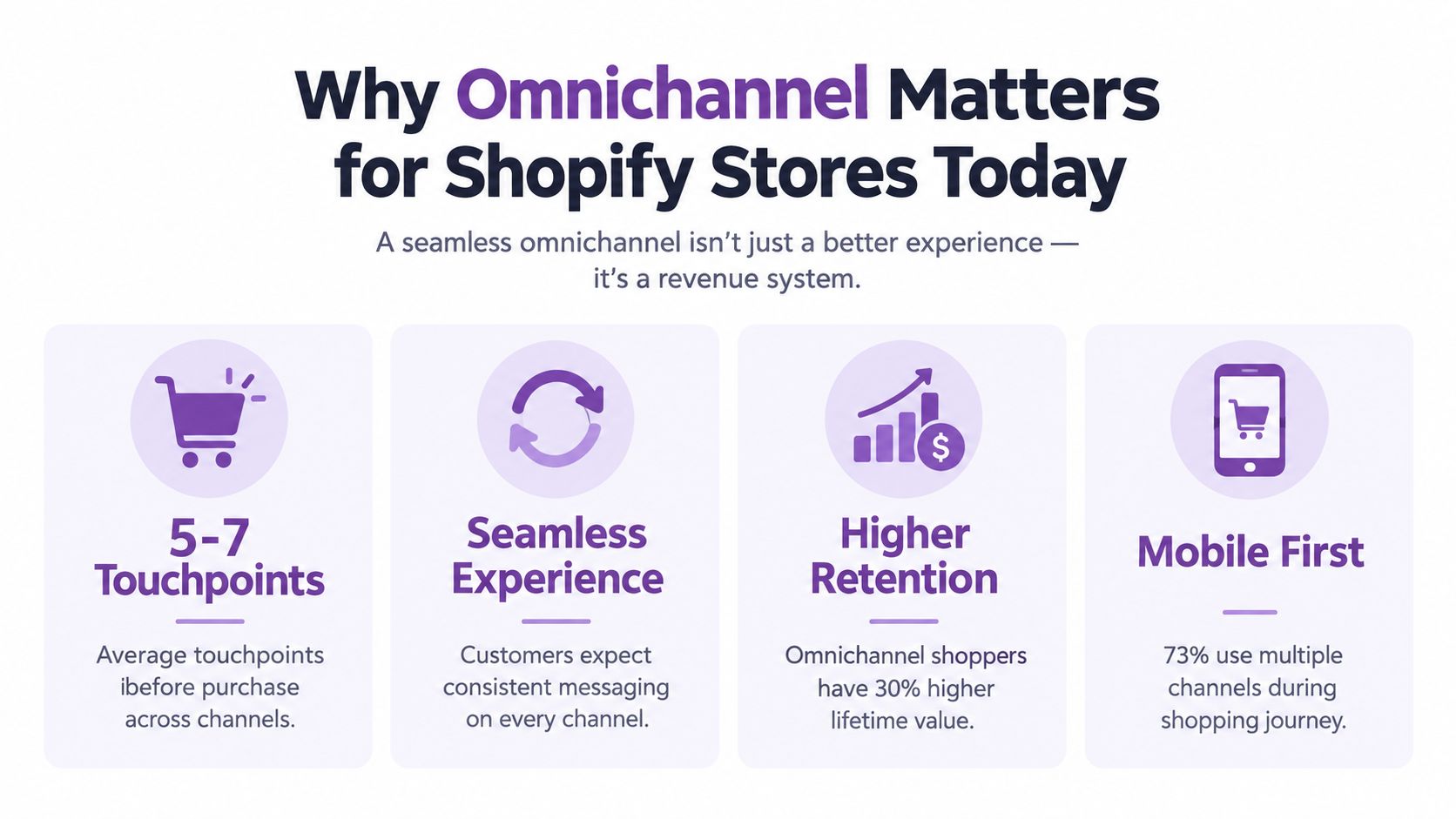
A Shopify shopper might discover a product on social media, compare prices on a phone, read an email at work, and return through a saved link that evening. Industry research estimates that consumers use 5–7 channels to research and purchase products. It also reports that 60% of shoppers use a mobile device in-store to check prices or reviews, while 52% switch between devices during one purchase journey (industry overview of omnichannel marketing behavior).
For a store owner, those handoffs create operational risk. A welcome email may continue promoting an item after purchase. A retargeting ad may appear while support is resolving an issue. An SMS reminder may arrive after another channel has already recovered the cart. Each message can be reasonable on its own and still feel careless when customer events are not shared.
The revenue case for coordination
Familiarity across touchpoints supports purchase confidence. One industry summary reports that 80% of consumers are more likely to buy from brands offering an omnichannel experience, a finding that reinforces the value of consistent offers, customer context, and timing (omnichannel consumer and business benchmarks).
The performance case extends beyond reach. Findings on ecommerce campaigns report that marketers using three or more channels in one campaign achieved a 287% higher purchase rate than single-channel campaigns. The same source reports a 47.7% greater likelihood of conversion for omnichannel campaigns that included SMS, along with higher purchase frequency, average order value, and retention for omnichannel programs (ecommerce omnichannel performance findings).
Those findings do not justify adding every channel to a Shopify store. Coordination works when each channel has a defined job and a shared event model. Email can explain the offer, paid media can create demand, the storefront can remove purchase friction, and SMS can deliver the immediate trigger after a shopper shows intent.
SMS should stay selective. Send an abandoned-cart reminder only when consent is valid and the order has not already been completed. Suppress promotional messages after purchase or during an active support case. YipSMS flows can support that timing, but the store still needs clear rules for consent, eligibility, frequency, and suppression.
Practical rule: Add a channel only when you can define the customer action it improves and the data event that tells the next channel what happened.
A workable system connects Shopify events, channel responsibilities, YipSMS flow logic, and customer-level measurement. That structure gives the team a way to judge whether a message helped the journey, rather than rewarding every channel for claiming the same order.
Mapping the Customer Journey Across Every Touchpoint
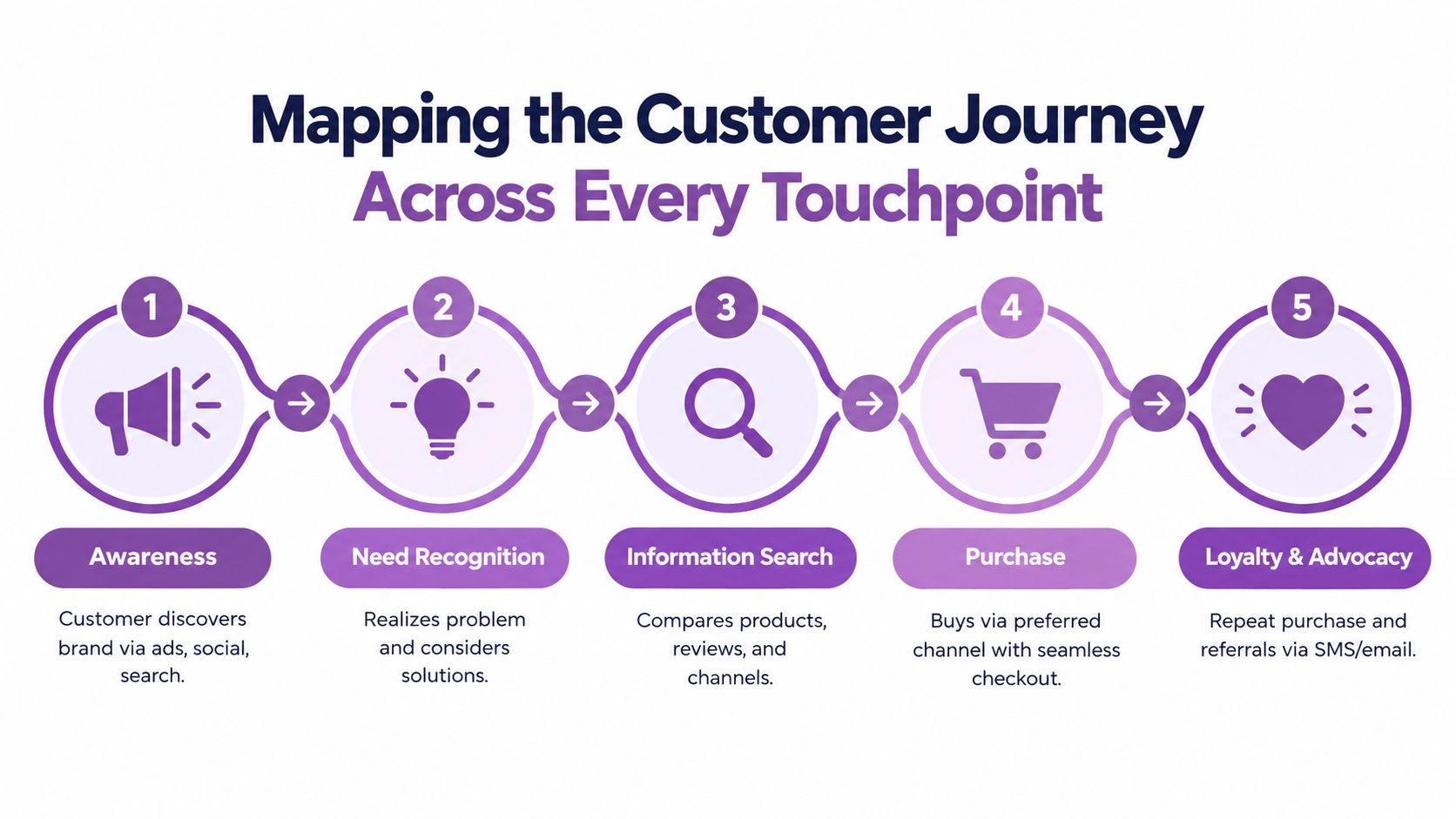
Start with customer behavior, not your channel list. A useful journey map follows five stages: awareness and need recognition, information search and processing, transaction, delivery and returns, and loyalty and engagement (customer journey research on omnichannel retail).
For each stage, record the customer's intent, the event that proves movement, the channel best suited to help, and the channel that should stay quiet. This prevents every team from sending the same message because a customer exists in its audience.
Assign a job to every stage
Awareness and need recognition should make the problem recognizable. Social content, creator placements, search, and paid media can introduce the product category or a customer problem. Avoid sending promotional SMS to cold visitors at this point unless they've explicitly subscribed.
Information search is where email, product pages, reviews, comparison content, and customer support do the heavier work. A viewed-product event can inform an SMS follow-up later, but the message should add context, such as a product benefit, sizing help, or a direct path back to the item. It shouldn't repeat the ad.
Transaction belongs to the storefront and checkout experience. Email and SMS can recover a stalled cart or checkout, but each message needs a stop condition. Once Shopify records a completed order, recovery messages must be suppressed immediately.
Delivery and returns require utility over persuasion. Shipping updates, delivery notifications, tracking information, and support access reduce uncertainty. Promotional content during a delayed delivery or unresolved support issue can damage trust even if the offer is attractive.
Loyalty and engagement starts after the customer has received the product and had a reasonable chance to use it. Email may educate or collect feedback, while SMS can support replenishment, relevant recommendations, or a carefully timed repeat-purchase prompt.
Look for broken handoffs
Draw the journey as a timeline and mark every handoff between web, email, SMS, support, and any physical retail touchpoint. Then ask four questions:
- Thematic cohesion: Does the brand sound recognizable across each interaction?
- Consistency: Do price, product availability, shipping terms, and promises match?
- Context sensitivity: Does the message reflect what the customer just did?
- Connectivity: Does one event change what the next channel sends?
A customer who clicks an email about a specific product should land on that product, not a generic collection. A customer who buys should leave acquisition and abandonment segments. A customer who opts out of SMS should remain suppressed even if another system still lists a mobile number.
For a deeper operational model, use this guide to multi-channel customer journeys as a reference while documenting your own events, ownership, and suppression rules.
Choosing Channels and Building Your Shopify Tech Stack
More channels create more coordination work. That trade-off matters because recent market coverage reports that only 43% of organizations have expanded beyond email and SMS, while 11% report full integration between messaging platforms and CRM or business systems. The same source says 80% cite a lack of unified omnichannel functionality as the main barrier to adding channels (2026 digital customer communication overview).
Use a selective test before committing engineering time or media budget. Score a channel by segment fit, customer intent, margin, operational readiness, and its ability to contribute a distinct job. A channel that reaches many people but can't receive purchase, support, or inventory signals may create more fatigue than revenue.
| Channel | Best Use Case | Integration Effort | Revenue Impact |
|---|---|---|---|
| Education, nurture, launches, post-purchase content | Moderate | Supports consideration and retention | |
| SMS | Urgent reminders, recovery, shipping utility, time-sensitive campaigns | Moderate | Strong when intent and timing are clear |
| Paid social | Demand creation, prospecting, retargeting | Moderate | Expands reach and assists conversion |
| Shopify storefront | Product evaluation and checkout | Core system | Converts intent into orders |
| Customer support | Objection handling, delivery issues, returns | Moderate | Protects trust and repeat purchase |
| POS or retail touchpoint | In-person evaluation and purchase continuity | Higher | Connects offline and online behavior |
Build the lean version first
Your minimum viable stack should establish one usable customer record across Shopify, your CRM, email service provider, SMS platform, point-of-sale system, and support tools. The exact vendors matter less than the data fields and events that move between them.
At minimum, define:
- Identity fields: Email, phone number, Shopify customer ID, consent status, and source.
- Commerce events: Product viewed, cart created, checkout started, order completed, refund, and subscription or replenishment signal.
- Service events: Ticket opened, delivery problem, return requested, and issue resolved.
- Message controls: Last sent time, campaign category, channel eligibility, and suppression reason.
A connected two-channel system usually beats a six-channel stack that can't agree on whether the customer has already purchased.
Teams managing visual products, accessories, or fashion catalogues can also use WearView when evaluating how product presentation supports discovery and consideration. The useful question isn't whether the tool adds another touchpoint. It's whether it improves a mapped stage and passes meaningful behavior back into the customer record.
Putting SMS to Work Inside Your Omnichannel System with YipSMS
SMS works best as the immediate trigger, not as the entire omnichannel plan. Email can carry detail and education. Paid media can create demand. Shopify records intent and purchase. SMS closes the timing gap when the customer has taken an action that deserves a fast, relevant response.
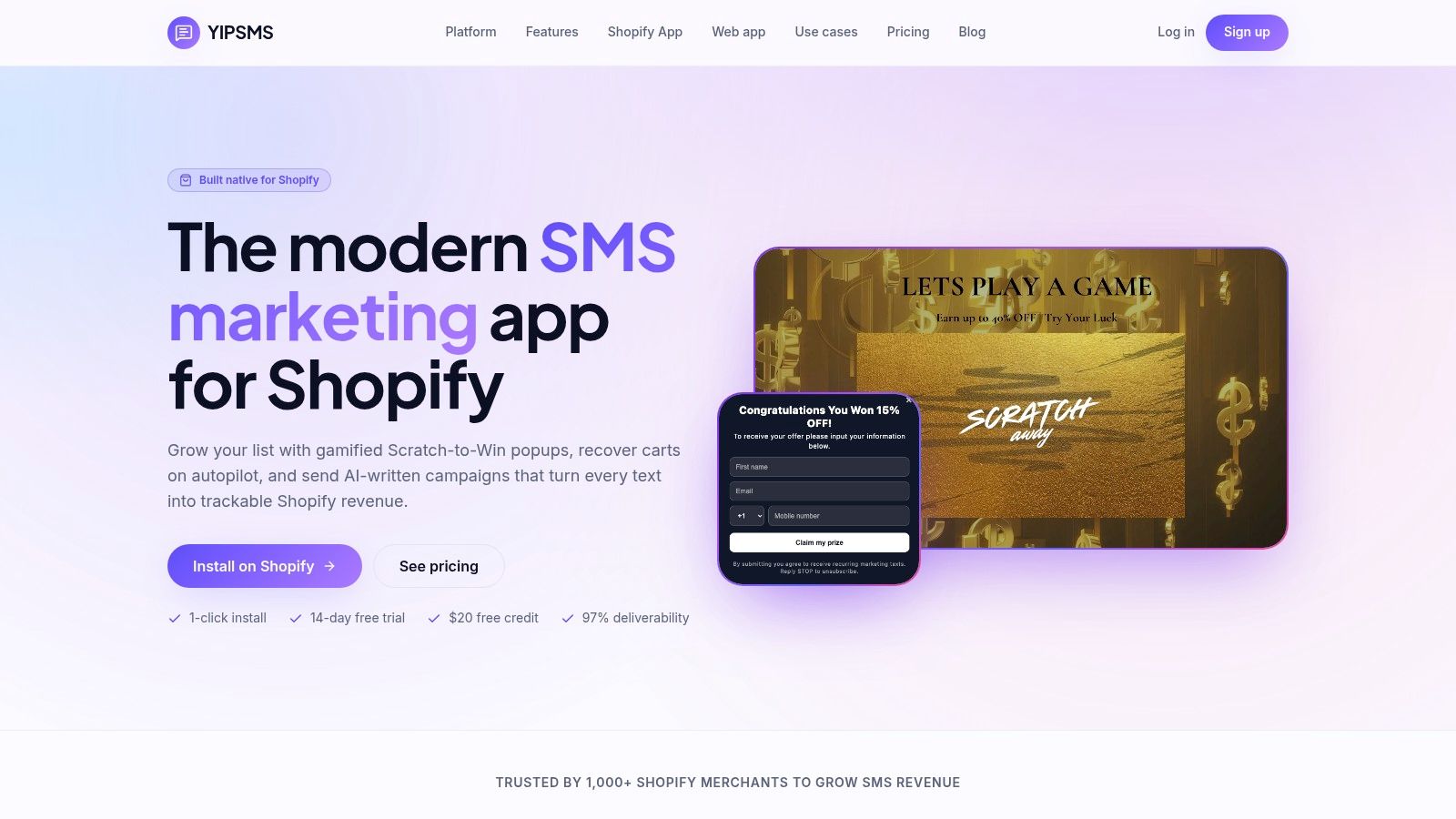
A Shopify merchant can connect YipSMS through the Shopify integration guide, then use one-click setup and a drag-and-drop popup designer to grow a permissioned subscriber list. The practical setup work is less about designing a clever message and more about defining which Shopify events start a flow, which events stop it, and which other channels must remain silent.
Start with four revenue-oriented flows
Cart and checkout abandonment should be your first recovery test. Send only after the customer has given the required promotional consent, reference the products left behind, and stop the sequence as soon as Shopify records an order. A useful hook is: “Still thinking it over? Your selected items are waiting here: [link].” Don't manufacture urgency if inventory or pricing hasn't changed.
Viewed-product follow-up needs restraint. A customer who browsed a product hasn't necessarily asked for a sales message. Use the event to segment the customer, then send a concise follow-up only when the product category and prior engagement justify it. “Need help choosing the right size or finish? See the details here: [link]” is more useful than repeating the product title.
Shipping and delivery notifications are utility messages, not promotional blasts. Include the brand name, order context, and tracking path. If a customer has an open delivery issue, suppress unrelated promotions until support resolves it.
Personalized recommendations should use purchase or browsing context. Recommend a compatible product, replenishment item, or related category. Avoid using a generic “you may also like” message when the customer has no relevant behavior signal.
YipSMS also supports bulk and scheduled campaigns. Use those for launches, inventory announcements, and customer segments with a clear reason to receive the message. Keep campaign logic separate from automated recovery so a scheduled promotion doesn't collide with a triggered flow.
Design consent and governance before copy
Promotional SMS requires separate affirmative consent. The opt-in should be distinct from purchase completion, record the timestamp, phone number, and exact disclosure language, and avoid burying permission inside general terms and conditions (SMS compliance requirements for ecommerce).
For EU and UK customers, design the process around GDPR and PECR requirements, including a freely given, specific, informed opt-in rather than a pre-checked or bundled permission (EU and UK ecommerce SMS compliance guidance). The first confirmation text should restate the brand name, enrollment, opt-out keyword, and message frequency.
Set governance rules in writing:
- Frequency caps: Limit promotional sends by customer, not merely by campaign.
- Sequence priority: Service notifications outrank recovery, and recovery outranks broad promotions.
- Real-time suppression: Remove buyers from cart, checkout, and acquisition flows immediately after purchase.
- Conflict handling: Pause promotional messaging for customers with unresolved support or delivery issues.
- Channel coordination: If email delivers the detailed explanation, SMS should provide the short action or alert.
This short walkthrough can help operators visualize the setup and flow-building process:
Abandoned-cart SMS deserves careful measurement because it reaches customers with unusually high intent. Independent benchmark pages report recovery conversion ranges from about 8–12% to 15–20%, with click-through rates often around 19–30% (abandoned-cart SMS benchmark overview). A separate production dataset recorded 1,999,408 delivered texts, 534,974 clicks, and 65,566 recovered orders, with the supplied benchmark calculating a 12.3% click-to-order conversion and 3.3% of delivered messages ending in a recovered order (cart-recovery SMS benchmark dataset).
Measuring What Matters and Optimizing for Growth
A Shopify dashboard can show opens and clicks without showing whether the customer bought, bought again, spent more, or stayed active. Measure each flow by journey stage, and connect events to a customer ID whenever the store can do so.
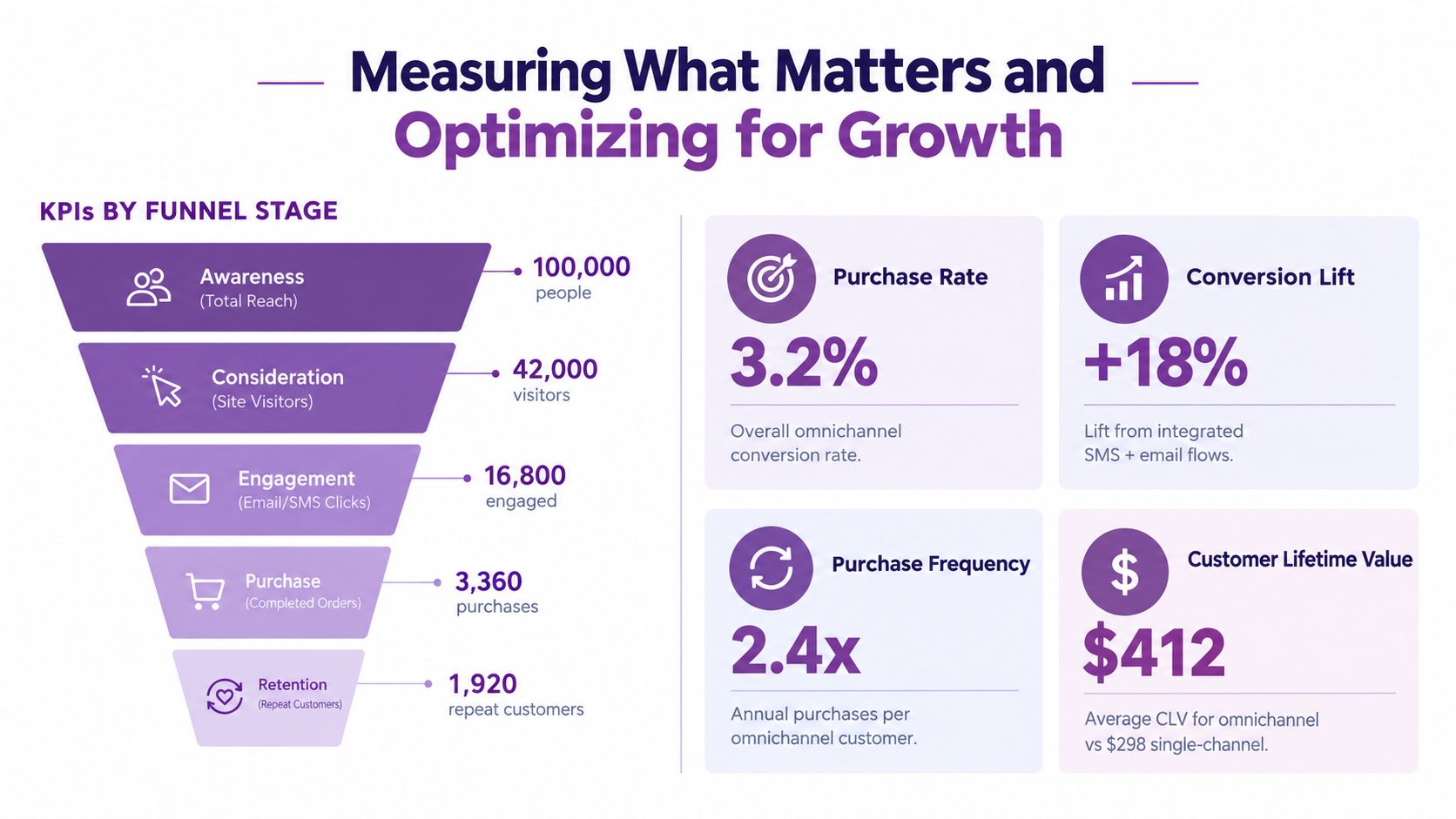
Omnichannel performance should be judged against business outcomes, including purchase rate, purchase frequency, average order value, and retention. Those measures reveal whether channel coordination is improving the customer relationship. Engagement totals alone cannot show that.
Use a simple measurement template
Create one reporting row for every flow or campaign. Include:
- Audience and entry event: Who qualified, and what action started the journey?
- Suppression event: What behavior removed the customer from the sequence?
- Channel path: Which channels appeared, and in what order?
- Primary outcome: Completed order, recovered order, repeat purchase, or resolved service event.
- Revenue view: Attributed revenue, margin contribution, refunds, and message or media cost.
- Customer outcome: Purchase frequency, retention, unsubscribe rate, and support impact.
For YipSMS, monitor delivery, opens, clicks, and ROI in real time, then match those results to Shopify orders. High clicks with weak order completion usually indicate landing-page friction, price resistance, poor product fit, or a broken checkout handoff. Weak clicks point to timing, copy, audience quality, or an irrelevant trigger.
A useful operating rule is to assign one owner and one decision to every metric. If a number cannot change a flow, handoff, audience, or budget decision, it does not belong in the primary dashboard.
Test the failure mode, not just the wording
Change one variable at a time. Test the delay after cart creation, the message angle, the landing destination, the offer structure, or the relationship between SMS and email. Changing the audience and offer together makes the result difficult to interpret.
Separate performance problems into three gaps:
Timing gap: The message arrives too soon, too late, or after the customer has already acted.
Channel gap: The selected channel does not fit the customer's urgency, preference, or journey stage.
Message gap: The content does not answer the customer's current question or provide a clear next action.
For broader analysis of event quality, customer-level reporting, and digital commerce measurement, use this digital commerce analytics resource. Keep the dashboard operational. Each metric should lead to a specific action, such as changing a suppression rule, revising a handoff, or removing a channel that adds complexity without improving the journey.
Your Omnichannel Playbook and Next Steps to Launch
Launch the system in a narrow sequence rather than attempting a complete channel transformation at once. Start with the customer journey that already contains clear intent, then add coordination around it.
The first operating cycle
Map: Write the five stages, list the Shopify events, and name the channel responsible for each customer action.
Connect: Confirm that Shopify, email, SMS, support, and any POS data share a usable customer identifier and consent status.
Trigger: Build cart and checkout recovery first, then add viewed-product follow-ups, delivery notifications, and recommendations only when their entry and exit conditions are reliable.
Govern: Document frequency caps, message priority, opt-out handling, buyer suppression, and support suppression before activating campaigns.
Review: Check flow performance on a regular rhythm, inspect exceptions manually, and remove messages that duplicate another channel.
Use these starter workflows:
- Cart recovery: Cart event, permission check, concise SMS reminder, email detail if needed, immediate order suppression.
- Post-purchase nurture: Order confirmation, delivery utility, product education, support path, then a relevant recommendation.
- Repeat purchase: Completed-order segment, product-use or replenishment signal, email context, SMS action prompt, suppression after purchase.
The best system isn't the one with the largest channel count. It's the one where each message arrives with context, stops when the customer acts, and gives the next channel a better starting point. Expand only after the current flow produces clean data and a clear business decision.
YipSMS Inc. provides Shopify SMS marketing tools for consent-based list growth, cart and checkout recovery, viewed-product follow-ups, shipping and delivery notifications, personalized recommendations, and bulk or scheduled campaigns. Visit YipSMS Inc. to connect SMS to your omnichannel marketing strategy and start building coordinated flows with real-time analytics.
How this article was made: the YIPSMS team drafts some articles with AI writing tools, then checks pricing, compliance and product details against how YIPSMS actually works before publishing. Spotted something wrong? Tell us through your YIPSMS account.