Mobile Marketing Analytics Tools That Drive Shopify ROI
The global mobile analytics market reached USD 8.3 billion in 2025 and is projected to reach USD 33.6 billion by 2034, a 16.31% compound annual growth rate from 2026 through 2034, according to IMARC Group's mobile marketing statistics. For a Shopify merchant, the useful question is whether reporting ties an SMS subscriber's consent, timing, and order history to profit that survives after discounts and opt-outs.
A cart-recovery text can post a clean CTR and still lose money. Maybe the customer was already coming back, the code cut too deep, or another channel did the persuading before SMS took the last click. I've seen Shopify flows in tools like YipSMS look strong on delivered and clicked rates while unsubscribe creep taxes every future send.
Judge the stack by durable subscriber value: incremental orders, repeat-purchase lift, margin after incentives, and consent quality high enough to keep revenue compounding.
Table of Contents
- Why Mobile Marketing Analytics Tools Now Run the Shop
- How Mobile Marketing Data Actually Flows
- Must-Have Features in Modern Mobile Marketing Analytics Tools
- Privacy, Consent, and Compliance Considerations
- Setting Up Analytics for Your Shopify SMS Stack in 30 Days
- YipSMS Analytics in Action on a Shopify Store
- Evaluation Checklist and Optimization Loop
Why Mobile Marketing Analytics Tools Now Run the Shop
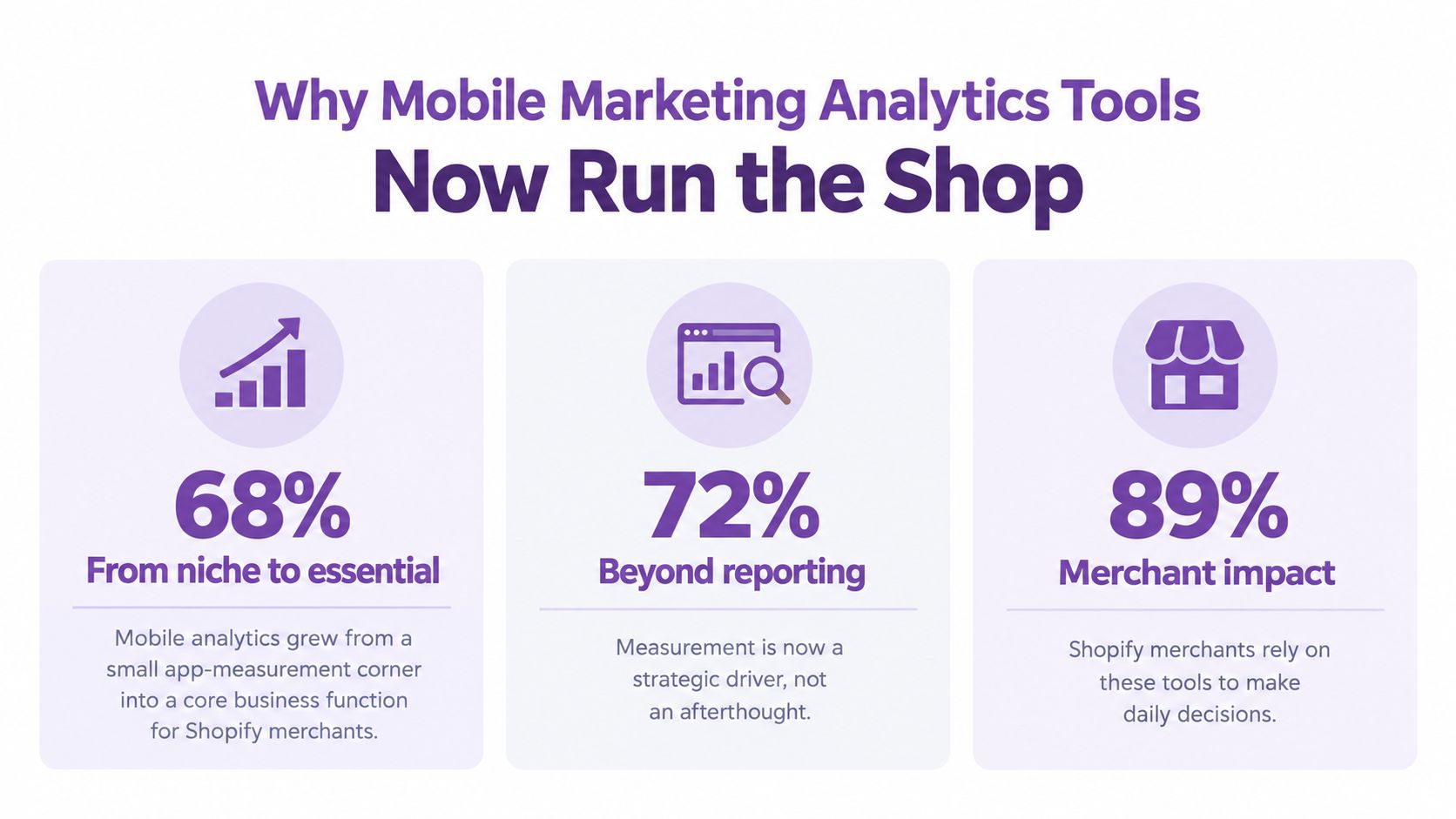
That market growth signals a change in what analytics does for a merchant. Reporting used to summarize clicks after a send. Now measurement decides where budget goes, which subscribers get suppressed, how a lifecycle flow follows up, and whether an acquisition source produces buyers who come back. The forecast cited above puts the shift in commercial context: analytics is a substantial part of the software and data infrastructure businesses run on.
Growth doesn't guarantee useful reporting, though. An SMS dashboard in a tool like YipSMS can show delivered messages, clicks, and attributed revenue while the economics of a flow stay hidden. Three gaps cause most of the trouble: whether the buyer intended to purchase anyway, what the discount did to margin, and how message frequency treated the consent base.
Mobile marketing analytics tools earn their place when they close those gaps. A clean event trail from message to Shopify order supports budget decisions and exposes where a flow needs adjustment. A figure labeled "revenue" is only as trustworthy as the instrumentation, transaction matching, and attribution rules behind it.
Operator's test: If a dashboard can't trace a campaign result back to a specific customer action and Shopify order, don't raise spend on that number alone.
The practical shift is from collecting engagement numbers to engineering subscriber value. Opens and clicks describe behavior; they say little about profit or about whether the list stays opted in. Use those metrics to locate friction. Then weigh campaigns against what compounds: orders that hold their margin, customers who buy again, and a consent base that keeps growing.
How Mobile Marketing Data Actually Flows
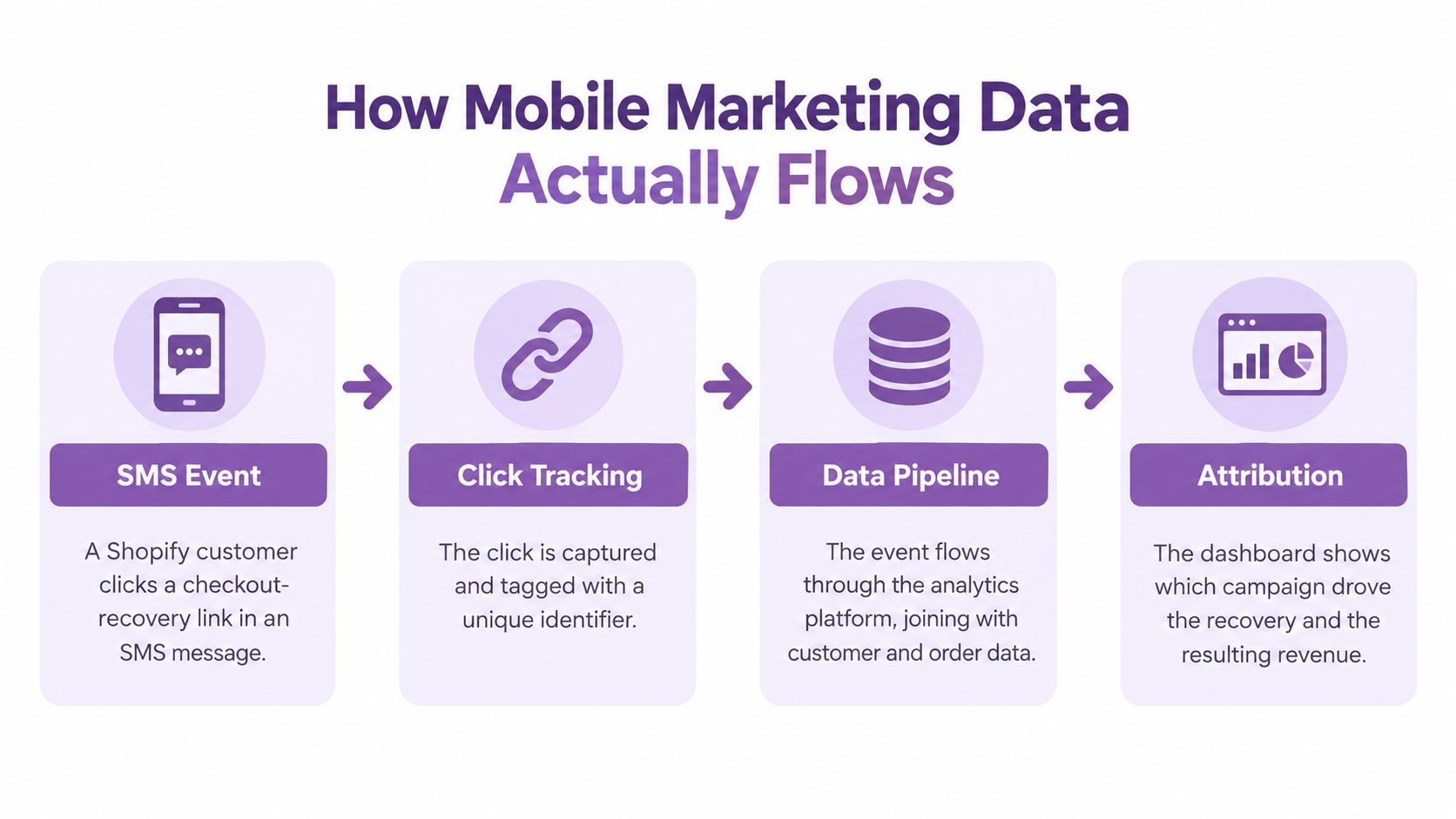
A customer taps a checkout-recovery SMS link, browses, and buys in the same session. Whether the order gets credited correctly, and whether you can later tell if that buyer came back or opted out, depends on four handoffs in the data chain.
- Capture the action. The SMS platform records the tap on a campaign link. That link needs campaign metadata and a subscriber-level identifier, so the click ties back to a consented customer rather than anonymous traffic.
- Join the journey. Analytics picks up the click and connects it to on-site behavior like product views and checkout starts. In a Shopify-native setup such as YipSMS feeding Shopify events, first-party order records are the dependable join key for this step.
- Match the purchase. When the order completes, the purchase event should carry a stable order ID plus value, currency, and line items. Google's ecommerce event documentation explains that ecommerce actions must be explicitly implemented. Installing an analytics tag does not make a dashboard infer missing purchase data.
- Assign credit. The reporting tool runs its attribution model over the recorded path and labels a result for the campaign.
The click is the easy part. Breaks I have traced usually happen at the join, where a missing identifier turns a known subscriber into a stranger.
The dashboard figure is a model's reading of events. In Google Analytics 4, data-driven attribution distributes fractional conversion credit across touchpoints using a counterfactual model that estimates how conversion likelihood changes when an interaction is added or removed. Modeled credit is more informative than handing the last SMS click everything by default; it still cannot prove the message caused an extra purchase.
Identifier quality decides what you can measure next. If the subscriber ID survives all four stages, you can connect that campaign to repeat purchases, margin after discount, and opt-out behavior weeks later. If it drops at stage two, you get a click report and a revenue guess.
Keep campaign IDs and Shopify transaction fields consistent wherever you send events, then reconcile attributed orders against actual order records on a schedule. Customer data analytics for Shopify covers how first-party records support that reconciliation. When attributed totals and Shopify totals disagree, this guide to fix attribution blind spots walks through where credit gets lost or double-counted.
Must-Have Features in Modern Mobile Marketing Analytics Tools
A tool shortlist should start with the decisions your team needs to make, not the most impressive-looking demo. For Shopify SMS, the core requirements are usable attribution, trustworthy event data, and a way to connect campaigns to customer behavior after the initial order.
| Feature Bucket | Why It Matters | Weight |
|---|---|---|
| Attribution modeling | Separates a campaign's modeled contribution from last-click credit and supports comparison with controlled tests. | High |
| Cohort and retention views | Shows whether customers from a signup source or flow return and purchase again. | High |
| Shopify-native data sync | Connects events with Shopify orders, products, transaction IDs, and revenue. | High |
| Segmentation | Helps compare customer groups and avoid sending every campaign to the entire list. | Medium |
| Real-time reporting | Helps catch delivery failures or campaign problems while a send is underway. | Medium |
A reporting interface is only as valuable as the events behind it. Google's ecommerce event guidance makes the implementation requirement clear: product views, purchases, shopping behavior, and revenue analysis rely on explicitly implemented ecommerce events. Before comparing dashboards, confirm that a purchase event carries a transaction ID and the relevant value, currency, and product information. Otherwise, an attractive funnel chart can describe incomplete or duplicated data.
Cohort views are more useful than an all-time average when you're deciding whether a signup incentive, acquisition source, or SMS flow attracts customers who come back. Segmentation matters for a similar reason: it lets the team compare groups and tailor sends instead of treating every subscriber as equally engaged.
Don't pay extra for a report no one acts on. Prioritize the ability to audit event definitions, reconcile order records, and export or inspect underlying data over elaborate visualizations that don't change a decision.
For a small Shopify team, built-in SMS analytics can reduce the work of stitching together click and campaign activity. A broader analytics platform can provide deeper cohort and cross-channel analysis, but only if the store has the time and data quality to maintain it. Score shortlisted tools against the table, then test whether each can answer a real question with your own Shopify events.
Privacy, Consent, and Compliance Considerations
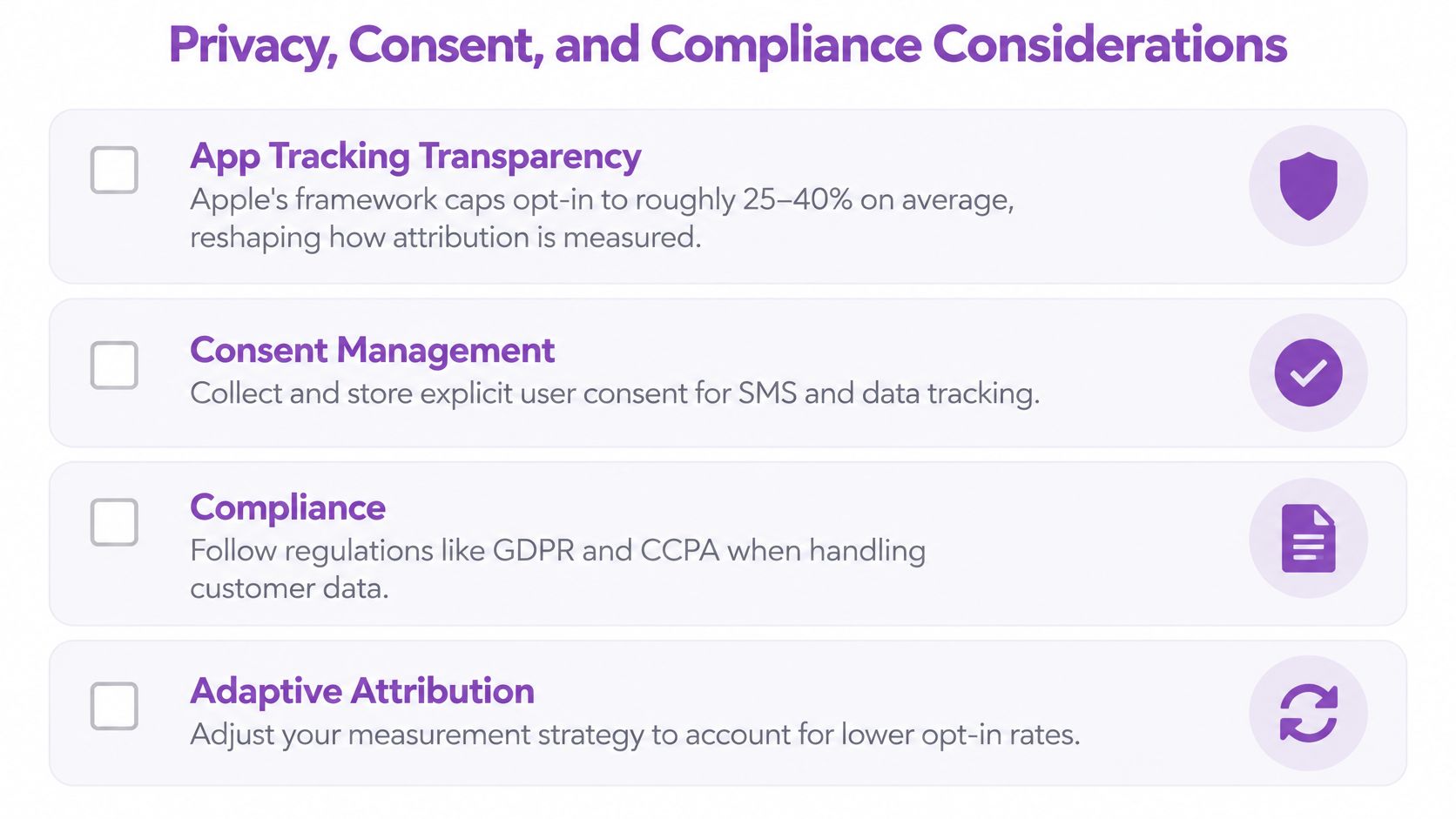
A campaign can show healthy click activity and still be one consent audit away from getting pulled. Apple's App Tracking Transparency framework made that trade-off visible: introduced with iOS 14.5 in April 2021, ATT requires apps to obtain explicit permission before tracking a user's activity across other companies' apps and websites. An industry estimate places average ATT opt-in rates at approximately 25% to 40%, which is why aggregated reporting, modeled conversions, and privacy-preserving attribution now sit beside user-level tracking in this mobile analytics market overview.
For a Shopify merchant, the practical response is to treat consent as a revenue input, not a legal footer. Store the consent state next to the subscriber profile and make every report separate observed events from modeled or incomplete ones. When reviewing measurement practices, this guide to how to track conversions in 2026 gives useful context for building around privacy limits.
Treat consent fields like order fields
For U.S. e-commerce stores, promotional SMS generally requires prior express written consent under the TCPA. The signup should identify the phone number, say the customer agrees to recurring automated marketing texts, disclose that consent is not a condition of purchase, and state that message and data rates may apply. A dedicated, unchecked SMS box is easier to defend than consent folded into checkout terms.
Keep promotional consent separate from transactional messaging. Order confirmations and shipping updates usually fall under informational messaging, while marketing texts need the higher standard. In a Shopify-native SMS stack such as YipSMS, the subscriber record should carry phone number, source, timestamp, disclosure version, and scope so a flow can prove who was eligible before it takes credit for the order.
Put suppression and complaint signals beside revenue
For U.S. sends, schedule promotions by the recipient's local time. The permitted window identified in this TCPA SMS compliance guidance is 8:00 a.m. to 9:00 p.m. local time. Use recipient-level time-zone logic, block sends outside that window, and keep a clear STOP route. After an opt-out, send no more than one confirmation and stop promotional traffic unless the customer re-enrolls.
The dashboard should show consent status, opt-outs, complaints, delivery failures, and quiet-hours suppression next to revenue per recipient. If a tool cannot expose those signals or sync suppression fast enough, a profitable-looking flow may only be borrowing future subscriber value. Use the Shopify SMS TCPA compliance checklist when auditing consent capture, opt-out handling, and eligibility before scaling a winner.
Setting Up Analytics for Your Shopify SMS Stack in 30 Days
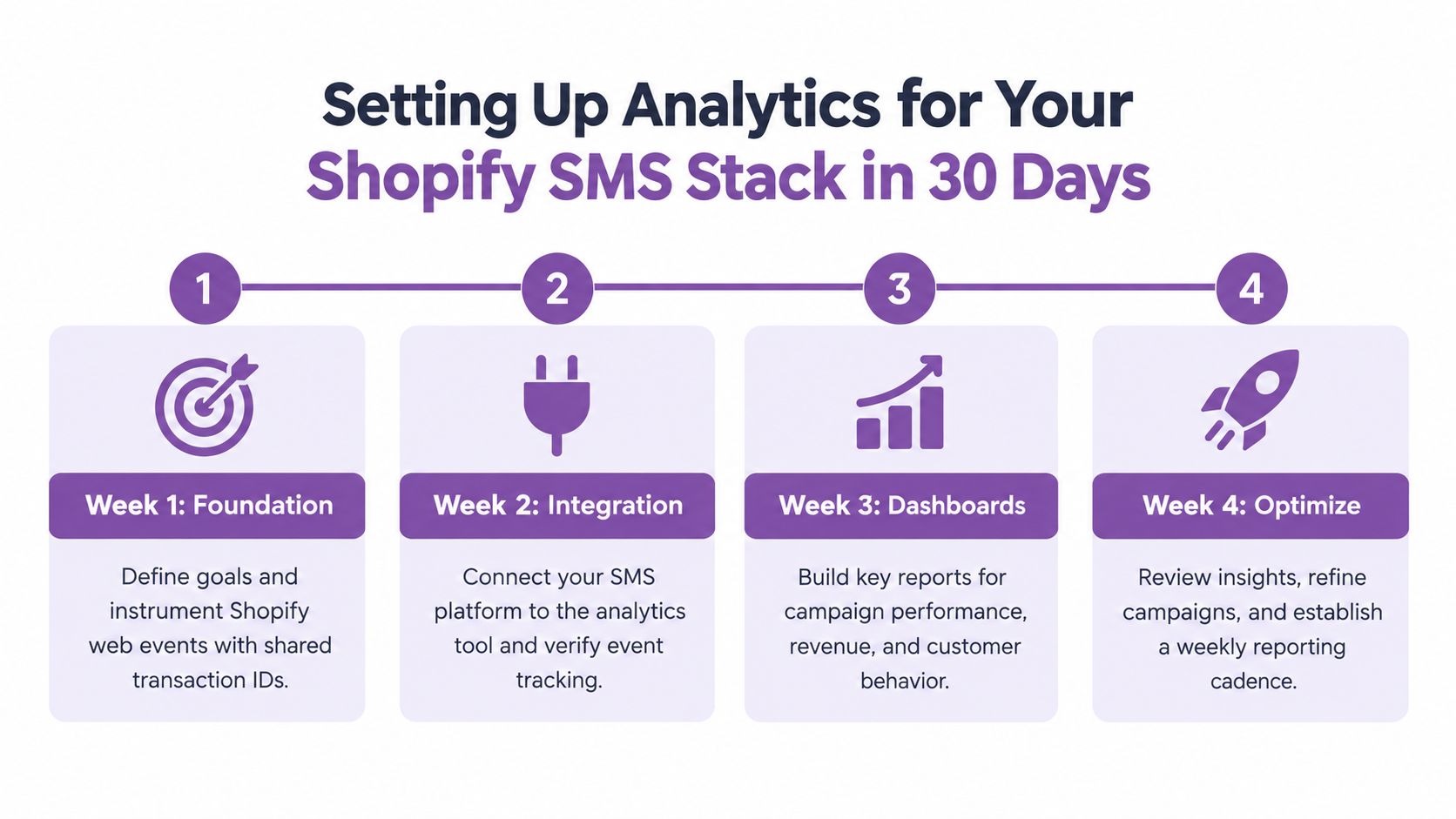
A measurement setup doesn't need to become a long analytics project. Work through a focused sequence: define the question, make the data joinable, build reports that answer it, then test whether a flow drives extra orders.
Week 1, Define outcomes and instrument events
Choose the business question first: for example, whether checkout recovery generates profitable orders without eroding margin. Map the events needed to answer it, including product view, checkout start, purchase, refund, promotion exposure, and message delivery. Standardize a transaction ID and record timestamp, value, currency, product identifier, and campaign ID where relevant.
Deliverable: an event map that lists each event, required fields, and the source that sends it. Sign off only when test orders can be reconciled with Shopify records.
Week 2, Connect campaign activity to order data
Link SMS clicks and campaign identifiers with the same customer journey and Shopify order data. Check that click tracking distinguishes each campaign and that purchases aren't counted twice when a customer returns through another channel. If you need an integration partner to help connect systems, compare its scope and data ownership expectations with custom integration solutions for NGOs, a reference point for thinking through purpose-built data connections.
Deliverable: a reconciliation check showing that campaign clicks and completed orders carry usable identifiers. Sign off when a test journey flows from message interaction to the matching order.
Week 3, Build cohort and frequency reports
Create views for campaign performance, revenue by signup source, customer return behavior, and opt-outs by flow. Add recipient-level send-time suppression and a subscriber frequency cap; don't treat a full-list broadcast as the default. Report by cohort as well as in aggregate, so strong results from one segment don't conceal poor results elsewhere.
Deliverable: a dashboard that combines campaign results with subscriber-health signals. Sign off when someone on the team can identify a flow to refine and explain why.
Week 4, Test incrementality and settle the cadence
Run a controlled holdout for a cart-recovery flow. Suppress messages to a randomized group, compare order outcomes with the group that receives the flow, and account for margin and discounts before making a return claim. Set a reporting window long enough for your data to appear. Google notes that ecommerce data may take roughly 24–48 hours to begin populating reports after tagging, so set baseline windows in calendar days rather than hours using its ecommerce reporting guidance.
Deliverable: a documented comparison between the flow and its holdout, plus a recurring review schedule. That's a working measurement loop, not just a dashboard ready for screenshots.
YipSMS Analytics in Action on a Shopify Store
A Shopify apparel store runs three YipSMS automations: cart abandonment, viewed-product follow-up, and shipping notifications. The operator's first job is separating messages that drive purchases from transactional updates, then tying every campaign result back to a Shopify order. The dashboard view that earns its place shows delivered, failed, clicked, converted, and campaign-attributed revenue side by side, with campaign identifiers that make each order relationship auditable.
Flow-level reporting comes first. A cart-recovery click that ends in an order deserves scrutiny before anyone calls it a win. Reconcile the attributed purchase with Shopify's transaction record, check for duplicate events, and weigh it against the holdout comparison before claiming the revenue is incremental. Viewed-product follow-ups need the same discipline. A click signals interest. Repeat purchases and margin say whether the follow-up builds subscriber value or harvests demand that existed anyway.
Use frequency and opt-outs as operating signals
A send plan protects the subscriber relationship as much as it protects campaign numbers. Benchmarks summarized by SMS marketing statistics put the median opt-out rate near 0.32% per send, and roughly 1.4% per month for brands sending four to six messages monthly, with opt-outs climbing once volume passes eight messages. Treat those figures as reference points rather than targets. When a segment's opt-outs climb after the third message in a week, that is fatigue, and the fix is suppression or a slower cadence, not a cleverer subject line.
Shipping notifications get their own reporting lane. Customers expect them, engagement on them means something different, and folding them into campaign numbers makes promotional performance look healthier than it is. Keep each flow's deliveries, clicks, purchases, and opt-outs distinct enough to identify which experience needs work.
Read the full subscriber picture
Attributed revenue is one input. The store also watches complaint signals, failed deliveries, repeat purchase rate, and opt-outs, because consent quality decides how long a subscriber keeps producing value. A campaign that generates clicks but little contribution after discounts and costs gets its audience or offer revised, not its volume scaled. A subscriber who keeps buying while keeping permission granted is worth more than a CTR spike, even when the spike photographs better in a recap.
The dashboard exists to force a decision: continue, adjust, or suppress a flow. Document what changed, then compare the next cohort against the earlier one. I've watched teams skip that last step and end up arguing from memory about whether a change worked. Written-down comparisons end the argument.
Evaluation Checklist and Optimization Loop
A dependable optimization rhythm connects campaign activity to customer value. On Monday, review the previous sends by flow: delivered, failed, clicked, converted, revenue attributed, and opted out. Check whether the results reconcile with Shopify orders, then choose one action, such as changing a segment, adjusting a message, or investigating a mismatch.
A click is a useful diagnostic. It isn't a profit metric, and last-click credit isn't a holdout test.
On a monthly review, compare cohorts by signup source, consent language, incentive, and message frequency. Include opt-outs, repeat purchasing, discounts, margin, and customer-service costs when judging subscriber value. A campaign with lower immediate conversion may be the better choice if it keeps subscribers engaged and produces stronger contribution over time.
Use a quarterly tool review to check whether the analytics stack still supports the questions the team asks. Confirm that event definitions remain accurate, transaction IDs match, consent and opt-out data are visible, and the attribution model's output is compared with controlled tests. For a practical framework to connect campaign costs and returns, use this guide to SMS marketing ROI.
Keep the working checklist short enough to run consistently:
- Revenue per recipient: Compare campaign-attributed value with campaign cost and margin.
- Opt-outs by flow: Find the message, audience, or frequency associated with subscriber loss.
- Repeat purchasing: Review cohort behavior over the period relevant to your customer lifecycle.
- Consent and delivery: Check that sends go only to eligible, reachable subscribers.
- Incrementality: Use a holdout to distinguish modeled attribution from added purchases.
Don't set a single CTR as the headline score. Use the dashboard to find friction, validate the event trail, and decide whether the campaign strengthens the customer relationship as well as near-term revenue.
YipSMS Inc. offers Shopify SMS marketing tools for campaign analytics, trackable links, and automations for cart recovery, viewed products, and customer notifications. If you want to connect SMS activity with clearer Shopify revenue and subscriber-health reporting, visit YipSMS Inc..
How this article was made: the YIPSMS team drafts some articles with AI writing tools, then checks pricing, compliance and product details against how YIPSMS actually works before publishing. Spotted something wrong? Tell us through your YIPSMS account.