8 Cart Abandonment Examples That Recover Sales in 2026
Most abandoned cart texts get ignored because they're interchangeable. Same "you left something behind", same generic code, same countdown. A shopper who has walked away from three carts this month has read that script three times and knows exactly how it ends.
The behaviour behind it hasn't budged. Statista's long-running series on online shopping cart abandonment worldwide records a 70.22% rate in 2026, following an all-time high in 2013 and a steady climb from 2014 onward (Statista cart abandonment series). Roughly seven of every ten carts holding at least one product never become orders, and that has held through mobile commerce, digital wallets, one-click checkout, and better payment rails.
So better copy alone won't rescue a broken checkout. It does mean the message is the part you can fix this week.
Here are eight cart abandonment examples, each pulled apart the same way: the copy, where it sits on the recovery timeline, what it costs you in margin, which intent it answers, and what to expect. Then I'll show how to stack them into a single sequence rather than firing one text and hoping.
The principle that does most of the work: match the message to the shopper's reason for leaving. A code answers a price objection. A review answers doubt. A retry link answers a failed transaction. Send the wrong one and you teach a buyer to ignore the next one.
Table of Contents
- 1. Gentle Reminder Within One Hour
- 2. Time-Limited Discount Offer
- 3. Low Stock or Scarcity Alert
- 4. Free Shipping Nudge
- 5. Social Proof and Reviews Message
- 6. Help-Oriented Check-In
- 7. Multi-Step Recovery Sequence
- 8. Personalized Product and Variant Reminder
- Cart Abandonment SMS Examples at a Glance
- Build Your Sequence and Start Recovering Carts
1. Gentle Reminder Within One Hour
The first text in a sequence should ask for one thing, which is that the shopper comes back.
Hi Sarah, you left the Trail Runner Jacket in your cart. Complete your order here: {checkout_link} Reply STOP to opt out.
It works because it lands while intent is still warm. She named a product, picked a size, then got interrupted by a call or a form. Naming the item does the remembering for her, and one link removes the decision. Nothing here asks her to weigh a discount, so it can fire first without training anyone to wait for a code.
Consent comes before copy. CTIA's messaging guidance asks senders to obtain express written consent for marketing texts, support opt-out through text, email, or phone, and acknowledge a stop with one final confirmation before going quiet (CTIA messaging security best practices). A number collected for delivery updates doesn't authorise this send.
Keep it inside one segment. Under 160 characters, a branded short link, and the product name trimmed so the STOP line never gets cut. Test your merge fields on a two-item cart and on a missing first name before the flow goes live.
Schedule on the shopper's clock, not yours. Hold anything that would land after quiet hours and send it the next morning.
For the trade-offs between one hour, three hours, and next morning, this breakdown of abandoned cart timing covers the numbers I watch.
2. Time-Limited Discount Offer
A deadline plus a code is the most dependable lever in recovery and the most expensive one to pull.
Your cart is waiting. Take 10% off with code COMEBACK10 before it expires tonight: {checkout_link}
It converts a "later" decision into a "now" decision, which is the whole job when the cart is full and no objection remains. The expiry does the work. The percentage just makes the deadline worth noticing.
Run the Margin Math First
Ten percent sounds like a rounding error until it meets your gross margin. On a $100 item at 60% margin, the code leaves $50 instead of $60, a sixth of the profit. On the same item at 30% margin it leaves $20 instead of $30, a third of it. On a first order that difference decides whether the customer was profitable to acquire.
Set the smallest discount that moves the number. Test 5% against 10% before assuming you need double digits, and read revenue per recipient, not click rate.
Make the code single-use and short-lived. Shared codes travel. Single-use codes expire with the shopper who received them.
Hold the offer for the second message. A code in the first text teaches repeat buyers to abandon on purpose.
Worked example: a $90 candle set abandoned at 11pm on a 70% margin product. A 10% code costs about $9 of a $63 margin, which is survivable once. Run it on every cart for a month and the same shoppers start waiting for Friday.
The cheaper alternative is fixing the checkout. Baymard Institute estimates the average large ecommerce site could achieve a 35.26% conversion-rate increase from checkout design improvements alone, with around 32 distinct improvements available per site (Baymard cart abandonment research). Spend there before you spend margin.
Margin rule: if a discount recovers fewer orders than the same money spent on checkout fixes, you're paying for revenue you already had.
3. Low Stock or Scarcity Alert
Picture a sneaker that shows 40 units in stock and 2 in the size the shopper chose. That is the only scarcity worth texting.
Heads up, only 3 pairs of the Canvas Sneakers in size 10 are left. Grab yours: {checkout_link}
It works because it reframes the decision. "Maybe later" becomes "not in my size later", and a shopper juggling three tabs suddenly has a reason to finish. The risk is symmetrical: one invented countdown and every future message from you reads as a sales tactic.
Pull the number from inventory, not from your head. Wire the message to variant level so size, colour, and quantity are true at send time.
Use it only where demand is real. Limited runs, seasonal colourways, and size breaks justify a scarcity text. A permanent stock item doesn't.
Pair it with the plain reminder. Send the reminder first and the stock alert later, so urgency reads as escalation rather than the opener.
Worked example: your sneaker has 400 units across six sizes, with 3 pairs left in size 10 and 60 in size 12. Text only the shoppers whose cart holds size 10, and let everyone else receive the standard reminder. That one filter is the difference between a useful alert and a store that cries wolf every Tuesday.
The mirror of this message is the back-in-stock alert for everyone who arrived after it sold out, worth building at the same time as your back in stock notifications.
4. Free Shipping Nudge
Cost is the objection that appears most often at the last step. In 2025, almost 40% of U.S. consumers abandoned an online purchase during checkout because of additional costs such as shipping, taxes, or fees (Statista checkout abandonment reasons). That's specific and fixable, and free shipping answers it without touching your price.
Good news, {first_name}. Your order ships free today when you finish checkout: {checkout_link}
The message works because it removes the surprise instead of discounting the product. A shopper who balked at $7.95 in shipping isn't hunting for 10% off. They're annoyed about a cost that appeared late and made the total feel dishonest.
Show the same threshold in the cart. If the text promises free shipping over $75, the cart has to say it too, or the shopper arrives at payment and finds a different story.
Use the threshold nudge for carts near the line.
You're only $12 away from free shipping. Add one more item or check out now: {checkout_link}
That version lifts average order value instead of cutting into it, and it gives the shopper something to do rather than something to decide.
The strongest evidence for this one comes from checkout design rather than copy. A mid-market specialty retailer on Adobe Commerce moved estimated shipping costs and ZIP-based quotes into the cart, cut cart-to-shipping drop-off from 29% to 17% within three weeks, and brought overall abandonment from 74% to 58% (checkout optimization case study). The same project lifted revenue per visitor from $1.95 to $3.12 and cut checkout support tickets from 112 to 34 a month.
Test free shipping against a small percentage discount at your own average order value. Below $50, shipping usually wins. Above $150, the percentage often does.
5. Social Proof and Reviews Message
"Best mug I've ever owned" is a stronger sales argument than 10% off when the doubt is quality.
Shoppers love this one: "Best mug I've ever owned." Your cart is still waiting: {checkout_link}
It works because it hands the reassurance to someone else. The shopper isn't deciding whether they like the product. They're deciding whether they trust your description, the fit, or the finish. A verified quote from a buyer with the same concern settles that faster than any product page paragraph.
Match the review to the doubt. For apparel, quote a reviewer talking about fit, not packaging. For a pour-over set, quote the one that mentions the seal not leaking.
Use the current rating. Pull the live average and the live count. "Rated 4.8 by 312 buyers" beats "our bestselling set" because the shopper can check it in two taps.
Keep the quote under about 90 characters so the message stays in one segment and the link survives the trim.
Use it on considered purchases. Higher price, longer decision, or a first-time buyer who has never touched your product. It does little for a $12 impulse item.
Worked example: a $180 ceramic set abandoned at 9pm. The quote that matters is "arrived double-boxed, not a chip", because breakage is the silent worry behind a cart like that. It costs no margin and scales to every abandoned cart you have.
6. Help-Oriented Check-In
Some carts stall on uncertainty rather than price. A sizing question, a compatibility check, a returns policy nobody can find on the page.
Hi {first_name}, need help choosing the right size for your cart? Reply here and our team will answer within one business day.
It works because it asks a question instead of demanding a purchase. The shopper who was about to open a second tab to compare gets an answer in the thread they're already reading, and you find out which objection keeps appearing across your store.
Diagnose the Abandonment Before You Text
Not every silent cart is a decision. In a 2026 survey of more than 1,400 shoppers across North America, Europe, and Asia-Pacific, 63% of checkout-related abandoners cited payment or checkout problems, with failed transactions the largest category at 28%, ahead of too many steps and missing preferred payment methods at 21% each (WooCommerce checkout trends). A shopper whose payment timed out doesn't need a sizing question. They need a retry link and a second payment option.
Complexity produces the same silence. Baymard's benchmark found 17% of U.S. online shoppers had abandoned an order in the previous quarter because the checkout was too long or complicated, against an average U.S. checkout displaying 23.48 form elements by default where 12 would do the job (Baymard checkout usability benchmark). No reply-to-help text fixes a form that long.
Staff the inbox to match the promise. "Within one business day" needs someone watching the replies, or the message costs you trust instead of recovering a sale.
Build saved replies for sizing, delivery dates, and returns, then push the recurring question back into the product page and the FAQ.
7. Multi-Step Recovery Sequence
The sequence is where the other seven examples earn their keep, because each step answers a different objection.
A working three-step shape looks like this.
Hour 1: You left the Trail Runner Jacket in your cart. Finish here: {checkout_link}
Day 1: Still deciding? Take 10% off with COMEBACK10 until midnight: {checkout_link}
Day 3: Last call. We release your cart tomorrow, but here are two similar jackets other shoppers picked: {checkout_link}
Stop on purchase. Every step needs a goal check, or a buyer gets three texts about an order they placed on Friday.
Track opt-outs by step. If step three carries most of the unsubscribes, that message is too aggressive, not the list.
Cap the sequence at three or four texts and exclude anyone who received another campaign in the previous 48 hours.
The intervals matter less than the ladder. A published benchmark lays out an email at 2 to 4 hours, a text with a discount at 24 hours, and a final message at 48 hours that offers alternative products or asks for feedback (Klaviyo abandoned cart benchmarks). Treat 24 and 48 as testable starting points, then compare conversion, margin, and revenue per recipient by category.
What a sequence can't do is compensate for the checkout. Baymard rates 65% of sites as having a mediocre checkout or worse, with only 2% rated good (Baymard checkout usability research). Stacking reminders on a broken form just raises your unsubscribe rate.
8. Personalized Product and Variant Reminder
Specificity is the cheapest upgrade in the whole sequence. Name the exact item and the shopper no longer has to reconstruct the decision.
Hi Maya, your Medium Navy Hoodie (qty 1) is still in your cart. Finish checkout here: {checkout_link}
It works because it proves the text is about her cart rather than a batch blast. Variant detail does extra work on mobile, where she can't hover, zoom, or keep three tabs open to remember what she picked.
That's also where the losses sit. Statista reports that, in the United States, mobile buyers showed a cart-abandonment rate approximately 10 percentage points higher than desktop buyers (Statista category cart abandonment rates). On a small screen, confirming a size is enough effort to end the session.
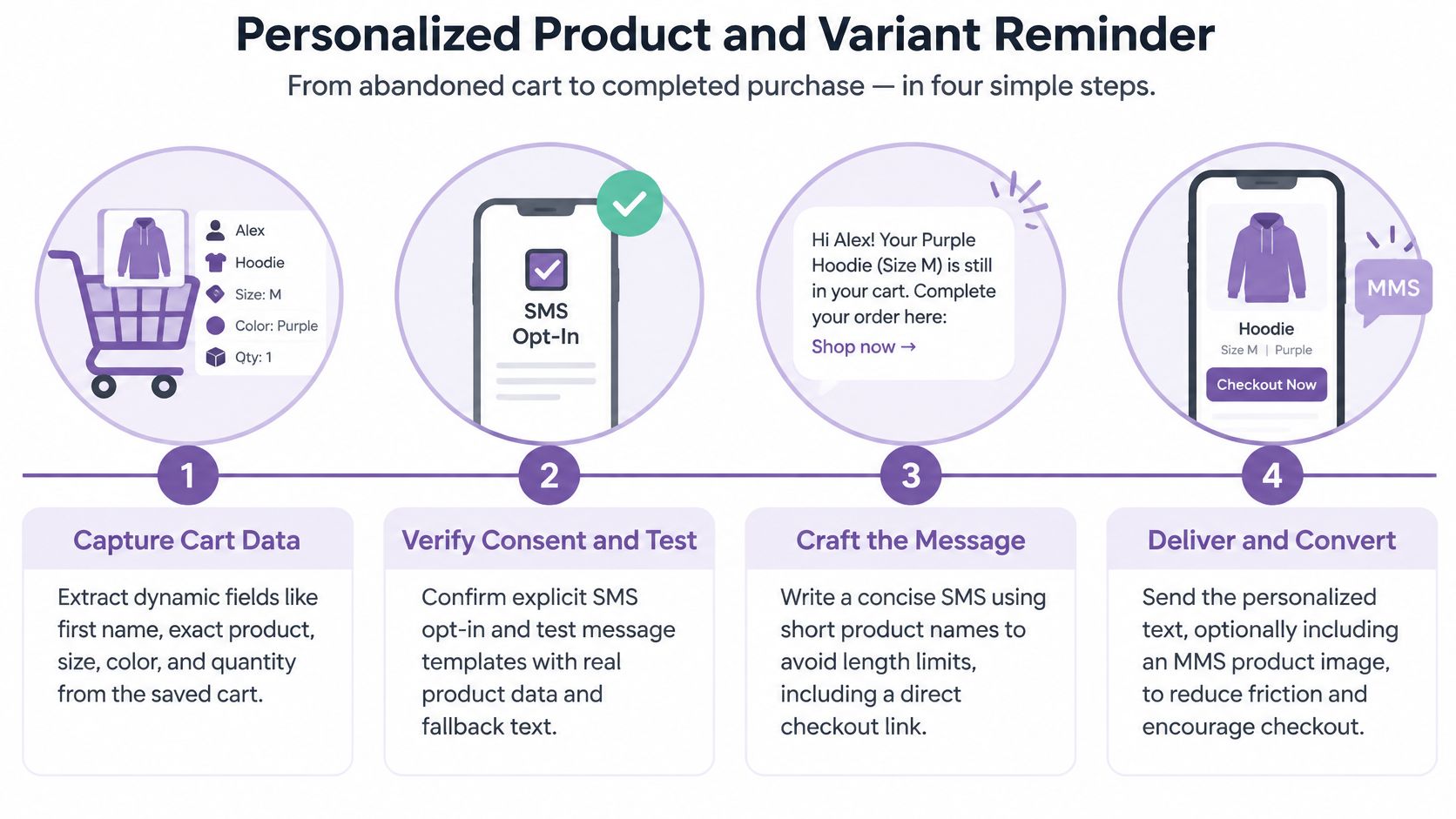
Test the template with real data. Long product names, three-item carts, a discount already applied, a missing first name. Each one breaks a template somewhere, and you find out in production unless you test first.
Write fallbacks that read like sentences. "You left 3 items in your cart" is fine. A greeting with an empty field is not.
Trim product names to about 40 characters and use a generic label for multi-item carts.
Confirm consent and the number before the send. Personalization makes an unauthorised text feel worse, not better.
The follow-up is where this pays off twice: a recommendation built from the same cart, covered in this guide to personalized product recommendations.
Cart Abandonment SMS Examples at a Glance
Each message has a place in the sequence. Start with a low-cost reminder, then match later touches to the shopper's likely objection. Use discounts only when the expected recovery justifies the margin.
| Item | Timing in Sequence | Incentive Required | Best For |
|---|---|---|---|
| Gentle Reminder Within One Hour | 30–60 minutes after abandonment; usually first | No | Reaching shoppers while purchase intent is fresh |
| Time-Limited Discount Offer | Usually second, after a plain reminder; offer often lasts 24 hours | Yes, a time-limited discount | Motivating hesitant shoppers to act |
| Low Stock or Scarcity Alert | After the first reminder, when live stock or sale-deadline data supports the claim | No | Limited, seasonal, or high-demand products |
| Free Shipping Nudge | After shipping costs appear at checkout, usually within 24 hours | Conditional; free shipping or a threshold offer | Addressing shipping-cost objections |
| Social Proof and Reviews Message | Often 1–2 days after abandonment | No | Reassuring hesitant or first-time buyers |
| Help-Oriented Check-In | Within 24 hours, when a shopper stalls | No | Resolving questions about sizing, shipping, or compatibility |
| Multi-Step Recovery Sequence | Across several days: within an hour, within 24 hours, then within 48–72 hours | Optional | Recovering shoppers who need multiple nudges |
| Personalized Product and Variant Reminder | Second touch, after the plain reminder | No | Making the reminder relevant and reducing checkout friction |
Build Your Sequence and Start Recovering Carts
The eight examples aren't alternatives. They're slots, and the job is deciding which slot answers which reason.
My default sequence runs at 2 hours, 24 hours, and 48 hours, and the first touch does the least work.
2 hours: the plain personalized reminder. Example 1 with example 8's variant detail. No code, one link, stop line attached. It's the highest-volume message you'll send and the cheapest.
24 hours: the objection. Take one from example 4 for shipping complaints, example 5 for doubt, or example 6 for a shopper who stalled inside checkout. Match it to the reason. Don't broadcast the same offer to everyone.
48 hours: the low-pressure close. A final notice with alternatives, or a single code. Never a code and a countdown stacked in the same message.
Sort your abandonment by intent before you write anything. Hesitation wants a reminder and a review, and costs no margin. A price objection wants free shipping or a threshold nudge before it ever sees a percentage code. Uncertainty about fit, compatibility, or returns wants a help check-in with a real reply behind it. An operational failure such as a timeout or a routing error wants a retry link and a second payment method, never a discount.
Then measure each step separately with its own trackable link. Revenue per recipient, conversion, opt-out rate, and profit after discount, in that order. Clicks alone will flatter the discount message, because everyone clicks a code.
The merchants who recover well aren't the ones with the cleverest copy. They're the ones whose abandoned-cart link opens a preserved cart, whose shipping cost is visible before payment, and whose opt-outs are honoured on the first stop. The message is the last mile. The checkout is the road.
If you'd rather not build the plumbing first, YipSMS Inc. ships a prebuilt cart automation with follow-ups at 2h, 24h, and 48h, auto-shortened trackable links for per-campaign attribution, and TCPA-friendly compliance with automatic opt-out language and consent logs. The whole thing can be live inside the 14-day free trial.
YipSMS Inc. gives Shopify stores a recovery flow that works on install: the 2h, 24h, and 48h follow-ups this article describes, a popup builder for collecting opt-ins, and per-campaign short links so you can see which message brought the order back. Before you spend a single point of margin on discount codes, run one plain reminder against one offer and let the revenue per recipient decide. Start the 14-day free trial and send your first recovery text at YipSMS Inc..
How this article was made: the YIPSMS team drafts some articles with AI writing tools, then checks pricing, compliance and product details against how YIPSMS actually works before publishing. Spotted something wrong? Tell us through your YIPSMS account.