Omnichannel Customer Experience: A Guide for eCommerce
A shopper adds a jacket to her cart on her phone at lunch, checks store stock on the way home, and orders it for delivery that evening. The next morning, she receives a shipping update by SMS, followed by a discount text asking her to finish the purchase she's already made. Your teams may each have working campaigns, but your customer sees a business that hasn't kept up.
That's the practical problem behind omnichannel customer experience. For a Shopify merchant, the priority isn't adding another channel. It's making the channels you already use respond to what the customer did.
Table of Contents
- What an Omnichannel Customer Experience Really Means
- Why Connected Journeys Lift Spend and Repeat Visits
- How Channels Share One Customer Record
- Consent and Opt-Out Rules for SMS Flows
- Matching Each Journey Stage to the Right Channel
- Where Omnichannel Journeys Break and How to Measure Them
- Start With One Connected SMS Flow This Week
What an Omnichannel Customer Experience Really Means
Omnichannel customer experience means a customer's journey across your website, app, email, SMS, social media, and store feels like one continuous conversation. Channels remember each other, so the customer doesn't have to start over.
For the jacket shopper, that means the available size matches across touchpoints, her completed order replaces her abandoned cart, and support can see the delivery update she received. She doesn't need to understand your integrations. She just needs accurate information and a clear next action.
Multichannel is different. You can operate a storefront, email program, SMS list, and retail counter while each keeps its own customer record and campaign calendar. Having those channels doesn't make them connected.
Multichannel versus omnichannel experience
| Aspect | Multichannel | Omnichannel |
|---|---|---|
| Customer record | Separate record in each channel | One shared profile across channels |
| Cart and order state | Stays inside each channel | Syncs across website, SMS, email and store |
| Messaging rules | Each channel sends its own campaigns | Messages are suppressed or timed by the latest action |
| Measurement | Conversion counted per channel | Journey-level conversion, opt-outs and repeat purchase |
| Staff access | Support sees one channel at a time | Support sees the full order and message history |
What makes the connection real
Start with shared customer identity. Your systems need a reliable way to recognize that the person checking an order is the person who subscribed to SMS, without assuming every visitor on a shared device is the same shopper.
Then establish shared cart and order status. A messaging platform shouldn't behave as though an unpaid cart still exists after your checkout system records payment. Nor should a support agent promise stock based on an outdated inventory copy.
Finally, set common timing and frequency rules. Email and SMS teams need a shared decision about what should happen next, including when nothing should happen.
A connected experience sometimes means sending fewer messages, not finding more places to send them.
Don't begin by buying access to another touchpoint. Walk through a purchase using your existing channels and note every moment when information disappears. Which of your channels currently forgets what the customer just did?
Why Connected Journeys Lift Spend and Repeat Visits
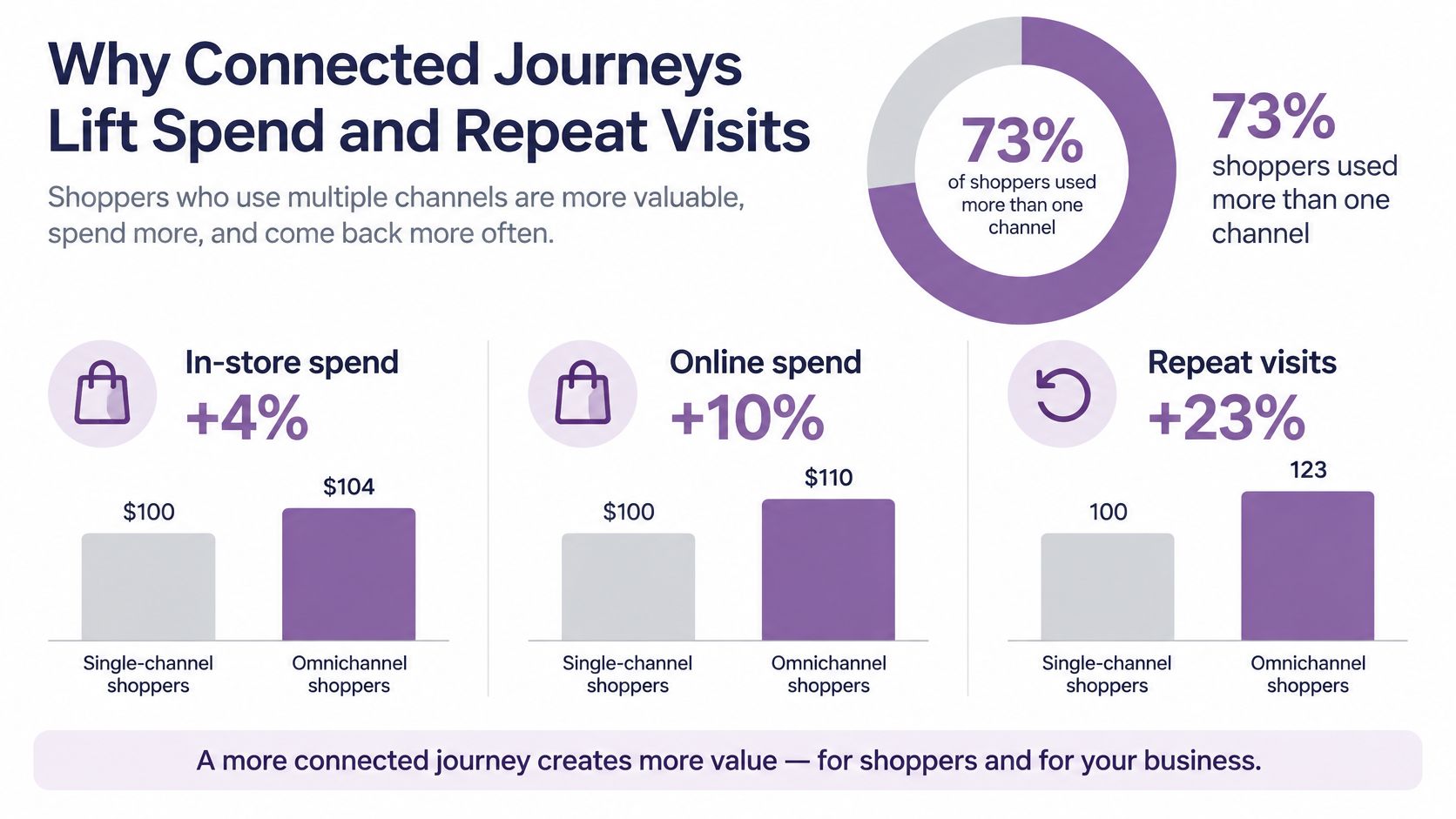
73% of shoppers used more than one channel in a study of 46,000 shoppers at a major U.S. retailer reported by Harvard Business Review in January 2017; omnichannel shoppers spent 4% more per in-store visit and 10% more online, customers using four or more channels spent 9% more in stores than single-channel shoppers, and omnichannel shoppers made 23% more repeat store visits within six months.
Those results make connected shopping commercially relevant. They don't give every merchant a guaranteed uplift, and they don't prove that sending more messages causes higher spending.
The spending and repeat-visit differences are summarized below.
Connection matters more than channel count
The useful operating lesson is continuity, not channel accumulation. Someone who checks a product online before visiting a store is trying to resolve uncertainty. Someone who opens an order notification wants reassurance, not another sales pitch.
For an eCommerce store, coordinate the work each interaction performs:
- Product discovery should help shoppers evaluate suitability, availability, and price.
- Cart recovery should make returning to an unfinished purchase straightforward.
- Order updates should explain what's happening without requiring a support ticket.
- Post-purchase engagement should fit the product purchased and the customer's current situation.
Say a shopper abandons a jacket because she's unsure about sizing. A useful recovery message links back to her cart and gives her access to sizing help. Once she buys, the next communication should concern her order, not repeat the incentive that brought her back.
That sequence deserves investment before another broadcast campaign does.
Commercial test: Judge the sequence by whether customers complete purchases and return, not by how many channels touched the order.
Treat the benchmark as direction, not a forecast
The historical study covered a single retailer's customer database. Its exact percentages aren't a forecast for your Shopify store, your category, or your SMS audience.
More engaged shoppers may also choose more channels. Don't confuse that association with proof that adding SMS will independently produce the same spending gap.
Run your own comparison using otherwise comparable eligible customers. Give one group coordinated lifecycle messages and keep the other on your existing approach, then compare repeat purchase rates over a period appropriate to your product. Keep discounts and eligibility consistent so you're testing the journey rather than a better offer.
How Channels Share One Customer Record
Build the journey around a current customer state, not a collection of mailing lists. The Manhattan Associates unified-commerce benchmark assessed 124 global specialty retailers across 286 capabilities using real purchases, returns, and digital and physical shopping journeys, spanning discovery through service.
That operational scope matters. A profile that combines contact details but omits fulfillment and support information won't prevent a wrong delivery message.
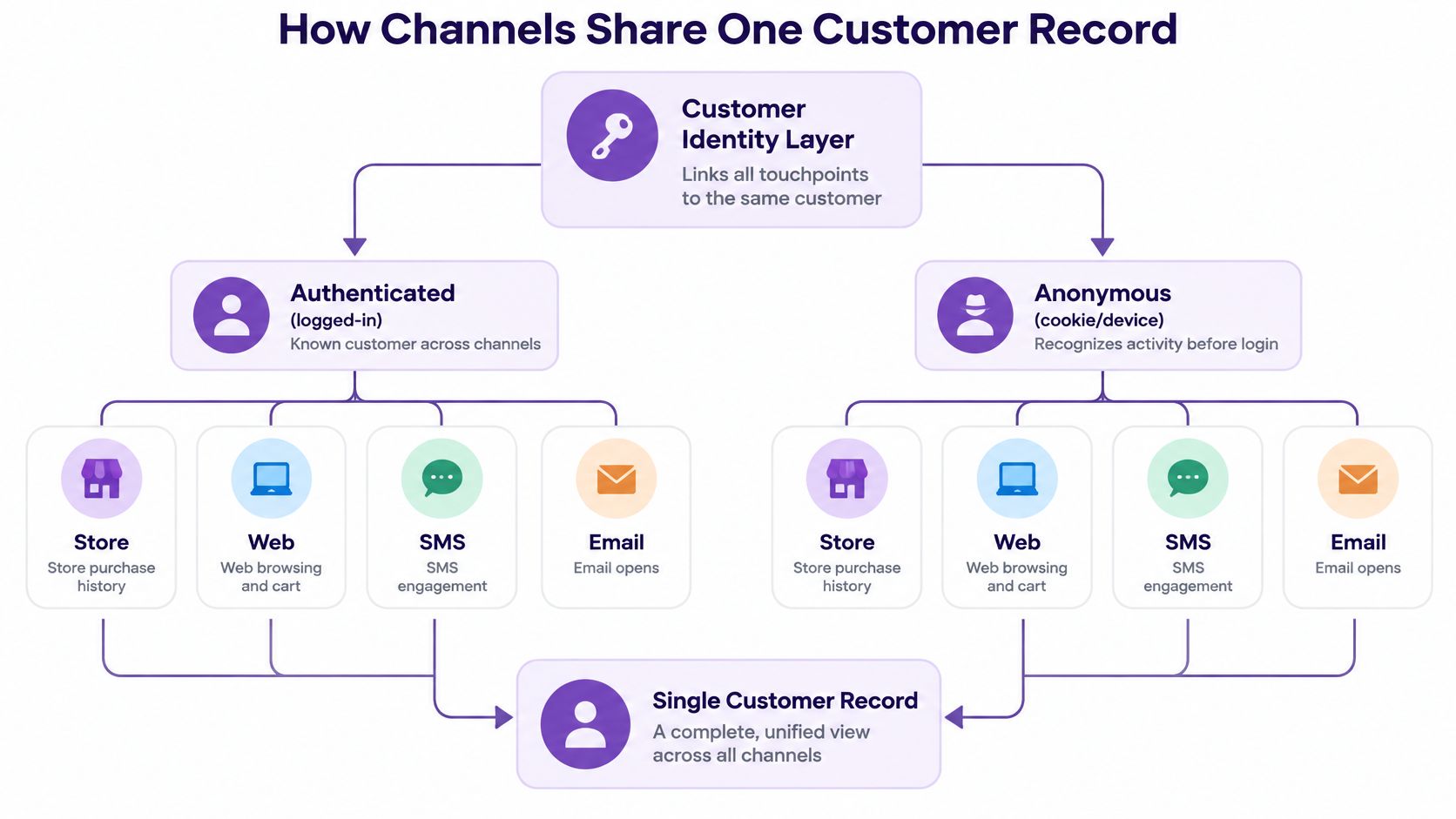
Use this identity model as the starting point.
Build the layers in the right order
Identity comes first. Link authenticated accounts, consented phone numbers, browser sessions, cart IDs, and order IDs through documented matching rules. Keep uncertain anonymous activity separate until you have a defensible connection. A single customer view should preserve those relationships, not erase their uncertainty.
Shared state comes next. Make order payment, fulfillment, stock availability, and channel permissions accessible to the systems making messaging decisions. SMS should use the same underlying facts as your storefront, email, support, and fulfillment tools.
Event triggers initiate work. Cart abandonment can queue a reminder. A fulfillment event can initiate a shipping update. Use event identifiers and timestamps so a retried webhook doesn't generate duplicate customer messages.
Suppression rules make the final decision. Recheck eligibility immediately before sending. Completed checkout cancels the queued cart reminder; a changed shipment status replaces an outdated delivery notification.
Apply the architecture to actual messages
For a viewed-product follow-up, check the current catalog and consent record before composing the message. Don't recommend an unavailable variant because a browsing event captured it earlier.
For a delivery update, distinguish an order from its individual shipments. A package being delivered doesn't necessarily mean the entire order has arrived.
Our implementation follows related operating principles: every opt-in from popup, scratch, keyword, AI chat, QR code, or CSV is dual-written into a master All Customers list. Imported Shopify segments stay live through webhooks, and click attribution is reconciled against Shopify checkout completion events.
Treat list membership as organization, not permission. A central list still needs current consent and suppression fields before anyone can send.
This video provides an additional reference for thinking through connected journeys.
Write down which system owns cart, checkout, shipment, and consent events. Name the single source of truth for each, along with the person responsible when synchronization fails.
Consent and Opt-Out Rules for SMS Flows
A phone number collected at checkout is a delivery detail, not a marketing key. Treat it as permission only when the customer has taken a clear positive action to receive promotional texts from your store. Under the UK's PECR, marketing texts generally require consent that is specific, informed, freely given, tied to your organization and the type of message, and demonstrated by an action you can prove. The ICO's electronic marketing guidance sets out that standard. Check each market you sell into; a UK workflow is not a universal template.
Capture permission you can demonstrate
Use an unchecked SMS-consent box at checkout or in a popup. Name the store, state that the customer is agreeing to marketing texts, link the privacy policy, and save the timestamp, exact wording, and acquisition source. Permission must be specific to your organization. An agency cannot pool consent across client brands, and a customer who opted in to one store's texts has not opted in to another's. A generic “updates” checkbox does not cover promotional SMS.
The YipSMS popup builder captures phone, email, and name in one tap, with TCPA-compliant consent and Privacy Policy links built in. Its TCPA-friendly controls include automatic opt-out language, double opt-in flows, and consent logs. Use the TCPA compliance checklist when reviewing U.S.-facing workflows, without assuming those controls establish UK compliance.
Which SMS sends are allowed in each situation
| Situation | Marketing SMS allowed? | Requirement |
|---|---|---|
| New popup subscriber | Yes, with positive opt-in | Unchecked box naming the store and message type, plus privacy link |
| Existing customer, similar product | Yes, under soft opt-in | Phone collected during a sale, opt-out offered at collection and in every message |
| Phone from an old list or a prospect | No, not without consent | Specific, recorded consent before any marketing text |
| Shipping or delivery update | Kept separate from promotions | Tied to the order; never mixed into promotional sends |
| Customer replies STOP | Stop as soon as possible | Suppress across all promotional segments and keep the record |
Don't stretch the soft opt-in
The ICO's small-business direct-marketing guidance describes the limited existing-customer exception: details must be obtained during a sale or negotiations, marketing must concern similar products or services, and an opt-out must be available at collection and in later messages. Old customer records are not blanket permission.
For withdrawals, the ICO's PECR compliance guidance requires an easy withdrawal route and stopping covered marketing immediately or as soon as possible. It identifies replying STOP to a short code as a possible mechanism.
Every campaign sent through YipSMS automatically adds opt-out language, and the platform handles STOP and HELP responses. Keep the suppression record across promotional segments so a later import or signup event cannot reactivate marketing.
Matching Each Journey Stage to the Right Channel
75% of shoppers consider consistency across websites, apps, email, social media, and stores important, but only 41% of brands deliver it, according to Adobe's retail digital-trends report; it also reports that 69% of consumers want retailers to anticipate needs with relevant offers or information, while only 35% believe brands succeed.
The answer isn't more personalization everywhere. It's assigning each channel a useful job and refusing to send messages that don't earn the interruption.
Channel and timing by journey stage
| Journey stage | Primary channel | Message type | Timing |
|---|---|---|---|
| Product discovery | Website and email | Recommendations and content | Ongoing, low urgency |
| Cart abandonment | SMS plus email | Reminder with cart link | Shortly after abandonment, then once more |
| Checkout completion | Onsite | Progress and offer prompt | During the session |
| Order shipped or delivered | SMS | Shipping and delivery updates | At each status change |
| Return or support request | SMS with link to chat or email | Status and resolution updates | At each status change |
| Replenishment or accessories | Email, or SMS with consent | Related product suggestions | After the expected use window |
Reserve SMS for messages that deserve attention
Product discovery needs room for comparison, imagery, and explanation. Keep that work on the website and in email rather than compressing your catalog into promotional texts.
For cart recovery, coordinate SMS and email as a sequence rather than simultaneous reminders. The table's follow-up is an operating starting point, not a requirement to contact every abandoned cart again. Skip it when the customer has purchased, withdrawn permission, or needs support instead.
During checkout, keep progress and relevant offer prompts onsite. Don't interrupt an active payment session with a text telling the shopper to return.
Shipping and support updates fit SMS when the customer expects them and the applicable messaging rules allow them. Send meaningful status changes with a tracking or support path, not every internal warehouse scan.
Replenishment and accessories are lower urgency. Base the timing on plausible product usage and purchase history, then let customers choose whether those suggestions belong in email or SMS. This multichannel customer-journey guide can help map the handoffs.
Set limits before adding personalization
- Cap combined promotional pressure. Set a shared frequency policy across email and SMS, with separate handling for necessary service communications.
- Respect recent purchases. Suppress acquisition offers after checkout and avoid recommending an accessory already included in the order.
- Offer preferences. Let customers choose message categories and channels instead of forcing an all-or-nothing relationship.
- Require meaningful intent. A cart add, completed order, or return request can justify a relevant action. Ignore a lone page view as a default trigger.
Review subscriber activity on a fixed schedule and remove persistently inactive contacts from promotional targeting. That's an audience-quality policy, not a universal legal expiration date for consent.
Test the lowest-effort message first. If a general cart reminder works, don't name an item the customer only browsed on another device merely because your software can.
Where Omnichannel Journeys Break and How to Measure Them
66% of consumers expect fast support through automated systems such as chatbots or virtual assistants, but only 33% feel brands deliver it, according to the 2025 Publicis Sapient retail consumer survey.
Opens alone tell you little about whether the journey works. A customer can interact with every message and still spend an afternoon chasing a missing package.
Design for the order that goes wrong
Start with delayed shipments, split orders, failed payments, inventory substitutions, and customers who have opted out of marketing but still need legitimate order communications. Each requires different routing, content, and permission handling.
A delayed-shipment message should explain the known status, the next action, and how to reach support. Don't invent a delivery promise because the template requires a date.
For a split order, identify the affected items and package. For a substitution, get the necessary customer decision rather than treating notification as approval. Failed-payment messages should provide a secure route to resolve the issue without exposing sensitive details in SMS.
Give agents the order context, messages already sent, and steps the customer has tried. Automation should hand off the case, not instruct the customer to explain it again.
Watch for these avoidable mistakes:
- Contradictory messages. A post-purchase cart reminder signals that your systems disagree.
- Repeated promotions. The same offer across email and SMS adds interruption without adding help.
- Unexpected disclosure. Highly specific browsing references can feel intrusive, even when identity matching is technically possible.
Measure maturity by how well you recover when an order goes wrong, not by how many channels appear in your dashboard.
Measure outcomes across the journey
Use a compact scorecard with consistent audience definitions.
| Metric | What to examine |
|---|---|
| Conversion after cross-channel exposure | Whether eligible shoppers complete the intended action |
| Opt-out rate | Whether customers reject the communication pattern |
| Repeat purchase rate | Whether buyers return within a category-appropriate window |
| Time to resolution | How long customers wait from issue creation to actual resolution |
| Revenue per subscribed customer | Whether audience value improves without excessive messaging |
Our real-time analytics show delivery, failures, clicks, and conversions as they happen. Use that visibility to diagnose a flow, not to declare that every attributed order was caused by SMS.
Keep opt-outs and customer-service contacts as guardrails. Rising conversion alongside rising opt-outs is a warning to investigate frequency and relevance before scaling; rising contacts can mean your messages create confusion rather than resolve it.
Log a failure state each week, assign an owner, and record what changed. Then check whether resolution time, related contacts, and customer outcomes moved in the intended direction.
Start With One Connected SMS Flow This Week
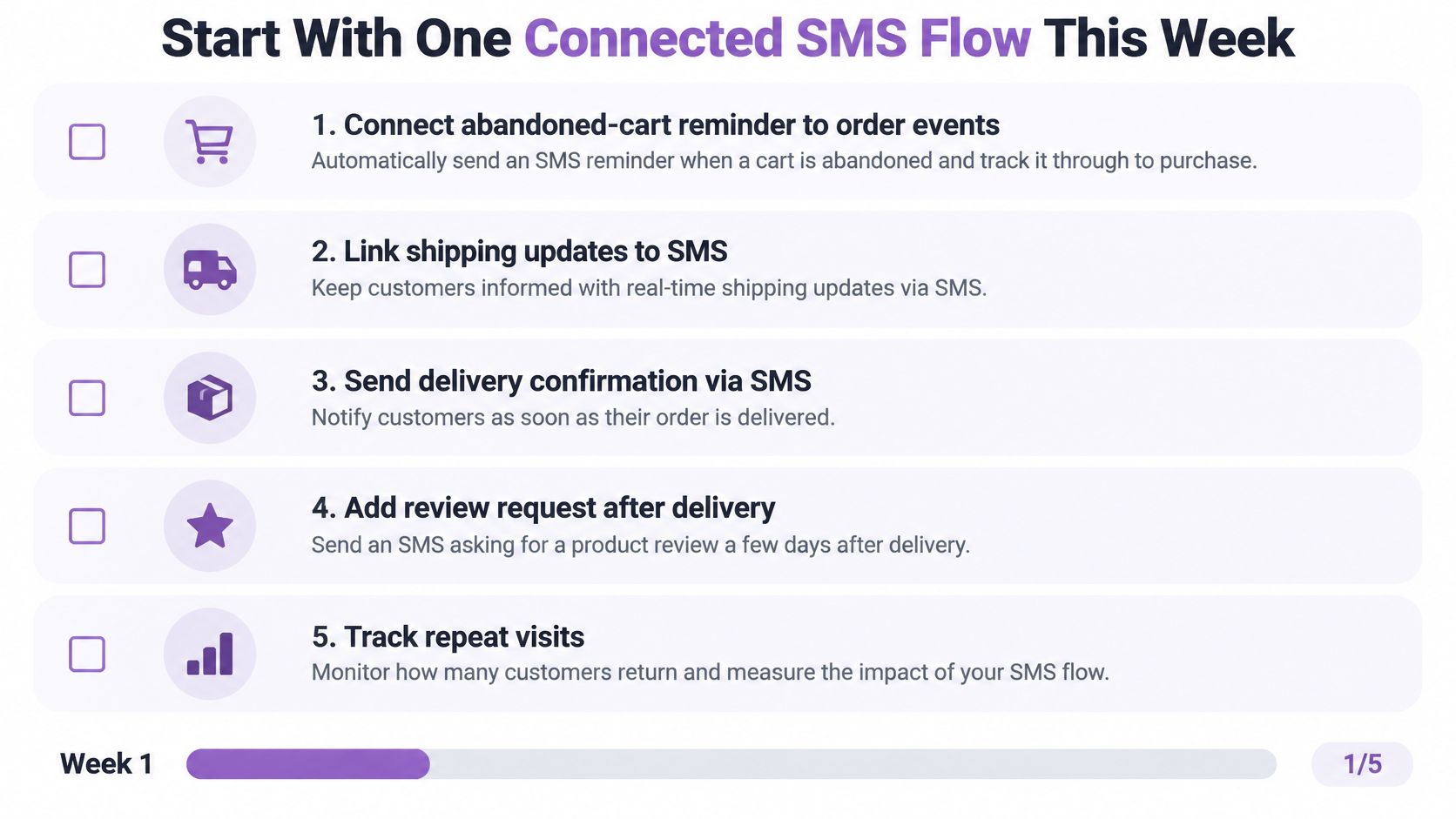
Connect abandoned-cart recovery to shipping and delivery updates first. They share an order lifecycle your store already tracks, giving you a manageable way to test whether customer communications change correctly after payment.
Keep the launch scope narrow. Don't add review requests, recommendations, and loyalty offers before you've tested the purchase-to-delivery handoff.
Launch with evidence and safeguards
Confirm the signup record. Inspect the live consent wording and verify that timestamp, wording, and source are saved. Test the actual form rather than relying on a screenshot from setup.
Test STOP and HELP. Use a test subscriber to check automatic responses and promotional suppression. Try reimporting that contact and confirm the withdrawal survives.
Connect recovery to checkout completion. Place an order while a reminder is queued. Verify that the pending message is canceled before it reaches the customer.
Connect fulfillment events. Test shipping and delivery changes against the latest status, including a split shipment. Don't substitute a fixed delay for actual fulfillment information.
Run a holdout test. As a proposed experiment, randomly assign half of eligible customers to receive no test SMS while preserving their existing necessary order communications. Define the audience, checkout-completion metric, repeat-purchase window, and test length before launch.
Use this checklist to keep the rollout focused.
Make the scaling decision deliberately
Our Shopify installation takes one click, and a first Scratch-to-Win popup and abandoned-cart automation can launch in under 10 minutes. Available prebuilt automations include Shipped Notification, Delivered Notification, Popup Subscriber Welcome, AI Chat Response, Keyword Opt-in Reply, and Shopify Segment Entry; a conversion-tracking pixel can attribute revenue to the campaign that drove it.
Fast setup isn't proof of incremental revenue. Keep the holdout comparison separate from campaign attribution.
Schedule a review after two weeks as an initial operating checkpoint. If revenue rises while opt-outs climb sharply, reduce frequency before scaling; if results and guardrails remain steady, consider a second journey stage, but continue measuring repeat purchases over the predefined window.
YipSMS Inc. offers Shopify SMS tools for subscriber signup, cart recovery, and shipping and delivery notifications. Visit YipSMS Inc. to start a connected flow, then test whether it helps customers finish purchases and resolve order questions with less effort.
How this article was made: the YIPSMS team drafts some articles with AI writing tools, then checks pricing, compliance and product details against how YIPSMS actually works before publishing. Spotted something wrong? Tell us through your YIPSMS account.